
Legnano → Legnano · 178.14 km · Monday, 5 October 2026 · UCI 1.Pro
The Coppa Bernocchi begins and ends in Legnano, an industrial city approximately 25 kilometres north-west of central Milan, but the landscape that defines the race lies farther north in the Valle Olona, the valley carved by the Olona River as it descends from the province of Varese towards the Milanese plain.
For anyone unfamiliar with northern Lombardy, the contrast can be difficult to see on a map. Legnano belongs to the Alto Milanese, the densely urbanised territory immediately beyond Milan where towns, factories and roads have expanded until the boundaries between neighbouring municipalities are often barely perceptible. Follow the Olona north, however, and the ground begins to fold around the river. Wooded slopes close around the valley, roads climb sharply away from the water and small historic centres occupy ridges above it.
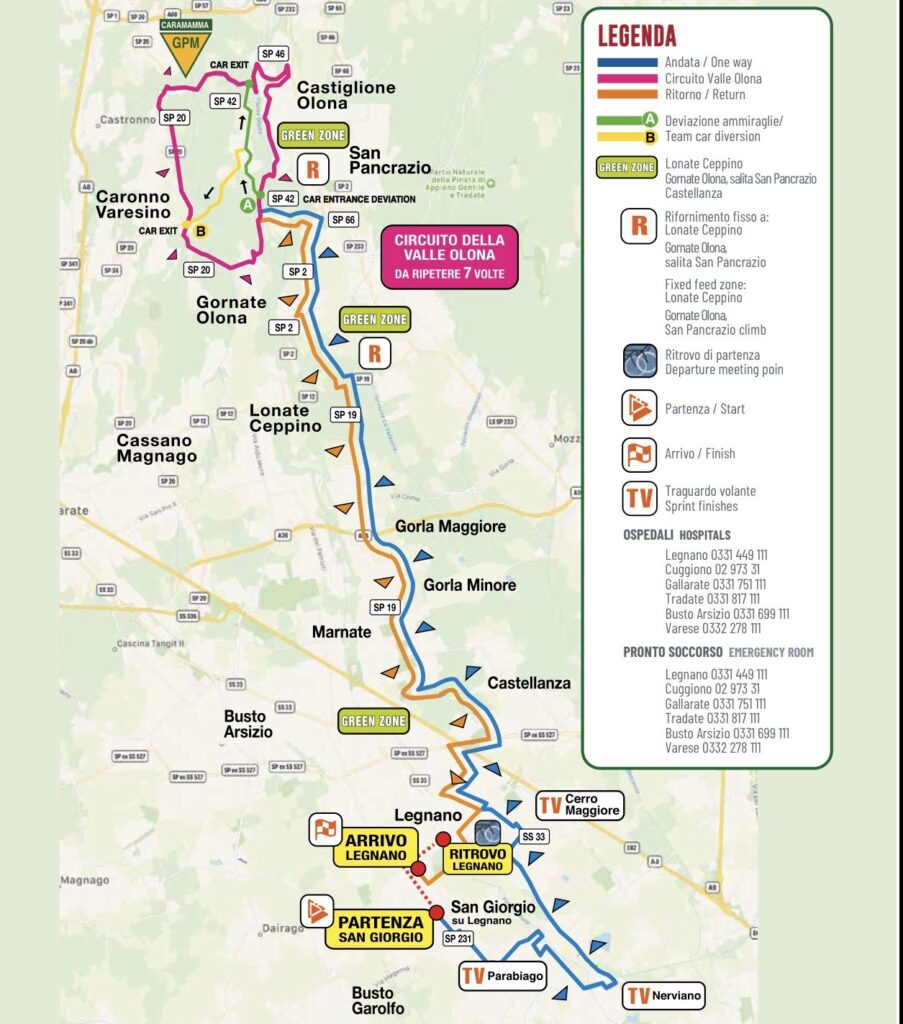
The 2026 Coppa Bernocchi uses both landscapes. After a ceremonial departure from Legnano, the race proper begins in neighbouring San Giorgio su Legnano. The opening 37 kilometres cross the predominantly flat Alto Milanese before reaching Torba, where seven laps of a 16.6-kilometre circuit begin. Each lap passes through Castiglione Olona and Castelseprio and includes the short climbs of Piccolo Stelvio and Caramamma. After 116.2 kilometres on the circuit, only 24.95 kilometres remain for the return to Legnano.
The race itself dates to 1919 and takes its name from Antonio Bernocchi, a textile industrialist and philanthropist whose family belonged to the industrial transformation of Legnano and its surroundings. The 2026 edition is the 107th Coppa Bernocchi and forms the second race of the Trittico Regione Lombardia, the sequence of three historic Lombard one-day races that begins with Coppa Agostoni and concludes with Tre Valli Varesine.
Its route also follows much of the history that created it. The Olona appears first as a river around which medieval communities developed, then as the source of power and water that helped turn this part of Lombardy into one of Italy’s great industrial districts. Farther upstream, the same valley contains Roman fortifications, a Lombard monastery and a Renaissance town before the race returns downstream towards Legnano.
START · San Giorgio su Legnano and the Industrial Edge of Milan
The riders assemble in central Legnano before completing a 2.5-kilometre neutral transfer. The official kilometre zero comes on Via XX Settembre in San Giorgio su Legnano, a neighbouring municipality immediately west of the city.
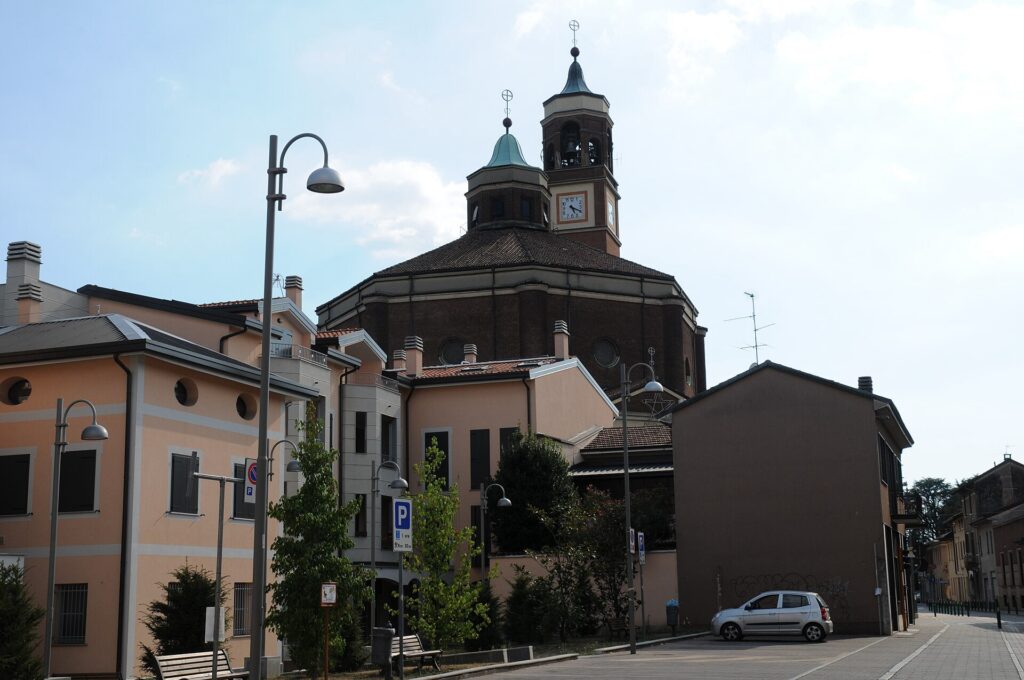
The Church of the Beata Vergine Assunta, the parish church of San Giorgio su Legnano in Lombardy. Photo by AlfaLancia, licensed under CC BY-SA 3.0, via Wikimedia Commons
From the road, the boundary is difficult to detect. Legnano, San Giorgio, Canegrate, Parabiago and the communities around them belong to an almost continuous belt of settlement spreading north-west from Milan. Their modern appearance is the product of an industrial expansion that accelerated during the 19th century, although villages, farms and roads existed here centuries before factories filled the spaces between them.
The first kilometres take the race through Canegrate and towards Parabiago. There are no hills yet. The road crosses the flat upper edge of the Po Valley, but within little more than four kilometres it reaches a town associated with one of medieval Milan’s most violent family struggles.
-173.7 km · Parabiago and a Visconti Civil War
Parabiago, reached at approximately km 4.45 of the race, is an old settlement west of Milan whose position near the Olona and along routes leading north helped give it importance long before modern industrialisation.
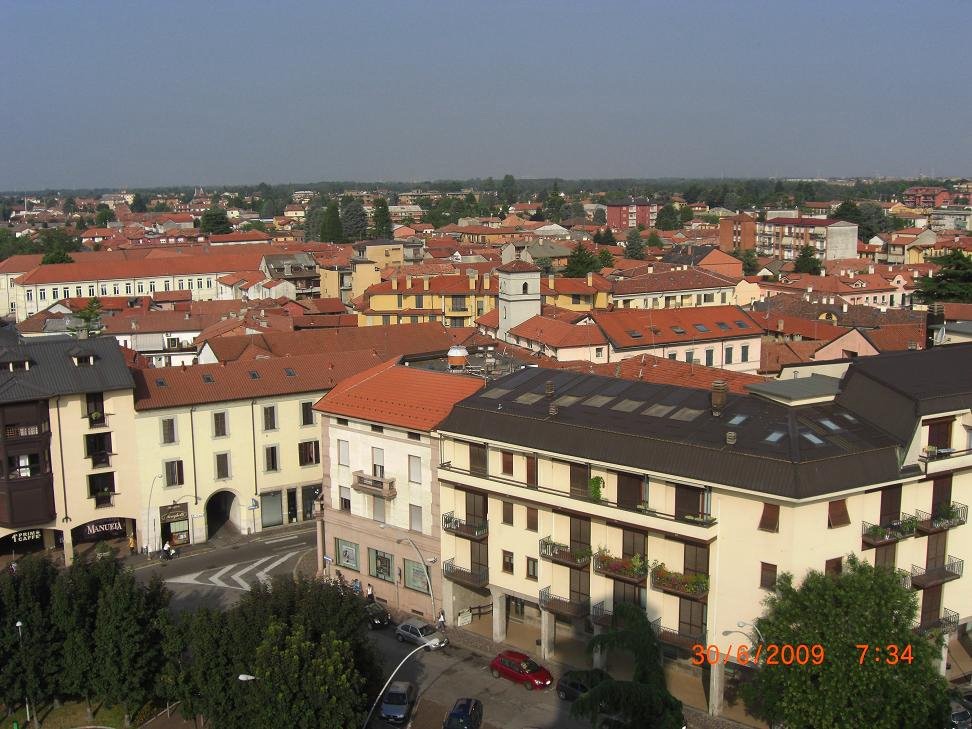
An elevated view across Parabiago toward the district of Ravello in Lombardy. Photo by Zanna13, licensed under CC BY-SA 4.0, via Wikimedia Commons
On 21 February 1339, the surrounding countryside became the battlefield for a struggle within the Visconti, the dynasty that dominated Milan during much of the later Middle Ages. One side represented Azzone Visconti, lord of Milan, whose army was commanded by his uncle Luchino. Against them stood another member of the family, Lodrisio Visconti, who had assembled an army in an attempt to seize power.
The battle unfolded in severe winter conditions. Luchino was captured during the fighting, but the arrival of reinforcements reversed the situation and Lodrisio’s army was defeated. The victory strengthened Azzone’s branch of the family and soon acquired a religious legend of its own. Milanese tradition attributed the reversal partly to the miraculous intervention of Saint Ambrose, the 4th-century bishop who became the patron saint of Milan, and for centuries a procession commemorated the victory.
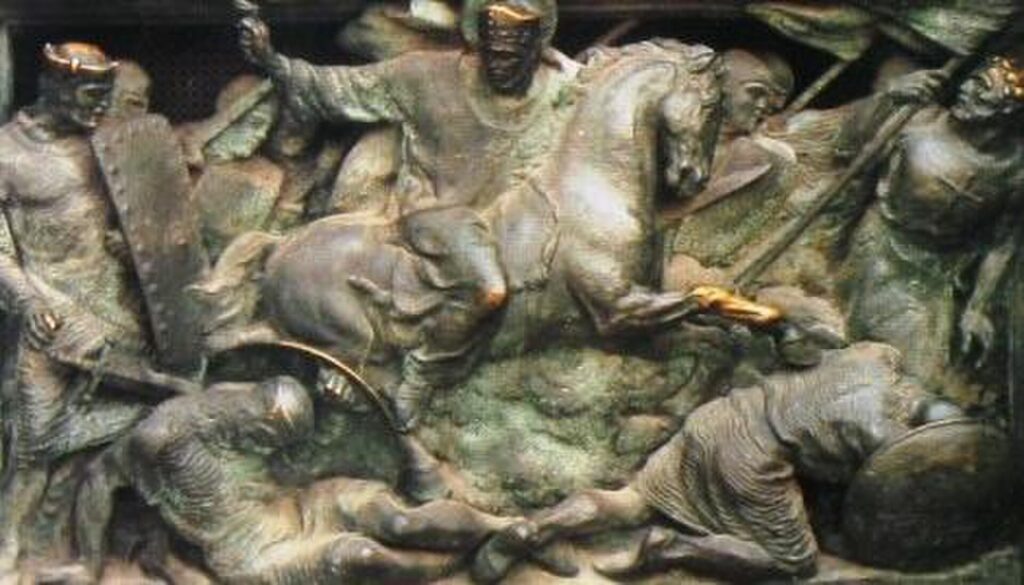
Saint Ambrose appears during the Battle of Parabiago in a bronze relief on Milan Cathedral’s main portal, created by Lodovico Pogliaghi. Photo by Daufer; dedicated to the public domain under CC0 1.0, via Wikimedia Commons
The race crosses Parabiago twice during these opening kilometres. At km 5.3 comes the first intermediate sprint before the road continues to Nerviano.
-170.5 km · Nerviano and the Medieval Olona
Nerviano, entered at km 6.51, is another old community beside the Olona. By the Middle Ages it had become the centre of a pieve, a territorial district organised around an important church with baptismal rights. In medieval Lombardy, these districts often carried administrative importance as well as religious authority, linking smaller settlements to a central church and community.
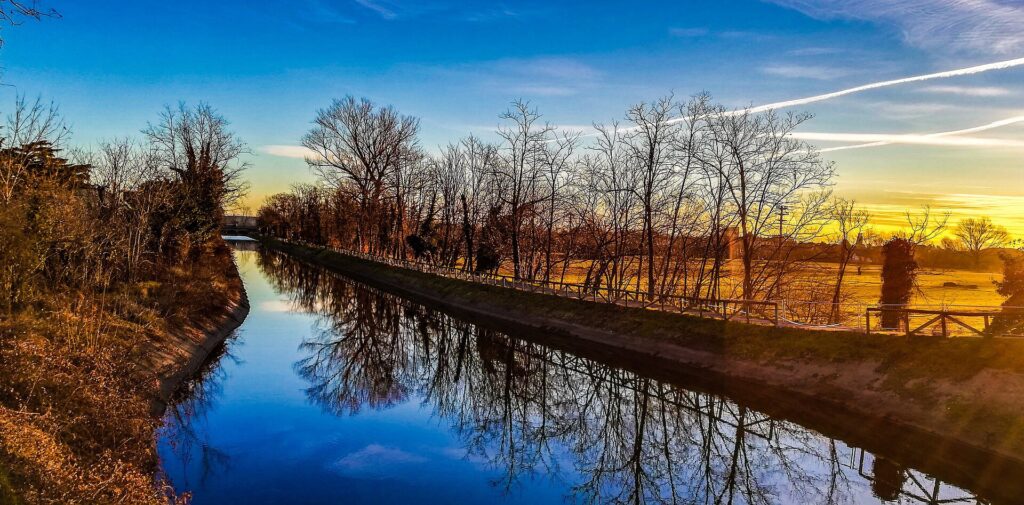
The crossing of the Olona River and the Villoresi Canal at Nerviano, Lombardy. Photo by Ivan Stesso, licensed under CC BY-SA 4.0, via Wikimedia Commons
The river that passed through Nerviano supported agriculture and mills, while the road connecting Milan with the country towards Lake Maggiore brought merchants, armies and travellers through the settlement. Frederick Barbarossa’s campaigns against the northern Italian communes reached this corridor during the 12th century, while forces involved in the later Visconti struggle at Parabiago also moved through the surrounding countryside.
At km 7.5 the riders contest another intermediate sprint. They are still less than eight kilometres into the race, but the Olona has already begun linking places whose histories repeatedly depended upon the road and river running between Milan and the north.
The modern industrial story becomes more visible a few kilometres later.
-164.1 km · Cerro Maggiore and the Bernocchi Textile Empire
At km 14.01 the race reaches Cerro Maggiore, another municipality of the Alto Milanese and one of the places most directly connected with the family whose name the race carries.
Antonio Bernocchi came from a family whose textile enterprise grew alongside the industrialisation of Legnano and its neighbouring towns. His father Rodolfo had begun with an artisanal bleaching operation in Legnano in 1868. Antonio and his brothers Michele and Andrea expanded the business into bleaching, printing, finishing and dyeing, gradually creating a substantial industrial concern.
The company spread beyond a single factory. A weaving plant operated at San Vittore Olona, while at Cerro Maggiore the Bernocchi company opened a large spinning mill in 1905 containing tens of thousands of spindles. Textile production was becoming distributed across the same network of towns now crossed by the race, supported by labour, roads, railways and proximity to Milan.
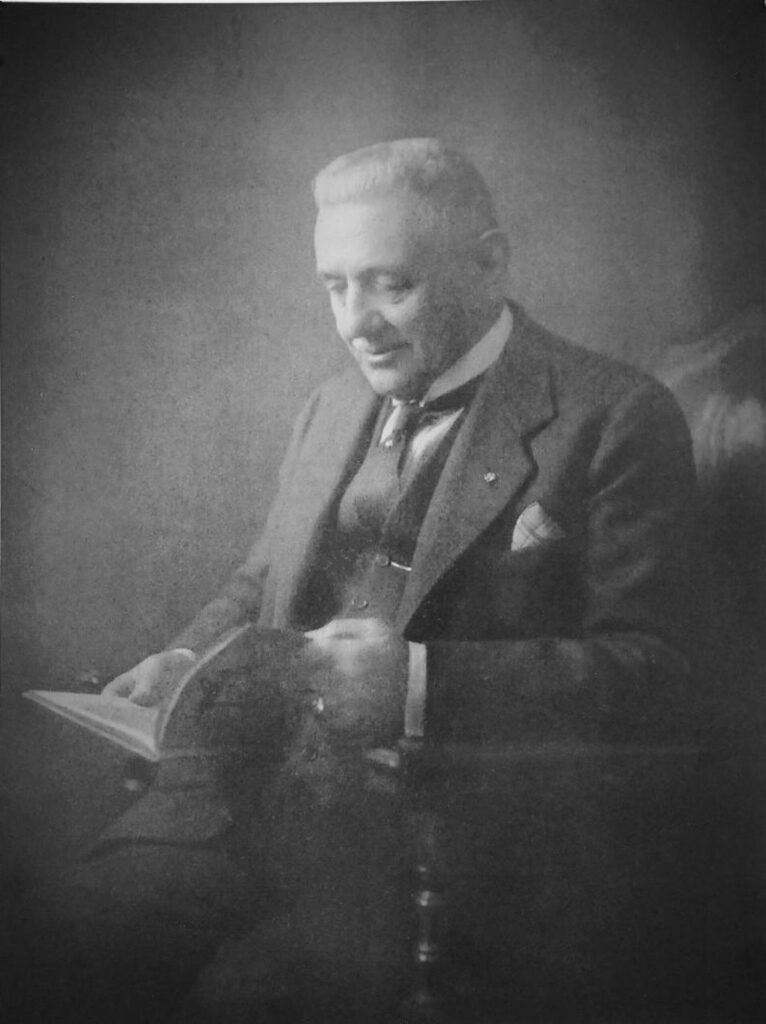
Italian textile industrialist Antonio Bernocchi in Milan in 1919, the year the cycling race bearing his name was founded in Legnano. Image from the Archivio Bernocchi; public domain, via Wikimedia Commons
Bernocchi also invested part of his wealth in civic and cultural projects, following a pattern common among major industrial families of the period. Sport belonged to the same rapidly changing urban society. The bicycle was practical transport, industrial technology and mass entertainment at once, and northern Italy became one of the places where cycle manufacturing and professional racing developed together.
The Unione Sportiva Legnanese, founded in 1913, wanted to establish a major race after the interruption of the First World War. With Bernocchi’s support, the first Coppa Bernocchi was held in 1919.
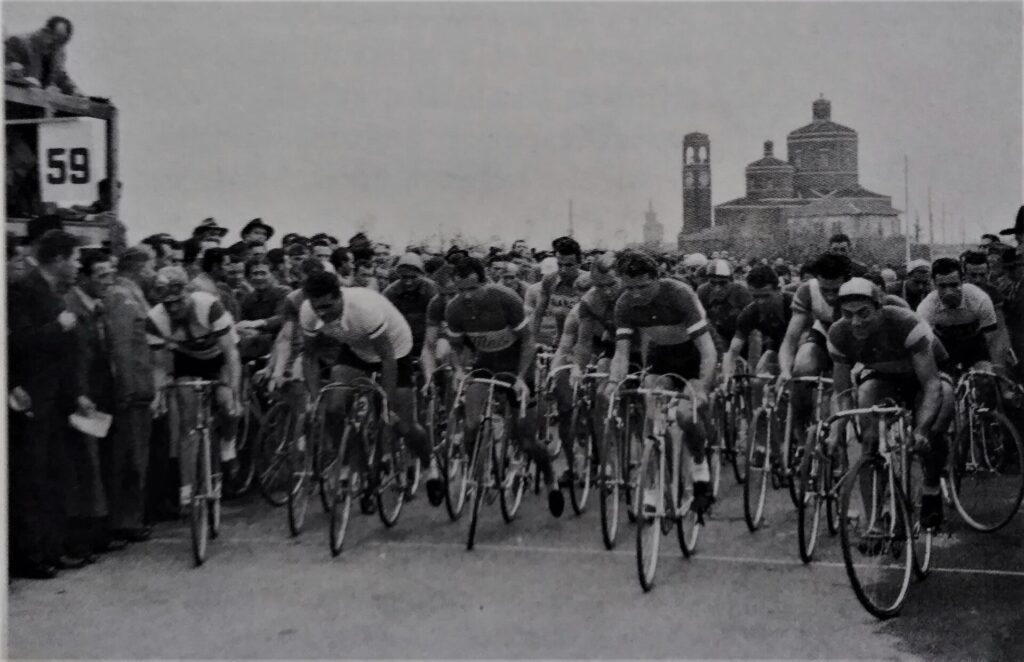
Riders gather at the start of the 1935 Coppa Bernocchi in Legnano, with the Sanctuary of Saint Thérèse of the Child Jesus in the background. Unknown photographer; public domain, via Wikimedia Commons
The riders leave Cerro Maggiore and briefly return through Legnano before turning north through Castellanza, Marnate, Gorla Minore, Gorla Maggiore, Cairate and Lonate Ceppino. The continuous metropolitan fabric begins to loosen as the Olona valley narrows.
-147.1 km · Lonate Ceppino and the Approach to the Valle Olona
At km 31.04 the race enters Lonate Ceppino, one of the communities lining the middle course of the Olona in the province of Varese. The road is now approaching the terrain that will occupy most of the afternoon.
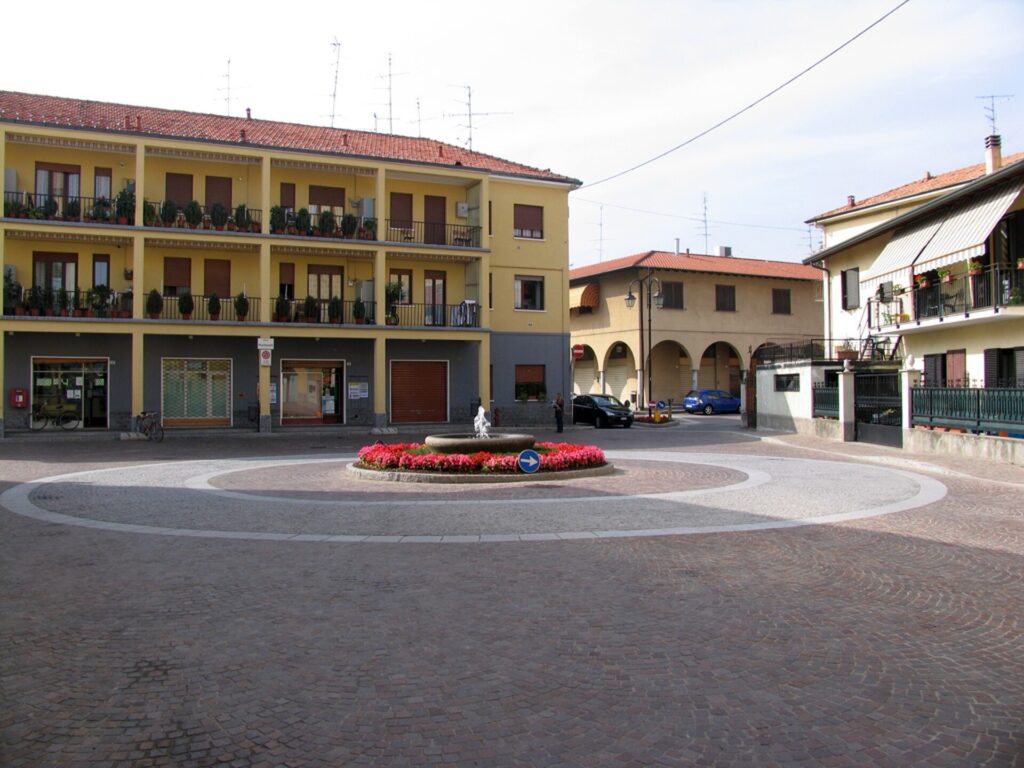
A panoramic view of Lonate Ceppino in the province of Varese, Lombardy. Photo by adirricor, licensed under CC BY 3.0, via Wikimedia Commons
The difference from the opening kilometres is increasingly physical. Around Legnano the Olona passes through a broad urban and industrial landscape. Farther north, the river runs beneath more pronounced slopes, with settlements occupying both the valley floor and the higher ground above it.
Water had powered mills along the Olona for centuries before industrialisation. During the 19th century, that older productive landscape was absorbed into something much larger. Cotton spinning, weaving, bleaching, dyeing and mechanical engineering expanded along the river, using its water and taking advantage of the proximity of Milan and the growing railway network.
The environmental cost was severe. Industrial discharge and urban sewage eventually made the Olona one of the most polluted rivers in Italy, particularly downstream through the heavily industrialised municipalities. The river that had encouraged settlement and manufacturing became a record of the industrial transformation itself.
At Gornate Olona the race reaches Torba. The flat opening is over.
-141.1 km · Torba and the Beginning of the Seven-Lap Circuit
At km 37.04, with 141.10 kilometres remaining, the riders reach Torba, a small locality of Gornate Olona, and begin the first of seven laps of the 16.6-kilometre Valle Olona circuit.
Torba is also the entrance to one of the richest archaeological landscapes anywhere on the course.
The Monastery of Torba began not as a monastery but as part of a late Roman defensive system. During the final centuries of the Western Roman Empire, fortifications were established in this valley to help control movement between the Milanese plain and routes towards the Alps. A surviving tower still preserves part of that military architecture.
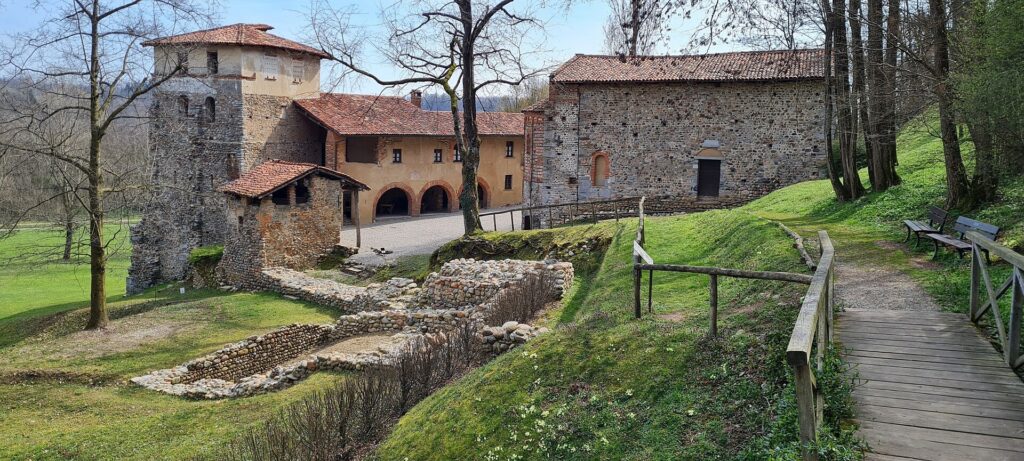
Torba Abbey, a former Lombard monastery and UNESCO World Heritage Site at Gornate Olona in Lombardy. Photo by Derbrauni, licensed under CC BY 4.0, via Wikimedia Commons
The political world around it changed repeatedly. Ostrogoths, Byzantines and eventually the Lombards, a Germanic people who invaded Italy beginning in 568, controlled the region. Under Lombard rule the former military complex gradually acquired a religious role, and by the 8th century Benedictine nuns had established a community at Torba, incorporating the ancient tower into the monastery.
Above it lay Castelseprio, a fortified settlement whose strategic importance also originated in the late Roman period. Together, Torba and Castelseprio controlled a corridor that mattered because of geography long before professional cycling arrived: the Olona provided a natural route between the plain around Milan and the country leading towards the Alps.
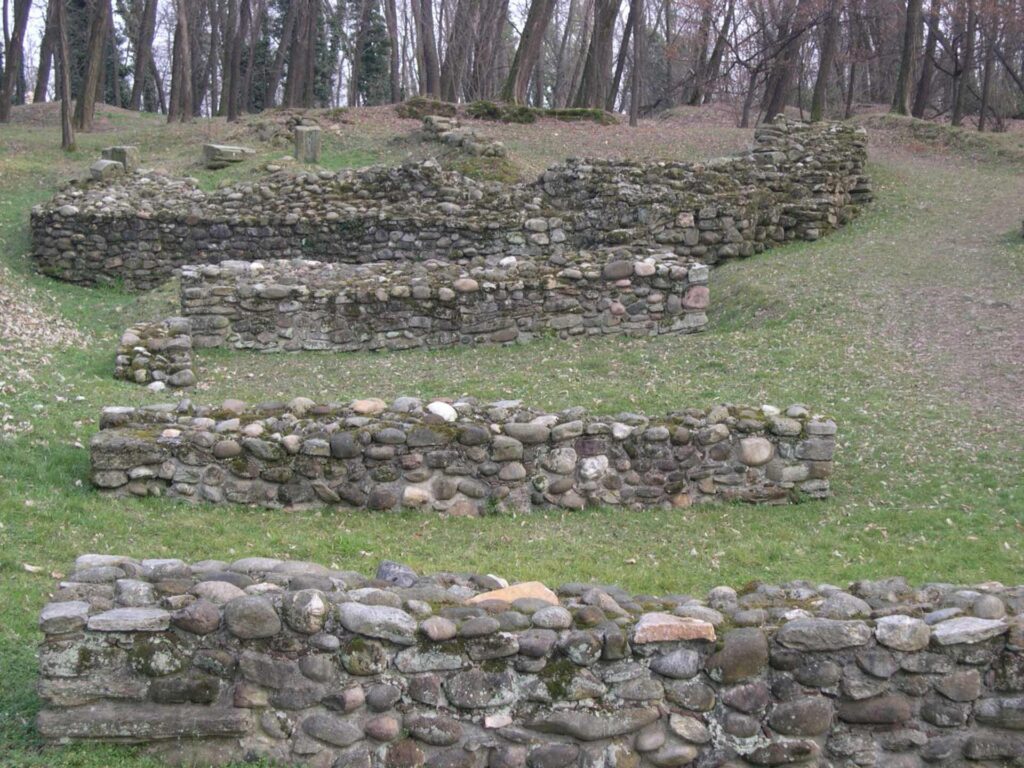
The ruined entrance bridge of the early medieval fortified settlement at Castelseprio, now part of a UNESCO World Heritage Site in Lombardy. Photo by Adelchi, licensed under CC BY-SA 2.5, via Wikimedia Commons
Today Torba and Castelseprio form part of the UNESCO World Heritage property Longobards in Italy: Places of Power, which brings together monuments associated with the Lombard kingdom that ruled much of the Italian peninsula between the 6th and 8th centuries.
The riders will return to Torba every 16.6 kilometres. The roadbook places the starts of subsequent laps at km 53.64, 70.24, 86.84, 103.44, 120.04 and 136.64.
FIRST LAP · Castiglione Olona, a Renaissance Town Above the River
Only a few kilometres after Torba, the course enters Castiglione Olona, a small historic town overlooking the valley whose centre contains an extraordinary concentration of early Renaissance art and architecture.
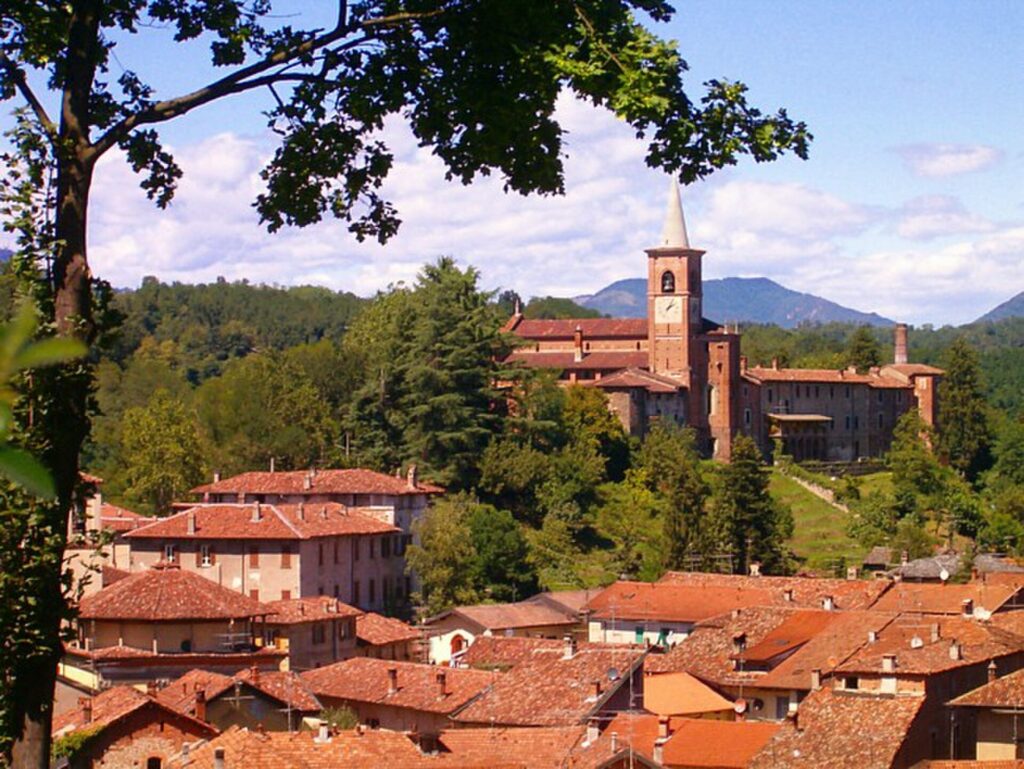
A panoramic view of Castiglione Olona, a historic village in Lombardy’s Olona Valley. Photo by Idéfix, licensed under CC BY-SA 3.0, via Wikimedia Commons
Its transformation was largely the work of Cardinal Branda Castiglioni, a churchman and diplomat born into the local noble family during the 14th century. Branda travelled widely, participated in the international politics of the Catholic Church and encountered artistic developments beyond Lombardy. Late in his life, he used his wealth and connections to reshape his family’s town.
Beginning in the 1420s, churches, palaces and public buildings appeared under his patronage. Branda invited Tuscan artists to work beside Lombard craftsmen, among them Masolino da Panicale, a Florentine painter associated with the transition from late Gothic art towards the visual language of the early Renaissance.
The result is unusual for this part of Lombardy. The Collegiata, built on the hill where an older fortress had stood, contains frescoes by Masolino and other artists, while the nearby baptistery preserves Masolino’s cycle of scenes from the life of Saint John the Baptist. Branda’s palace and the Church of Villa extended the project through the settlement below.
Castiglione Olona is consequently sometimes called an “island of Tuscany in Lombardy.” The phrase describes the unexpected arrival of Tuscan Renaissance forms in a small northern town, not a resemblance between the landscapes of Varese and Tuscany.
The race does not simply pass once beneath it. Castiglione Olona returns on every lap, its narrow streets and bends forming part of the circuit itself. The official roadbook specifically identifies road narrowing and curves through Castiglione Olona and Castelseprio as features requiring attention.
FIRST LAP · Piccolo Stelvio and Caramamma
After Castiglione Olona the road reaches Gornate Olona, where two short climbs give the circuit much of its character.
The first is known as the Piccolo Stelvio, or Little Stelvio. The name is deliberately disproportionate. The real Passo dello Stelvio is the immense 2,757-metre Alpine pass famous for its long sequences of hairpins and its place in the history of the Giro d’Italia. Here in the Valle Olona there is no comparable mountain. The nickname refers instead to a compact twisting ascent whose bends evoke, on a much smaller scale, the visual character of the Alpine road.
The roadbook places the Piccolo Stelvio section on Via Diaz before the course turns through Via Monte Novegno towards Caramamma, another short climb out of the valley. On the first lap Caramamma is reached around km 44.64, leaving approximately 133.5 kilometres.
Neither ascent needs to be imposing by itself. The circuit is only 16.6 kilometres long, and the riders complete it seven times. Piccolo Stelvio and Caramamma therefore become recurring changes of gradient inside a race that repeatedly descends towards the river and climbs away from it.
Caramamma also carries the official Gran Premio della Montagna, or mountains classification, on the second, fourth and sixth laps.
The road continues through Morazzone, Caronno Varesino and Carnago before returning through Castelseprio to Torba.
-124.5 km · Second Lap and the First Caramamma GPM
The second circuit begins at km 53.64, leaving 124.50 kilometres, and the roads are already familiar when the peloton returns through Castiglione Olona and Gornate Olona.
This time Caramamma has a formal prize attached to it. The first GPM comes at km 60.55, or approximately -117.6 km. The classification will return every second lap rather than on every passage, creating three marked moments within the seven repetitions.
By now the race is moving repeatedly through a remarkably compressed historical landscape. A few kilometres separate Renaissance Castiglione Olona from Torba and the archaeological remains of Castelseprio, where the story reaches almost a thousand years further into the past.
Castelseprio · From Roman Fortress to Abandoned Medieval Town
Castelseprio, crossed near the end of every circuit, began as a fortified settlement controlling the Olona valley during the later Roman Empire. Its position above the surrounding country allowed movement through the valley to be watched at a time when northern Italy was becoming increasingly difficult for Roman authorities to defend.
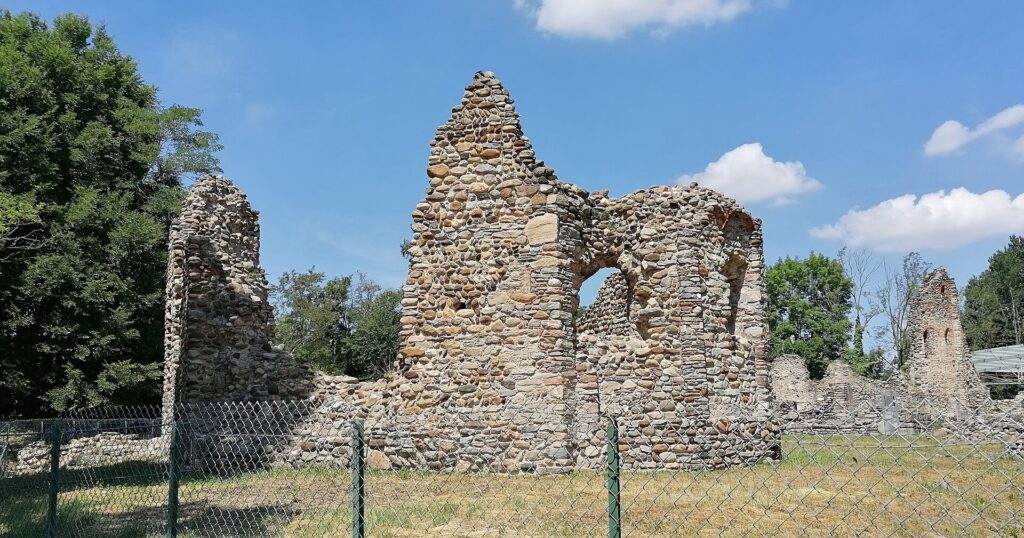
The ruins of the Church of San Paolo within the fortified archaeological site of Castelseprio in Lombardy. Photo by Capricornis crispus, licensed under CC BY-SA 4.0, via Wikimedia Commons
The stronghold survived the empire that created it. Under the Lombards, Castelseprio became an important administrative and military centre, and its role continued under the Carolingians after Charlemagne conquered the Lombard kingdom in 774.
Among the surviving monuments is Santa Maria foris portas, literally Saint Mary “outside the gates”, a small church famous for a cycle of early medieval frescoes. Their precise dating has been debated by scholars, but their quality and unusual style make them some of the most important surviving paintings from early medieval Italy.
Castelseprio eventually became entangled in the political struggles of medieval Lombardy. In 1287, forces of Ottone Visconti, archbishop and lord of Milan, destroyed the fortified settlement during conflict with the rival della Torre family. The site was ordered not to be rebuilt, and the abandoned ruins gradually disappeared beneath vegetation.
That destruction helped preserve what archaeology later recovered. Instead of developing continuously into a modern town, the fortified centre remained largely abandoned while settlement continued elsewhere.
Seven times the race passes through the modern municipality and back towards Torba, repeatedly circling a landscape where Roman military planning, Lombard government and medieval Milanese rivalry survive within a few kilometres.
-91.3 km · Fourth Lap and the Second GPM
The fourth lap begins at km 86.84, leaving 91.30 kilometres. By this point the race has completed three full circuits and more than half the total distance.
Caramamma’s second GPM arrives at km 93.75, approximately -84.4 km. The road is identical to the previous passages, but the accumulation is not. Every 16.6 kilometres brings Castiglione Olona, Piccolo Stelvio, Caramamma, Morazzone, Caronno Varesino, Carnago and Castelseprio back into the race.
There is no single mountain around which the Coppa Bernocchi can be organised. Its central difficulty comes from repeatedly crossing the sides of a river valley. The climbs are short, the descents arrive quickly and the next change in gradient is never far away.
The Olona itself sits beneath much of this movement, a small river that has carried an extraordinary amount of human activity along its banks.
The Olona · Mills, Cotton and Mechanical Engineering
Long before factories appeared, the Olona powered water mills. Grain milling was the most obvious use, but water power could be adapted to other processes, and communities along the valley developed around access to both the river and the routes running beside it.
The industrial revolution changed the scale. During the 19th century, textile production expanded dramatically along the Olona, particularly as cotton spinning and weaving became mechanised. The valley offered water, workers and proximity to Milan, while railways increasingly connected its factories with national and international markets.
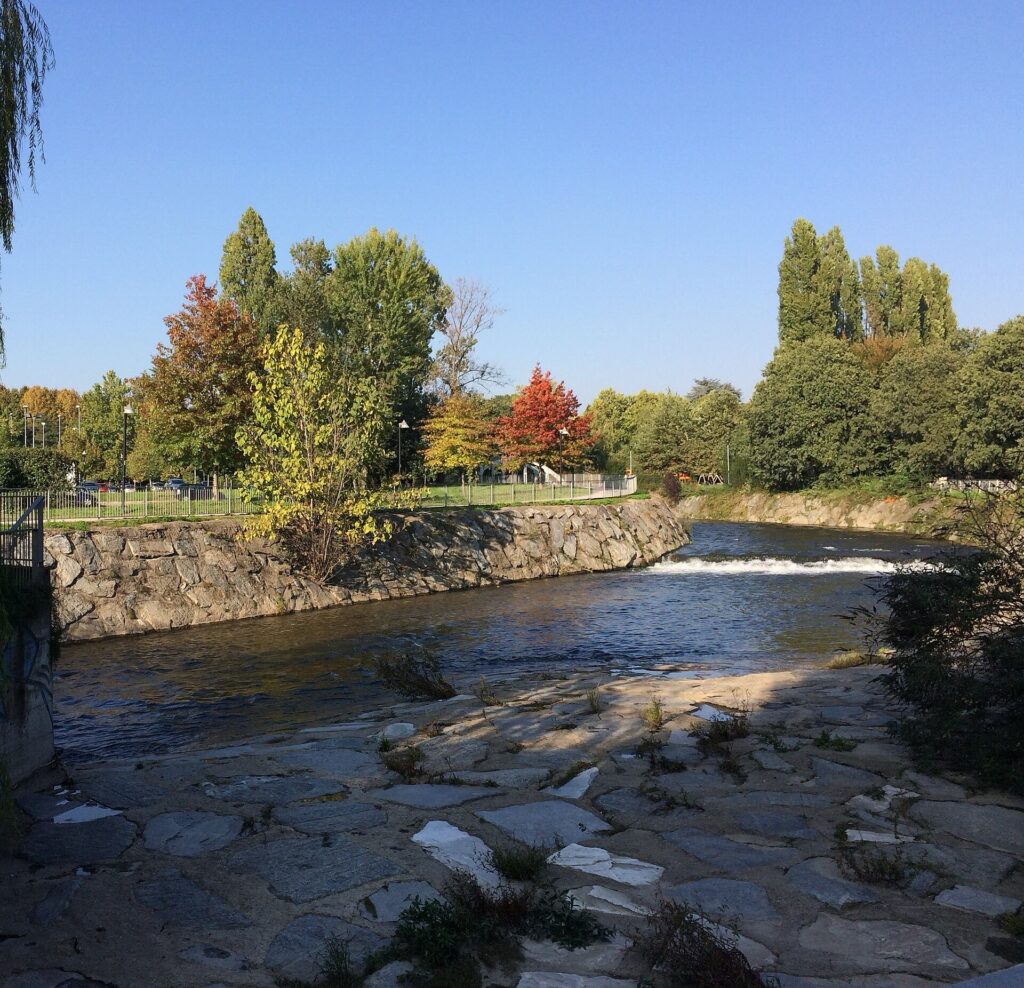
The Olona River flowing through Legnano in Lombardy. Photo by LukeWiller, licensed under CC BY-SA 3.0, via Wikimedia Commons
Legnano became one of the principal centres of this development. Textile firms operated beside major engineering companies such as Franco Tosi, founded in 1882 and later known for turbines, engines and heavy mechanical equipment. One of its earliest steam engines was supplied to a cotton mill in nearby Castellanza, illustrating how closely mechanical engineering and textile production were connected.
The river running beneath the race therefore links two very different landscapes. Around Torba and Castelseprio it passes below woodland, archaeological sites and small historic communities. Downstream towards Castellanza and Legnano, the same watercourse enters the industrial belt that transformed Lombardy during the 19th and 20th centuries.
The riders will follow that direction only after two more complete circuits.
-58.1 km · Sixth Lap and the Final Caramamma GPM
The sixth lap begins at km 120.04, leaving 58.10 kilometres.
The third and final mountains classification at Caramamma comes at km 126.95, or approximately -51.2 km. The race still has another full lap to complete afterwards, so the GPM does not mark the end of the climbing. Piccolo Stelvio and Caramamma will both return once more.
By now the circuit has turned a small group of roads into most of the race. The first passage through Castiglione Olona introduced its Renaissance churches; the next laps returned past the same buildings without requiring their story to begin again. Torba’s Roman tower remains beside the route, Castelseprio remains above the valley, and the Olona continues below them while the physical condition of the race changes with every passage.
-41.5 km · The Seventh and Final Lap
At km 136.64, with 41.50 kilometres remaining, the riders cross Torba for the seventh and final circuit.
There is no GPM at Caramamma this time. Piccolo Stelvio comes once more, followed by the final climb through Caramamma at approximately km 144.24, leaving about 33.9 kilometres. From there the route continues through Morazzone, Caronno Varesino, Carnago and Castelseprio for the last time.
At km 153.19, with 24.95 kilometres to go, the circuit ends at Gornate Olona. After 116.15 kilometres spent looping through the Valle Olona, the race finally turns south and does not return.
The terrain changes quickly. Lonate Ceppino comes first, then Cairate, Gorla Maggiore, Gorla Minore and Marnate. The river corridor gradually widens and the towns begin to close around the road again.
-10.7 km · Castellanza and the Industrial Olona
At approximately km 167.49 the race reaches Castellanza, leaving around 10.7 kilometres.
Castellanza belongs to the industrial Olona rather than the archaeological valley farther north. Textile mills grew here during the same period that transformed neighbouring Legnano, and the town became part of the manufacturing belt where cotton, engineering and transport infrastructure reshaped the river corridor.
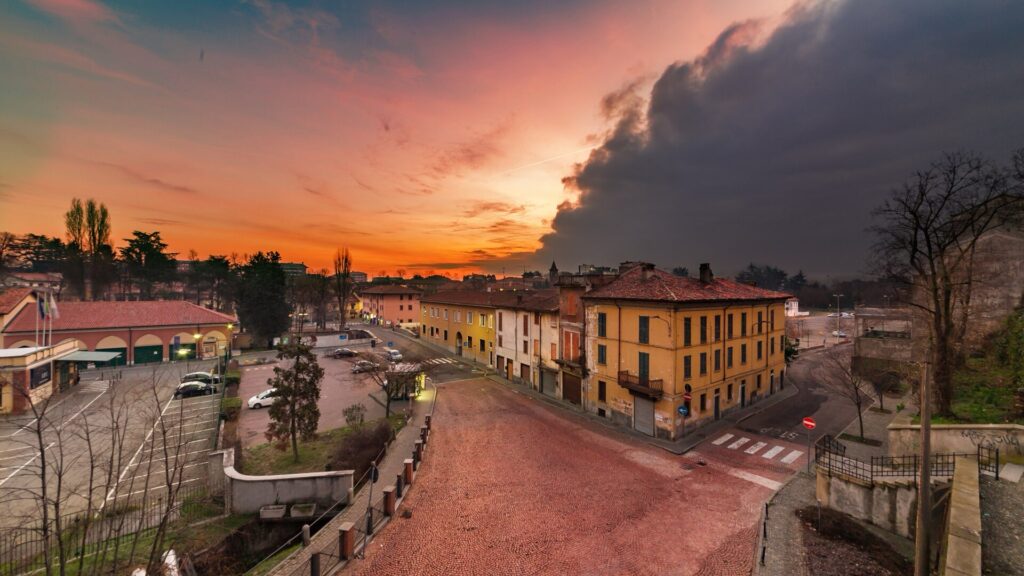
Castellanza in Lombardy. Photo by Sat123 (Lorenzo Beccacece), licensed under CC BY 3.0, via Wikimedia Commons
Among the important names was the Cantoni cotton company, whose factories formed part of one of Lombardy’s major textile enterprises. In 1883, the newly established Franco Tosi engineering works supplied a steam engine to Cantoni’s Castellanza mill, a small but revealing connection between two industries that were growing together along the Olona.
The riders are now travelling through the world that produced the Coppa Bernocchi itself. The river that passed beneath Roman fortifications at Torba and a Renaissance experiment at Castiglione Olona has returned to the dense industrial territory in which Antonio Bernocchi built his textile enterprise and Legnano became a manufacturing city.
Only a few kilometres remain.
-5 km · Back Into Legnano
The official roadbook marks the entrance into Legnano with five kilometres remaining, on Via Barbara Melzi. The road descends slightly before negotiating a roundabout and continues along a two-lane urban road.
Legnano’s history reaches much further back than its factories. On 29 May 1176, the surrounding area became the setting for one of the most famous battles of medieval northern Italy.
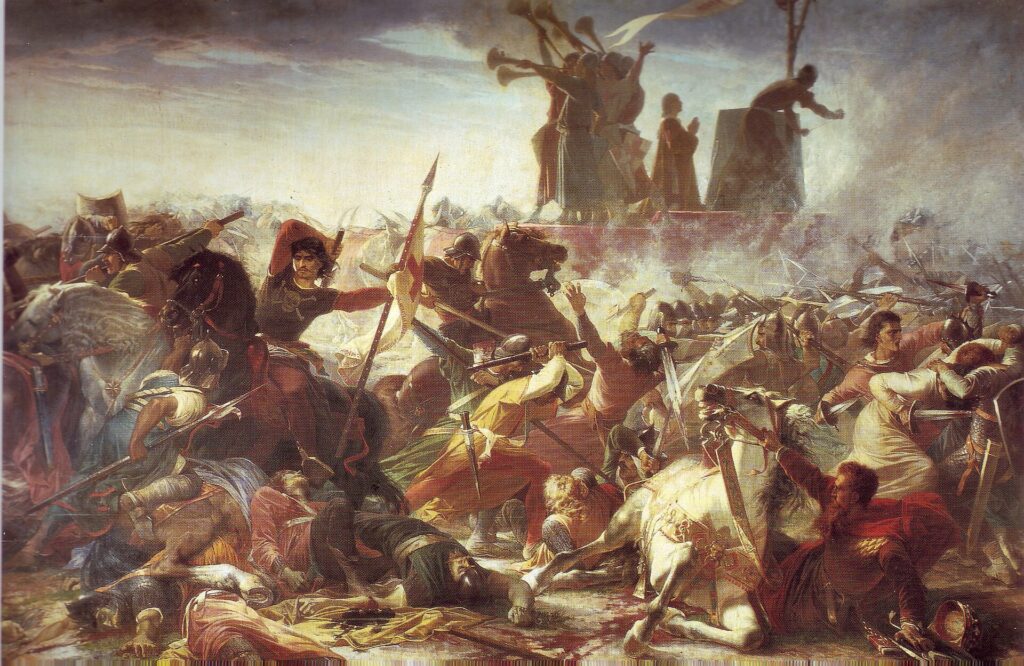
The Milanese defend their Carroccio during the Battle of Legnano in 1176, painted by Amos Cassioli. Public domain, via Wikimedia Commons
The Battle of Legnano was fought between the army of Holy Roman Emperor Frederick I Barbarossa and the Lombard League, an alliance of northern Italian communes that resisted imperial attempts to impose tighter control over their increasingly wealthy and autonomous cities.
Medieval accounts describe communal infantry gathering around the Carroccio, a large ceremonial wagon carrying civic and religious symbols that acted as a focal point for the army. The imperial forces initially pressed their opponents hard before the Lombard army recovered and forced Barbarossa’s troops to retreat.
The victory later became much more than a medieval military episode. During the 19th-century movement for Italian unification, writers and political activists looked backwards for stories that could be interpreted as resistance to foreign domination. Legnano, despite belonging to a medieval political world very different from modern nationalism, became one of those symbols.
From that later memory emerged Alberto da Giussano, the supposed warrior who led defenders of the Carroccio. His historical existence is doubtful, and the stories surrounding him appear in sources considerably later than the battle, but he became one of its most recognisable figures. A monument to him still stands in Legnano.
Giuseppe Verdi’s 1849 opera La battaglia di Legnano, written amid the revolutionary upheavals surrounding the First Italian War of Independence, demonstrates how completely the medieval battle had been absorbed into the political imagination of 19th-century Italy.
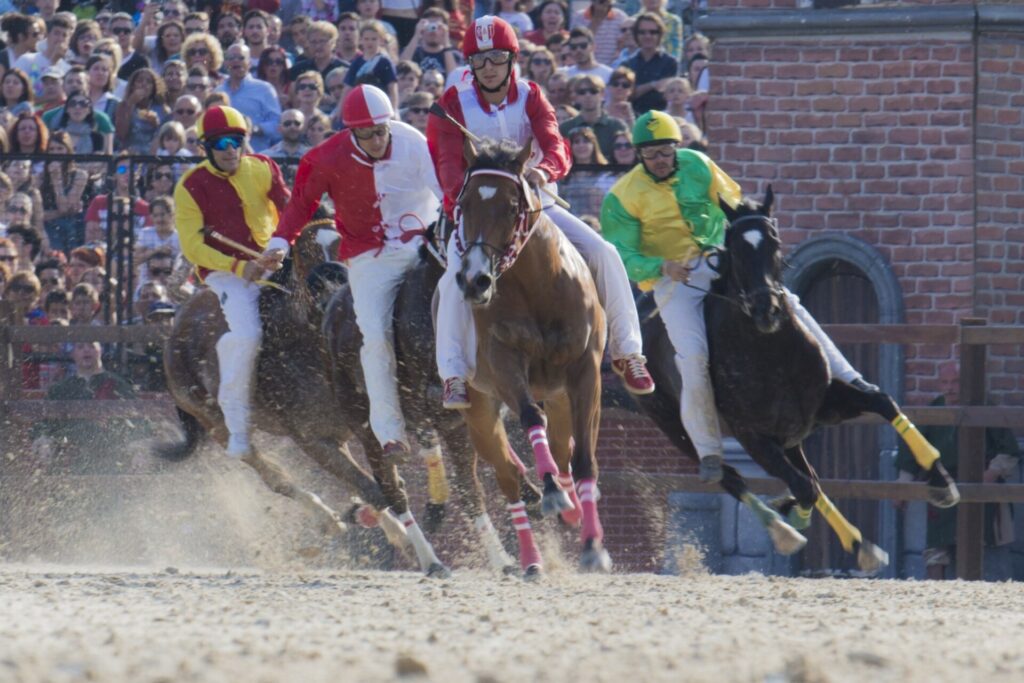
The traditional bareback horse race at the 2014 Palio di Legnano, an annual festival commemorating the Battle of Legnano. Unknown photographer, licensed under CC BY-SA 4.0, via Wikimedia Commons
The modern city continues to commemorate the event through the Palio di Legnano, in which eight traditional districts, known as contrade, participate in ceremonies and a horse race.
The peloton has little time for any of this as it enters the final urban sequence.
-3 km · The Final Streets of Legnano
At three kilometres remaining, the race reaches Viale Cadorna. The official roadbook describes a right-hand bend followed approximately 300 metres later by a roundabout, after which the riders enter a fast 1.3-kilometre straight on a four-lane road.
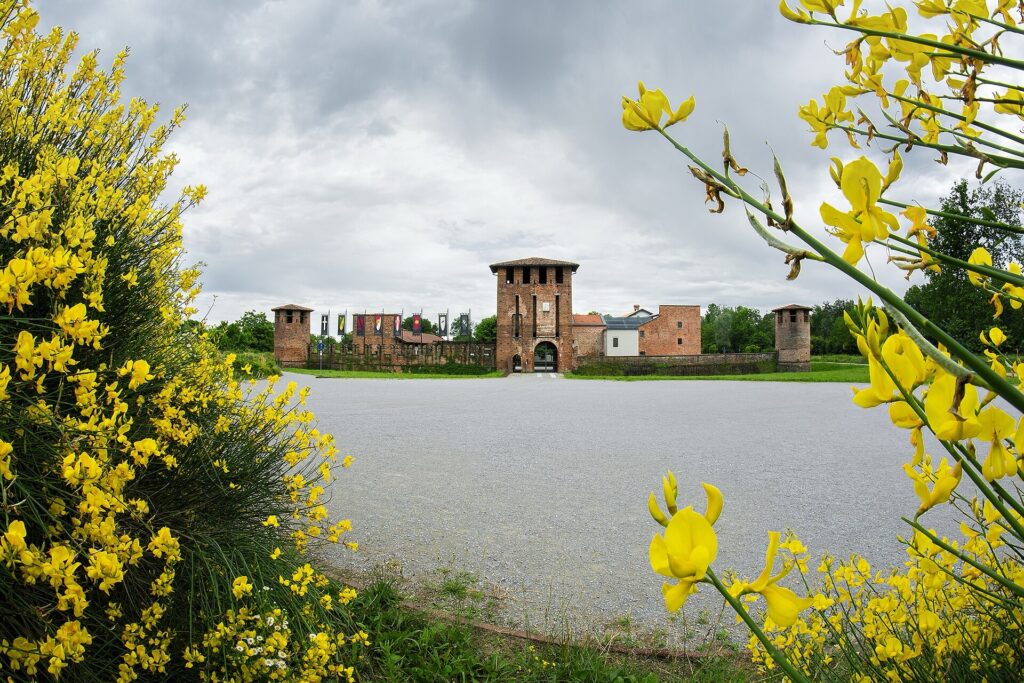
The medieval Castello di San Giorgio, also known as Legnano Castle, surrounded by yellow spring flowers. Photo by Aldo Signorelli, licensed under CC BY-SA 4.0, via Wikimedia Commons
The contrast with the Valle Olona is complete. There are no wooded slopes and no narrow historical centres. The closing kilometres run through the broad roads of the modern industrial city.
At approximately -600 metres, a right turn narrows the roadway briefly. A small speed bump follows, after which the final 500 metres are straight, broad and unobstructed.
It is a finish designed for speed after a race whose middle section has been anything but straightforward.
FINISH · Via XX Settembre, Legnano
The line comes on Via XX Settembre, at the end of 178.14 kilometres.
The Coppa Bernocchi first appeared in 1919, when U.S. Legnanese and Antonio Bernocchi created a race in a city being transformed by factories, mechanical engineering and textiles. More than a century later, the roads around Legnano have become part of a vast metropolitan landscape, but the race still escapes north along the Olona towards a narrower valley where entirely different periods remain unusually close together.
For much of the afternoon, the peloton has circulated among them. A late Roman defensive tower survives at Torba. The remains of Castelseprio recall the Lombards and the struggles of medieval Milan. Masolino’s frescoes remain in Castiglione Olona. Below all three, the Olona continues towards the industrial towns downstream.
By the time the riders reach Via XX Settembre, none of those places is visible. The final straight belongs entirely to modern Legnano, the city in which Bernocchi made his fortune and the cycling club bearing its name found a race to organise in 1919. After seven laps above the Olona, the river valley is behind them and there is only the line.