
Lissone → Lissone · 166.7 km · Sunday, 4 October 2026 · UCI 1.1
The Coppa Agostoni takes place entirely inside Brianza, a historical and geographical region immediately north of Milan, where the immense flatness of the Po Valley begins to wrinkle into hills before the higher mountains of Lombardy rise towards the Alps. Brianza has no single administrative boundary and is divided today between several provinces, but it has retained a strong regional identity built around its towns, industries, Catholic institutions, villas and densely cultivated hills.
The race carries a second name that makes this connection explicit: Giro delle Brianze, or Tour of the Brianzas. Since 1996, that title has accompanied Coppa Agostoni because the race lies entirely across the Monza and Lecco sides of Brianza. The 2026 edition passes through 26 municipalities without ever leaving this relatively compact corner of Lombardy.
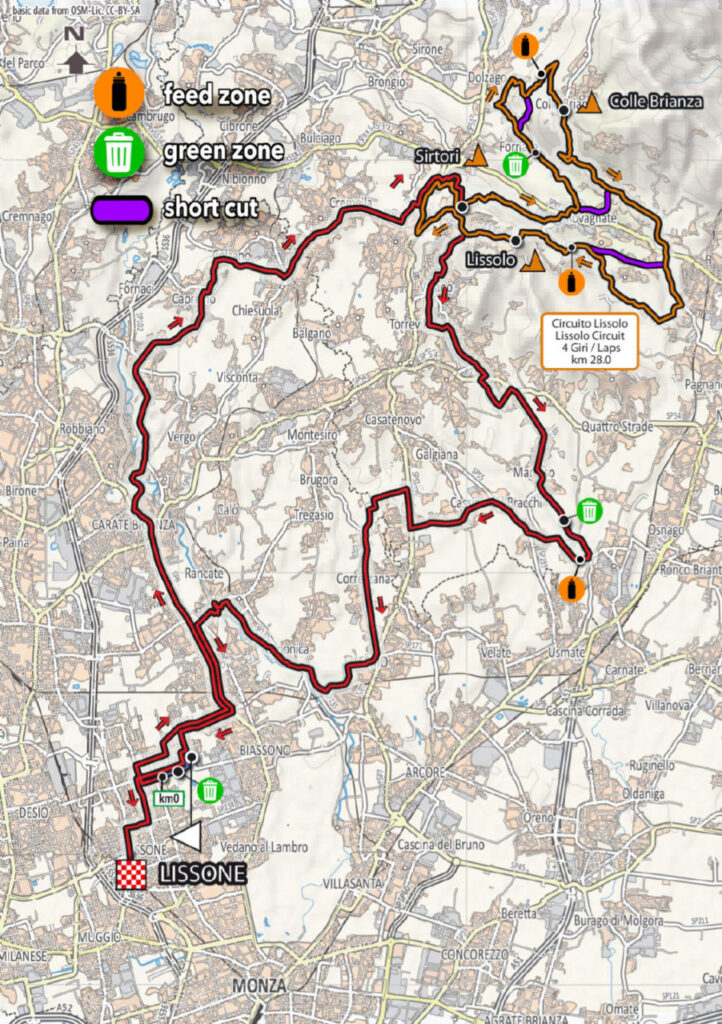
Its centre is Lissone, a town immediately north of Monza that became one of Italy’s most important centres for furniture production. The race begins there, follows the Lambro valley north and reaches the hills around Sirtori, Colle Brianza and Lissolo. Four laps of a 28-kilometre circuit provide most of the climbing, with twelve ascents in total, before approximately 35 flatter kilometres carry the survivors south through Brianza and back to Lissone.
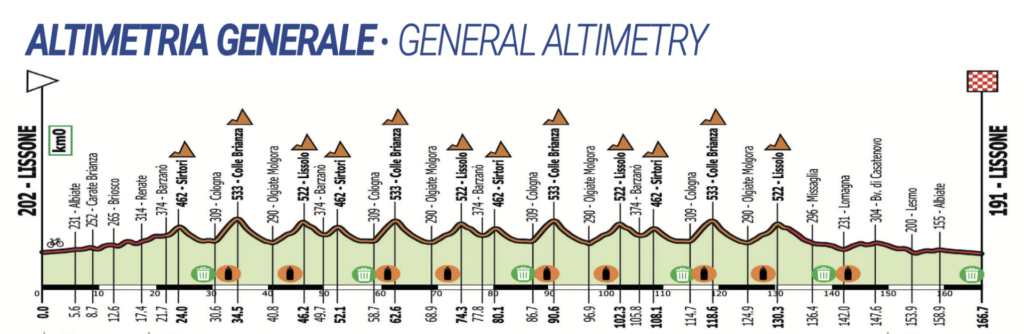
Those hills are not mountains. The longest climb, Lissolo, measures only 5.4 kilometres at an average of 4.3 percent, while Sirtori is 1.5 kilometres at 4.9 percent and Colle Brianza 3.8 kilometres at 6 percent. Their difficulty develops through repetition and through the abrupt change in terrain north of Milan. Urban Lombardy gives way to wooded slopes, old villages, terraced vineyards and viewpoints from which the plain stretches towards Milan in one direction while the first substantial Alpine heights rise in the other.
The Coppa Agostoni has travelled through this landscape since 1946. It was created in memory of Ugo Agostoni, a professional cyclist born in Lissone in 1893 who won Milan-Sanremo in 1914 and the Giro dell’Emilia two years earlier. The race bearing his name now opens the Trittico Regione Lombardia, a sequence of three historic Lombard one-day races completed by Coppa Bernocchi and Tre Valli Varesine on the following two days.

START · Lissone and the Furniture Capital of Brianza
The race begins in Lissone, between Monza and the first hills of Brianza, in one of the most densely urbanised parts of northern Italy. Its modern appearance can make its history difficult to read. Streets, workshops, apartment buildings and industrial premises merge almost continuously with neighbouring municipalities, part of the enormous metropolitan landscape extending north from Milan.
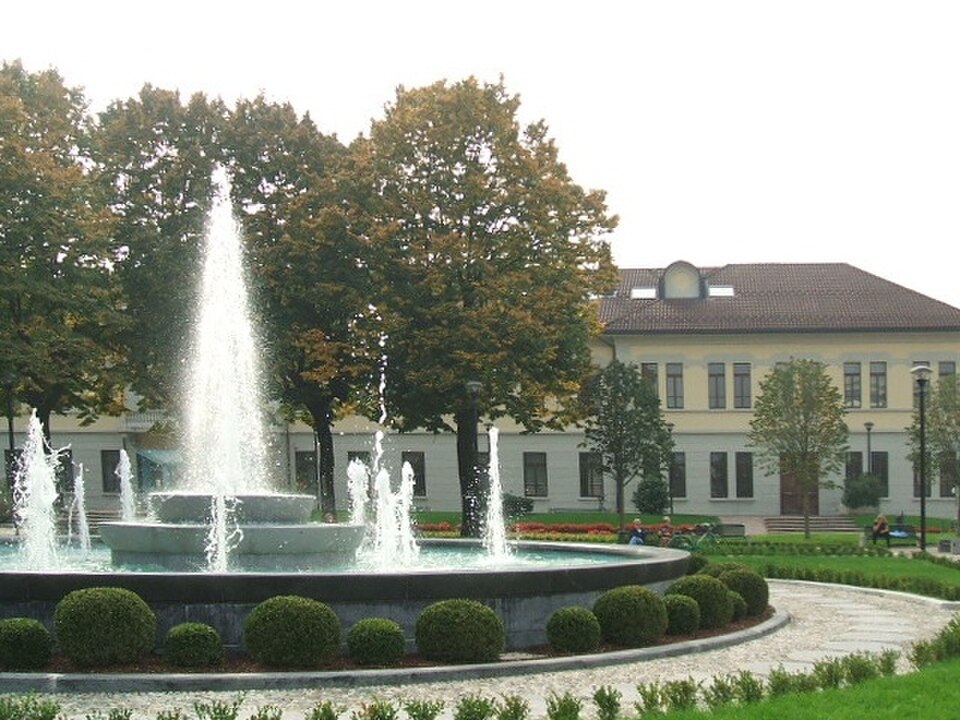
For generations, however, Lissone’s name was closely associated with one particular material: wood. Furniture making existed across Brianza as a domestic and artisanal activity, often combined with agriculture, but during the 19th century Lissone began transforming that craft into a specialised economy. Around the 1830s, local furniture makers increasingly organised production beyond individual commissions, coordinating workshops and transporting finished furniture towards the much larger Milanese market. During the following decades, larger firms appeared alongside networks of small family workshops, supported by specialist trades including carving, upholstery and metalwork.
By the later 19th century, Lissone had become one of Italy’s principal furniture centres. A professional school for drawing and carving was established in 1870, reflecting a trade that increasingly required not only carpenters but designers, decorators and craftsmen capable of working within changing fashions. The wider Brianza district eventually became internationally associated with furniture and design, an industrial identity that survived the enormous transformation of manufacturing during the 20th century.
Even the organisation behind the race carries that history in its name. Sport Club Mobili Lissone, literally referring to the town’s furniture industry, was founded in 1946 and celebrates its 80th anniversary in 2026. In its first year, the club organised a race commemorating a cyclist who had grown up in Lissone half a century earlier.
Ugo Agostoni · The Lissone Rider Who Won Milan-Sanremo
Ugo Agostoni was born in Lissone on 27 July 1893 and became a professional cyclist in 1911, when road racing still belonged to an era of extremely long distances, rudimentary equipment and roads frequently left unpaved.
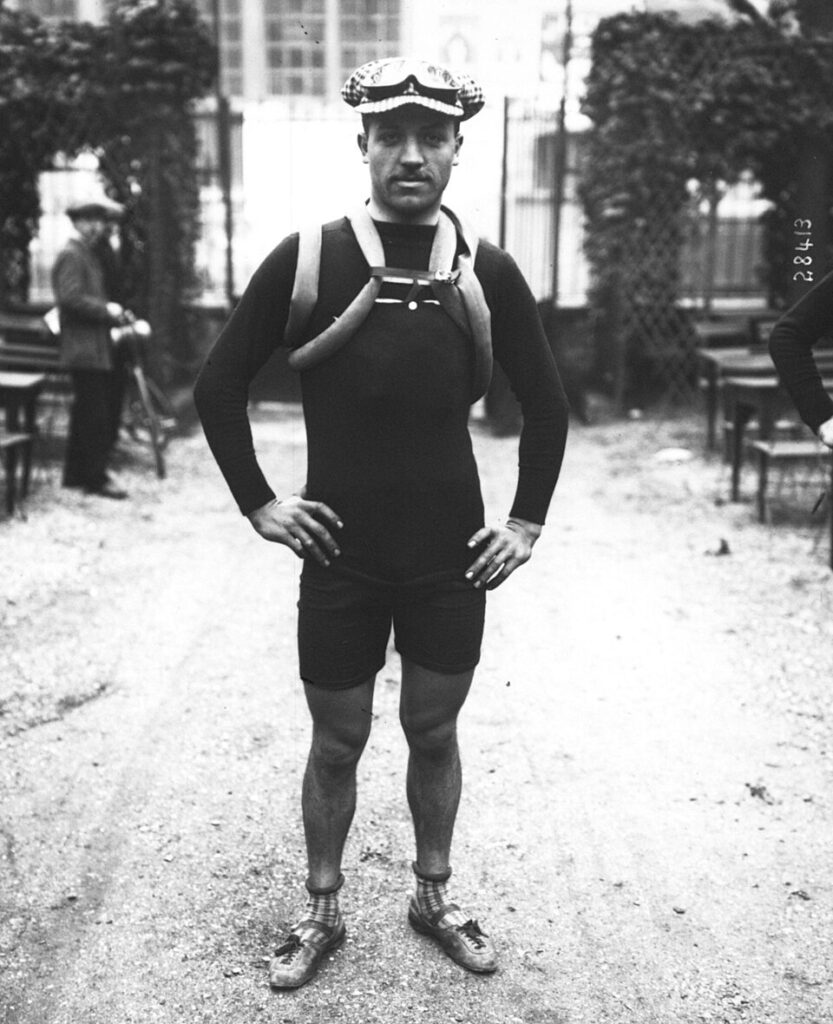
His early results established him quickly. In 1912, riding for Peugeot, he won the Giro dell’Emilia, the race that now finishes with repeated climbs to San Luca in Bologna. A year later he established an Italian hour record of 40.529 kilometres on the track in Florence.
His greatest victory came on 5 April 1914 in Milan-Sanremo, already one of the defining races of Italian cycling. The route measured 286.5 kilometres, and Agostoni reached Sanremo after more than ten and a half hours of racing, defeating Carlo Galetti and French rider Charles Crupelandt.
The First World War interrupted his career, as it did those of an entire generation of European cyclists, but Agostoni returned to professional racing afterwards. He finished fifth in the 1919 Giro d’Italia and fourth in that year’s Giro di Lombardia, continuing to compete into the 1920s. He died in 1941.
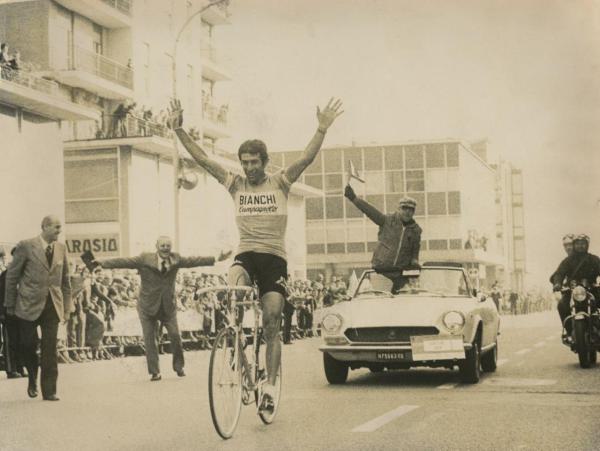
Five years later, cyclists gathered in his home town for the first race carrying his name. The Coppa Agostoni has since been won by riders including Felice Gimondi, Eddy Merckx, Roger De Vlaeminck, Francesco Moser, Giuseppe Saronni, Gianni Bugno, Jan Ullrich and Laurent Jalabert, placing a race confined to a small part of Lombardy inside the much wider history of post-war European cycling.
From Lissone, the road turns north and begins following a river that runs in the opposite direction, descending from the hills towards Monza and Milan.
The Lambro · A River From the Hills to Milan
The Lambro rises in the hills near Lake Como before flowing south through Brianza, Monza and the eastern side of metropolitan Milan, eventually reaching the Po.
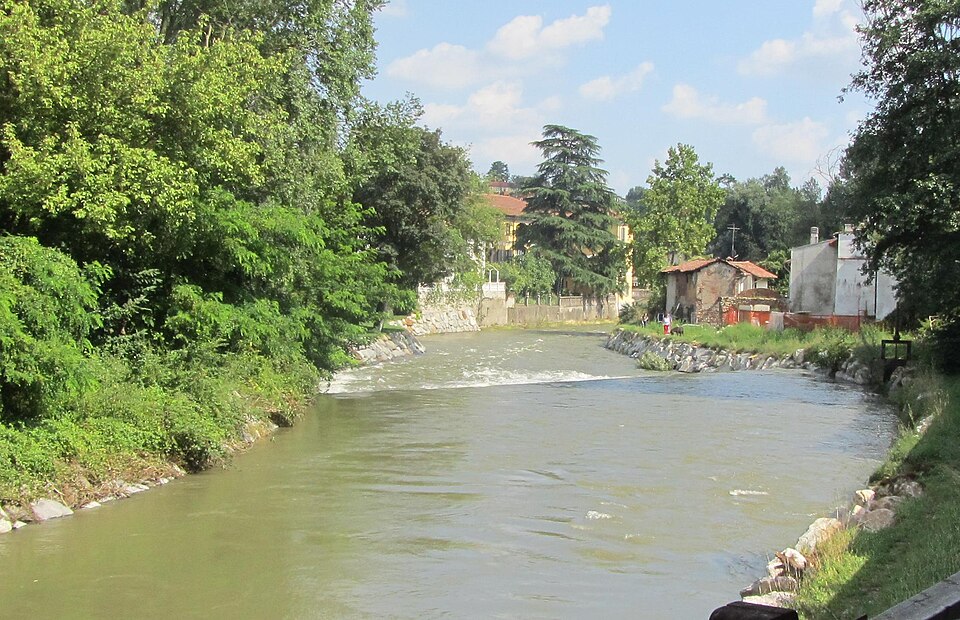
It is not a large river, but its valley forms one of the natural corridors through a landscape otherwise crowded by towns, roads and industry. Before modern urbanisation, the Lambro supplied water to farms and settlements and helped power mills and workshops. Its course connected the hills with Monza and Milan long before modern roads filled the spaces between them.
The race follows the valley northwards. The continuous urban fabric around Lissone gradually loosens, and beside the river at Agliate stands one of the oldest surviving religious complexes in Brianza.
Agliate · A Romanesque Basilica Beside the Lambro
Agliate, now part of the municipality of Carate Brianza, is a small settlement whose principal monument is the Basilica of Saints Peter and Paul, one of the most important surviving Romanesque religious complexes in Brianza.
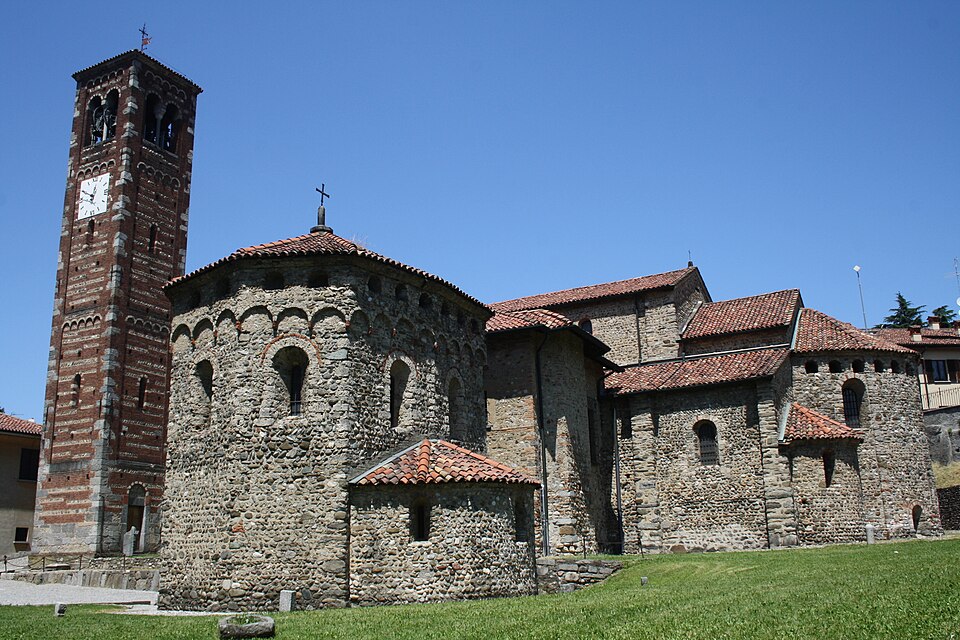
Romanesque architecture developed across much of western Europe during the 10th to 12th centuries, before Gothic architecture introduced taller structures, pointed arches and increasingly elaborate systems of vaulting. Romanesque churches generally favour thick masonry, rounded arches and strongly defined volumes, although the form developed differently from region to region.
At Agliate, the church and its separate baptistery preserve the atmosphere of an early medieval religious centre beside the Lambro. Their stone architecture belongs to a Brianza very different from the industrial towns farther south, when communities were organised around rural settlements, estates and ecclesiastical institutions scattered through the countryside.
The race crosses the Lambro and begins moving away from its valley. Around Briosco, the flat metropolitan landscape starts breaking into ridges and shallow valleys.
Briosco · Where the Plain Begins to Break Apart
Briosco stands in the northern part of the province of Monza and Brianza, where the continuous urban landscape north of Milan begins to fragment into hills, woods and agricultural ground.
Brianza occupies the transition between the Po plain and the Alpine foothills, and much of its rolling terrain carries the legacy of geological processes associated with the Alps and with glaciers extending southwards during colder periods. Ice, meltwater and sediments helped produce low ridges and shallow depressions rather than the immense flat surfaces found farther south.
Farms adapted to these irregular slopes through mixed agriculture rather than the enormous fields characteristic of the lower plain. Villages occupied ridges and hillsides, while roads followed contours or climbed abruptly from one shallow valley into another.
Around Capriano, near Briosco, the 2026 route begins testing that terrain before continuing through Cassago Brianza towards Cremella. The principal circuit is still ahead, but the straight horizons around Lissone have already disappeared.
Cremella and the Old Hill Country of Brianza
Cremella is one of the small settlements of the Lecco side of Brianza, where villages are separated less by great distances than by the folds of the landscape between them.
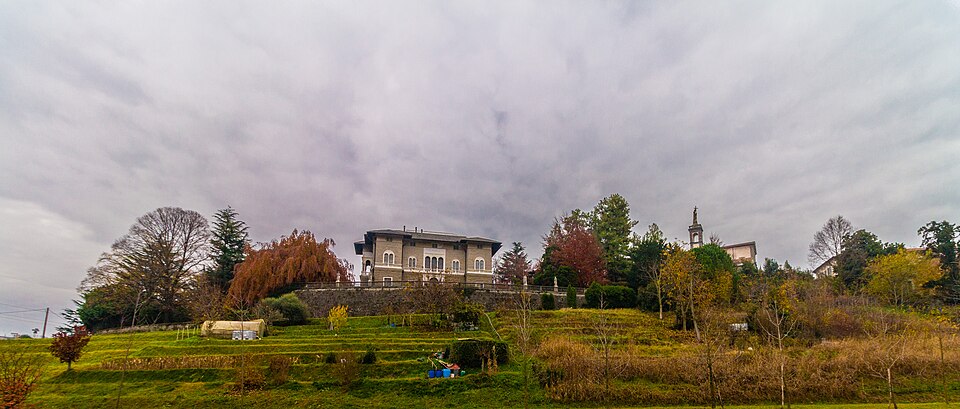
During the Middle Ages and early modern period, communities across this territory were often grouped into pievi, districts centred on important baptismal churches that gradually acquired administrative as well as religious functions. Noble families, monasteries and the rulers of Milan held land among the hills, while farming and local markets connected settlements that rarely developed into large towns.
Brianza itself never grew around a single dominant city. Milan exerted enormous economic and political influence from the south, while Como and Lecco connected its northern edge with the lakes and Alpine valleys. Between them emerged a dense network of villages, estates and later workshops rather than one regional capital.
That pattern becomes particularly clear as the race passes Barzanò, Sirtori and Colle Brianza. The settlements lie close together on a map, but ridges and valleys repeatedly separate them on the road.
At Barzanò, the race enters the 28-kilometre circuit it will complete four times.
THE LISSOLO CIRCUIT · Four Laps Through the Brianza Hills
The central part of the 2026 Coppa Agostoni consists of four laps of a 28-kilometre circuit containing the climbs of Sirtori, Colle Brianza and Lissolo.
Sirtori rises for 1.5 kilometres at an average of 4.9 percent, Colle Brianza continues for 3.8 kilometres at approximately 6 percent, and Lissolo measures 5.4 kilometres at 4.3 percent, with sections reaching around 15 percent. None is particularly imposing in isolation. Four laps mean twelve ascents, connected by roads that rarely allow the rhythm to settle for long.
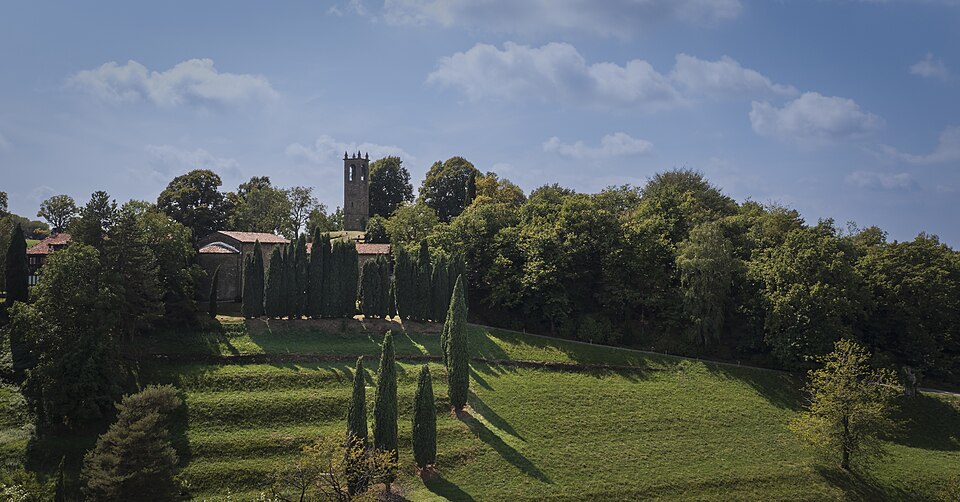
The circuit carries the race into a Brianza that feels increasingly distant from the industrialised territory around Lissone. Villages occupy ridges, woodland fills the steeper slopes and roads repeatedly open views across the plain before dropping into another fold of the hills. Around Montevecchia, generations of farmers cut terraces into the slopes for vines, herbs and fruit.
The first ascent comes at Sirtori.
Sirtori · A Village Above the Milanese Plain
Sirtori is a small hill town in the province of Lecco, positioned high enough above the surrounding country for the landscape south towards Milan to open beyond its slopes.
The settlement has ancient roots. Roman-period inscriptions found in the area preserve the name of the Sertorii, a family whose presence may lie behind the later place name. The surrounding country then belonged to Cisalpine Gaul, the Roman name for the territories of northern Italy before their full integration into Roman Italy.
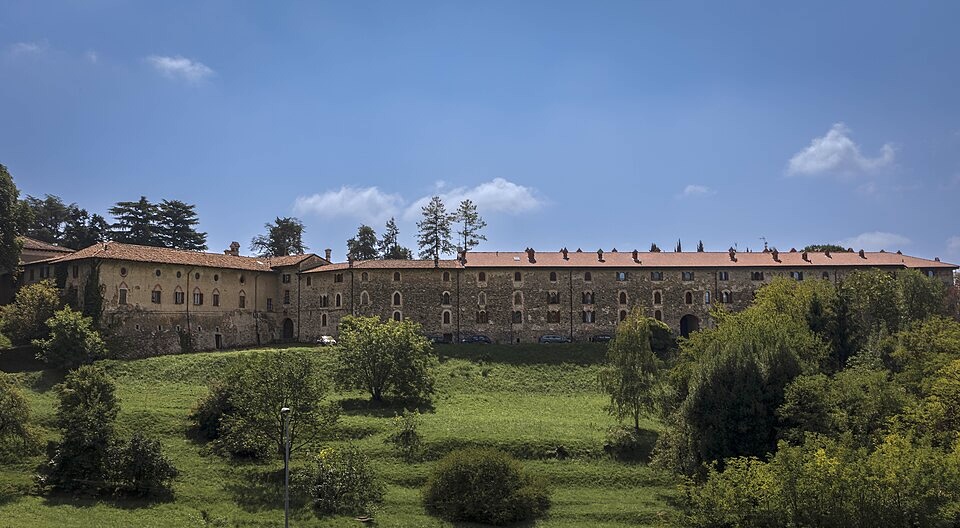
Centuries later, Sirtori formed part of the Duchy of Milan, the powerful state centred on Milan that controlled much of Lombardy during the late Middle Ages and Renaissance. During the 17th century, under Spanish Habsburg rule, the village became a feudal possession of the Sirtori family.
Approximately three quarters of the municipal territory is hilly, with sandstone-derived soils and deposits connected to ancient glacial activity. Fields and woodland occupy slopes overlooking the plain, and on clear days metropolitan Milan lies across the southern horizon.
The road does not descend far before the next ridge begins.
Colle Brianza · Between the Plain and the Alps
Colle Brianza is both the name of a municipality and a concise description of its position on some of the higher ground of Brianza, between the Milanese plain and the mountains around Lecco.
The race climbs for approximately 3.8 kilometres at six percent, the most sustained of the three principal ascents on the circuit. As the road gains height, the geography of Lombardy becomes unusually legible. The Po Valley stretches south towards Milan, while to the north the land rises towards Lecco, Lake Como and the first substantial Alpine mountains.
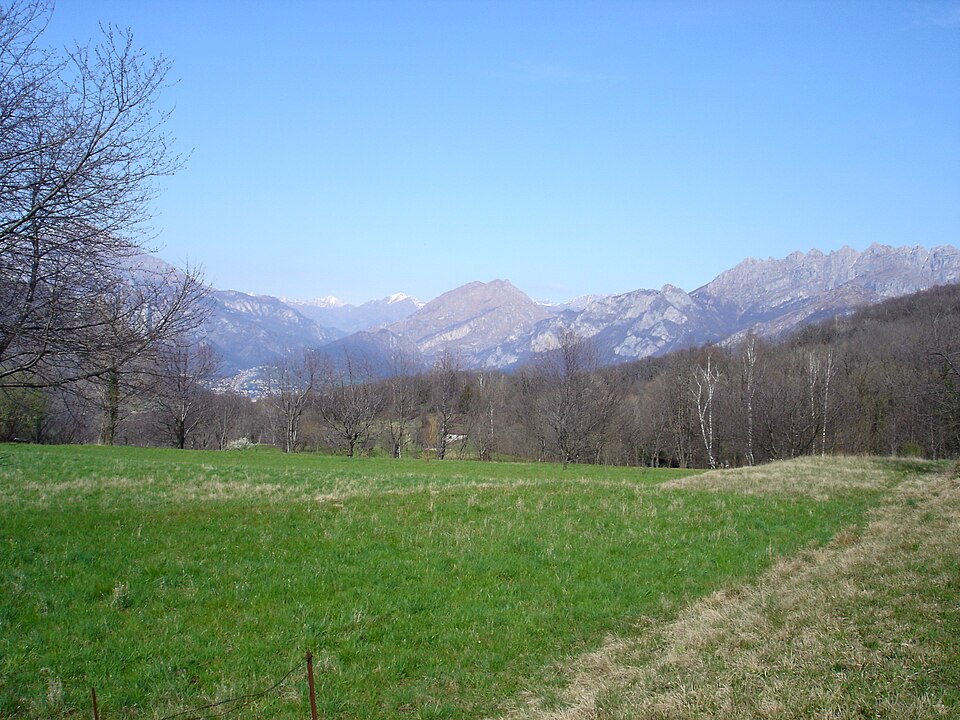
Brianza occupies the country between those two worlds. Its villages could develop on relatively dry and defensible slopes while remaining close to fertile lower ground, and later the same proximity to Milan encouraged manufacturing and suburban growth without completely erasing the older agricultural landscape.
Roads fall from one ridge only to begin climbing another, and the circuit soon reaches the ascent whose name has become most closely associated with the Coppa Agostoni.
Lissolo · The Climb at the Heart of the Coppa Agostoni
Lissolo is a small locality in the Brianza hills rather than a major mountain pass, but repeated ascents of its road have made the name familiar within the history of the Coppa Agostoni.
The 2026 climb extends for approximately 5.4 kilometres at an average of 4.3 percent, with maximum gradients around 15 percent. The average conceals an irregular road where easier sections are interrupted by sharper ramps, forcing repeated changes of pace rather than one continuous climbing effort.
By the time the riders reach Lissolo, they have already crossed Sirtori and Colle Brianza. The same sequence waits on the next lap, and again on the one after that. The circuit gradually acquires its difficulty without ever becoming mountainous, as each return reduces the amount of recovery available between the steeper sections.
The road lies within a broader landscape of woods, cultivated slopes and old agricultural terraces around Montevecchia and the Curone Valley, whose prominent hill rises nearby.
Montevecchia and the Curone Valley · Vineyards Cut Into the Hills
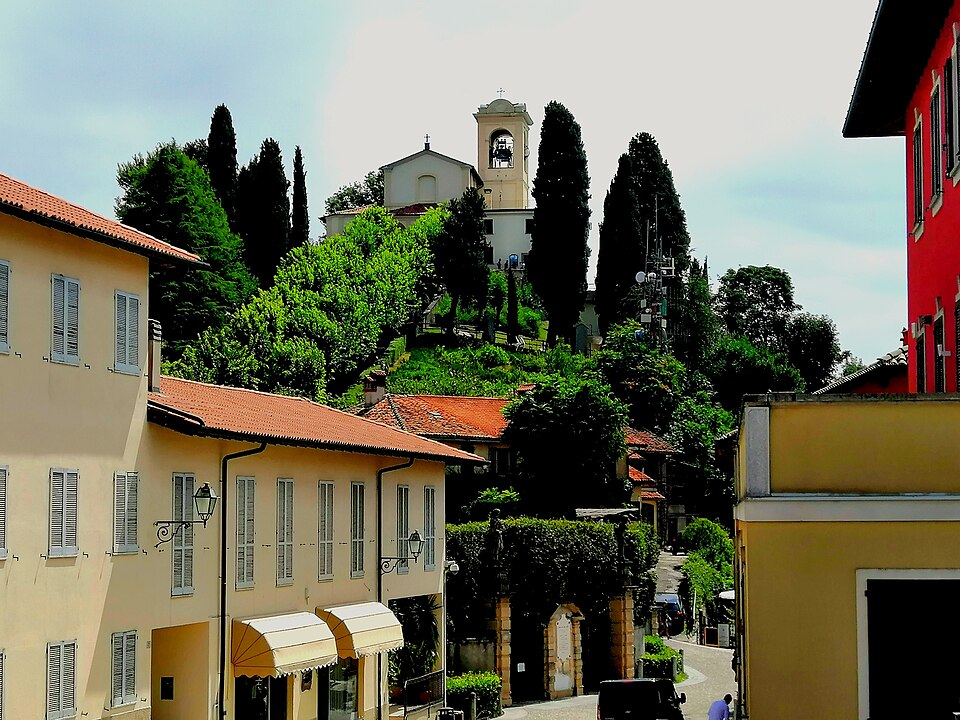
Montevecchia is a hill village and protected landscape rising above southern Brianza. Its slopes form part of the Montevecchia and Curone Valley Regional Park, established to conserve woodland, streams, farmland, traditional settlements and agricultural terraces constructed over many centuries.
Those terraces are known locally as ronchi. Farmers built dry-stone retaining walls across steep slopes to create narrow strips of flatter ground where crops could grow. Vines became particularly important on the warmer southern exposures, often sharing the terraces with rosemary, sage, vegetables and fruit trees, while cooler northern slopes were more likely to remain wooded.
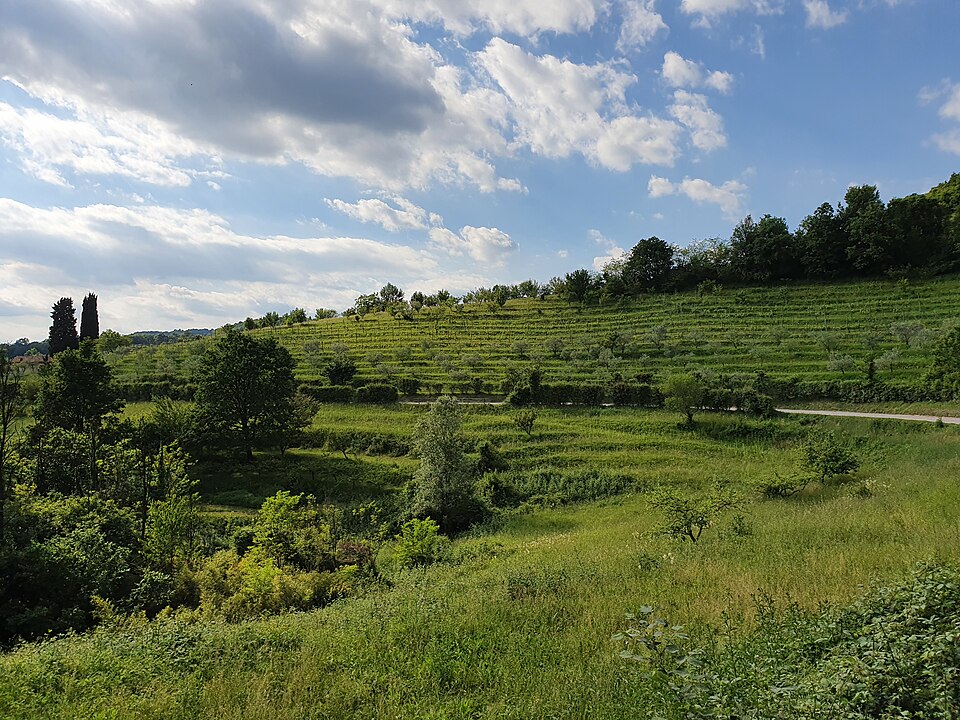
The work accumulated slowly across generations. Each wall extended the area that could be cultivated on difficult ground, until entire hillsides had been reshaped into narrow horizontal steps. Where farming later retreated, abandoned terraces sometimes disappeared beneath woodland and scrub without entirely losing the stone structures underneath.
Above them stands the Sanctuary of the Beata Vergine del Carmelo, a church occupying the summit of Montevecchia. A staircase of 181 steps leads towards its forecourt, followed by a sequence of 18th-century chapels forming a Via Crucis, the devotional representation of Christ’s journey to the crucifixion. From the hill, views extend across much of the Po Valley and, in clear conditions, towards the Alps and distant Apennines.
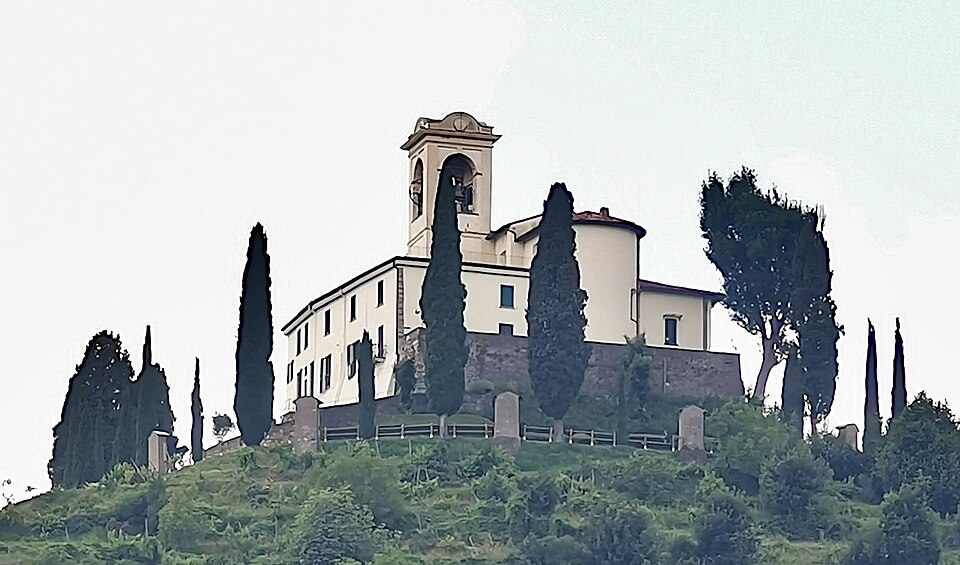
The race remains below the sanctuary, returning instead to Sirtori, Colle Brianza and Lissolo. With every lap, the geography stays almost unchanged while the peloton does not.
Eventually the circuit releases the riders south.
FINAL 35 KM · Leaving the Hills
Approximately 35 kilometres remain when the race leaves the Lissolo circuit. The repeated climbing ends and the road begins returning towards the denser southern part of Brianza.
The distance is long enough for groups to reorganise after the hills, while the terrain no longer offers the succession of climbs that created those groups in the first place. Near Lomagna, Montevecchia remains above the surrounding country, its sanctuary visible on the wooded and terraced hill.
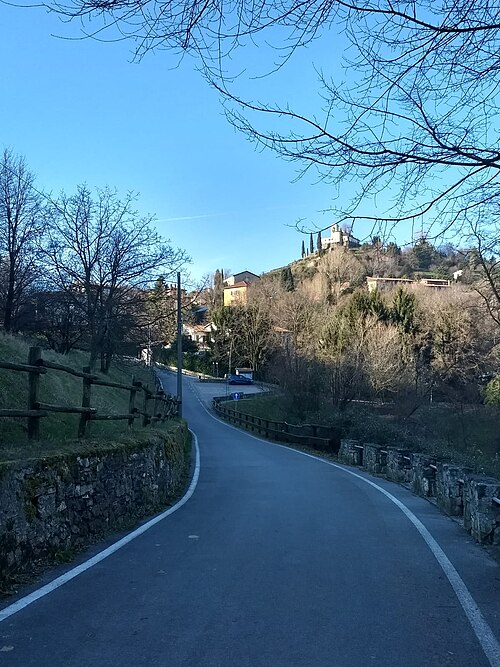
The towns begin drawing closer together again. Roads that only a few kilometres earlier ran between woodland and fields return towards the urban belt north of Monza, although traces of the older aristocratic countryside survive beside the Lambro.
One of them stands at Canonica Lambro.
Canonica Lambro · Villa Taverna and the Milanese Aristocracy
Canonica Lambro, now part of Triuggio, is a small settlement beside the river where Villa Taverna, a Renaissance and later aristocratic residence, stands above the valley.
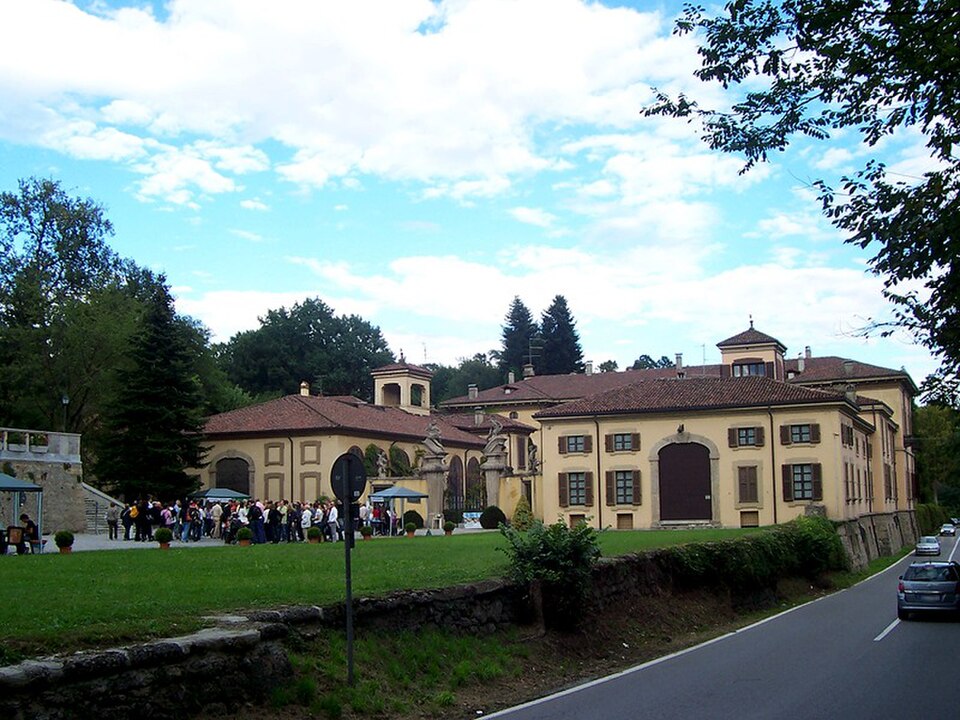
The site had been associated with a medieval religious and fortified complex before passing into the possession of Francesco Taverna in the early 16th century. Taverna became one of the leading officials of the Duchy of Milan, eventually serving as grand chancellor during an era when France, the Habsburg Empire and Italian states competed for control and influence across northern Italy.
From 1525, the Taverna family transformed the property into a country residence. Its present form developed over subsequent centuries around a U-shaped plan, gardens and a position slightly above the Lambro. It belonged to a wider tradition in which Milanese aristocratic families maintained estates beyond the city, combining agricultural property with residences used for leisure, political relationships and displays of status.
The landscape around Canonica was already being celebrated during the Renaissance. In 1559, writer Bartolomeo Taegio described the estate through its hills, plants, scents and carefully arranged paths, presenting the country villa as a retreat from urban political life in which agriculture and cultivated nature became part of aristocratic culture.
The race reaches the Lambro again here after spending much of the afternoon east of its valley. Beyond Albiate, the older countryside is increasingly absorbed into the urban fabric surrounding Lissone.
Albiate and the Return to Urban Brianza
Albiate lies beside the Lambro only a few kilometres north of Lissone. The river encountered near Agliate early in the race has curved through Brianza while the peloton spent much of the afternoon crossing the hills to its east.
During the 19th and 20th centuries, industrialisation transformed this southern part of Brianza into one of Italy’s most productive manufacturing districts. Furniture, textiles, mechanics and specialist workshops spread through communities where production often depended upon networks of small and medium-sized businesses rather than only large factories.
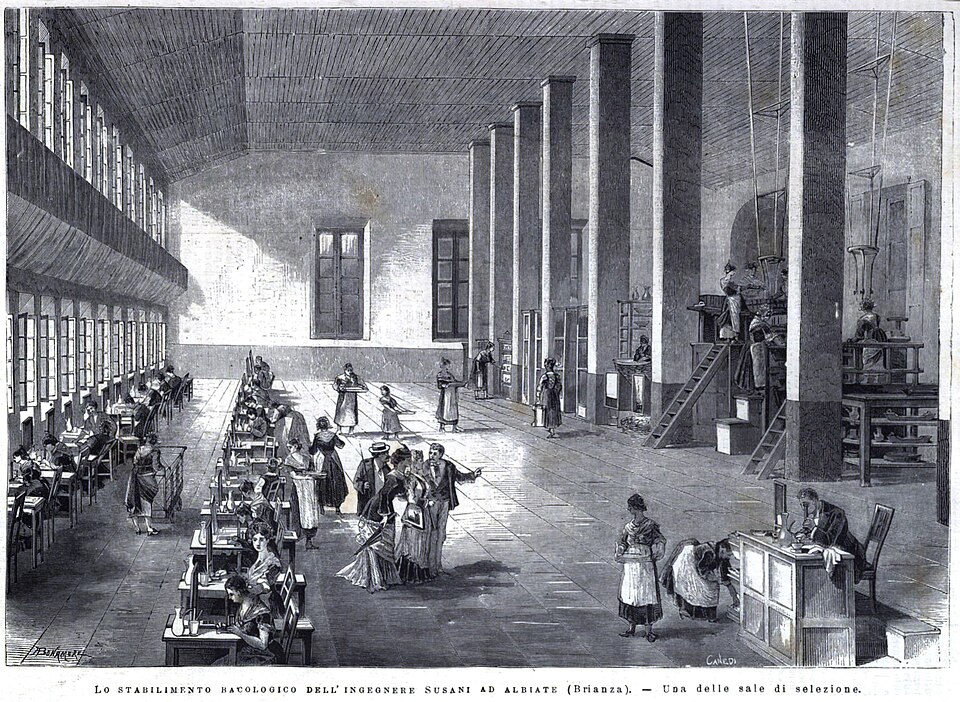
Fields between neighbouring settlements gradually filled with roads, workshops and housing as Milan’s metropolitan influence expanded northwards. Old villages remained identifiable around churches and historic centres, but the boundaries between them became increasingly difficult to perceive from the road.
The race passes through Sovico and Macherio before entering Lissone. The climbs have ended, and the roads once again resemble those on which the day began.
FINISH · Via Matteotti, Lissone
The Coppa Agostoni finishes on Via Matteotti in Lissone, returning to the home town of the cyclist whose name it has carried since the first edition in 1946.
Ugo Agostoni raced in a cycling world that would be almost unrecognisable beside the modern finish. His 1914 Milan-Sanremo lasted more than ten and a half hours, his career crossed the First World War, and he competed at a time when Italian professional racing was still establishing many of the traditions that later became part of the sport’s identity.
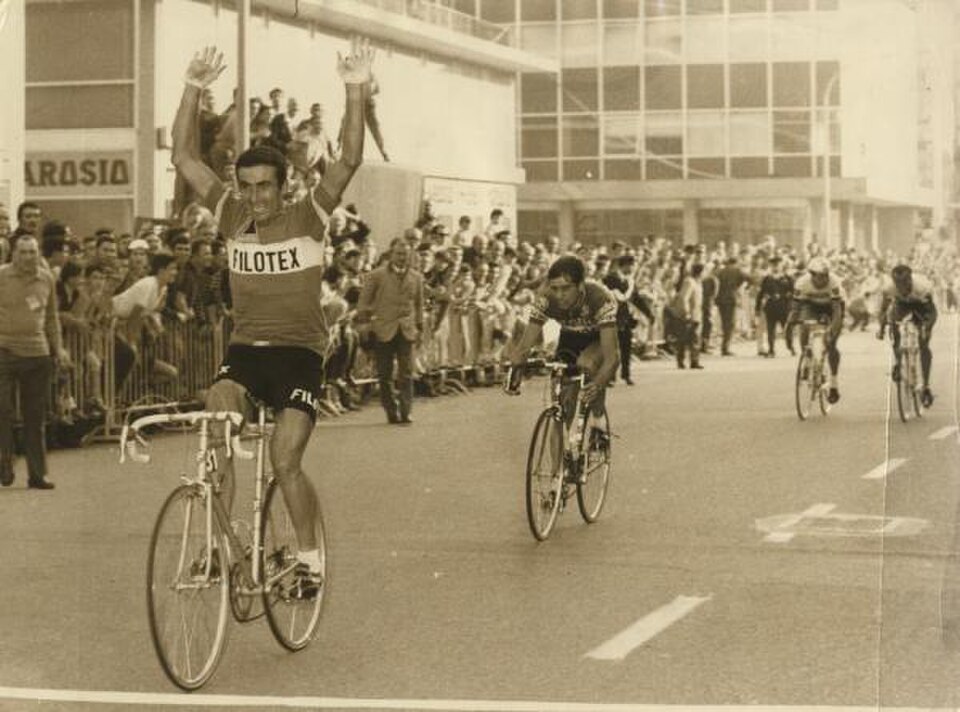
The race created in his memory survived into a very different Brianza. Lissone’s furniture workshops expanded into an industrial district, towns spread into one another and the metropolitan edge of Milan moved steadily north. Yet only a short ride away, the roads around Sirtori, Colle Brianza, Lissolo and Montevecchia still climb through woods, terraces and villages built into the folds between the plain and the Alps.
On Via Matteotti, those hills are behind the riders. The road is flat again, the houses close around the course, and the Coppa Agostoni ends where it began, in the town where Ugo Agostoni first learned to race.