
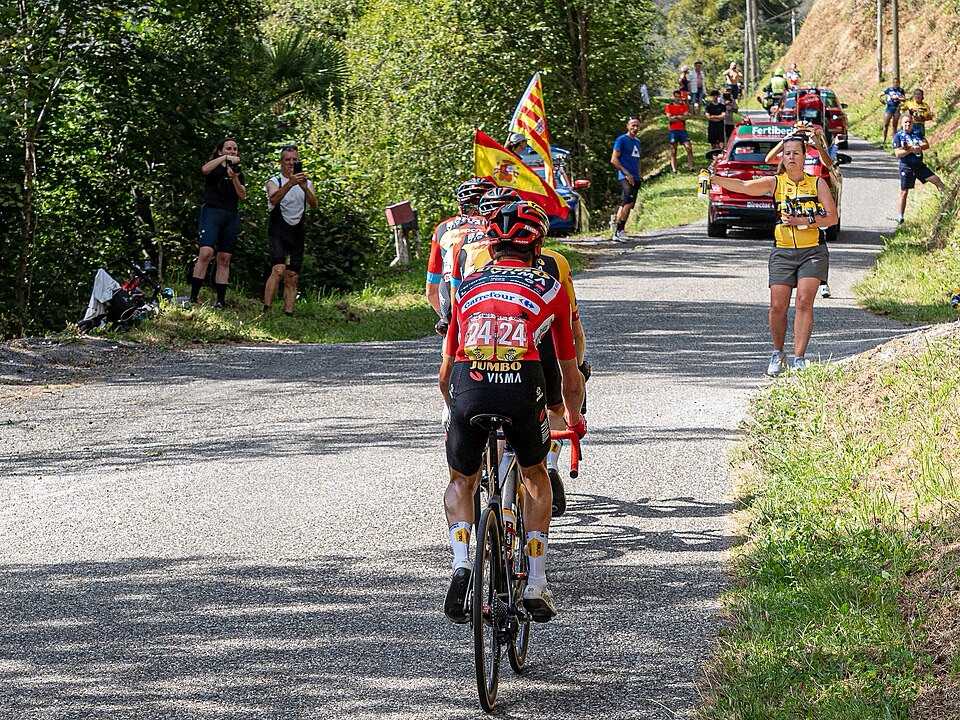
On 31 August 2023, Sepp Kuss crossed the finish line at the Observatorio Astrofísico de Javalambre, high in the mountains of eastern Spain, to win the sixth stage of the Vuelta a España. The American had escaped into a large breakaway before leaving his remaining companions behind on the final climb. Behind him, his Jumbo-Visma teammates Primož Roglič and Jonas Vingegaard were competing against the other general-classification contenders, taking time from their rivals.
Kuss was one of the finest mountain domestiques in professional cycling. Earlier that season, he had helped Roglič win the Giro d’Italia and Vingegaard win the Tour de France. His usual responsibility was to protect a designated leader, control the pace on difficult climbs and sacrifice his own opportunities when the team’s objectives required it. At the Vuelta, however, the situation was beginning to change.
Two days after his stage victory, Kuss took the red jersey of race leader. He would eventually win the entire Vuelta, finishing seventeen seconds ahead of Vingegaard and more than a minute ahead of Roglič. Jumbo-Visma occupied all three places on the final podium in Madrid, completing an unprecedented season in which the organisation had won all three men’s Grand Tours with three different riders.
Kuss’s victory revealed something fundamental about professional cycling. The distinction between a leader and a domestique is not necessarily a distinction between a great rider and an ordinary one. It is a decision about how an individual’s abilities can best contribute to a collective objective. A cyclist strong enough to win a Grand Tour may spend years helping somebody else achieve that ambition, while a rider selected as a leader can find himself dependent on teammates whose names rarely appear in the headlines.
A professional cycling team is therefore more complicated than a collection of athletes wearing the same jersey. It is an organisation built around different physical abilities, tactical responsibilities and sometimes competing ambitions. Although only one rider can win an individual race, that victory may depend on the work of several others whose own chances have already been sacrificed.
Understanding how those responsibilities are distributed begins long before the riders reach the starting line.
A Professional Team Is Much Bigger Than Eight Riders
When eight cyclists from the same team appear at the start of the Tour de France, they represent only part of a much larger organisation. A men’s UCI WorldTeam typically maintains a roster of around thirty professional riders, competing across an international calendar that extends from the opening races of the year to the final events of autumn.
The WorldTour is the highest tier of men’s professional road cycling. Below it are UCI ProTeams, professional organisations that can compete in many major international events and receive invitations to WorldTour races. Continental teams operate at another level, often with smaller budgets and more geographically concentrated racing programmes. These classifications describe the teams’ registration status and access to competitions, rather than providing a simple measure of every rider’s ability.
Some WorldTour organisations also operate separate development squads, frequently registered at Continental level. These teams provide younger riders with opportunities to compete internationally, learn professional racing routines and prepare for a possible move to the senior roster. Development riders may train alongside established professionals or receive opportunities with the senior organisation under applicable regulations, but they are not automatically part of its Grand Tour selection.
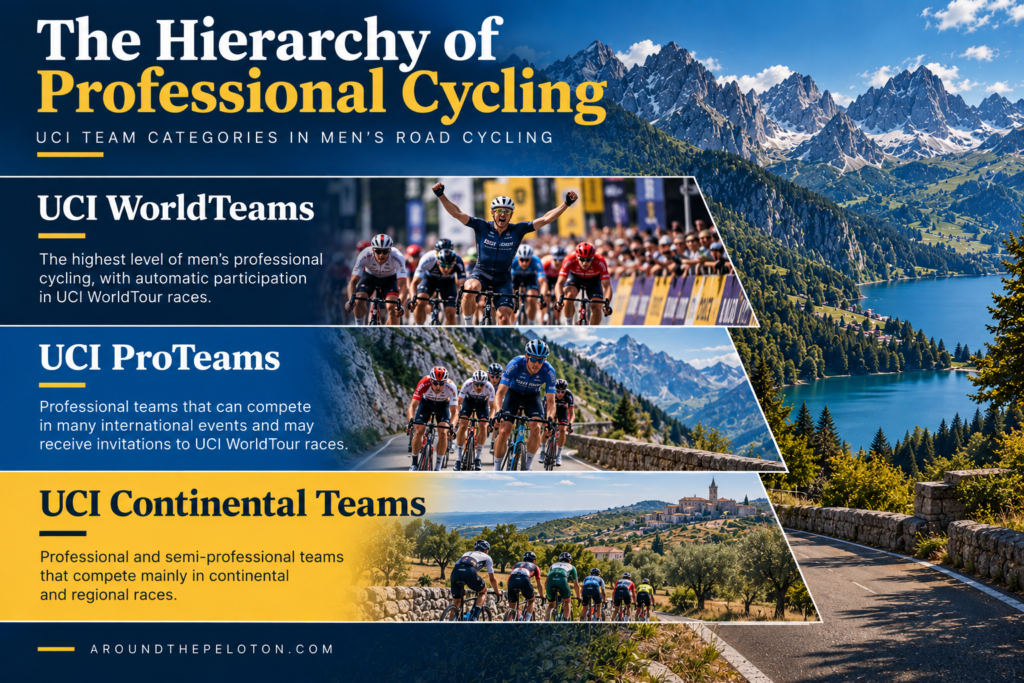
Women’s professional cycling follows a comparable structure, with UCI Women’s WorldTeams, Women’s ProTeams and Continental teams. Roster and race-entry regulations differ, but the central principles of specialisation, leadership and collective support apply equally.
A men’s team enters eight riders in each of the three Grand Tours: the Giro d’Italia, Tour de France and Vuelta a España. Many other major races permit seven riders per team, while some competitions have smaller lineups. The number is determined by the event’s regulations, not by the total number of professionals employed by the organisation.
Consequently, a rider omitted from the Tour de France squad has not necessarily fallen out of favour. He may be preparing for the Vuelta, recovering from an earlier racing programme or targeting one-day Classics later in the season. Other teammates might be racing elsewhere while the Tour is underway.
The team’s management must coordinate these different objectives across the entire calendar. A sprinter capable of winning flat stages may have little reason to enter a race dominated by long mountain climbs, while a specialist in the cobbled Classics might be more valuable in northern Europe than in a mountainous three-week stage race.
Selecting a Grand Tour squad means choosing eight riders from a much larger pool, with the route, available talent and intended objectives determining the final combination.
The Expedition Behind the Eight Riders
The riders are only the most visible members of the group travelling to a Grand Tour. Before the opening stage, team vehicles arrive carrying bicycles, spare components, clothing, nutrition supplies and the equipment required for three weeks on the road.
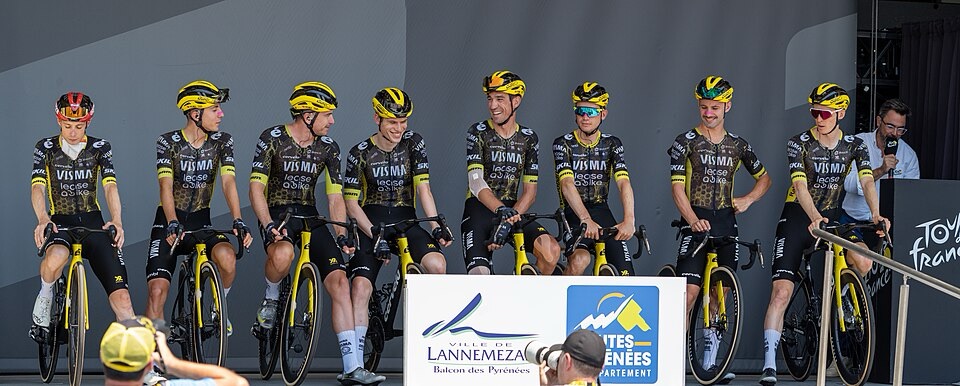
Directeurs sportifs oversee race strategy and communicate with riders from the team cars. Mechanics prepare bicycles and respond to technical problems, while soigneurs organise supplies, assist at feeding points and provide practical support and massages. Doctors, physiotherapists, nutritionists and other performance specialists help manage the riders’ health, recovery and fuelling.
Larger organisations may also travel with chefs, logistics coordinators and communications staff. Some specialists remain with the race throughout its duration, others attend selected stages, and certain responsibilities are handled remotely. Meanwhile, the rest of the professional roster continues training, competing or recovering elsewhere.
The Leader: The Rider Everyone Works For
The most important decision in assembling a Grand Tour squad is often determining what the team intends to achieve.
An organisation targeting the general classification, usually abbreviated to GC, needs a rider capable of performing consistently across three weeks. The leader must climb with the strongest competitors, limit losses in time trials, survive dangerous flat stages and recover sufficiently between successive days of racing.
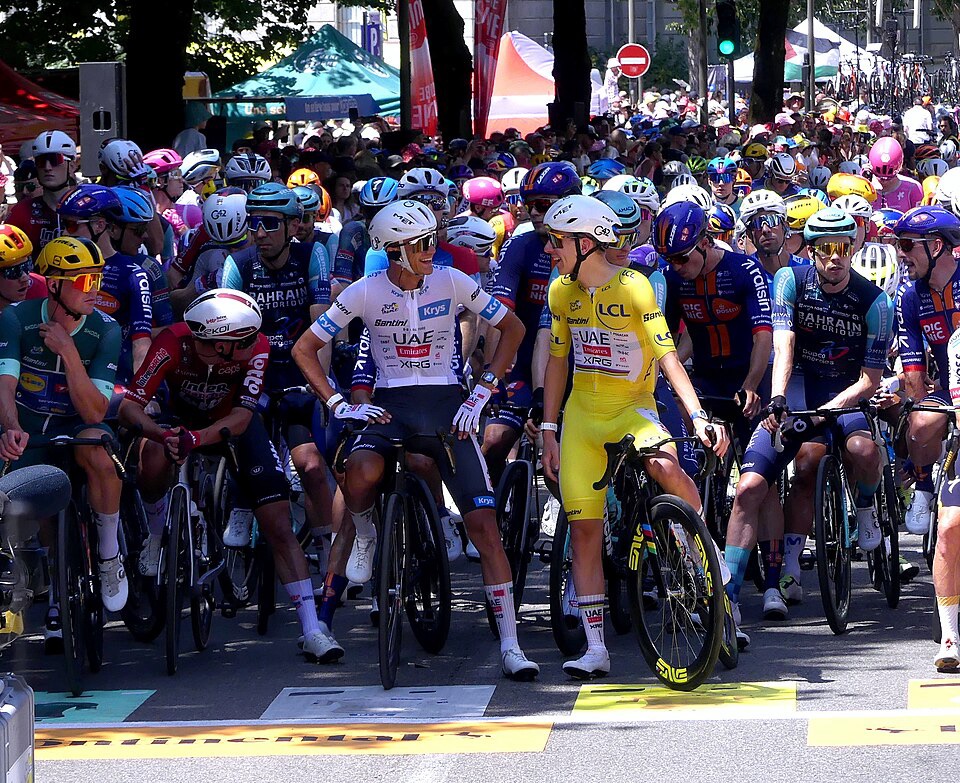
(Photo: Florian Pépellin / CC BY-SA 4.0 / Source: Wikimedia Commons, File: 17e étape Tour de France 2026 – Maillots Ligne de départ Chambéry.JPG)
The challenge extends well beyond the mountains. A contender can lose the Tour de France because of a crash, an unexpected split in the peloton or a mechanical problem at the wrong moment. Teammates therefore spend considerable time protecting the leader from situations that might prevent their strongest rider from reaching the decisive climbs in a competitive position.
The leader’s status does not mean that every teammate must remain beside them throughout every stage. Responsibilities are distributed according to the terrain. Powerful riders may provide protection on exposed roads, while climbing specialists are expected to remain available when the race reaches the mountains.
Leadership can take other forms. A squad built around a sprinter concentrates on stage victories, while a team without a realistic overall contender may give several riders freedom to pursue breakaways. A one-day Classic demands another kind of leader, selected for the specific roads and tactical challenges of that event.
Sometimes an organisation enters a race with two potential leaders, hoping to preserve more than one opportunity for victory. This can be a powerful advantage, but it also creates the possibility that teammates will become rivals.
When Two Leaders Want the Same Race
At the 1986 Tour de France, Bernard Hinault and Greg LeMond rode for the same La Vie Claire team. Hinault had already won the Tour five times, while LeMond had emerged as one of the strongest riders in the peloton. The French champion had previously indicated that he would help the American pursue victory, but the race developed into an increasingly tense contest between the two teammates.
Hinault attacked repeatedly, at times putting pressure on LeMond as well as their common rivals. The defining image came on the stage to Alpe d’Huez, where the two riders arrived together and crossed the finish line holding hands. Hinault was awarded the stage victory, while LeMond retained the yellow jersey. The gesture suggested unity, but it came after days of rivalry and did not erase the uncertainty surrounding their relationship.
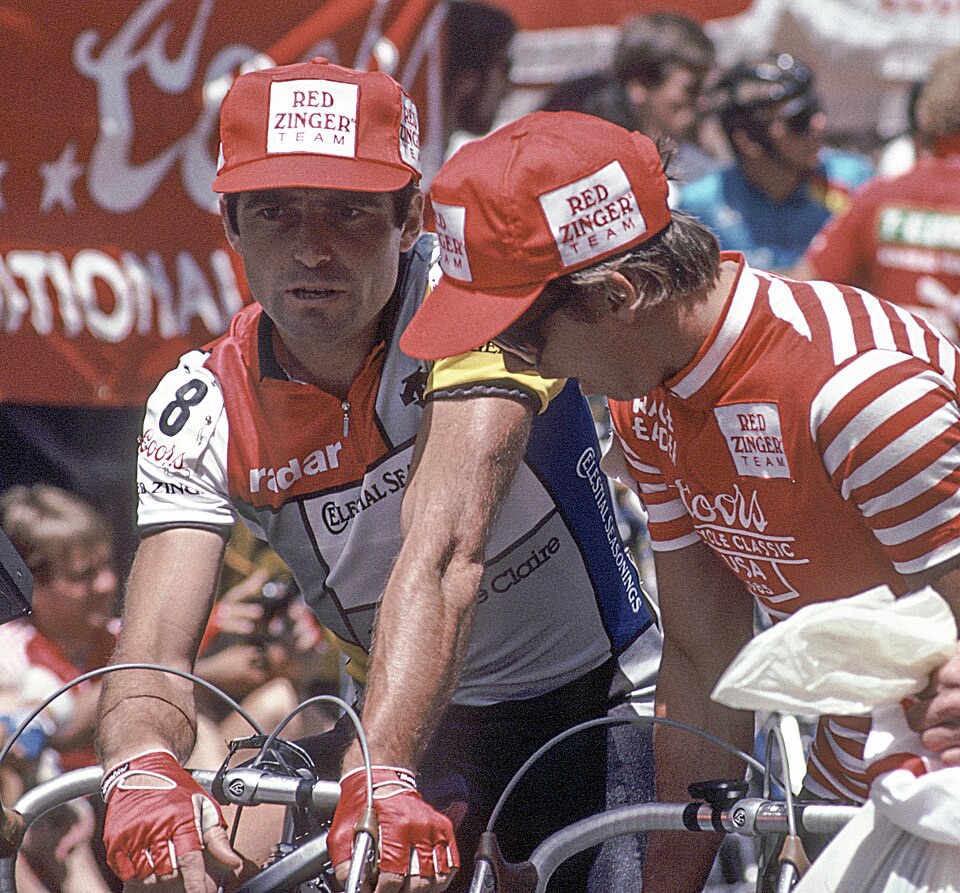
LeMond eventually won the Tour, becoming the first American to do so. The contest exposed the difficulty of maintaining a clear hierarchy when two exceptional riders believed they had legitimate claims to leadership.
A similar problem arose at the 2012 Tour de France. Bradley Wiggins was Sky’s principal leader, with Chris Froome occupying an important supporting role. Froome demonstrated formidable climbing strength and finished second overall behind Wiggins. Their performances gave Sky an extraordinary result, but also generated debate about how the team’s leadership should be managed.
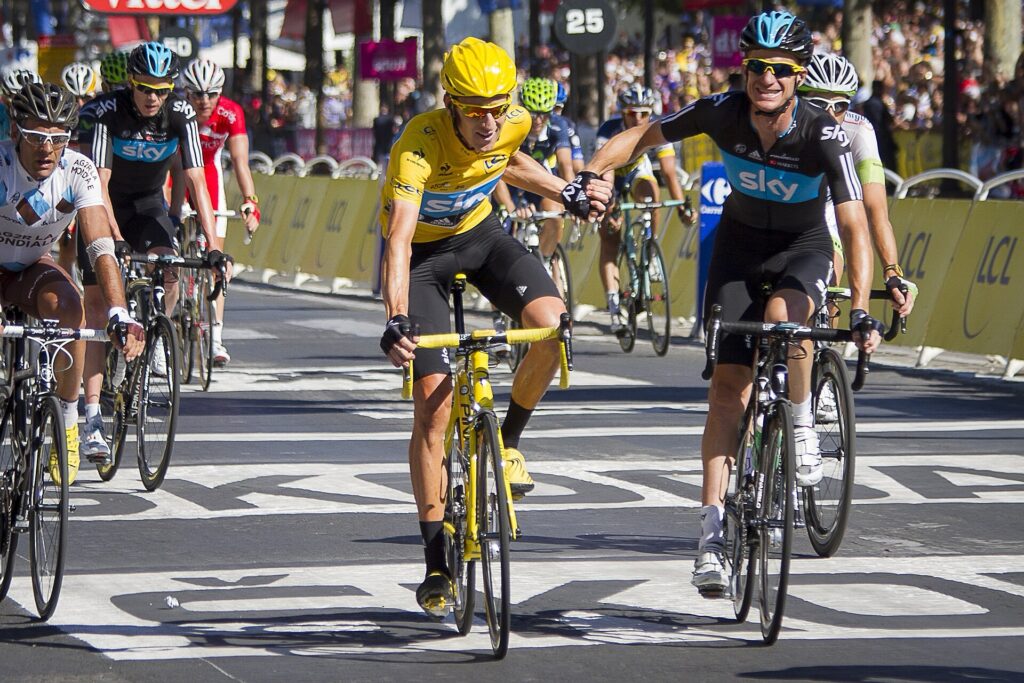
(Photo: William Morice / CC BY 2.0 / Source: Wikimedia Commons, File: Etape 20 du Tour de France 2012, Paris 10.jpg)
The question is not confined to men’s racing. At the 2023 Tour de France Femmes, Team SD Worx arrived with Demi Vollering as a leading overall contender and a squad containing several riders capable of winning major races themselves. Lotte Kopecky won the opening stage and wore the yellow jersey for much of the race, while Vollering ultimately took control of the general classification with her decisive victory on the Col du Tourmalet.
Vollering finished first overall and Kopecky second. Their success showed how a team containing multiple outstanding riders can pursue different opportunities during the same race, although balancing those ambitions requires careful decisions about who receives support and when.
The Domestique: The Rider Who Works for Someone Else
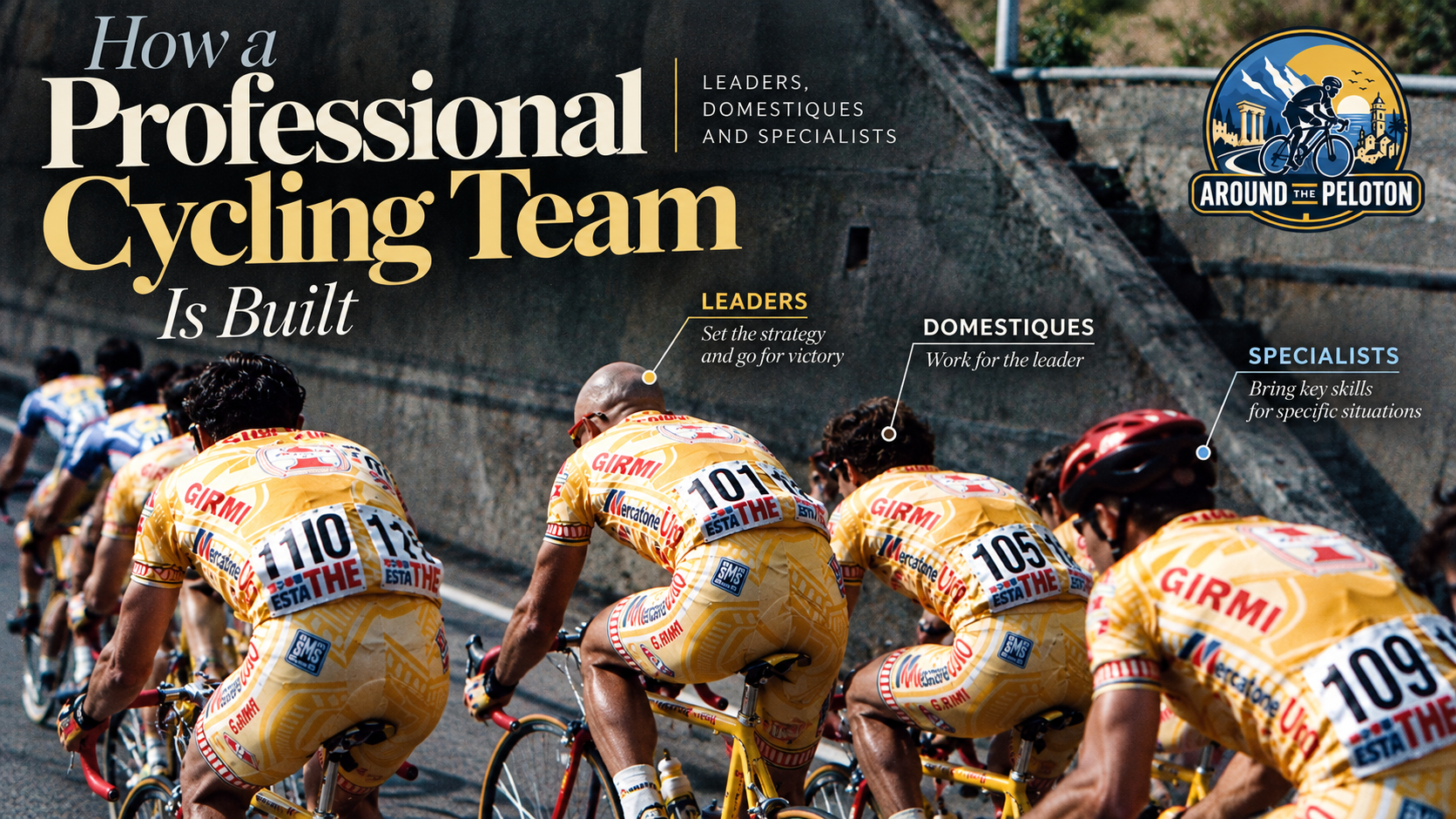
The word domestique comes from French and literally means servant. In professional cycling, it describes a rider whose principal responsibility is to work for a teammate rather than pursue personal victory.
The term can create the misleading impression that domestiques are inferior cyclists. Many are exceptional athletes who could lead smaller teams or win races under different circumstances. Their value lies in the ability to use their strength for a collective objective, often when preserving energy would benefit them personally.
One familiar duty is collecting food and bottles from the team car. A domestique drops towards the rear of the peloton, receives supplies and rides forward again to distribute them among teammates. The task can require repeated accelerations through a crowded field, particularly when the race is moving quickly.
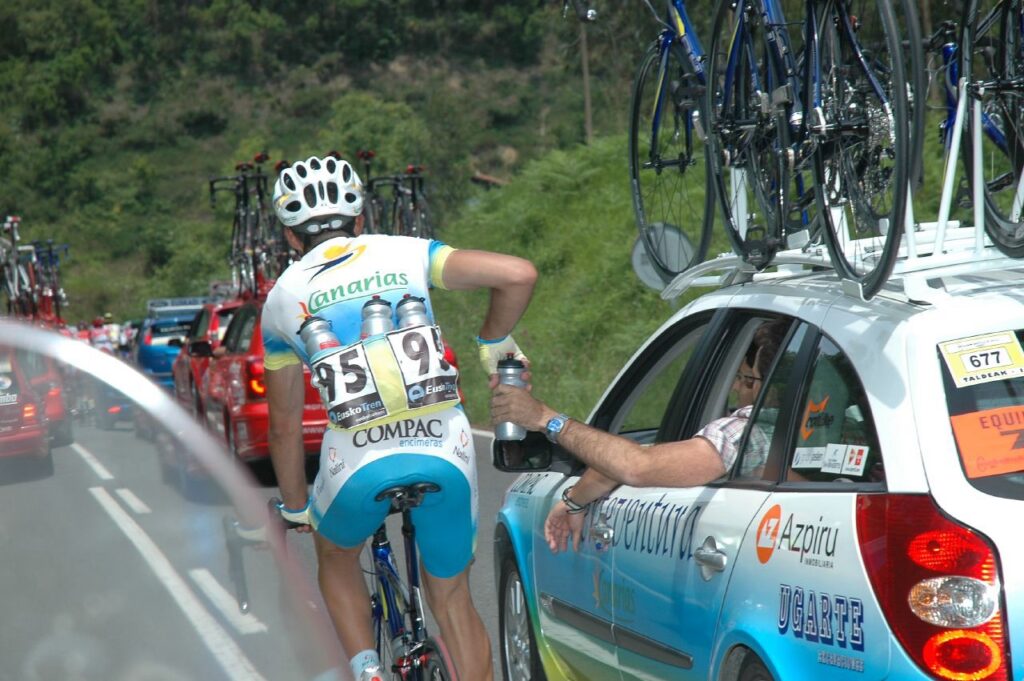
(Photo: Wikimedia Commons, File: Javier Cherro Molina.jpg)
But carrying bottles is only a small part of the work. Domestiques may spend hours riding at the front to control the advantage of a breakaway, protect leaders from the wind or help them maintain position before dangerous sections of road. If a leader suffers a mechanical problem, a teammate may stop to assist, surrender a wheel or bicycle when compatible, or help bring the leader back to the peloton.
Their contribution is particularly important in crosswinds. When the wind blows across the road, riders form diagonal formations called echelons, each seeking shelter behind and slightly beside the cyclist ahead. The width of the road limits how many can fit into the protected formation. Those left behind may be forced to expend much more energy, and the gaps can quickly become decisive.
A strong team anticipates the danger. Its domestiques position the leader near the front before an exposed section, reducing the risk of becoming trapped behind a split.
The domestique’s work is often measured by what does not happen. A leader avoids a crash, enters a climb near the front or reaches the final kilometres without spending unnecessary energy. None of those outcomes appears as an individual victory in the results, but each may contribute directly to success days or weeks later.
This creates an unusual relationship between effort and recognition. A domestique who has spent an afternoon controlling the race may be exhausted before the decisive climb begins. When the strongest riders accelerate, the domestique might be dropped immediately and finish many minutes behind. To an unfamiliar spectator, the result can look disappointing. Within the team, the rider may have completed the assignment perfectly.
Historically, professional cycling has also recognised this contribution through the sharing of prize money. In many teams, race winnings have been distributed among riders and sometimes staff according to established arrangements. The precise practice varies by organisation and era, but the tradition reflects an understanding that the person crossing the line first is rarely the only person responsible for the result.
Climbers, Rouleurs and the Specialists of the Peloton
Professional cycling demands different physical qualities on different roads. Long mountain passes, flat stages, short steep climbs and technical finishes place distinct demands on the riders, encouraging teams to recruit athletes whose abilities complement one another.
A climber is generally distinguished by the capacity to produce a high amount of power relative to body weight over sustained ascents. On long mountain passes, where gravity becomes a major resistance, this power-to-weight relationship is particularly important.
Mountain domestiques may set a demanding tempo, discourage attacks or remain beside the leader until the final kilometres of a climb. They are often among the strongest climbers in the race, even when their own results do not reflect that ability.
A rouleur is typically a powerful rider suited to sustained efforts on flatter or rolling terrain. Rouleurs can maintain high speeds for long periods, making them valuable when controlling breakaways, riding into headwinds or protecting teammates across exposed roads.
Time trial specialists possess some similar qualities, particularly the ability to sustain a high power output at a consistent pace. However, riding alone against the clock and navigating a crowded peloton require different skills, and a strong time trialist is not automatically an effective domestique.
A puncheur is especially effective on short, steep climbs and repeated accelerations. These riders often excel in hilly one-day Classics, where the decisive effort may last only a few minutes but arrive after several hours of demanding racing.
The categories overlap. Wout van Aert has demonstrated this versatility repeatedly, combining victories in Classics and sprints with time-trial performances and demanding support work in the mountains for Jumbo-Visma.
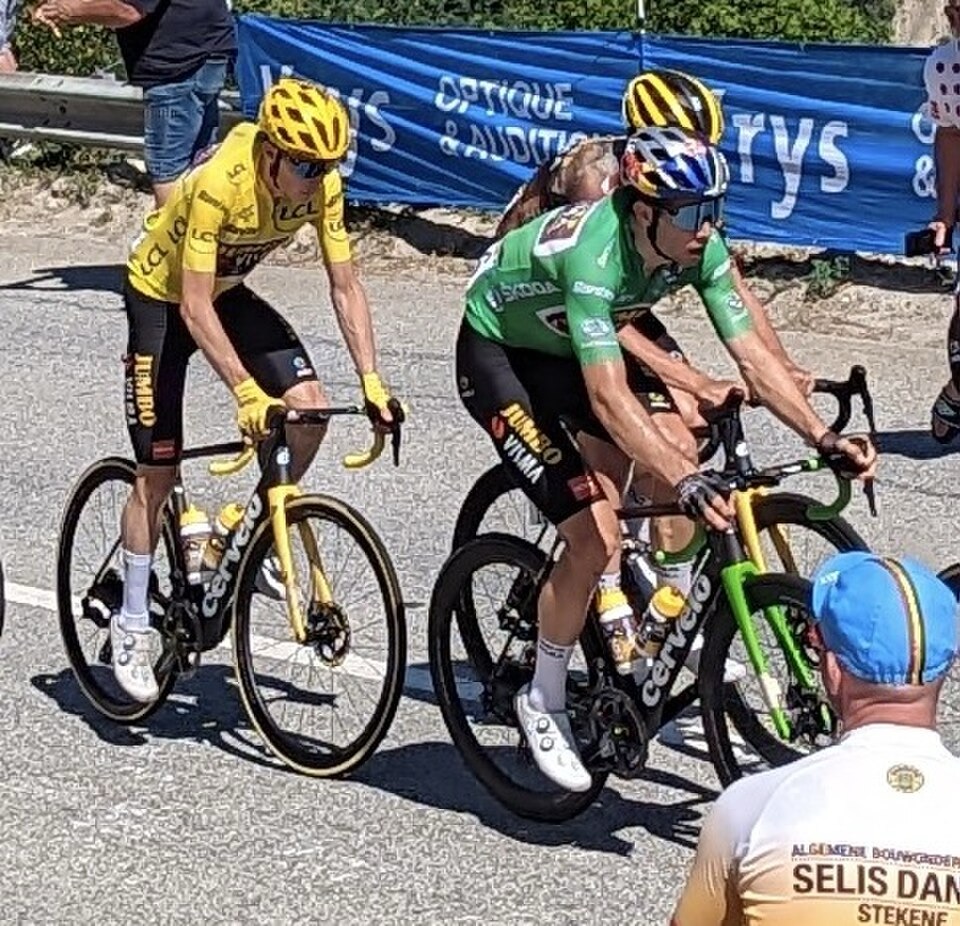
(Photo: Pierre_Bn / CC BY 2.0 / Source: Wikimedia Commons, File: Jonas Vingegaard and Wout van Aert (2022-07-14).jpeg)
During the 2022 Tour de France, Van Aert played a remarkable variety of roles. He won stages, wore the green jersey as leader of the points classification and contributed to the team’s campaign for Jonas Vingegaard’s overall victory. His performance on the Hautacam stage was particularly striking: after joining the day’s breakaway, he eventually helped apply pressure to Tadej Pogačar on the final climb before Vingegaard went on to win the stage.
Van Aert was not a conventional mountain domestique, yet his endurance, power and ability to perform across different terrain made him valuable far beyond the flat roads where a rider of his characteristics might traditionally be expected to excel.
Versatility is especially important when a team has only eight places available. A cyclist who can protect the leader on flat roads, contribute in the mountains and pursue an occasional stage opportunity may justify selection over a more narrowly specialised rider.
Building the Mountain Train
The mountain train is one of the clearest demonstrations of how different riders can combine their abilities in pursuit of a single objective.
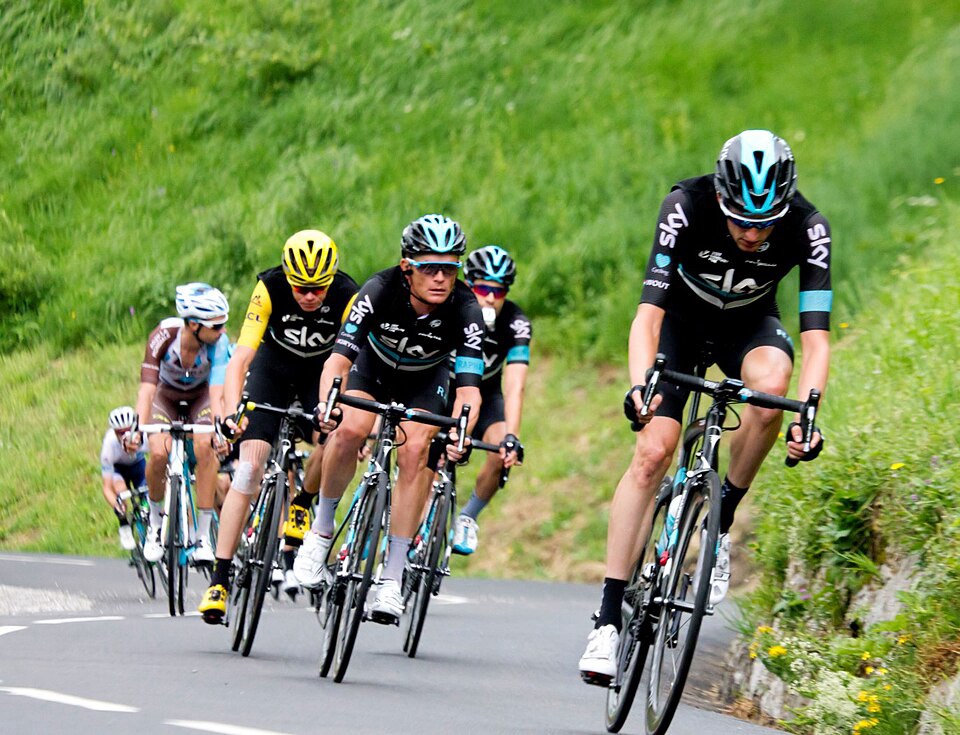
During the years when Team Sky, later Team Ineos, dominated the Tour de France, its carefully organised mountain formations became one of the most recognisable tactical features of the race. Chris Froome frequently approached decisive climbs surrounded by teammates capable of maintaining a demanding tempo. Riders such as Richie Porte, Wout Poels and Geraint Thomas performed important supporting roles during different periods of the team’s success.
(Photo: Filip Bossuyt / CC BY 2.0 / Source: Wikimedia Commons, File: Tour de France 2016, team sky (28595458045).jpg)
As the road tilted upwards, the responsibility passed progressively from one rider to another. A domestique set a hard tempo until reaching the limit of his effort, then moved aside. Another took over, maintaining pressure on the opposition while Froome remained sheltered within the shrinking group.
The arrangement demanded precise judgement. A pace that was too slow allowed rivals to attack repeatedly, while an excessive acceleration could isolate the team’s own leader. The objective was to establish a rhythm that suited the protected rider and made tactical experimentation increasingly expensive for the opposition.
Sky’s approach was often criticised for making mountain stages predictable, but its effectiveness came from the quality and coordination of the riders selected to execute it. Maintaining control deep into a major climb required more than a strong leader; it required teammates capable of riding at a level that many other professionals could not sustain.
The strongest mountain domestiques may be among the last riders remaining when the general-classification group has been reduced to its principal contenders. Their task can involve setting a demanding pace, responding to accelerations or remaining available if the leader encounters difficulty. Performing that work requires an elite climbing effort, even when the opportunity to turn it into an individual result belongs to somebody else.
The Sprinter and the Team Within the Team
A team built around a sprinter requires a different collection of abilities. Instead of preserving a general-classification contender for the final mountain, its objective may be to deliver one rider into the last few hundred metres of a flat stage with enough speed and energy to win.
The sprinter is often among the fastest athletes in the peloton over a short distance. Yet winning a sprint involves more than maximum speed. Positioning, timing, acceleration and the ability to navigate a crowded finish can determine whether a rider has an opportunity to compete.
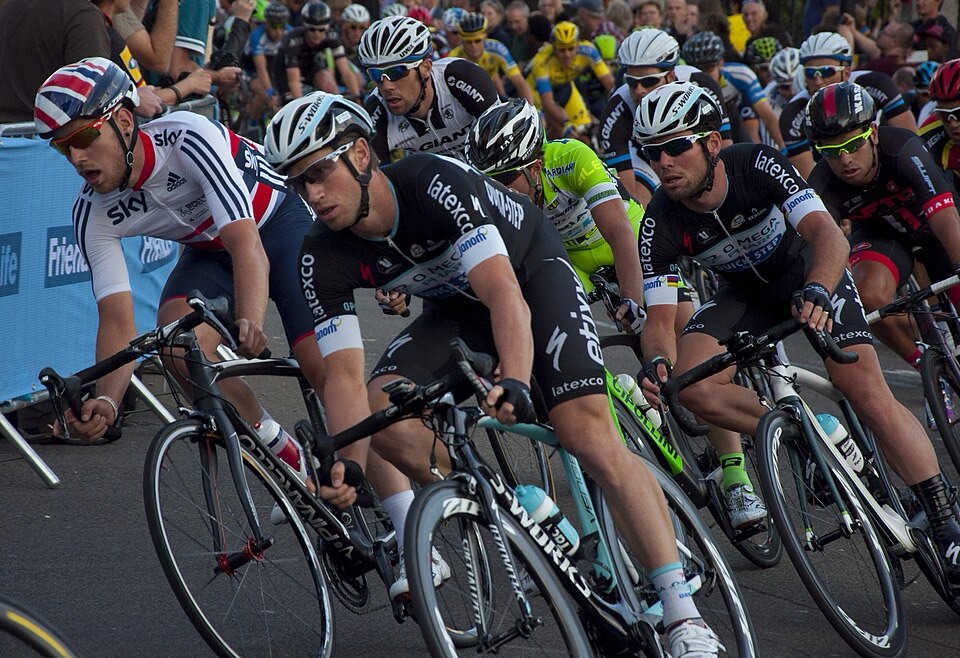
To create that opportunity, teams assemble lead-out trains: sequences of riders who progressively increase the pace towards the finish before moving aside as their efforts are exhausted.
The first members of the train may work several kilometres from the line, moving the sprinter towards the front and preventing rival teams from taking control. Other riders then sustain the speed as the road becomes increasingly crowded and the remaining distance decreases.
The final lead-out rider has one of the most specialised jobs in professional cycling. He must accelerate at the right moment, maintain enough speed to discourage rivals from overtaking and release his sprinter at a distance suited to that rider’s finishing ability.
(Source: Wikimedia Commons, File: Tour of Britain012 (15240451035).jpg)
Mark Renshaw’s partnership with Mark Cavendish provided one of the clearest examples of this relationship. During their years together at HTC-Columbia and its predecessor teams, Renshaw became renowned for delivering Cavendish into sprinting position. His ability to navigate the final kilometres and judge the timing of the lead-out was a major element of the team’s sprint strategy.
The partnership relied on familiarity as much as physical strength. A lead-out rider must understand when the sprinter wants to accelerate, how much speed can be maintained through corners and how to react when another team attempts to take control.
Launching too early can leave the sprinter exposed to the wind before the ideal moment. Waiting too long can allow rivals to move ahead or leave insufficient road to accelerate.
A team selecting riders for a sprint-focused Grand Tour therefore needs powerful rouleurs, experienced positioning specialists and at least one cyclist capable of performing the final lead-out. Those choices may come at the expense of additional mountain support.
A squad attempting to win both the general classification and multiple sprint stages faces a difficult compromise. Its GC leader needs climbers, while its sprinter requires riders who can chase breakaways and organise finishes. Eight places rarely allow an organisation to build two complete supporting groups.
The Breakaway Specialist: Winning Without a Leader
Not every professional team enters a Grand Tour with a realistic chance of winning the overall classification or dominating the bunch sprints. For smaller organisations, particularly ProTeams invited to major races, breakaways can provide both opportunities for victory and valuable exposure.
A breakaway specialist is a rider capable of recognising the right moment to attack, surviving long periods ahead of the peloton and judging how to distribute effort across difficult terrain. Physical strength matters, but so does tactical intelligence. Escaping too early can waste energy, while waiting too long may allow the decisive group to form without the rider.
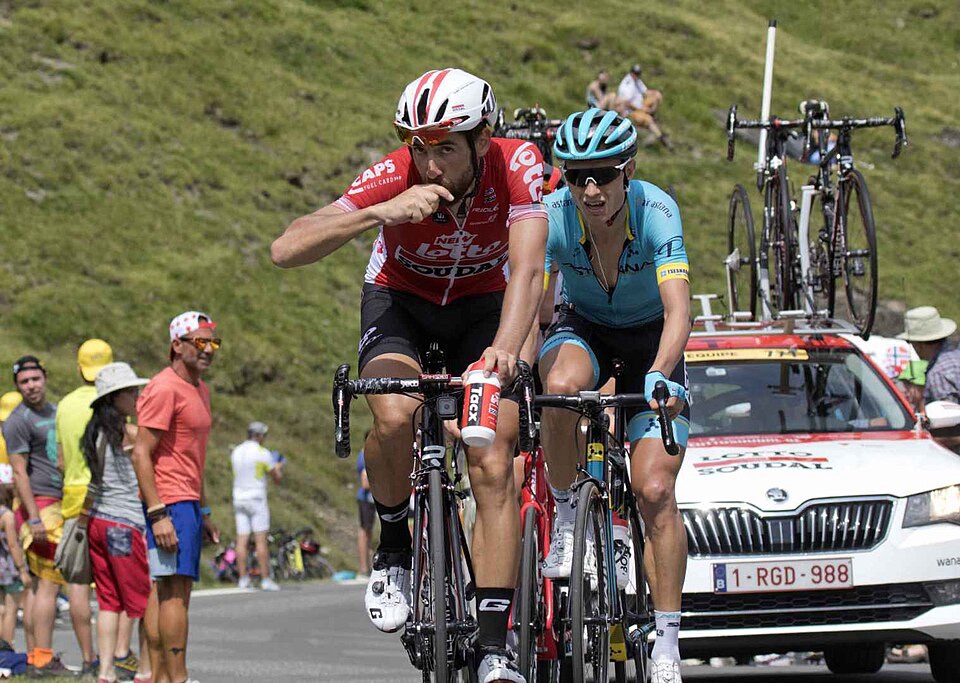
Thomas De Gendt became one of the best-known exponents of this approach. The Belgian repeatedly pursued victories from long-distance attacks, including his celebrated win on the Stelvio stage of the 2012 Giro d’Italia and his solo success at Saint-Étienne during the 2019 Tour de France.
(Source: Wikimedia Commons, File: TDF34808 de gendt (43769469151).jpg)
De Gendt’s victories were not simply the result of riding harder than everyone else. They depended on selecting stages where the peloton might hesitate, identifying suitable companions and understanding when to abandon cooperation and attack alone.
A team can deliberately select riders for this kind of racing. An aggressive climber may target mountain breakaways, while a powerful rouleur might be more effective on rolling terrain. A puncheur could concentrate on stages with short, steep climbs near the finish.
Breakaway riders can also perform tactical work for a general-classification leader. A teammate placed in an early escape may become useful later if the leader attacks and reaches the same section of road. The rider ahead can then provide pacing, supplies or assistance, transforming what initially appeared to be an independent move into part of a larger strategy.
Such tactics require careful planning and communication, because a rider in the breakaway must balance personal opportunities against the possibility that the team will need assistance later.
For organisations without a dominant leader, however, the freedom to attack can be central to their identity. A successful breakaway may produce a stage victory, a classification jersey or a day of television exposure that justifies the team’s presence in the race.
The Road Captain: Leadership Without the Spotlight
Not every important decision can be made from a team car. Professional races unfold across long stretches of road, often with the peloton moving through corners, climbs and narrow passages where circumstances change faster than instructions can be communicated.
The road captain is an experienced rider entrusted with helping organise the team during the race. The position does not necessarily belong to the strongest cyclist or the designated leader. It requires tactical judgement, communication and the confidence of teammates who must respond quickly to changing situations.
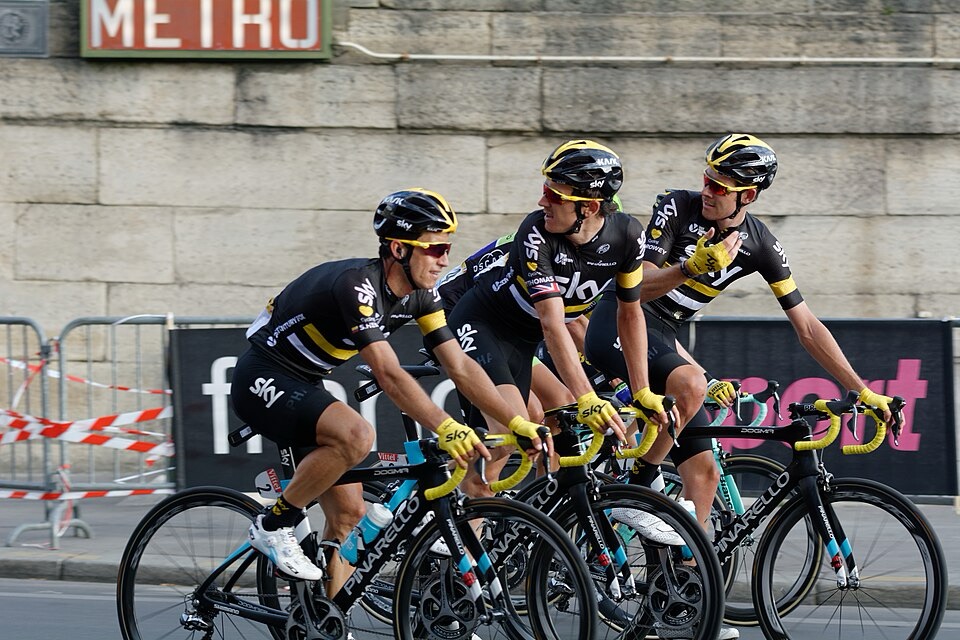
Luke Rowe became closely associated with this responsibility during his career at Sky and Ineos. A strong Classics rider with extensive experience on difficult northern European roads, Rowe developed a reputation for guiding teammates through positioning battles, crosswinds and the nervous approaches to decisive sections of a race.
(Source: Wikimedia Commons, File: Tour de France 2016 Stage 21 Paris Champs-Elysées (28516940206).jpg)
His value was particularly apparent during the opening week of a Grand Tour, when flat stages can be more dangerous to an overall contender than their profiles suggest. The peloton may travel at high speed through narrow roads, roundabouts and exposed countryside, with teams fighting constantly for position.
A road captain recognises when the group needs to move forward, when an attack is becoming dangerous or when teammates should conserve energy. The role involves understanding the behaviour of rival teams as well as communicating with one’s own riders.
The directeur sportif considers the broader strategy from the team car, using race information and radio communication to advise the squad. The road captain operates inside the peloton, where changes in speed, wind direction and positioning can be felt immediately.
The relationship between the two is collaborative. A tactical plan developed before the stage may require adjustment within seconds, and the road captain helps translate those changes into action.
Not every team formally appoints one rider to the position. Leadership responsibilities can be shared among experienced teammates, particularly when different riders are better suited to particular sections of a race.
When the Plan Falls Apart
The 1987 Giro d’Italia produced one of professional cycling’s most famous disputes over team leadership. Stephen Roche and Roberto Visentini were teammates at Carrera, but both had ambitions to win the race. Visentini was the defending champion, while Roche had arrived in strong form after winning the Tour de Romandie.
The team’s management had not established a permanently uncontested leader before the race. Both riders were allowed to compete, with the expectation that the road would eventually determine which deserved support.
Visentini took the pink jersey and appeared to be establishing control. But on the stage to Sappada, Roche rode away from the group containing his teammate, triggering a controversy that would dominate the remainder of the race.
Visentini considered the move a betrayal, believing Roche had attacked when he should have been supporting the race leader. Roche defended his actions and maintained that he had not deliberately undermined his teammate. Their disagreement became public, placing the Carrera organisation in an increasingly difficult position.
Roche ultimately won the Giro, while Visentini’s challenge collapsed. The Irishman went on to win the Tour de France and the world road championship later that year, completing one of cycling’s most extraordinary seasons.
The dispute exposed the fragile relationship between individual ambition and collective responsibility. Both riders had the ability to contend for victory, but their team had struggled to establish a hierarchy that both would accept.
A very different kind of leadership problem emerged during stage 17 of the 2023 Vuelta a España, on the brutally steep slopes of the Alto de l’Angliru. Kuss was wearing the red jersey, but his teammates Roglič and Vingegaard remained close enough in the general classification to threaten his lead.
As the race approached the summit, Roglič accelerated and Vingegaard followed, leaving Kuss struggling behind. The two riders gained time on their own teammate, even though all three belonged to the same team and occupied the leading positions in the overall standings.
Roglič won the stage, with Vingegaard finishing alongside him. Kuss arrived nineteen seconds later, his advantage over Vingegaard reduced to just eight seconds. The sight of two teammates riding away from their race leader created immediate questions about whether Jumbo-Visma intended to protect Kuss’s red jersey or allow all three riders to compete for victory.
The following day, the team publicly committed to supporting Kuss’s overall lead. He retained the red jersey through the remaining stages.
Eight Riders, One Result
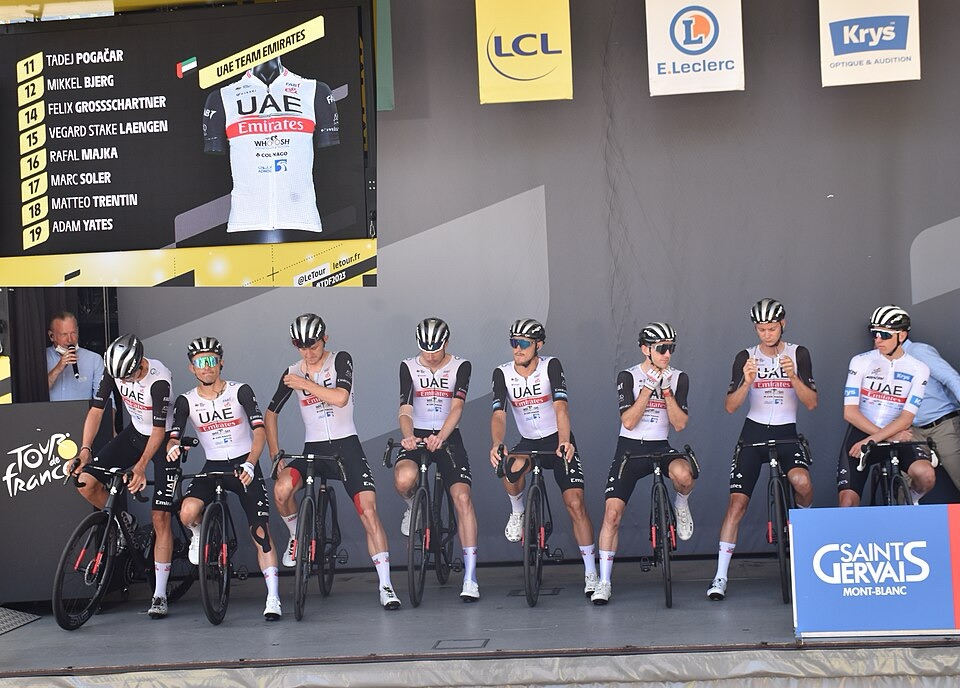
(Source: Wikimedia Commons, File: UAE Team Emirates – Tour de France 2023 D.jpg)
When a Tour de France winner stands on the podium in Paris, the result is recorded under one name. The general classification does not list the domestiques who protected the winner from crosswinds, the climbers who controlled the mountains or the road captain who guided the team through dangerous stages.
Their work remains largely invisible in the final standings, although each contribution may have prevented a loss that would otherwise have changed the outcome. A rider who surrendered a bicycle after a mechanical problem, controlled a breakaway for hours or delivered the leader safely to the foot of a climb may have played a decisive role without ever appearing near the front of the final classification.
The same principle applies to a sprint victory, where the final acceleration is often the product of several kilometres of coordinated work. The sprinter crosses the line first, but the opportunity has been created by teammates whose efforts ended before the finish.
A professional team is therefore not necessarily strongest when it selects its eight most accomplished individuals. A group containing several potential leaders may struggle if nobody is willing to control the peloton, protect teammates or sacrifice personal ambitions. A less celebrated lineup can be more effective when its riders possess complementary abilities and understand exactly what is expected of them.
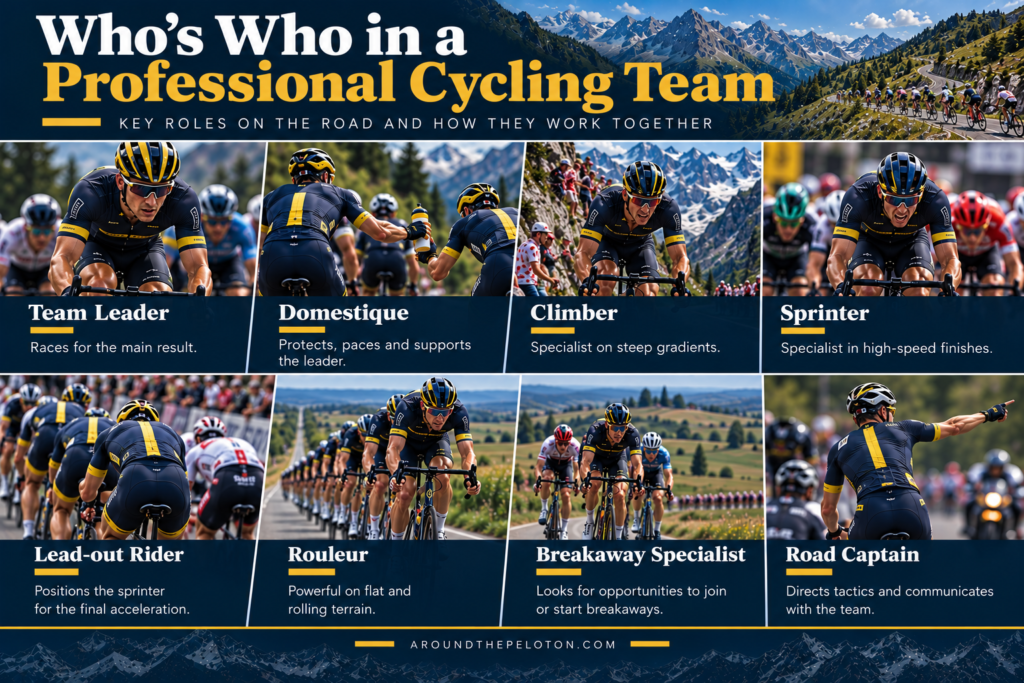
The riders selected for a Grand Tour must cover a remarkable range of responsibilities. Some will spend hours fighting the wind, others will control mountain passes or position a sprinter at sixty kilometres per hour. One may be entrusted with tactical decisions inside the peloton, while another is given the freedom to pursue a stage victory from a breakaway.
Their roles can change as the race develops. A designated leader may become a domestique, and a domestique may become the rider everyone else is asked to protect. Kuss’s victory at the 2023 Vuelta was an exceptional example, but the possibility of such a reversal is built into the structure of the sport.
When the eight riders line up together at the start, their matching jerseys conceal differences in ability, responsibility and ambition. Over the following three weeks, those differences determine how the team races, which opportunities it pursues and what each rider is prepared to surrender.
The winner may stand alone on the podium. The victory rarely belongs to that rider alone.
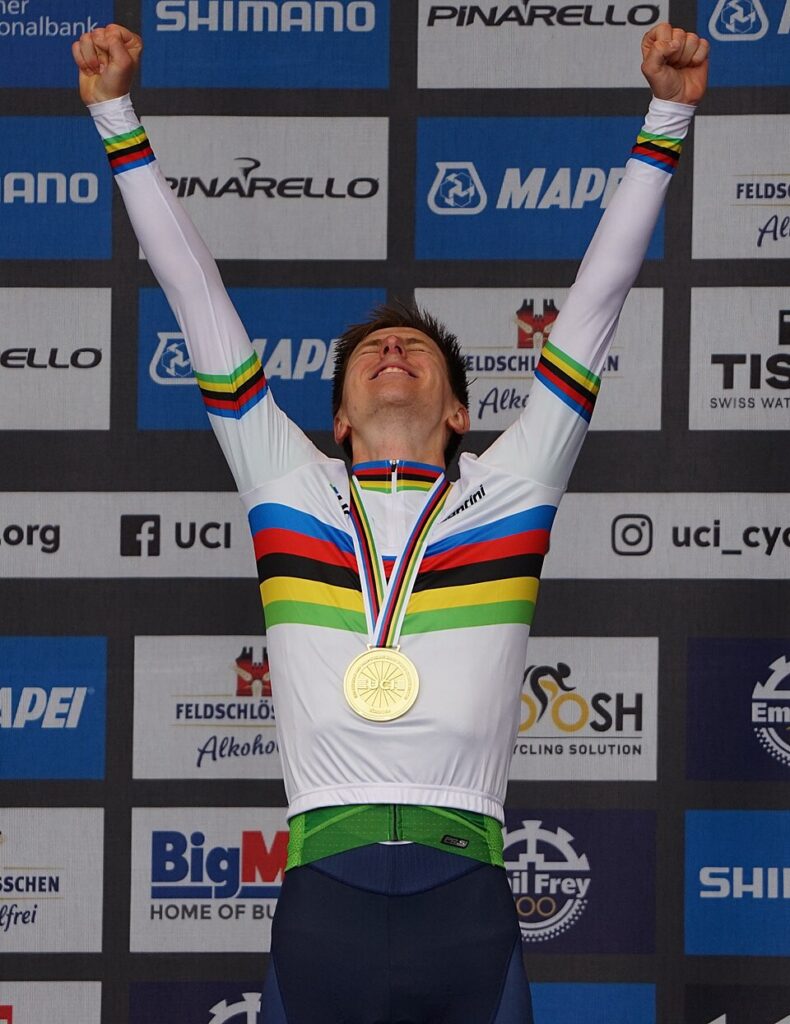
(Photo: Albinfo / CC BY-SA 4.0 / Source: Wikimedia Commons, File: Pogacar WCH2024.jpg)