
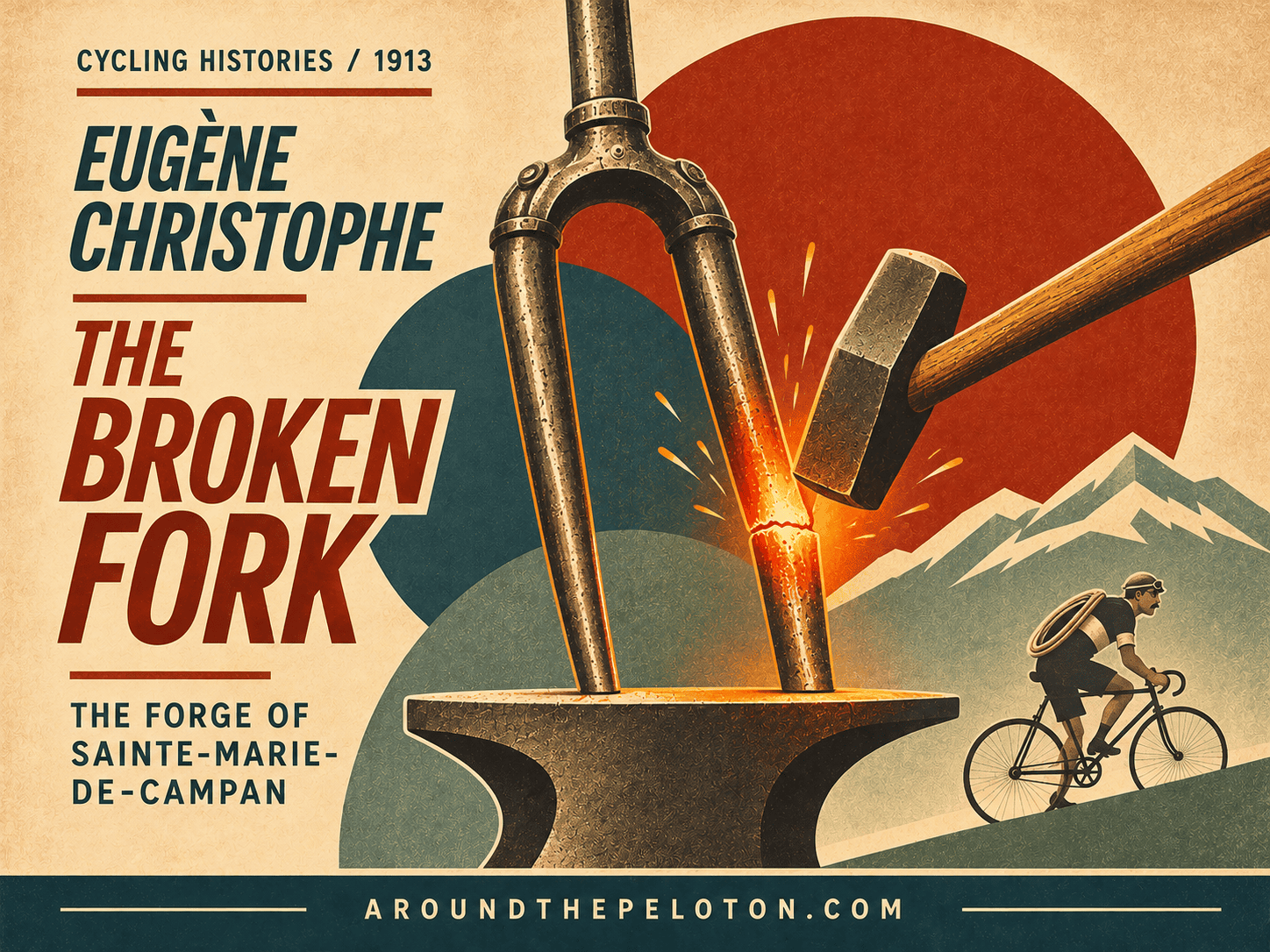

On 9 July 1913, a cyclist carrying a damaged bicycle appeared on the road descending from the Col du Tourmalet towards Sainte-Marie-de-Campan, a small village in the French Pyrenees. His name was Eugène Christophe, and only a few hours earlier he had been among the strongest riders in the Tour de France. He had crossed the high mountain passes in contention for overall victory, but a mechanical failure had forced him to abandon the saddle and continue on foot.
The village lay in the upper Adour valley, where the road from the Tourmalet descended towards the settlements of the Campan region. Christophe needed a workshop capable of repairing steel, and Sainte-Marie-de-Campan had one. Its blacksmith’s forge ordinarily served the practical needs of a mountain community, but that afternoon it would become the setting for an episode that entered the history of the Tour de France.

The difficulty was not simply finding someone who could repair the bicycle. Under the race regulations, Christophe was responsible for performing the work himself. The blacksmith could provide equipment and advice, but the cyclist would have to carry out the repair under the supervision of officials, while his rivals continued towards the stage finish in Luchon.
Sainte-Marie-de-Campan: A Village Beneath the Tourmalet
Sainte-Marie-de-Campan lies in the Hautes-Pyrénées department of southwestern France, within the commune of Campan. It occupies a position in the upper Adour valley, where roads connect the settlements below the Col du Tourmalet with the higher mountain landscape and neighbouring valleys.

The Adour rises in the surrounding Pyrenees, its upper branches draining the mountains before joining farther down the valley. From Sainte-Marie-de-Campan, the road climbs westward towards the Tourmalet, while routes through the Campan valley provide access to Bagnères-de-Bigorre and, by way of the Col d’Aspin, the Aure valley.
This geography made the village a practical stopping point long before cycling became part of its identity. Mountain roads connected farms, villages and markets, allowing people to transport agricultural produce, livestock and essential supplies. The same routes could become difficult during winter, when snow and adverse weather restricted movement across the higher passes.
The traditional economy of the valley depended heavily on agriculture and pastoral activities. Livestock were moved between lower settlements and mountain pastures, while local craftsmen maintained the equipment required for farming, transport and everyday life. In a community where machinery and tools could not always be replaced quickly, the ability to repair damaged metal objects was particularly valuable.
A blacksmith’s workshop belonged naturally to that environment. Farmers needed agricultural implements repaired, horses required shoeing, and carts depended on metal fittings that could wear or break. The forge was not a specialised bicycle workshop, but its equipment made it capable of handling the kind of steel repair that Christophe required.

The Tourmalet had first appeared in the Tour de France in 1910, only three years before Christophe’s accident. Rising to 2,115 metres above sea level, it had quickly become one of the most demanding roads in the race. The mountain’s rough surface, steep gradients and exposed conditions created challenges that went far beyond climbing ability alone.
For riders descending towards Sainte-Marie-de-Campan, the village represented a return from the high mountains to the inhabited valley. In Christophe’s case, it also offered the possibility of finding the tools needed to continue.
The 1913 Tour de France: Racing Without Mechanical Support
The Tour de France of 1913 covered approximately 5,300 kilometres in fifteen stages, with individual days regularly exceeding 300 kilometres. Riders competed over rough, frequently unpaved roads on heavy bicycles, carrying the responsibility for repairs themselves. There were no replacement machines waiting in team cars, and outside mechanical assistance could bring a penalty.

The sixth stage, from Bayonne to Luchon, took the riders across approximately 326 kilometres of the Pyrenees, including the Col d’Aubisque and the Col du Tourmalet. Introduced to the Tour only three years earlier, these mountain roads were still formidable territory for a race whose competitors already faced enormous distances and unreliable surfaces.
Eugène Christophe was well equipped for such conditions. An experienced road racer and cyclo-cross specialist, he had finished second in the 1912 Tour and entered the following edition as a genuine contender. On the road towards Luchon, he crossed the Aubisque among the leaders and remained at the front over the Tourmalet. With important rivals struggling in the mountains, he was moving into a position from which overall victory appeared possible. Then, on the descent towards Sainte-Marie-de-Campan, his front fork broke.
The Broken Fork and the Walk Down the Mountain
The fork is one of a bicycle’s essential structural components. It connects the front wheel to the steering assembly and supports the forces transmitted through the wheel while riding. A serious failure can make the bicycle impossible to steer safely, particularly on a steep mountain descent.
Christophe’s fork was damaged badly enough to prevent him from continuing. The exact cause has been described differently in historical accounts. Some refer to a collision with a vehicle, while others suggest an impact with a stone or a failure of the component itself. The surviving narratives do not establish a single uncontested explanation.

With no replacement bicycle available, Christophe removed the front wheel, lifted the damaged machine and began walking down the mountain.
Accounts differ over the precise distance, generally placing the walk between approximately ten and fourteen kilometres. The descent was difficult enough on a functioning bicycle, and Christophe was now carrying a heavy steel machine after hours of racing across the Pyrenees.
As he made his way towards the valley, riders he had already beaten on the climbs began passing him. His advantage disappeared, and the possibility of winning the Tour became increasingly remote. The mechanical failure was costing him time that could not be recovered through stronger riding alone.
Christophe later recalled the frustration of watching his rivals continue while he struggled down the mountain road. The surface was rough, and the damaged bicycle was awkward to carry. Reaching Sainte-Marie-de-Campan would at least give him a chance to find assistance, although he still had no certainty that the fork could be repaired.
When he finally arrived in the village, he was directed towards the local blacksmith’s workshop.
Inside the Forge: Repairing the Bicycle
A traditional blacksmith’s workshop was organised around a hearth, where metal could be heated until it became workable. Bellows supplied additional air to the fire, allowing it to reach temperatures suitable for shaping iron and steel. An anvil provided a solid surface for hammering, while tongs, hammers, drills and other tools allowed the craftsman to manipulate damaged objects.

These were the facilities available to Christophe. His broken fork could not be restored by tightening a loose fitting or replacing a simple component. It required work on the damaged steel, using equipment normally employed for agricultural implements, horseshoes and other practical objects.
The blacksmith could explain what needed to be done, but the Tour’s regulations prevented him from performing the repair. Race officials remained present to ensure that Christophe complied with the prohibition on outside assistance.
The situation was unusual even by the demanding standards of the early Tour. Christophe had spent hours racing across the mountains, carried his bicycle down a long descent and now had to work with metalworking tools in an unfamiliar workshop. The experienced craftsman possessed the equipment and technical knowledge, but the exhausted cyclist was responsible for carrying out the physical work.
The exact repair method is not fully documented. Some historical accounts describe heating and joining the damaged sections, while others refer to drilling holes and securing the broken parts together. What is consistent is that Christophe had to restore the fork sufficiently to support the front wheel and withstand the remaining journey.
The work took hours. Estimates vary, with some accounts describing approximately three hours inside the forge and others placing the total repair time closer to four. During that period, the leading riders continued across the Pyrenees, extending the gap between Christophe and the front of the race.
The repaired fork was not a replacement supplied by a manufacturer. It was the original damaged component made usable again through improvised workshop repairs, completed under the supervision of officials who were determined to enforce the regulations.
The Assistance Penalty
The repair produced one final complication, almost absurd in comparison with everything Christophe had already endured.
According to the traditional account, a young local assistant helped operate the forge’s bellows while Christophe worked on the damaged fork. The bellows forced air into the fire, maintaining the heat needed for metalworking. The boy was not replacing the fork, handling the bicycle or performing the repair himself. He was helping keep the fire burning.
For the Tour officials, however, that was sufficient. They considered the assistance a breach of the regulations and imposed a ten-minute penalty, subsequently reduced to three minutes.

Some historical accounts describe the infringement differently, referring to assistance with drilling rather than operating the bellows. The precise action remains disputed, but the penalty itself is an established part of the episode.
Christophe had carried his bicycle down the Tourmalet, found a village workshop and spent hours repairing the damaged steel under official supervision. The regulations had been followed closely enough that officials could watch him struggle through the work, yet not closely enough to prevent a few minutes of outside help from becoming a punishable offence.
The reduction from ten minutes to three offered little consolation. By then, the leaders were hours farther along the road, and Christophe’s opportunity to win the Tour had effectively disappeared.
Returning to the Road
Once the repair was completed, Christophe reassembled his bicycle and left the workshop. The fork was sufficiently functional for him to resume the stage, although the leaders had travelled far beyond Sainte-Marie-de-Campan.He continued towards Luchon, where Philippe Thys won the stage. Christophe finished several hours behind the Belgian, having lost the advantage he had established in the mountains.
The setback changed the course of his Tour. Christophe had been a serious contender, but the time lost walking and repairing his bicycle was too costly to overcome. He nevertheless continued through the remaining stages and reached Paris, finishing seventh in the final classification. Thys went on to win the Tour de France, the first of his three overall victories.
The decision to continue gave the forge incident much of its lasting significance. Christophe had fulfilled the demands imposed by the regulations and restored his bicycle to working condition, but the repair could not recover the hours that had disappeared while the race continued without him.
Eugène Christophe: The Rider Behind the Story
Eugène Christophe was born in Paris on 22 January 1885 and became one of the leading French cyclists of the early twentieth century. Known as Le Vieux Gaulois, or the Old Gaul, he was recognised for his distinctive moustache, physical resilience and ability to compete over difficult terrain.
He had already achieved considerable success before the 1913 Tour. Christophe was an accomplished cyclo-cross rider, winning multiple French championships, and had established himself in major road competitions. In 1910, he won Milan–San Remo, demonstrating his ability to succeed in one of the sport’s most demanding one-day races.

His versatility made him particularly well suited to the early Tour de France, where poor roads, long distances and mechanical difficulties demanded more than climbing ability or speed. He had finished second in the 1912 Tour, although that edition was decided by a points classification rather than the cumulative-time system used in 1913.
The broken fork therefore interrupted the race of an established contender, not an obscure competitor who became famous through a single incident.
The Yellow Jersey and Two More Broken Forks
Christophe’s relationship with mechanical misfortune did not end in Sainte-Marie-de-Campan. In 1919, when the Tour returned after the First World War, he became the first rider officially recognised as wearing the yellow jersey. Introduced to distinguish the race leader from the rest of the field, the maillot jaune would become one of cycling’s most recognisable symbols.
Christophe was again in contention for overall victory when his front fork broke near Valenciennes during the penultimate stage. The repair cost him more than two hours and ended his hopes of winning the Tour. He eventually finished third, while Firmin Lambot took the overall victory.

In 1922, Christophe suffered another fork failure during the Tour, this time in the Alps. The circumstances differed from those of 1913, but the recurrence reinforced the association between his career and extraordinary mechanical setbacks.
Three Tours, in 1913, 1919 and 1922, had produced the same type of failure. Christophe never won the Tour de France, despite repeatedly demonstrating the strength and endurance needed to compete for victory.
The Forge as a Place of Cycling Memory
The workshop in Sainte-Marie-de-Campan acquired historical significance because of an event that lasted only a few hours. Its original function was practical and local, serving the needs of a mountain community. After 1913, it also became associated with one of the most frequently retold stories in Tour de France history.
Christophe returned to Sainte-Marie-de-Campan in June 1951 for a commemoration of the incident, reenacting the repair that had taken place nearly four decades earlier. Photographic records preserved by the departmental archives of the Hautes-Pyrénées document the occasion, showing the former rider revisiting the village and recalling the events of 1913.
The historical record also identifies people connected with the commemoration, including Marie Despiau, who had helped guide Christophe to the forge during the original incident. These details demonstrate how the story remained part of local memory long after the race itself.
A commemorative plaque was installed at the former forge in 1965, while a statue of Christophe in Sainte-Marie-de-Campan provides another visible reminder of the episode. The village has consequently become a place of interest for cyclists travelling through the Campan valley and over the Tourmalet.
The original workshop has undergone changes over time, and its history should not be confused with a preserved museum interior. Its importance lies in the documented association between the building, the village and Christophe’s repair.
For visitors, Sainte-Marie-de-Campan offers a different kind of cycling landmark from a mountain summit or a famous finish line. The story belongs to a workshop in a settled valley, where a practical repair became an episode of international sporting history.
The Road, the Village and the Broken Fork
The Col du Tourmalet has become one of professional cycling’s most celebrated mountains, its reputation built through more than a century of racing. Riders still cross the pass, and amateur cyclists travel to the Pyrenees to experience its climbs and descents, although the roads, bicycles and conditions have changed enormously since 1913.
Sainte-Marie-de-Campan occupies a quieter place in that history. It is remembered not for a stage victory or a decisive attack, but for the arrival of a rider carrying a bicycle he could no longer use. Christophe’s chance of continuing depended on a village blacksmith’s equipment and the practical knowledge of a trade that had served mountain communities for generations.

That encounter between professional cycling and rural craftsmanship is what makes the forge more than a curiosity from the Tour’s early years. Christophe was competing in one of the world’s most demanding sporting events, yet his race could continue only because an ordinary workshop possessed the tools needed to repair his machine.
The road still descends from the Tourmalet into the upper Adour valley, passing through the landscape where Christophe walked with his broken bicycle. In Sainte-Marie-de-Campan, the memory of that July afternoon remains attached to a village forge, a place where the history of the Tour de France was shaped not by a victory, but by the determination to return to the road.
Images Credits
01. Sainte-Marie-de-Campan, French Pyrenees. Photograph by Paul Hermans (2019), sourced from Wikimedia Commons, licensed under the Creative Commons Attribution-ShareAlike 4.0 International license (CC BY-SA 4.0).
02. Start of the 1913 Tour de France. Photograph by Agence Rol (29 June 1913), preserved in the Bibliothèque nationale de France’s Gallica collection, sourced from Wikimedia Commons, identified as Public Domain under the Creative Commons Public Domain Mark 1.0 (PDM 1.0).
03. Eugène Christophe, French Cyclocross Champion (1911). Photograph by Agence Rol (19 March 1911), preserved in the Bibliothèque nationale de France’s Gallica collection, sourced from Wikimedia Commons, identified as Public Domain under the Creative Commons Public Domain Mark 1.0 (PDM 1.0).
04. Eugène Christophe, Paris–Roubaix (1908). Photograph by Agence Rol (19 April 1908), preserved in the Bibliothèque nationale de France’s Gallica collection, sourced from Wikimedia Commons, identified as Public Domain under the applicable French and United States copyright provisions
05. Eugène Christophe’s Bicycle Fork, 1919. Historical collection photograph (photographer uncredited), Musée National du Sport, preserved and digitised by the Bibliothèque nationale de France, sourced from Wikimedia Commons, identified as Public Domain under French and United States copyright law, without a Creative Commons license.
06. Col du Tourmalet, eastern side. Photograph by Anthospace (2021), sourced from Wikimedia Commons, licensed under the Creative Commons Attribution-Share Alike 4.0 International license (CC BY-SA 4.0).
07. Eugène Christophe’s 1913 Tour de France Race Number. Historical artefact (1913), creator uncredited, from the Musée National du Sport collection (MS 949), digitised by the Bibliothèque nationale de France, sourced from Wikimedia Commons, identified as Public Domain under French and United States copyright law.
08. Tribute to Eugène Christophe, Campan. Photograph by Renhour48 (2025), sourced from Wikimedia Commons, released under the Creative Commons CC0 1.0 Universal Public Domain Dedication (CC0 1.0)
09. Eugène Christophe, Col d’Aubisque (1922). Photograph by Agence Rol (5 July 1922), preserved in the Bibliothèque nationale de France’s Gallica collection, sourced from Wikimedia Commons, identified as Public Domain under the Creative Commons Public Domain Mark 1.0 (PDM 1.0).
10. Eugène Christophe, 1912 Tour de France. Photograph by Agence Rol (28 July 1912), preserved in the Bibliothèque nationale de France’s Gallica collection, sourced from Wikimedia Commons, identified as Public Domain under French and United States copyright law