
Sunday, 8 November 2026 | Singapore | 2.45 km circuit | 25 laps expected | Approximately 61.25 km | Professional race: 4:30 pm
Singapore has spent more than two centuries transforming the shoreline around its historic centre. What began as a trading settlement beside a river became one of Asia’s busiest ports, a colonial administrative centre and eventually the financial capital of an independent city-state. Warehouses gave way to offices, reclaimed land pushed the coastline outward, and roads originally built to serve commerce became part of a carefully planned urban landscape.
On Sunday, 8 November 2026, those roads will host the fifth Tour de France Singapore Criterium, now carrying the title sponsorship of EFGH. The professional race will bring internationally recognised riders to a compact circuit around the Padang, the Singapore River and Marina Bay, with 25 laps expected to produce approximately 61.25 kilometres of racing.

The event is not a stage of the Tour de France but an international criterium associated with the French Grand Tour. Its appeal is different from that of a conventional road race. There are no mountain passes or journeys between towns, only a repeated contest of acceleration, positioning and timing on streets surrounded by landmarks representing different periods of Singapore’s history.
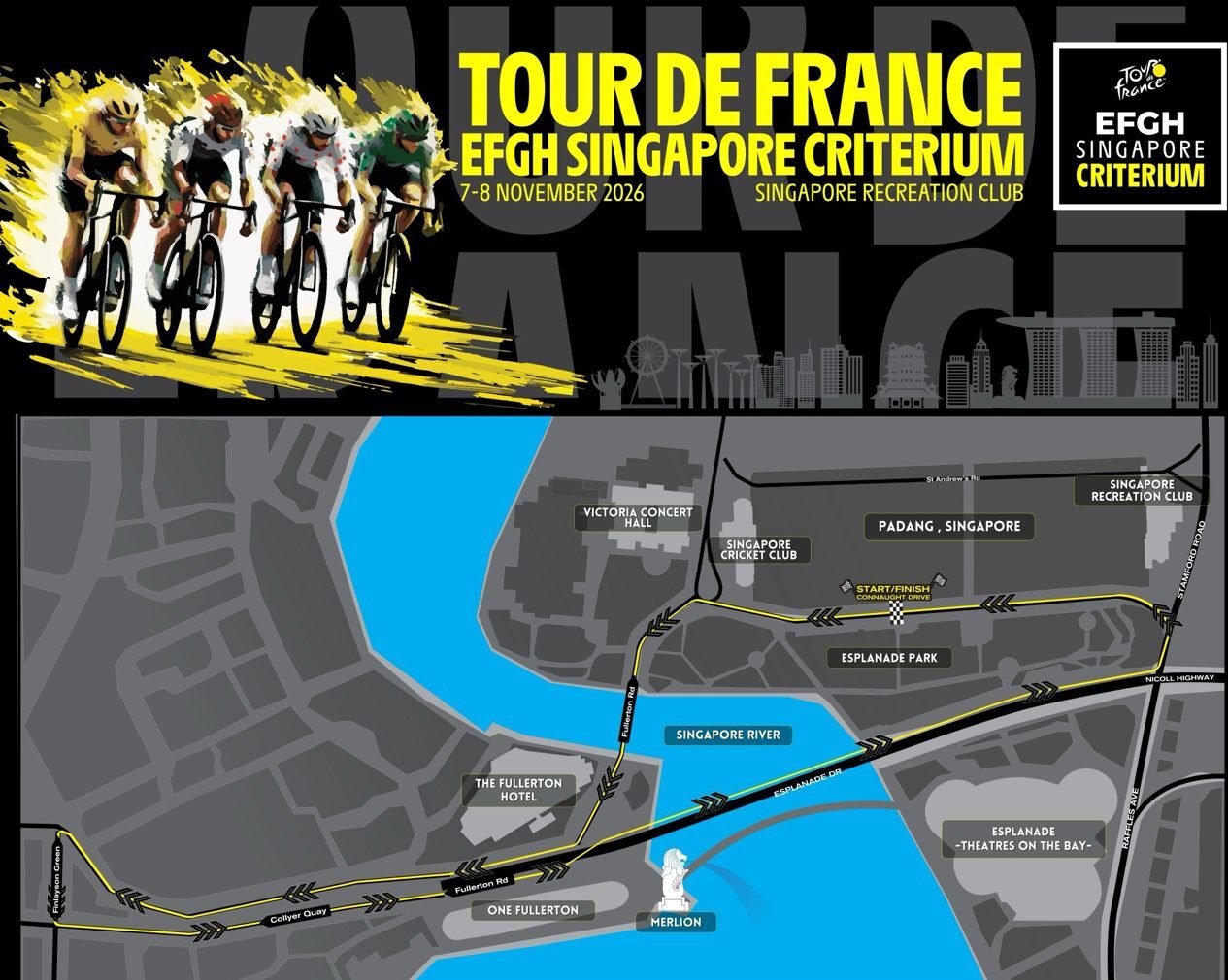
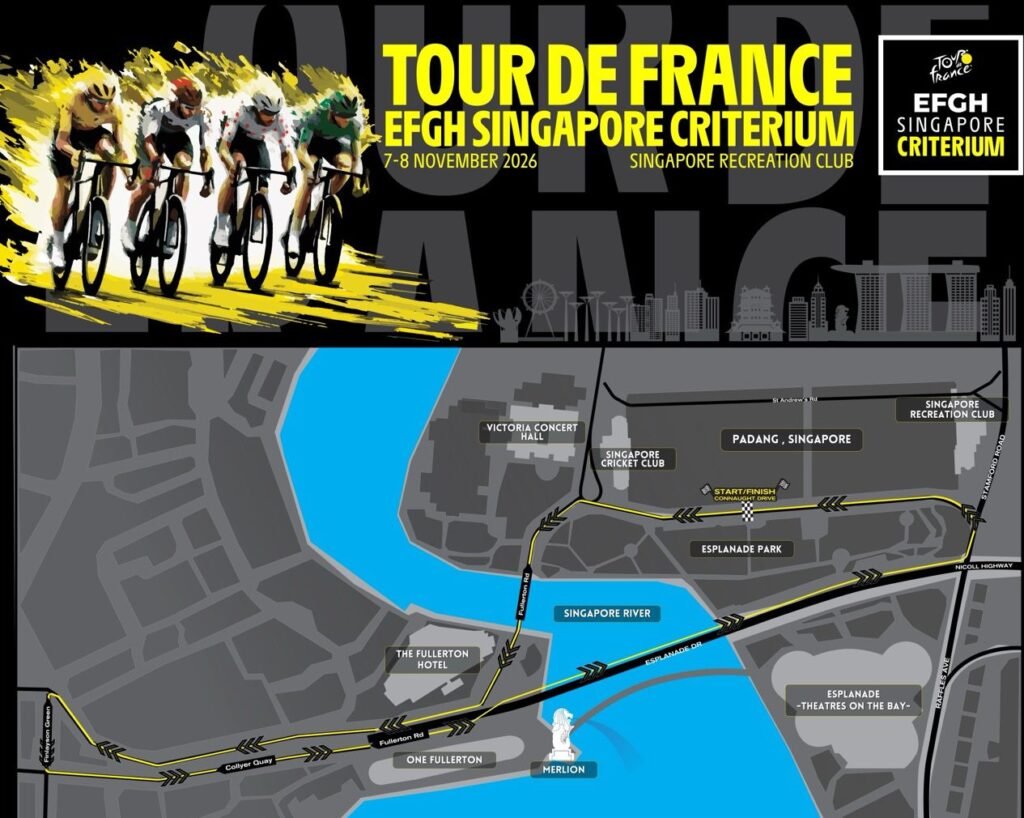
The 2026 course incorporates the waterfront roads around Collyer Quay and Finlayson Green, with the start and finish on Connaught Drive beside the Singapore Recreation Club. The circuit connects the historic civic centre with the former commercial waterfront and modern Marina Bay, offering a compact journey through the city’s geography without the long distances associated with traditional road racing.
The 2026 Circuit: One Lap Through Singapore’s Historic Centre
Connaught Drive and the Padang: Where Sport Became National History

The professional race begins and ends on Connaught Drive, beside the Singapore Recreation Club and the Padang. This broad green field, surrounded by some of the country’s most significant civic buildings, has been associated with organised sport and public ceremony since the nineteenth century.
Cricket, football and other activities became established here as Singapore developed into a British colonial trading settlement. The Singapore Cricket Club, founded in 1852, and the Singapore Recreation Club, established in 1883, came to occupy opposite sides of the field. Their histories reflect a colonial society in which sporting institutions often followed distinctions of class and ethnicity. The Recreation Club was particularly associated with Singapore’s Eurasian community, while the Cricket Club emerged within the social world of British colonial residents.
The Padang eventually acquired a significance far beyond recreation. It became associated with political ceremonies and public gatherings, including celebrations of Singapore’s achievement of self-government in 1959 and independence in 1965. Its designation as a National Monument in 2022 recognised the importance of this open ground to the country’s collective memory.
For the criterium, Connaught Drive is the point toward which every tactical decision leads. Riders must negotiate the circuit’s changes of direction while preserving enough speed and position for the final sprint beside a field where Singapore’s sporting traditions and national history have repeatedly intersected.
Victoria Theatre and Anderson Bridge: A Civic Centre Beside a Working Port
Near the Padang stands Victoria Theatre and Victoria Concert Hall, a complex whose history reflects Singapore’s changing public institutions. The original Town Hall was completed in 1862, providing space for civic administration and public gatherings in a settlement whose population and commercial importance were expanding rapidly.

The adjoining Victoria Memorial Hall was added in the early twentieth century, with a clock tower linking the two structures. Over time, the complex became associated with theatrical performances, concerts and other cultural events, transforming buildings originally connected with colonial civic life into important venues for the independent city’s performing arts.
The story is not simply one of architectural preservation. The complex illustrates how Singapore inherited institutions and buildings from the colonial period but gradually gave them different functions and meanings. A town hall that once served the administration of a British settlement became part of a cultural landscape used by a much broader public.

Nearby Anderson Bridge, opened in 1910, was built to improve connections across the Singapore River as traffic increased around the commercial centre. Its steel structure and decorative details belong to an era when the port’s expansion demanded more substantial urban infrastructure.
The bridge forms one of the circuit’s distinctive geographical features. Riders cross a waterway that once carried much of Singapore’s commercial traffic, moving from the historic civic district toward streets associated with shipping, administration and finance.
The Singapore River: The Waterway That Built a Port

The Singapore River is relatively short, but its historical importance is enormous. When Stamford Raffles established a British trading post in 1819, the sheltered river mouth provided a practical location for warehouses, vessels and commercial activity. The settlement expanded as traders arrived from China, India, the Malay world and other parts of Southeast Asia.
For much of the nineteenth and early twentieth centuries, the river was crowded with boats transporting merchandise between larger ships and riverside warehouses. Bumboats became a familiar feature of the waterfront, while merchants, labourers and traders worked in streets that connected the port with the growing settlement.

The river was also a place of cultural encounter. Different communities participated in Singapore’s commercial development, bringing languages, religious traditions and business practices that helped shape the city’s diverse population. Their economic opportunities were unequal, however, reflecting the social hierarchies of colonial society.
By the twentieth century, intensive commercial activity had contributed to serious pollution. In 1977, the government launched a major programme to clean up the Singapore River and Kallang Basin, relocating or reorganising polluting activities and improving infrastructure over the following decade.
The cleanup helped transform the waterfront. Former warehouses acquired new commercial and leisure functions, public promenades replaced parts of the working riverfront, and the waterway became a central feature of the modern city.

The criterium’s river crossings connect this history with the surrounding districts that emerged through Singapore’s later urban development. The boats and cargo that once defined the waterway have largely disappeared, but the river remains the geographical centre around which much of the historic city is organised.
Fullerton Road: The Building That Connected Singapore to the World
Beyond Anderson Bridge, the circuit reaches Fullerton Road, close to one of Singapore’s most prominent colonial buildings. Completed in 1928, the Fullerton Building housed the General Post Office and other government departments, occupying a commanding position near the mouth of the Singapore River.
Its neoclassical architecture, monumental columns and formal proportions reflected the authority of British administration. Yet the building’s significance extended beyond its appearance. The General Post Office was an essential part of the communications network that sustained Singapore’s international commercial relationships.

Before electronic communication transformed business, letters and postal documents carried shipping instructions, contracts, financial information and personal correspondence between Singapore and destinations across the world. The work performed inside the building was closely connected to the activity of the port outside it.
A merchant arranging the shipment of goods, a shipping company communicating with an overseas office or a family corresponding across continents all depended on systems of communication that passed through institutions such as the General Post Office.
The building was later converted into the Fullerton Hotel, opening in 2001 after an extensive restoration. Its new function preserved an important architectural landmark while replacing its former administrative role with one connected to hospitality and international tourism.
The transformation is particularly striking because the building’s location remains central to Singapore’s international identity. Where postal workers once handled correspondence from across the world, visitors now arrive at a hotel occupying one of the city’s most recognisable historic addresses.
Collyer Quay and Finlayson Green: The Circuit’s Defining Turn
The extension into the commercial district around Collyer Quay and Finlayson Green is one of the most distinctive features of the current Singapore Criterium circuit.

Collyer Quay developed during the nineteenth century as Singapore’s port expanded. Named after George Collyer, an engineer associated with the colonial administration, it became an important address for shipping companies, merchants and financial institutions.
The original waterfront lay much closer to the road than it does today. Successive reclamation projects altered the shoreline, creating space for larger commercial buildings and separating parts of the historic quay from the open bay. The names of the surrounding streets still recall the maritime economy upon which Singapore’s prosperity was built.
Finlayson Green lies within this historic business district. The circuit incorporates a U-turn around the area, creating a technical feature that distinguishes the lap from a simple succession of fast waterfront roads.

A U-turn forces the peloton to reduce speed sharply before accelerating again, producing a concertina effect that becomes more pronounced farther back in the group. Riders who enter near the front can accelerate into clearer road, while those behind may spend additional energy closing gaps.
This matters particularly during the final laps, when teams begin organising their sprinters. Losing position at the turn can leave a rider too far behind the leaders, while entering it well placed may provide an advantage on the return toward the waterfront.
The turn therefore adds more than a change of direction. It creates a recognisable point of tactical pressure within a compact urban race, where small losses of momentum can accumulate over repeated laps.
The Merlion: A National Symbol That Had to Be Moved
Near the historic river mouth stands the Merlion, the statue combining the head of a lion with the body of a fish. Although it has become one of Singapore’s most recognisable symbols, its origins are relatively recent.
The fish represents the island’s maritime heritage and its association with Temasek, while the lion refers to the legend of Sang Nila Utama, the prince traditionally connected with the naming of Singapura, or Lion City.

The Merlion was developed as a tourism symbol in the 1960s, during the early years of independence. The original statue, created by sculptor Lim Nang Seng, was unveiled by Prime Minister Lee Kuan Yew on 15 September 1972.
Its later history contains an unexpected episode of urban engineering. When Esplanade Bridge was completed in 1997, the new structure obstructed views of the Merlion from the waterfront. A bridge intended to improve traffic connections had unintentionally diminished the visibility of one of Singapore’s best-known national symbols.
In 2002, the 70-tonne statue was moved approximately 120 metres to its present location near One Fullerton. The operation required barges and enormous cranes, with the sculpture lifted over Esplanade Bridge because it could not pass beneath the structure as originally planned.
The relocation preserved the Merlion’s relationship with the historic river mouth while giving it an unobstructed position overlooking Marina Bay. It also illustrates the practical challenges of maintaining familiar landmarks in a city whose infrastructure and shoreline have changed so extensively.
The Merlion stands beside the racing corridor rather than on the course itself, but its story belongs to the same waterfront geography that shapes the criterium.
Esplanade Bridge and Marina Bay: The City Beyond the Old Shoreline
The circuit’s waterfront section takes the riders toward Esplanade Drive and Marina Bay, where the city’s modern architecture contrasts with the colonial buildings encountered earlier in the lap.
Esplanade Bridge opened in 1997, providing an important road connection across the river mouth as the surrounding area developed. Its broad roadway belongs to a different period of urban planning from Anderson Bridge, reflecting the needs of a modern commercial centre rather than those of an early twentieth-century port.

Marina Bay’s development has depended heavily on land reclamation. New land created space for financial towers, public promenades, cultural buildings and major architectural projects, extending the city beyond parts of its original shoreline.
Marina Bay Sands, opened in 2010, is among the most recognisable results of this transformation. Its three towers and connecting rooftop structure have become part of Singapore’s international image, rising above an area that was once open water.
The building forms part of the wider skyline rather than the racecourse itself. Its presence nevertheless helps explain why the waterfront looks so different from the landscape that surrounded the Singapore River during the colonial period.

For the criterium, the broader roads provide opportunities to regain speed after the tighter changes of direction around the commercial district. Their influence will depend on the final barrier layout, road conditions and how the riders approach the remaining corners.
Esplanade Park: Lim Bo Seng and the Memory of Occupation
Esplanade Park preserves a different chapter of Singapore’s history. Among its memorials are the Cenotaph, commemorating those who died in the world wars, and the Lim Bo Seng Memorial, dedicated to one of Singapore’s best-known resistance figures during the Japanese occupation.
Japanese forces captured Singapore in February 1942, ending the British defence of the island and beginning an occupation that lasted until 1945. The defeat undermined assumptions about British imperial power and left a lasting mark on the political and social history of Southeast Asia.

Lim Bo Seng had been a businessman and prominent member of Singapore’s Chinese community before becoming involved in resistance against Japan. After leaving Singapore, he trained in intelligence work in India and became associated with Force 136, a clandestine unit that gathered information and supported operations behind Japanese lines in occupied Malaya.
He returned to Malaya to help establish an intelligence network, but the operation was compromised. Following betrayal and the capture of other agents, Lim was arrested in March 1944 and imprisoned at Batu Gajah in Perak.
Japanese military police subjected him to starvation and torture in an attempt to obtain information about the resistance network. He refused to betray his comrades and died in captivity on 29 June 1944, aged 35.
After the war, his remains were returned to Singapore, where he received a ceremonial funeral before burial at MacRitchie Reservoir. The memorial in Esplanade Park was unveiled on 29 June 1954, preserving his story within the public landscape of a city that had experienced occupation, liberation and the gradual movement toward independence.

His memorial is particularly significant because it places an individual life within a much larger historical event. The Japanese occupation is often described through military campaigns and political consequences, but Lim’s story reveals the personal sacrifices involved in clandestine resistance and the difficult choices faced by those who opposed the occupation.
Nearby stands Esplanade, Theatres on the Bay, which opened in 2002 as a major performing arts centre. Its two domed structures are covered with angular sunshades designed for Singapore’s tropical climate, creating an exterior frequently compared to the spiky surface of a durian.
The complex provides spaces for music, theatre, dance and other performances, reflecting Singapore’s investment in cultural institutions. Its proximity to the wartime memorials brings different expressions of public memory and cultural identity into the same waterfront district.
From the Esplanade area, the circuit returns toward the Padang and Connaught Drive, completing a lap through the historic civic centre, the former commercial waterfront and the modern landscape of Marina Bay.
Twenty-Five Laps: How the Singapore Circuit Will Race
The professional criterium is expected to cover 25 laps of the 2.45-kilometre circuit, producing a calculated distance of approximately 61.25 kilometres. The final professional race distance remains subject to confirmation.
The circuit’s defining characteristics are its river crossings, the waterfront roads around Collyer Quay, the Finlayson Green U-turn and the return to the Connaught Drive finish.
Unlike a conventional road race, where terrain and distance may gradually separate the field, a short urban criterium places repeated demands on acceleration and positioning. Riders must conserve energy while remaining close enough to the front to respond to attacks and prepare for the finish.
A rider who attacks after a demanding change of direction may force opponents into an immediate pursuit, while a well-organised group can use the broader roads to regain control. The race can therefore shift rapidly between aggressive attacks and efforts by sprint-oriented teams to maintain a compact peloton.
Singapore’s tropical climate adds another variable. High humidity and warm conditions can increase the physical demands of repeated efforts, while rain may alter grip and the risks associated with cornering.
The 2025 edition demonstrated how weather and tactics can influence the outcome. Severe conditions forced the cancellation of the team time trial, while the professional criterium was contested on wet roads. Ben Healy’s late attack nearly upset the sprinters’ plans, but the Irishman was caught just 900 metres from the finish, allowing Jonathan Milan to win ahead of Biniam Girmay and Jasper Philipsen.
The result demonstrated that Singapore’s circuit can accommodate more than one tactical approach. An attacker can exploit hesitation and the repeated interruptions to the peloton’s rhythm, but a coordinated pursuit can still bring the field together before the final straight.
For 2026, the closing approach to Connaught Drive will again be decisive. Whether the race ends in a sprint or a successful late attack, the winner will need to manage the circuit’s repeated accelerations and arrive at the Padang with enough strength to finish the job.
The Tour de France in Singapore: Five Editions and One Farewell
The Tour de France Singapore Criterium began in 2022, bringing the branding and international recognition of the French Grand Tour to Southeast Asia. Its format differs fundamentally from the three-week race in France, but it allows local spectators to watch professional riders compete on closed city streets.
Jonas Vingegaard won the inaugural edition in 2022, followed by Jasper Philipsen in 2023. The 2024 event, however, became the most historically significant edition because it marked the final professional race of Mark Cavendish.
Mark Cavendish: The Last Sprint
Cavendish arrived in Singapore in November 2024 at the end of a career that had transformed the history of sprinting. The British rider from the Isle of Man had spent nearly two decades competing at the highest level, winning stages across the Grand Tours and becoming one of cycling’s most recognisable figures.
Earlier that year, he had achieved the milestone that defined the closing chapter of his career. At the Tour de France, Cavendish won his 35th stage, surpassing the long-standing record of 34 victories held by Eddy Merckx.
The achievement had required years of persistence. Cavendish had experienced injuries, illness, difficult seasons and repeated uncertainty over his future, but he continued racing in pursuit of the record. His victory in France gave him a place in Tour history that had once seemed increasingly difficult to reach.
Singapore offered a different kind of final appearance. The criterium was not another opportunity to extend his Tour de France record, but a chance to bring his professional career to an end in front of spectators far from the European roads on which he had achieved so much.
He wore race number 35 in recognition of his record-breaking achievement. Before the start, fellow riders honoured him with a ceremonial display, raising their bicycles on one wheel and spinning the other in tribute.
The race covered 25 laps of the shorter 2.3-kilometre circuit used in 2024, for a total of 57.5 kilometres. As the laps passed, Cavendish became increasingly aware that he was approaching the end of his professional career. He later explained that the final five laps had made him conscious of how little racing remained.
Yet the farewell did not become a ceremonial procession. Cavendish contested the finish and won the sprint ahead of Jasper Philipsen and Arnaud De Lie, ending his professional career with another victory.
The result was remarkable not because a criterium carried the competitive weight of a Tour de France stage, but because of the circumstances. A rider whose career had been defined by the precision and speed of sprinting finished his final professional appearance by doing exactly what had made him famous.
The victory gave the Singapore Criterium a place in cycling history beyond its role as an international showcase. The event became the setting for the final race of one of the sport’s greatest sprinters, linking a relatively young Asian competition with nearly twenty years of professional cycling.
A New Generation for 2026
Jonathan Milan continued the sequence of winners in 2025, claiming victory after the wet-weather race in which Healy’s late attack came close to succeeding.
The 2026 edition introduces EFGH as title sponsor and continues the event’s development through a programme that includes community participation and amateur racing.
Among the announced professional participants are Biniam Girmay, Isaac del Toro and Paul Seixas, bringing together established sprint specialists and younger riders who have attracted attention through their performances in major professional races.
Philipsen and Girmay bring established finishing speed, while Del Toro and Seixas represent a younger generation with broader stage-racing ambitions. Their presence gives the event a field combining proven sprinters with riders capable of animating the race through attacks.
The Singapore Criterium should be understood as an international showcase rather than an equivalent of a Tour de France stage. Its importance lies in bringing professional cycling to a wider audience, encouraging local participation and creating a connection between the sport and the city that hosts it.
Race Weekend: 7–8 November 2026
The fifth Singapore Criterium takes place across two days, with activities centred on the Singapore Recreation Club and the surrounding race precinct.
Saturday, 7 November, includes a ticketed social session with professional riders, Festival Village activities and the team presentation, giving spectators opportunities to encounter the participants before the main racing programme.
Sunday begins with community and amateur events, including the À l’Attaque categories and invited rides. The programme includes opportunities for different age groups and rider categories to compete on the closed-road circuit.
The professional team time trial is scheduled from 2:30 to 3:30 pm, followed by an opening parade between 3:30 and 4:30 pm. The professional criterium begins at 4:30 pm Singapore time, with racing expected to finish at approximately 6:00 pm.
The podium ceremony is scheduled from 6:00 to 7:00 pm. Timings remain subject to change, and spectators should consult the latest organiser information before travelling.
The principal event location is the Singapore Recreation Club on Connaught Drive, beside the Padang. Road closures will affect the surrounding streets, making public transport the practical option for reaching the venue.
The Finish at the Padang
When the riders return to Connaught Drive for the final time, they will cross the finish line beside a field where organised sport has been part of Singapore’s public life for more than 150 years.
The Padang’s history began within the institutions of a British colonial settlement, but its meaning changed as Singapore moved toward self-government and independence. Cricket and football shared the space with political gatherings and national ceremonies, transforming a colonial recreation ground into one of the country’s most important civic landmarks.

The criterium adds another sporting occasion to that history. Its international riders, modern bicycles and Tour de France branding belong to a world far removed from the nineteenth-century clubs that first established themselves around the field, yet the setting remains recognisably the same.
The final sprint will last only seconds. The winner will celebrate on Connaught Drive, the spectators will begin to disperse, and the barriers will eventually be removed. The Padang will return to its familiar place within Singapore’s Civic District, carrying another sporting memory into a history that has continued to evolve alongside the city itself.
Images Credits
01. Singapore Skyline at Dusk. Photograph by Basile Morin (2018), sourced from Wikimedia Commons, licensed under the Creative Commons Attribution-ShareAlike 4.0 International license (CC BY-SA 4.0).
02. Singapore Recreation Club. Photograph by Dietmar Rabich (2019), sourced from Wikimedia Commons, licensed under the Creative Commons Attribution-ShareAlike 4.0 International license (CC BY-SA 4.0)
03. Victoria Theatre and Concert Hall, Singapore. Photograph by Bjoertvedt (2018), sourced from Wikimedia Commons, licensed under the Creative Commons Attribution-ShareAlike 4.0 International license (CC BY-SA 4.0).
04. Anderson Bridge, Singapore. Photograph by Zairon (2015), sourced from Wikimedia Commons, licensed under the Creative Commons Attribution-ShareAlike 4.0 International license (CC BY-SA 4.0).
05. Singapore River, Historic Heart of the City. Photograph by William Cho (2011), sourced from Wikimedia Commons, licensed under the Creative Commons Attribution-ShareAlike 2.0 Generic license (CC BY-SA 2.0).
06. Singapore River and Boat Quay, 19th Century. Historical photograph by an unidentified photographer (c. 1860–1900), preserved in The National Archives, United Kingdom (CO 1069-484-064), sourced from Wikimedia Commons, identified as Public Domain under expired UK Crown Copyright
07. Singapore River, Early 1960s. Photograph by Don Christie (c. 1963), sourced from Wikimedia Commons, licensed under the Creative Commons Attribution-ShareAlike 4.0 International license (CC BY-SA 4.0).
08. Fullerton Road, Singapore. Photograph by Philip Nalangan (2006), sourced from Wikimedia Commons, licensed under the Creative Commons Attribution 4.0 International license (CC BY 4.0).
09. Collyer Quay Skyline, Singapore. Photograph by Luka Peternel (2017), sourced from Wikimedia Commons, licensed under the Creative Commons Attribution-ShareAlike 4.0 International license (CC BY-SA 4.0)
10. Finlayson Green, Singapore. Photograph by Chernenkaya (2010), sourced from Wikimedia Commons, licensed under the Creative Commons Attribution-ShareAlike 3.0 Unported license (CC BY-SA 3.0).
11. Merlion at Marina Bay, Singapore. Photograph by CEphoto, Uwe Aranas (2015), sourced from Wikimedia Commons, licensed under the Creative Commons Attribution-ShareAlike 3.0 Unported license (CC BY-SA 3.0).
12. Esplanade Bridge, Singapore. Photograph by Erwin Soo (2013), sourced from Wikimedia Commons, licensed under the Creative Commons Attribution 2.0 Generic license (CC BY 2.0).
13. Marina Bay, Singapore. Photograph by Diego Delso (2023), sourced from Wikimedia Commons, licensed under the Creative Commons Attribution-ShareAlike 4.0 International license (CC BY-SA 4.0).
14. Lim Bo Seng and Tan Chong Tee. Historical photograph (1940s), photographer unidentified, reproduced in Force 136: Story of a WWII Resistance Fighter (1995), sourced from Wikimedia Commons, identified as Public Domain under expired British Crown Copyright (PD-BritishGov).
15. Lim Bo Seng Memorial, Esplanade Park. Photograph by Terence Ong (2006), sourced from Wikimedia Commons, licensed under the Creative Commons Attribution 2.5 Generic license (CC BY 2.5)
16. The Padang and Singapore Skyline. Photograph by Terence Ong (2006), sourced from Wikimedia Commons, licensed under the Creative Commons Attribution 2.5 Generic license (CC BY 2.5).