

Sunday, 15 November 2026 | Saitama, Japan | 62.9 km | 17 laps of approximately 3.7 km | Main Professional Criterium
The Tour de France has spent more than a century turning geography into sporting theatre. Its history belongs to Alpine passes, Pyrenean valleys, provincial towns and the long roads connecting them. Yet thousands of kilometres from France, another chapter of that story unfolds beneath railway lines, beside office towers and around an enormous arena in the Japanese city of Saitama.
On 15 November 2026, the Tour de France Saitama Criterium will bring the international peloton to Saitama-Shintoshin, a district north of Tokyo whose modern appearance conceals a history of travellers, railway workers and communities shaped by Japan’s transformation into an industrial nation. Seventeen laps of approximately 3.7 kilometres will produce a 62.9-kilometre contest through streets developed on land formerly associated with railway operations.

The race will look different this year. In previous editions, one of its most recognisable moments came when the peloton entered Saitama Super Arena, passing through a building better known for concerts and indoor sporting events before emerging onto the surrounding roads. Renovation work has closed that passage for 2026, sending the riders around the arena’s perimeter instead.
The change removes a distinctive spectacle, but it also places greater emphasis on the streets themselves. The revised course winds through a district created at the turn of the twenty-first century, where railway engineering, administrative planning and commercial development have produced an urban landscape unlike the historic European settings usually associated with professional road racing.
Beyond the modern buildings lies an older Saitama. The region once formed part of the highway network connecting Edo with Kyoto, while nearby Omiya became an important centre for the railway workers who helped modernise Japan. Shrines, post towns and industrial workshops preceded the glass towers and pedestrian plazas now surrounding the race.
The criterium occupies only a small part of this landscape, but its circuit provides an unusual perspective on the successive journeys that shaped it.
The 2026 Circuit: One Lap Around Saitama-Shintoshin
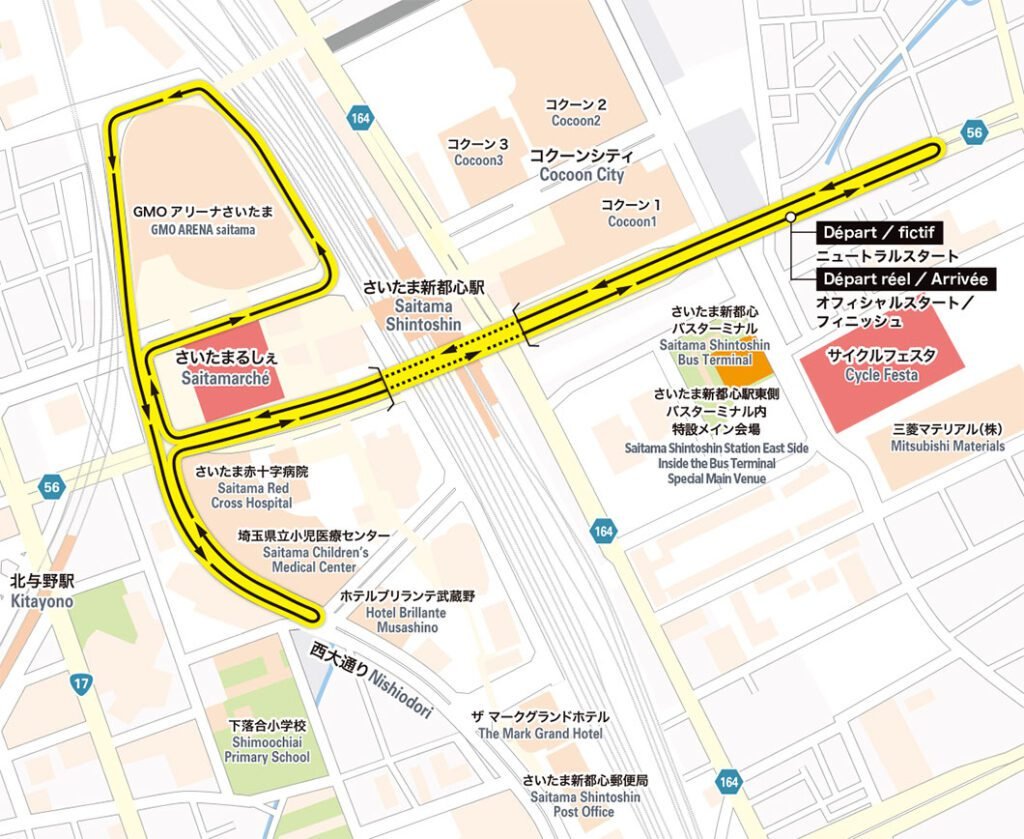
The professional race covers 17 laps of approximately 3.7 kilometres, giving an official distance of 62.9 kilometres. A neutralised parade lap precedes the competition, allowing spectators to see the riders before the timed race begins.

The circuit is concentrated around Saitama-Shintoshin Station and GMO Arena Saitama, the venue long known as Saitama Super Arena. The start and finish are positioned near the station’s eastern bus terminal, while the western portion passes through streets surrounding the arena, the Nishi-Odori area and Hotel Brillante Musashino.
Between the two halves lies the railway corridor. Riders cross beneath the tracks through a road underpass, descending below railway level before climbing back toward the surrounding streets. The organisers have incorporated this modest rise into the race’s climbing classification, an unexpected feature for a criterium held in a largely flat urban district.
The official spectator guide identifies several particularly important locations. At the junction of Higashi-Nishi Odori and Nishi-Odori, spectators can watch the riders pass three times during each lap. Near Hotel Brillante Musashino stands the final-kilometre marker, while the arena perimeter provides the most visible change from previous editions.
These landmarks divide the course into recognisable sections, each revealing a different aspect of the district’s development.
Saitama-Shintoshin Station: Where the Railway Shaped the City
The railway tracks above the circuit belong to a story that began long before Saitama-Shintoshin Station opened in 2000. During the nineteenth century, Japan underwent a period of rapid industrial transformation, replacing centuries-old patterns of travel and commerce with a growing network of railways, factories and modern infrastructure.

Following the Meiji Restoration of 1868, the new government regarded transport as essential to national development. Japan’s first railway opened between Shimbashi and Yokohama in 1872, and the network expanded steadily as engineers and railway companies connected the capital with other parts of the country.
Omiya, immediately north of the present circuit, became an important junction. Its railway facilities attracted mechanics, engineers and skilled craftsmen, establishing an industrial community whose work supported the expanding transport network.
By the late twentieth century, changes in railway operations had created opportunities to redevelop land near the tracks. The area between Omiya and Urawa offered space for a new district that could accommodate government offices, commercial facilities and public institutions without rebuilding the older centres themselves.
Saitama-Shintoshin emerged from that transformation. Its station opened in 2000, alongside major buildings that established the area as a new administrative and commercial centre. The tracks remained the organising feature of the landscape, but the activities surrounding them had changed.
Commuters now arrive for work, visitors attend concerts and families cross elevated pedestrian walkways between shops and public spaces. During the criterium, professional cyclists pass beneath the railway corridor, briefly occupying streets whose arrangement owes much to the transport system above.
The Underpass: An Unexpected Climb Beneath the Tracks
A climbing competition might seem out of place in Saitama-Shintoshin, where office towers and railway bridges dominate the skyline and the surrounding terrain offers little resemblance to the mountains of the Tour de France. Yet the road beneath the railway corridor provides a short descent and ascent, enough for the organisers to designate a climbing point near the western side of the Higashi-Nishi Odori underpass.
Its difficulty is not comparable with a mountain ascent. Riders descend beneath the tracks, negotiate the enclosed section and accelerate back toward street level, repeating the effort as the laps accumulate.

The climbing classification gives this otherwise ordinary piece of urban infrastructure a sporting purpose. Riders seeking intermediate points may accelerate before the rise, while those concentrating on the overall result must decide whether the effort is worth following.
For spectators, the underpass offers one of the course’s most distinctive moments. The peloton disappears beneath the railway infrastructure before emerging into daylight, its movement briefly framed by the concrete structures supporting the tracks.
Here, the terrain of the race has been created by engineers rather than mountains, a fitting feature for a criterium held in a district whose history is inseparable from the railway.
GMO Arena Saitama: The Building That Changed the Race
The arena has been the architectural centrepiece of the Saitama Criterium since its first edition in 2013. Opened in 2000 as Saitama Super Arena, the building was designed to accommodate events ranging from concerts and basketball to figure skating and combat sports, with an adaptable interior capable of serving different audience sizes.

Its construction formed part of the wider Saitama-Shintoshin redevelopment. Placing a major entertainment venue beside a railway station allowed thousands of spectators to arrive without relying entirely on road transport, while surrounding shops, restaurants and hotels benefited from the activity generated by large events.
The arena subsequently hosted international sporting competitions and performances by major Japanese and overseas musicians. Its scale and flexibility made it one of the country’s notable multipurpose venues, but the criterium introduced a use that few such buildings could claim.
In previous editions, professional road cyclists entered the arena during the race, moving from the surrounding streets into an enclosed venue before returning outside. The passage created an extraordinary contrast between the familiar environment of road racing and the interior of a building designed for concerts and indoor sport.
For spectators and television audiences, it became one of the event’s defining images, distinguishing Saitama from the many urban criteriums held on conventional street circuits.
That passage disappears in 2026. Renovation work has made the interior unavailable, and the organisers have redirected the course around the arena’s exterior.
The building remains the dominant landmark, but the racing now unfolds entirely on the surrounding roads. The change also demonstrates how a city-centre cycling event must adapt to the continuing use and redevelopment of the buildings around it.
Nishi-Odori: Three Passages Through One Junction
The junction of Higashi-Nishi Odori and Nishi-Odori offers one of the most unusual viewing opportunities on the circuit. According to the official spectator guide, riders pass through this intersection three times during each lap, allowing the crowd to follow the race from a single location without waiting for an entire circuit to be completed.

Early in the afternoon, the peloton may pass as a compact group, with riders testing the pace and teams beginning to establish their positions. A few laps later, the same junction might reveal a breakaway forming, a chase gathering momentum or a line of riders struggling to regain contact.
The repeated passages also make the evolution of the race easier to follow. Spectators can compare the movements of an escape group and its pursuers over a relatively short interval, watching whether the gap is growing or whether the peloton is beginning to organise a response.
For visitors unfamiliar with criterium racing, the junction provides an accessible introduction to its appeal. Rather than witnessing a single fleeting passage, the crowd can observe a contest developing through successive laps.
Hotel Brillante Musashino: The Final Kilometre
Near Hotel Brillante Musashino, the organisers identify the flamme rouge, the red marker traditionally signalling one kilometre remaining.
The expression belongs to the vocabulary of French road racing and has become familiar to generations of Tour de France spectators. On a mountain stage, it may mark the final steep section of a long ascent. On a flat finish, it announces the moment when sprint trains begin their final preparations and attackers make their last attempts to escape.

In Saitama, the marker stands within a modern district of government offices, hotels and public facilities, far from the French landscapes in which the tradition developed. Its meaning, however, remains unchanged.
When the riders pass it for the final time, the contest enters its decisive kilometre. The crowd will have watched the same approach repeatedly throughout the afternoon, but the last passage carries a different urgency as teams and individual riders commit to the finish.
Keyaki Hiroba and Saitamarché: Beyond the Racing Streets
Beside the arena, Keyaki Hiroba provides a public gathering space within the commercial heart of Saitama-Shintoshin. Its name comes from the Japanese zelkova tree, or keyaki, whose presence softens the surrounding landscape of concrete, glass and elevated walkways.

During the criterium weekend, the plaza hosts Saitamarché, a market bringing regional food and products into the event precinct. The name combines Saitama with the French word marché, reflecting the Tour de France connection while placing local traditions at the centre of the experience.
The market also introduces visitors to a prefecture extending well beyond the metropolitan landscape around the circuit. Saitama’s agricultural communities have long produced vegetables and wheat, contributing to regional food traditions that include several varieties of udon noodles.
These traditions belong to the wider prefecture rather than the racing streets themselves, but the market gives visitors a reason to encounter them. Alongside the international cycling spectacle, it provides a distinctly local element of the weekend.
Keyaki Hiroba and Saitamarché are not part of the competitive road surface. They form part of the surrounding festival environment.
The Eastern Roads: Returning to the Finish
After completing the western section, the riders return beneath the railway corridor toward the eastern roads and the official finish near the Saitama-Shintoshin Station East Side Bus Terminal.
This part of the district reflects the same redevelopment that created the station and arena precinct. The streets accommodate public transport, commercial activity and pedestrian access throughout the year, but during the criterium they become the setting for the race’s final approach.
The eastern turnaround and return toward the finish complete the lap, bringing the peloton back to the crowds gathered near the station.
For spectators, this is where the repeated journeys around the district ultimately acquire their meaning. The same stretch of road serves as both a familiar passage during the early laps and the decisive finishing approach when the race reaches its conclusion.
Before Saitama-Shintoshin: The Roads of Edo-Period Japan
Modern Saitama was established as a municipality in 2001 through the merger of Urawa, Omiya and Yono, with Iwatsuki joining in 2005. The city’s administrative history is therefore relatively recent, although the communities brought together beneath its name developed over many centuries.

During the Edo period, Japan was governed by the Tokugawa shogunate, with Edo, present-day Tokyo, serving as the political centre. A network of major highways connected the capital with Kyoto and other important cities, carrying officials, merchants, pilgrims and travellers across the country.
Among these roads was the Nakasendō, one of the principal routes between Edo and Kyoto. Unlike the coastal Tōkaidō, it followed an inland course through central Honshu, passing mountain districts and settlements whose economies depended partly on the movement of travellers.
Urawa and Omiya developed as post towns along the highway. Inns provided accommodation, merchants sold supplies, and local residents participated in the systems that supported official journeys. Travellers could obtain food, arrange transport and rest before continuing toward the next settlement.
The road was both a commercial opportunity and a responsibility for the communities along it. Maintaining services for travellers required labour and organisation, while the steady movement of people encouraged trade and the growth of roadside businesses.
These settlements already possessed established identities when the railway age began. Their importance had been shaped by centuries of travel, and the arrival of trains did not immediately erase the older patterns of commerce and community life.

Instead, the railway transformed the scale and speed of movement. Journeys that once required days on foot or horseback could increasingly be completed in hours, and towns connected to the new network acquired opportunities unavailable to settlements bypassed by the tracks.
Omiya developed into a railway centre, while Urawa became closely associated with prefectural administration. The modern district of Saitama-Shintoshin eventually emerged between them, occupying a landscape where successive generations had organised their lives around the movement of people and goods.
The criterium does not follow the old Nakasendō, but the highway provides a historical perspective on the region. Long before professional cyclists arrived, the roads around Saitama belonged to one of Japan’s important corridors of travel.
Shirai Sukeshichi and Omiya: The People Who Brought the Railway
Omiya’s emergence as a railway centre was not simply the inevitable consequence of Japan’s industrial expansion. It also depended on local people who recognised what a railway connection could mean for their community and worked to secure it.

Among them was Shirai Sukeshichi (白井助七), a local figure associated with efforts to bring railway infrastructure to Omiya during the late nineteenth century.
When the railway network expanded north of Tokyo, a station at Omiya offered the possibility of new commercial activity, improved transport connections and greater importance for the surrounding town. Yet the benefits of a railway did not automatically reach every settlement along a developing line.
Shirai was involved in the campaign that helped secure Omiya Station in 1885. He subsequently supported efforts to establish railway workshops in the town, which opened in 1894.
The workshops became one of the foundations of Omiya’s industrial identity.
Steam locomotives required regular maintenance, while carriages, wheels, brakes and other mechanical components needed inspection and repair. Mechanics handled heavy machinery, engineers supervised repairs, and craftsmen developed specialist knowledge through experience and training.
The work was physically demanding and technically complex. Keeping trains operational required cooperation between workers whose skills supported a transport network expanding across Japan.
The workshops also transformed the surrounding community. Employment attracted workers and their families, while shops, housing and services developed around the industrial facilities. Technical knowledge passed between generations, creating an identity closely associated with engineering and railway operations.
Shirai’s importance lies in the earlier decision that helped make this development possible. He was not a locomotive mechanic or workshop engineer, but an advocate for the infrastructure that brought railway employment and industrial activity to Omiya.

His story gives a human dimension to a transformation often described only through stations, tracks and buildings. The railway changed Omiya because individuals recognised its potential, campaigned for its arrival and helped connect the town to Japan’s expanding transport system.
Today, that history is preserved at the Railway Museum in Omiya, which opened in 2007. Its collection includes historic locomotives and railway vehicles, presenting the development of Japanese transport from the nineteenth century to the modern era.
The museum lies beyond the criterium circuit, but the railway corridor visible throughout Saitama-Shintoshin belongs to the same history. The modern district surrounding the race developed long after Shirai’s campaign, yet its existence is difficult to separate from the railway infrastructure that made Omiya an important transport centre.
Hikawa Shrine: The Older Heart of Omiya
A short journey from the modern railway district leads to Musashi Ichinomiya Hikawa Shrine, one of the region’s important Shinto religious sites.
The shrine is associated with the ancient traditions of Musashi and is dedicated to deities including Susanoo-no-Mikoto. Its long approach, lined with trees, creates a striking contrast with the commercial towers and railway structures of Saitama-Shintoshin.
The name Omiya itself refers to a great shrine, reflecting the institution’s importance to the surrounding community.For centuries, religious sites such as Hikawa Shrine served as centres of local identity. Festivals and ceremonies brought people together, while visitors and pilgrims contributed to the activity of nearby settlements.

The shrine’s presence helped shape Omiya long before railway workshops and modern stations altered the town’s economy. Its continued importance reveals how different periods of Japanese history coexist within the same urban area. The railway transformed Omiya into a transport centre, but the older religious landscape remained part of its identity.
Neither the shrine nor the Railway Museum lies on the criterium circuit. Together, however, they reveal two aspects of Saitama’s history that are difficult to appreciate from the modern streets alone: the religious traditions of the old settlements and the industrial labour that supported Japan’s transformation.
Seventeen Laps: How the Main Race Will Be Decided
The professional criterium covers 17 competitive laps of approximately 3.7 kilometres, producing an official distance of 62.9 kilometres. The neutralised parade lap takes place before the timed competition and does not count toward that total.
The course demands repeated accelerations through the western streets, careful positioning around the arena and a brief rise through the railway underpass. Its eastern section provides opportunities for sustained speed, but the turnaround and return toward the finish prevent riders from settling into an uninterrupted rhythm.
A rider who loses several places through a corner may need to accelerate sharply to regain contact. Over seventeen laps, those efforts can consume substantial energy, particularly when the pace increases or attacks force the peloton into a long line.
Intermediate sprint and climbing classifications create additional reasons for riders to attack before the final lap. A small group may attempt to establish an advantage through the more technical sections, while sprint-oriented teams try to maintain control without using too many riders in the pursuit.
The circuit offers opportunities for both approaches. Its corners and underpass can help attackers disrupt the peloton’s rhythm, but the longer eastern roads provide space for an organised chase.
The timing of any decisive attack will be especially important. An acceleration immediately after the underpass could exploit riders recovering from the short rise, while a move through the arena perimeter may benefit from the repeated corners. Neither guarantees success, because the eastern section offers the chasing peloton a chance to organise.
Weather may also influence the contest. Mid-November in Saitama is generally cooler than the summer conditions familiar from the Tour de France, although wind, rain and changes in road grip could affect the speed at which riders negotiate the corners.
The most likely tactical contest is therefore between riders attempting to disrupt the peloton through the technical western section and teams seeking to maintain enough organisation to deliver a sprint. A late breakaway would need to carry its advantage through the eastern turnaround, while a sprinter must survive the repeated accelerations without losing position or exhausting the teammates needed for the finish.
The Tour de France in Japan: A Connection Since 2013
When the first Tour de France Saitama Criterium took place in 2013, it brought one of Europe’s most recognisable sporting identities to a Japanese city whose modern centre had opened little more than a decade earlier.
The Tour de France began in 1903 and developed into an event closely associated with the landscapes and communities of France. Its yellow jersey, mountain stages and celebrated champions became familiar to audiences far beyond Europe, creating an international following that extended well beyond the roads on which the race was contested.
Saitama offered those audiences a different experience. Rather than watching the peloton pass once along a rural road, spectators could follow the riders through repeated laps, observing attacks, intermediate competitions and the gradual reorganisation of the field.
The format also allowed Japanese cyclists to compete alongside international professionals, bringing the European racing world into direct contact with the domestic audience. Over successive editions, the criterium welcomed major Tour de France riders and developed a programme combining professional competition with community activities and regional events.
The COVID-19 pandemic interrupted that continuity, but the race subsequently returned, maintaining its position as an international cycling occasion in Japan.
Its sporting significance differs from that of a Tour de France stage. The Saitama Criterium is a shorter, specialised event, designed to bring professional riders and spectators together in a compact urban setting.
What makes it distinctive is the combination of international cycling traditions with a Japanese city whose architecture, transport systems and cultural history provide a setting unlike the roads of France.
Japan’s Cycling Tradition: From Keirin to the International Peloton
Japan’s cycling history developed along a different path from that of the European road-racing nations, producing one of the sport’s most distinctive competitive disciplines.
Keirin began in Japan after the Second World War, with the first official races held in 1948. The sport developed within a highly organised professional system, where riders competed on banked tracks and relied on tactical positioning, acceleration and sprinting speed.

The discipline later entered international competition, becoming an Olympic event for men in 2000 and women in 2012. Its global adoption brought a Japanese form of cycle racing to audiences around the world, although international keirin differs in important respects from the domestic professional system.
Road racing followed a separate development. Japanese riders increasingly pursued opportunities abroad, but establishing a career within the European professional peloton remained difficult. Beyond the demands of competition, riders faced unfamiliar languages, team structures and racing calendars, often spending much of the season far from home.
The Saitama Criterium connects these different cycling traditions without confusing their competitive formats. The race is a road criterium, not a keirin event, but its compact circuit allows spectators to appreciate some of the qualities familiar from track racing: positioning, repeated accelerations and the importance of timing.
It also brings Japanese riders into direct competition with internationally recognised road professionals, giving domestic audiences a rare opportunity to follow that contest at close range.
Brandon McNulty, Paul Seixas and the Announced International Field
The organisers’ announced 2026 field includes riders from several international teams, combining established professionals, experienced one-day racers and younger competitors who have already achieved major results.
These names reflect the published participant announcements rather than a guarantee that every rider will start. Late withdrawals and substitutions remain possible before race day.
Brandon McNulty, representing UAE Team Emirates-XRG, is among the announced participants. The American won the men’s elite road race at the 2026 UCI Road World Championships in Montréal, earning the rainbow jersey worn by the reigning world champion.
McNulty’s career has demonstrated considerable versatility. His performances in stage races, time trials and one-day events have established him as a rider capable of succeeding in different competitive environments. On Saitama’s short circuit, that adaptability may prove valuable if the race becomes aggressive rather than developing toward a conventional sprint.
Paul Seixas, representing Decathlon CMA CGM Team, is another announced participant. The young French rider finished fourth overall at the 2026 Tour de France and third in the individual time trial at the 2026 UCI Road World Championships, results that underline his rapid emergence at the highest level of professional cycling.
His presence would bring one of France’s most promising young riders to a Japanese event built around the Tour de France’s international appeal.
Michael Matthews, representing Team Jayco AlUla, brings a different kind of experience. The Australian has combined sprinting speed with the endurance required for demanding one-day races and major stage races throughout his career. He won the Tour de France points classification in 2017 and has claimed four Tour stage victories.
Matthews also finished second behind McNulty in the 2026 World Championships road race, giving Saitama the prospect of seeing the two leading finishers from Montréal competing on the same urban circuit.
Oscar Onley, representing INEOS Grenadiers, is another announced participant. The British rider finished fourth overall at the 2025 Tour de France, establishing himself among the leading young general-classification contenders.
Mauro Schmid, representing Team Jayco AlUla, arrives with the distinction of having claimed his first Tour de France stage victory in 2026. His attacking qualities could make him an interesting participant on a circuit where short, aggressive efforts may influence the outcome.
Torstein Træen, representing Uno-X Mobility, is also included in the announced field. The Norwegian wore the yellow jersey during the fifth and sixth stages of the 2026 Tour de France, connecting his Saitama appearance with one of the year’s most recognisable sporting stories.
Other international participants add a variety of racing backgrounds and experience, although the final composition of the main criterium field remains subject to the organisers’ confirmed start list.
The organisers have announced 60 participants across the wider event programme, including different categories of riders. That figure should not be confused with the number contesting the main professional criterium.
Yukiya Arashiro: Every Edition, One Extraordinary Connection
Among the announced participants, Yukiya Arashiro holds a distinction that no visiting champion can match.
The Japanese rider is the only cyclist to have appeared in all twelve editions held since the Tour de France Saitama Criterium began in 2013. The count refers to editions actually staged, rather than consecutive calendar years, because the event experienced interruptions during the COVID-19 pandemic.
Born in Okinawa in 1984, Arashiro became one of Japan’s most internationally recognised professional road cyclists, establishing a long career within the European peloton. His appearances in the Tour de France and other major races brought Japanese cycling into competitions historically dominated by European teams and riders. Sustaining a career in that environment required more than racing ability, as Arashiro adapted to unfamiliar languages, cultures and professional structures while spending much of the season far from home.

For Japanese followers, his achievements offered evidence that a rider from Japan could compete consistently at the highest international level. His continuing presence in Saitama gives the event an unusual continuity. World champions, Tour de France contenders and visiting teams have changed over the years, but Arashiro has remained a familiar figure for spectators following the race since its beginning.
In 2026, he appears among the organisers’ announced participants as part of the Tour de France Criterium Special Guests selection, alongside Valentin Paret-Peintre and Émilien Jacquelin. The occasion also brings his career back to a domestic audience. Spectators who followed his European racing from thousands of kilometres away can watch him compete on Japanese roads alongside riders associated with the Tour de France.
Arashiro’s record traces the history of the Saitama Criterium itself, from a new international event in 2013 to an established occasion connecting Japanese cycling with the professional peloton.
Race Day: Sunday, 15 November 2026
The main professional criterium is scheduled from 2:50 pm to 4:25 pm Japan Standard Time, beginning with one neutralised parade lap followed by 17 competitive laps.
The podium ceremony is scheduled from 4:40 pm to 5:10 pm.
The event’s main venue is located near the Saitama-Shintoshin Station East Side Bus Terminal. The surrounding programme includes Saitamarché at Keyaki Hiroba, scheduled from 11:00 am to 5:00 pm, and Cycle Festa near Shintoshin Park, scheduled from 10:00 am to 4:30 pm.

Saitama-Shintoshin Station provides the principal public transport access to the race area. Road restrictions are scheduled from 9:00 am to 6:30 pm, while designated spectator areas are expected to open around 11:00 am.
Some spectator locations require tickets or invitations, and several sections of the course are restricted for safety. Visitors should consult the organisers’ latest information for access arrangements and any timetable changes.
The Finish: Seventeen Laps Through a Changing City
By the final lap, the riders will have crossed beneath the railway corridor seventeen times, negotiated the streets around the arena and returned repeatedly to the same junctions where spectators have followed the contest throughout the afternoon.

The winner may emerge from a late attack or a carefully organised sprint, but the race will have unfolded entirely within a district whose modern appearance tells only part of Saitama’s story.
Beyond the circuit, the old Nakasendō recalls travellers moving between Edo and Kyoto. Hikawa Shrine preserves traditions rooted in the region’s earlier history, while the efforts of Shirai Sukeshichi and the workers of Omiya’s railway workshops belong to the industrial transformation that reshaped Japan during the nineteenth and twentieth centuries.
Saitama-Shintoshin emerged much later, bringing offices, public institutions and entertainment facilities onto land shaped by that railway past. The arena, the station and the surrounding streets represent another stage in the region’s long relationship with transport and urban development.
When the barriers are removed and the roads reopen, trains will continue passing above the circuit, commuters will return to the station and the arena will remain part of the city’s everyday landscape. For a few hours, those familiar streets will have carried riders from Japan and abroad, adding a brief sporting chapter to a place whose history has always been shaped by movement.
Credits
01. Saitama-Shintoshin, Western District. Photograph by PRiMENON (2009), sourced from Wikimedia Commons, licensed under the Creative Commons Attribution-ShareAlike 3.0 Unported license (CC BY-SA 3.0).
02. Saitama-Shintoshin Station Concourse. Photograph by MaedaAkihiko (2021), sourced from Wikimedia Commons, licensed under the Creative Commons Attribution-ShareAlike 4.0 International license (CC BY-SA 4.0).
03. Saitama-Shintoshin Underpass. Photograph by Nagono (2008), originally published on Panoramio and sourced from Wikimedia Commons, licensed under the Creative Commons Attribution-ShareAlike 3.0 Unported license (CC BY-SA 3.0).
04. GMO Arena Saitama. Photograph by Kakidai (2018), sourced from Wikimedia Commons, licensed under the Creative Commons Attribution-ShareAlike 4.0 International license (CC BY-SA 4.0).
05. Nishi-Odori, Saitama-Shintoshin. Photograph by ミラー・ハイト (2017), sourced from Wikimedia Commons, licensed under the Creative Commons Attribution-ShareAlike 4.0 International license (CC BY-SA 4.0).
06. Hotel Brillante Musashino, Saitama-Shintoshin. Photograph by 掬茶 (2015), sourced from Wikimedia Commons, licensed under the Creative Commons Attribution-ShareAlike 4.0 International license (CC BY-SA 4.0).
07. Keyaki Hiroba, Saitama-Shintoshin. Photograph by 掬茶 (2013), sourced from Wikimedia Commons, licensed under the Creative Commons Attribution-ShareAlike 4.0 International license (CC BY-SA 4.0).
08. Urawa Station on the Nakasendō. Woodblock print by Keisai Eisen (19th century), from The Sixty-nine Stations of the Kisokaidō, sourced from Wikimedia Commons, identified as Public Domain under the Creative Commons Public Domain Mark 1.0 (PDM 1.0).
09. Ōmiya Station on the Nakasendō. Woodblock print by Keisai Eisen (19th century), from The Sixty-nine Stations of the Kisokaidō, sourced from Wikimedia Commons, identified as Public Domain under the Creative Commons Public Domain Mark 1.0 (PDM 1.0)
10. Japan’s First Steam Locomotive, Ōmiya Railway Museum. Photograph by 掬茶 (Kikucha, 2015), sourced from Wikimedia Commons, licensed under the Creative Commons Attribution-ShareAlike 4.0 International license (CC BY-SA 4.0).
11. Ōmiya Railway Works, Class DD13 Locomotive. Photograph by Rsa (2007), sourced from Wikimedia Commons, licensed under the Creative Commons Attribution-ShareAlike 3.0 Unported license (CC BY-SA 3.0).
12. Hikawa Shrine, Ōmiya. Photograph by Ocdp (2012), sourced from Wikimedia Commons, licensed under the Creative Commons Attribution-ShareAlike 3.0 Unported license (CC BY-SA 3.0).
13. Keirin Racing at Ōmiya Velodrome. Photograph by Paul Keller (2008), sourced from Wikimedia Commons, licensed under the Creative Commons Attribution-ShareAlike 3.0 Unported license (CC BY-SA 3.0).
14. Yukiya Arashiro, 2009. Photograph by musume miyuki (2009), originally published on Flickr and sourced from Wikimedia Commons, licensed under the Creative Commons Attribution 2.0 Generic license (CC BY 2.0).
15. Saitama-Shintoshin Station, Aerial View. Photograph by ブルーノ·プラス (2019), sourced from Wikimedia Commons, licensed under the Creative Commons Attribution-ShareAlike 4.0 International license (CC BY-SA 4.0).