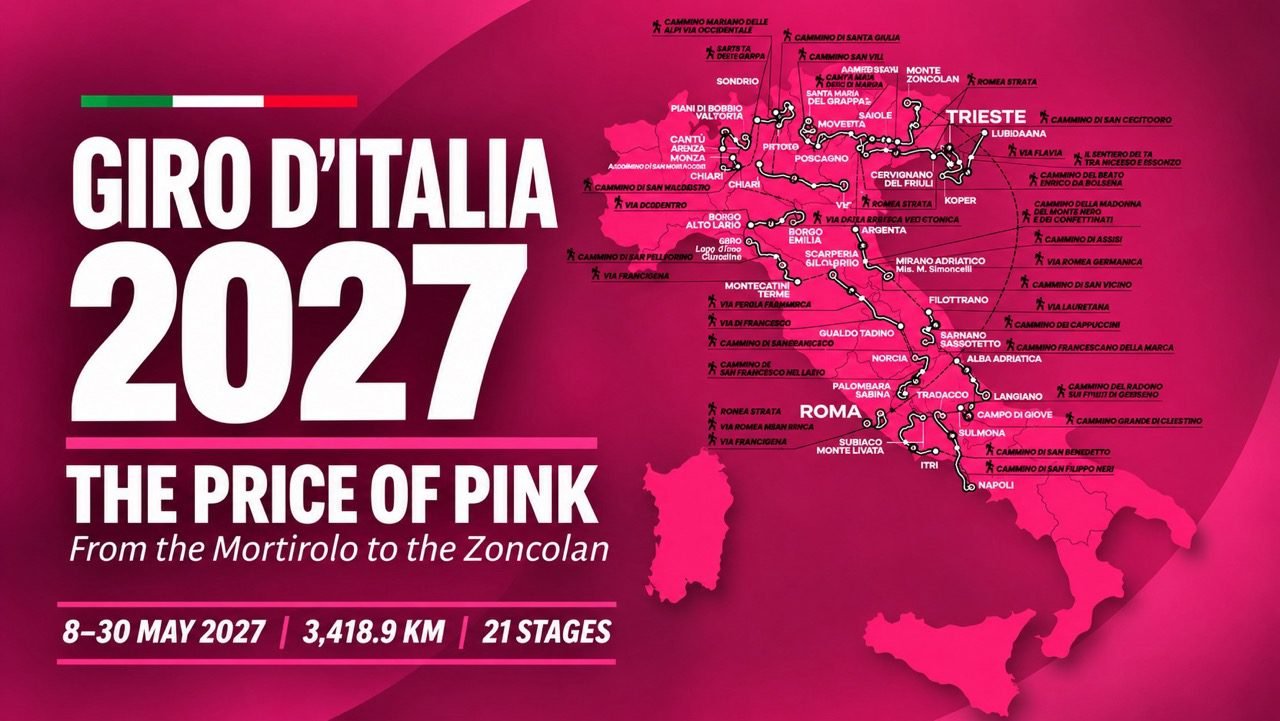

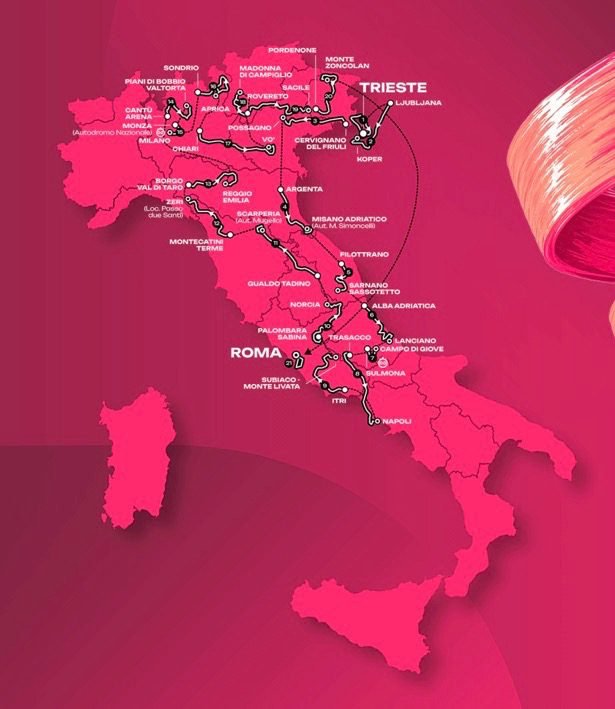
From Trieste to Rome, the 110th Giro d’Italia will cover 3,418.9 kilometres and accumulate 50,250 metres of climbing. Seven uphill finishes, two contrasting individual time trials and a final week featuring the Mortirolo, Gavia and Monte Zoncolan create a route rich in sporting difficulty and cycling history. The 2027 edition also celebrates Italy’s pilgrimage routes and visits three famous motor racing circuits, connecting the Corsa Rosa with traditions extending far beyond professional cycling.
On 5 June 1994, Marco Pantani rode into Aprica having produced one of the performances that would establish his reputation as an exceptional climber. The stage from Merano had taken the Giro over the Stelvio, Mortirolo and Santa Cristina, a succession of Alpine roads capable of exposing even the most accomplished riders. Pantani, then twenty-four years old, attacked on the Mortirolo and continued to build his advantage, eventually winning the stage by 2 minutes 52 seconds over Claudio Chiappucci and 4 minutes 6 seconds over race leader Evgeni Berzin. Although Berzin retained the Maglia Rosa and went on to win the Giro, Pantani had demonstrated how an aggressive climber could transform a race that appeared to be under another rider’s control.
Thirty-three years later, the Giro returns to Aprica with a mountain stage that invites comparisons with that remarkable afternoon. The 2027 route will climb the Mortirolo twice, crossing the Passo Gavia between the two ascents, before finishing in the Alpine resort where Pantani announced himself as a serious Grand Tour contender. Four days later, the race will confront Monte Zoncolan from Ovaro, one of the steepest roads ever used as a summit finish in professional cycling. The two stages form the centrepiece of a demanding final week, but their significance depends on everything that happens before the peloton reaches the Alps.
Presented in Rome on 3 November 2026, the route of the 110th Giro d’Italia begins in Trieste on Saturday, 8 May 2027, and concludes in the Italian capital on Sunday, 30 May. Its 21 stages travel through Slovenia, across the Adriatic side of Italy, into the Apennines and Tuscany, and through the mountains of Lombardy and the northeastern Alps. The 3,418.9-kilometre itinerary includes seven uphill finishes and 56.9 kilometres of individual time trialling, divided between the 19.6-kilometre climbing test to Campo di Giove and the faster 37.3-kilometre route from Monza to Milan.
What makes this Giro particularly interesting is the relationship between the stages rather than the difficulty of any individual day. The first major mountain finish arrives on Stage 5, long before the strongest contenders will want to reveal their full hand, while the longer time trial falls immediately before the second rest day and the Mortirolo-Gavia-Mortirolo queen stage. A rider could establish an advantage in the opening week, lose part of it against the clock in Milan and then find themselves forced to attack across some of Italy’s most demanding mountain roads. Conversely, a strong time triallist may enter the final week in the Maglia Rosa but discover that a lead built through aerodynamic efficiency is difficult to defend when the gradients become exceptionally steep.
The route rewards versatility while making tactical judgement unusually important. A strong team could control much of the opening fortnight, only to discover that its resources have been depleted before the greatest climbing challenges. An aggressive rider might recover several minutes through a spectacular attack, yet pay for that effort two days later at Madonna di Campiglio. Such possibilities are part of the Giro’s enduring attraction, and the 2027 edition provides enough opportunities for the race to change direction more than once before the final journey into Rome.
Giro d’Italia 2027: Complete Stage Calendar
The interest ratings consider each stage’s sporting appeal, potential for tactical uncertainty and likely influence on the overall classification. They are Around the Peloton editorial assessments rather than official classifications of difficulty.
| Stage | Date | Start → Finish | Distance | Likely Race Type | Interest |
|---|---|---|---|---|---|
| 1 | Sat 8 May | Trieste → Trieste | 172 km | Hilly / first pink jersey | ★★★★☆ |
| 2 | Sun 9 May | Ljubljana → Koper | 166 km | Hilly / reduced sprint | ★★★★☆ |
| 3 | Mon 10 May | Cervignano del Friuli → Possagno | 163 km | Rolling / puncheurs | ★★★☆☆ |
| 4 | Tue 11 May | Argenta → Misano Adriatico | 151 km | Sprint | ★★☆☆☆ |
| 5 | Wed 12 May | Filottrano → Sarnano-Sassotetto | 139 km | Mountain / summit finish | ★★★★★ |
| 6 | Thu 13 May | Alba Adriatica → Lanciano | 148 km | Hilly / uphill finale | ★★★☆☆ |
| 7 | Fri 14 May | Sulmona → Campo di Giove | 19.6 km | Uphill individual time trial | ★★★★★ |
| 8 | Sat 15 May | Trasacco → Napoli | 219 km | Sprint / transition | ★★★☆☆ |
| 9 | Sun 16 May | Itri → Subiaco-Monte Livata | 180 km | Mountain / summit finish | ★★★★★ |
| — | Mon 17 May | Rest Day 1 | — | Recovery | — |
| 10 | Tue 18 May | Palombara Sabina → Norcia | 218 km | Hilly / breakaway | ★★★★☆ |
| 11 | Wed 19 May | Gualdo Tadino → Scarperia | 220 km | Rolling / sprint | ★★★☆☆ |
| 12 | Thu 20 May | Montecatini Terme → Zeri | 173 km | Mountain / summit finish | ★★★★☆ |
| 13 | Fri 21 May | Borgo Val di Taro → Reggio Emilia | 176 km | Sprint | ★★☆☆☆ |
| 14 | Sat 22 May | Cantù Arena → Piani di Bobbio/Valtorta | 187 km | High mountains / summit finish | ★★★★★ |
| 15 | Sun 23 May | Monza → Milano | 37.3 km | Individual time trial | ★★★★★ |
| — | Mon 24 May | Rest Day 2 | — | Recovery | — |
| 16 | Tue 25 May | Sondrio → Aprica | 192 km | High mountains / queen stage | ★★★★★ |
| 17 | Wed 26 May | Chiari → Vo’ | 194 km | Hilly / reduced sprint or breakaway | ★★★☆☆ |
| 18 | Thu 27 May | Rovereto → Madonna di Campiglio | 154 km | High mountains / summit finish | ★★★★★ |
| 19 | Fri 28 May | Rovereto → Sacile | 199 km | Hilly / breakaway | ★★★★☆ |
| 20 | Sat 29 May | Pordenone → Monte Zoncolan | 180 km | High mountains / summit finish | ★★★★★ |
| 21 | Sun 30 May | Roma → Roma | 131 km | Sprint / ceremonial finale | ★★★☆☆ |
Stage classifications and interest ratings are editorial forecasts based on the officially announced route. Five stars indicate stages with the greatest anticipated sporting significance. Detailed technical information may be refined by the organisers before the race.
Beyond the Race: Italy’s Ancient Pilgrimage Routes
The presentation of the 2027 Giro d’Italia introduced a cultural initiative extending beyond the sporting route. Alongside the men’s and women’s races, the organisers highlighted 35 of Italy’s pilgrimage routes, representing more than 15,000 kilometres of historic paths through the country’s cities, villages, countryside and mountains. Many of these itineraries have been travelled for centuries, connecting religious destinations with places of commercial, political and cultural importance. Although some sections can also be explored by bicycle, they represent a very different approach to travel from the speed and competition of a professional cycling race.
Four historic itineraries feature prominently in the initiative: the Via Francigena, Via Romea Strata, Way of St Francis and Way of St Benedict. The Via Francigena developed as one of the principal pilgrimage corridors connecting northern Europe with Rome, while the Via Romea Strata brought travellers from Central and Eastern Europe toward the Italian peninsula. The routes associated with St Francis and St Benedict connect places important to the lives and religious traditions of two figures whose influence extended across medieval Europe, passing through landscapes where monasteries, historic settlements and ancient roads remain important elements of the cultural heritage.

The connection with the 2027 Giro is particularly meaningful because the race itself visits places associated with these traditions. Subiaco, the destination of Stage 9, is inseparable from the early religious life of Saint Benedict, while Norcia, reached on Stage 10 after the first rest day, is traditionally regarded as his birthplace. The Giro will move through these landscapes at racing speed, but the pilgrimage routes provide another way to understand their geography, following paths established long before the construction of modern roads or the arrival of organised cycling.
The organisers’ initiative should not be confused with the official race itinerary, which does not necessarily follow the historic pilgrimage paths themselves. Instead, it places the Giro within a wider cultural framework that recognises the relationship between movement, landscape and historical memory. A mountain road may be a decisive sporting obstacle for the peloton, but for generations of travellers the surrounding territory has also been a place of religious devotion, trade, settlement and personal journeys. The cultural programme therefore offers an additional way of understanding the places encountered during the race, revealing connections that would be easy to overlook when concentrating exclusively on the competition.
The Adriatic Opening: Three Days Without a Safe Script
Stages 1–4 | 8–11 May
Trieste provides a fitting starting point for a Giro that will repeatedly cross the geographical and cultural boundaries of Italy. Situated at the northeastern edge of the Adriatic, the city developed for centuries as the principal maritime outlet of the Habsburg Empire, linking Central European markets with Mediterranean trade. Its grand waterfront, dominated by Piazza Unità d’Italia, still reflects the commercial importance it acquired under Austrian rule, while the older streets, coffee houses and surrounding limestone hills preserve the mixture of Italian, Austrian and Slavic influences that gives Trieste its distinctive character. The Giro has visited the city on numerous occasions, including the 1981 opening prologue won by Norway’s Knut Knudsen and the final stage of the 2014 edition, when Nairo Quintana celebrated his overall victory.

The 2027 opening stage begins and ends in Trieste, covering 172 kilometres and approximately 2,400 metres of elevation gain. After briefly crossing into Slovenia, the route returns toward the city with three climbs concentrated in the final 40 kilometres, creating a more demanding contest for the first Maglia Rosa than a conventional flat opening stage. The succession of climbs could favour an aggressive puncheur or a versatile rider capable of maintaining an advantage on the descending approach, although a reduced sprint remains possible if enough fast finishers survive. For the general classification teams, the more immediate concern will be positioning, since the combination of opening-day nervousness, narrow roads and repeated changes of rhythm can create unexpected gaps even before the race reaches its first major mountain.
The second stage takes place entirely in Slovenia, beginning in Ljubljana and travelling 166 kilometres toward Koper on the Adriatic coast. Ljubljana developed around a medieval settlement and acquired much of its present architectural identity through the work of Jože Plečnik, whose bridges, public spaces and riverside buildings transformed the capital during the twentieth century. Koper preserves a different historical inheritance, having spent centuries under Venetian influence, which remains visible in the architecture surrounding Tito Square and the Praetorian Palace. Between these cities, the riders face approximately 2,200 metres of climbing across undulating terrain, with a sharp rise near the finish capable of disrupting the sprint teams. The stage could therefore produce a confrontation between attackers seeking to exploit the final climb and fast riders hoping to regain contact on the descent.

Stage 3 brings the Giro back to Italy, travelling from Cervignano del Friuli to Possagno, a town best known as the birthplace of Antonio Canova. Born in 1757, Canova became one of Europe’s most influential Neoclassical sculptors, and his hometown preserves his artistic legacy through the Gypsotheca, the museum housing plaster models of his works, and the imposing Canovian Temple. The route approaches Possagno after tackling the Montello and Mostaccin climbs, difficulties that may not be severe enough to separate the leading general classification contenders but could remove the purest sprinters from contention. This is the kind of stage in which a late attack may succeed not because the terrain is exceptionally difficult, but because the teams capable of organising a pursuit have already lost too many riders.
Only on Stage 4 does the Giro offer a relatively straightforward opportunity for the fastest men. The 151-kilometre journey from Argenta to Misano Adriatico crosses the plains of Emilia-Romagna before finishing at the Misano World Circuit Marco Simoncelli, named in memory of the Italian motorcycle racer who died in 2011. The gentle profile should allow the principal sprint teams to organise a conventional finish, and the circuit provides broad racing roads after three days in which the terrain repeatedly favours smaller groups and opportunistic attacks. Misano also introduces an unusual secondary theme of the 2027 route, which will subsequently visit two more of Italy’s internationally recognised motor racing venues.
Michele Scarponi, the Apennines and the First Battle for Pink
Stages 5–9 | 12–16 May
The fifth stage begins in Filottrano, a small town in the Marche region whose place in Italian cycling history is inseparable from Michele Scarponi. Winner of the 2011 Giro d’Italia, following the disqualification of Alberto Contador’s result, Scarponi was admired not only for his climbing ability but also for the character and humour that made him a popular figure within the professional peloton. His death on 22 April 2017, when he was struck by a vehicle while training near his home, was felt deeply throughout Italian cycling. Ten years later, the Giro’s decision to begin a mountain stage in Filottrano provides an opportunity to remember a rider whose contribution to the sport extended well beyond his results.

The stage travels 139 kilometres from Filottrano to Sarnano-Sassotetto, climbing into the Sibillini Mountains and accumulating approximately 3,300 metres of elevation gain. Despite its relatively short distance, it offers the first substantial examination of the general classification, with the final ascent measuring approximately 13.1 kilometres at an average gradient of 7.4% and sections reaching 14%. Those figures are demanding enough to expose differences in climbing form, particularly if the pace is high before the leaders reach the lower slopes. The brevity of the stage may also encourage a more aggressive approach, since the strongest teams have less distance over which to recover from an early acceleration.
The opportunity nevertheless comes with a tactical complication. A rider who establishes an advantage at Sassotetto may find themselves wearing the Maglia Rosa before the first time trial and well ahead of the Alps, committing their team to responsibilities that could become increasingly expensive. Other contenders may prefer to gain a modest amount of time without taking control of the race, leaving a less threatening rider to carry the jersey through the following transitional stages. The situation illustrates an important distinction within Grand Tour racing: establishing superiority on one climb does not necessarily mean that assuming responsibility for the entire race is the most effective strategy.
Stage 6 continues through Abruzzo, travelling 148 kilometres from Alba Adriatica to Lanciano across a landscape where the Adriatic coastline gives way rapidly to rolling hills and the foothills of the Apennines. Lanciano has origins extending into antiquity and developed into an important medieval trading centre, with historic quarters that retain churches, narrow streets and architectural evidence of its former commercial importance. The stage’s repeated rises and uphill approach to the finish should favour riders capable of explosive accelerations, particularly if the leading sprint teams are unable to maintain a sufficiently large group. A successful late attack here would be less about conquering a major climb than recognising the moment when the peloton’s organisation begins to weaken.
The Uphill Time Trial: Sulmona to Campo di Giove
The first individual time trial arrives on Stage 7, covering 19.6 kilometres from Sulmona to Campo di Giove on the slopes of the Maiella massif. Sulmona, birthplace of the Roman poet Ovid in 43 BCE, occupies a mountain basin in Abruzzo and preserves a historic centre marked by medieval churches, the remains of its aqueduct and the broad Piazza Garibaldi. The road toward Campo di Giove exchanges that urban setting for a progressively more mountainous landscape, with the categorised climbing section measuring approximately 12.5 kilometres at an average gradient of 4.4% and steeper passages reaching around 9%.

The profile creates a test considerably different from the flatter individual time trial that awaits the riders in Milan. Aerodynamic efficiency remains important during the faster opening kilometres, but the sustained climbing gradually places greater emphasis on power relative to body weight, pacing and the ability to maintain an efficient effort as speed declines. A rider who begins too aggressively may reach the ascent with insufficient reserves, while a climber who manages the opening section carefully could gain time against a more powerful specialist whose advantage diminishes uphill. Equipment choices will also deserve attention, although the most effective approach will depend on the detailed course and each rider’s characteristics rather than a simple distinction between climbing and time trial bicycles.
For the contenders, Campo di Giove offers an early opportunity to compare their strengths under controlled conditions, without the tactical complications of teammates, breakaways or changing group dynamics. The result may clarify the hierarchy established at Sassotetto, but it could also overturn expectations if a rider better suited to sustained individual effort outperforms those who appeared strongest on the mountain finish. Unlike a road stage where tactical hesitation can influence the outcome, the time trial will leave little room for concealing differences in physical condition.
The opening week’s final weekend provides another contrast. Stage 8 travels 219 kilometres from Trasacco to Napoli, crossing the Apennines before approaching one of Europe’s most historically layered cities. Founded by Greek settlers and later shaped by Roman, medieval, Spanish and Bourbon rule, Naples preserves a remarkable concentration of historic streets, monumental churches and urban traditions beneath the volcanic presence of Vesuvius. The city welcomes the Giro for a sixth consecutive year, and although the long stage may favour a sprint, the distance could make the finish more selective than its final kilometres suggest.
Stage 9 returns to the mountains with 180 kilometres from Itri to Subiaco-Monte Livata. Itri occupies a historically important position along the routes connecting Rome with southern Italy, while Subiaco is associated with Saint Benedict, whose early religious life in the area contributed to the development of Western monasticism. Above the town, the Sacro Speco monastery occupies a dramatic position against the mountainside, providing one of central Italy’s most distinctive religious settings. The ascent toward Monte Livata offers another opportunity for the leading contenders to establish differences before the first rest day, when the results of Sassotetto and Campo di Giove may influence who feels obliged to attack and who can afford a more measured approach.
The Central Apennines: Long Roads, Hidden Dangers
Stages 10–13 | 18–21 May
The second week begins with a stage that could easily be underestimated beside the more celebrated Alpine climbs. From Palombara Sabina to Norcia, the riders cover 218 kilometres and approximately 3,600 metres of elevation gain across the central Apennines, passing through a region of mountain ridges, agricultural plateaus and historic settlements whose relative isolation has preserved distinctive local traditions. The route includes Forca di Presta and Forca Ventolosa near the Castelluccio area above Norcia, where the broad Pian Grande plateau is surrounded by the Sibillini Mountains and becomes famous in early summer for the seasonal flowering of cultivated fields and wild plants. The timing of that spectacle varies from year to year, but the landscape remains remarkable even outside the flowering period.
Norcia is traditionally associated with the birthplace of Saint Benedict and has a longstanding culinary reputation for cured meats, particularly pork products, reflected in the Italian term norcineria. The town has also been repeatedly affected by earthquakes, most recently during the destructive seismic sequence of 2016, and its buildings preserve evidence of both historical prosperity and the challenge of reconstruction. For the peloton, the constantly changing road profile could prove more demanding than a stage dominated by one major climb, since riders must repeatedly adjust their effort without the regular rhythm of a sustained ascent.

The sporting significance lies partly in the possibility of a large breakaway escaping while the general classification teams concentrate on protecting their leaders. A squad defending the Maglia Rosa may be willing to allow riders far behind overall several minutes of freedom, avoiding the expenditure required to control such a long and mountainous stage. However, that calculation becomes more complicated if a breakaway contains a rider close enough in the standings to threaten the lead, particularly when the strongest teams must decide whether to begin a pursuit before the final climbs. Norcia could therefore reward an ambitious outsider who recognises that the leading teams have more to lose through an extended chase than through allowing a stage victory to escape.
The following stage is the longest of the Giro, covering 220 kilometres from Gualdo Tadino to Scarperia and finishing at the Mugello motor racing circuit. Gualdo Tadino developed along routes crossing the central Apennines, while Scarperia was founded by Florence in the early fourteenth century as a fortified settlement and later became closely associated with traditional knife-making. The route offers another opportunity for sprinters after a lengthy crossing of the Umbrian and Tuscan landscape, although the accumulated distance could reduce the number of riders available to organise a finish. Unlike the relatively flat approach to Misano, the journey to Mugello could reward sprinters who combine speed with the endurance required to survive long stages through hilly terrain.
Passo Due Santi and the Legacy of Gino Bartali
Stage 12 travels 173 kilometres from Montecatini Terme to Zeri, leaving one of Italy’s best-known historic spa towns for the wooded mountains of the northern Apennines. Montecatini developed into a fashionable destination during the nineteenth and early twentieth centuries, when the popularity of thermal tourism encouraged the construction of elaborate bathing establishments and resort architecture. Zeri presents a markedly different landscape near the meeting point of Tuscany, Liguria and Emilia-Romagna, where mountain ridges and remote valleys have historically separated communities despite their geographical proximity.
The stage finishes near Passo Due Santi, in the Zum Zeri area, introducing a new uphill arrival to the Giro. Much of the day’s climbing is concentrated in the second half of the route, a distribution that could encourage attacks before the final ascent if a strong team is able to maintain pressure through the approach. For riders who have struggled on the earlier summit finishes, this provides another opportunity to recover time, although the roads of the Lombardy Prealps will offer a more substantial test two days later.

The organisers have designated the day as the Tappa Bartali, commemorating Gino Bartali, whose importance to Italian cycling extends far beyond his three Giro victories in 1936, 1937 and 1946. His rivalry with Fausto Coppi became one of the defining sporting narratives of postwar Italy, often interpreted through the contrasting personalities, backgrounds and approaches of the two riders. Bartali also played a role in helping persecuted Jews during the Second World War, using journeys by bicycle as part of rescue networks operating under the German occupation. His wartime activities led to his recognition by Yad Vashem as Righteous Among the Nations in 2013.
The connection between Bartali’s history and the mountain roads of central Italy offers a reminder of the distinctive character of the Giro. Its route regularly passes through places where sporting events intersect with much older histories, and the significance of a stage cannot always be understood through its altitude profile. In this case, the commemoration provides a broader context for a demanding uphill finish that might otherwise be remembered primarily for the performance of the leading climbers.
Stage 13 brings the peloton down toward the Po Valley, travelling 176 kilometres from Borgo Val di Taro to Reggio Emilia. The city occupies an important place in the formation of modern Italy, having been the setting in 1797 for the adoption of the green, white and red tricolour by the Cispadane Republic, an important predecessor of the national flag. Reggio Emilia also lends its name to an internationally influential approach to early childhood education developed after the Second World War. The relatively gentle profile should provide the sprinters with another opportunity, while the general classification contenders approach the second weekend knowing that two very different examinations await them.
Three Racing Circuits, Three Different Tests
One of the more unusual features of the 2027 route is the inclusion of three of Italy’s most recognisable motor racing circuits. Misano, Mugello and Monza belong to a sporting tradition shaped by the development of racing engines, technical innovation and the pursuit of speed. Their inclusion creates an interesting connection between two sports that share an emphasis on performance, precision and the ability to control a vehicle at high speed, although the physical demands of professional cycling remain fundamentally different from those of motorsport.
The first circuit appears on Stage 4, when the Giro finishes at the Misano World Circuit Marco Simoncelli on the Adriatic coast. The relatively flat 151-kilometre route from Argenta should favour a bunch sprint, with the circuit providing a distinctive setting for the first conventional confrontation between the fastest riders. Misano is strongly associated with motorcycle racing, particularly the Italian rounds of international championships, and its name commemorates Marco Simoncelli, the Italian rider who died following an accident at the 2011 Malaysian Grand Prix.

A week later, the Giro reaches the Autodromo Internazionale del Mugello at the conclusion of Stage 11. Set among the hills near Scarperia, the circuit opened in 1974, became part of Ferrari’s ownership in 1988 and hosted its first Formula One World Championship Grand Prix in 2020. Motorcycle racing remains central to its international reputation, particularly through MotoGP. The 220-kilometre journey from Gualdo Tadino is the longest stage of the Giro, and the demanding crossing of the Apennines may leave the sprinters with fewer teammates when they finally reach the circuit. The venue also has its own Giro history, having previously hosted finishes in 1977 and 2007.
Monza provides the third appearance and the most important for the overall classification. Unlike Misano and Mugello, it will not host a sprint finish but the departure of the 37.3-kilometre individual time trial to Milan on Stage 15. Opened in 1922, the Autodromo Nazionale Monza became one of the defining venues of Formula One and an enduring symbol of Italian motorsport. Its association with aerodynamic development and high-speed performance makes it a particularly appropriate starting point for a time trial in which aerodynamic efficiency, equipment and sustained power could have a substantial influence on the result.
The three circuits therefore serve different purposes within the Giro. Misano offers an early opportunity for sprinters, Mugello tests their endurance after a long crossing of central Italy, and Monza provides a potentially decisive examination for the Maglia Rosa contenders. Together, they introduce a distinctive motorsport theme without altering the fundamentally different challenges of the cycling route, and they connect three regions whose racing traditions have become internationally recognisable.
Ghisallo and Milan: When Two Different Strengths Collide
Stages 14–15 | 22–23 May
The second weekend may prove as important to the outcome of the Giro as the more dramatic mountain stages that follow. Stage 14 covers 187 kilometres from Cantù Arena to Piani di Bobbio/Valtorta and accumulates approximately 4,900 metres of climbing, while Stage 15 consists of a predominantly flat 37.3-kilometre individual time trial from Monza to Milan. The sequence creates an unusually direct comparison between mountain endurance and sustained aerodynamic performance, with the potential for riders to gain and lose significant time on consecutive days.
The mountain stage crosses Lombardy’s Prealps and includes roads associated with one of cycling’s most important cultural landmarks, the Madonna del Ghisallo. Located near Magreglio above Lake Como, the sanctuary became the patronal church of cyclists in 1949, when Pope Pius XII proclaimed the Madonna del Ghisallo their patron saint. The small church contains objects connected with riders and races, while the nearby Museo del Ciclismo preserves bicycles, jerseys and other material documenting the sport’s history. The surrounding roads are familiar from Il Lombardia, the great Italian autumn Classic that has repeatedly used the steep hills around Lake Como to create decisive confrontations.

The Giro follows a demanding succession of climbs that includes Ghisallo, Culmine di San Pietro, Miragolo San Salvatore and Alino before reaching the final ascent toward Piani di Bobbio. The accumulated elevation gain is arguably more important than the difficulty of any individual climb, since repeated efforts can gradually eliminate the domestiques available to support the strongest contenders. A team with several capable climbers may attempt to maintain pressure from the middle of the stage, hoping to isolate its rivals before the decisive ascent, while a leader whose teammates disappear early may be forced to respond to attacks without the usual tactical protection.
However, the following day’s time trial complicates any decision to attack aggressively. A lightweight climber who gains forty seconds at Piani di Bobbio may surrender that advantage in Milan to a rival with superior aerodynamic efficiency, while a strong time triallist who limits losses in the mountains could enter the second rest day in an excellent position. The stage therefore presents a calculation that cannot be resolved simply by identifying the strongest climber, since the value of an attack depends partly on the physical cost of producing it and the time that may be lost the following afternoon.
Monza to Milan: The Time Trial Before the Mountains
The second individual time trial begins at the Autodromo Nazionale Monza, among the most famous motor racing circuits in the world. Opened in 1922 and closely associated with the Italian Grand Prix, Monza is an appropriate setting for an event where aerodynamic efficiency, sustained power and precise pacing will determine performance. The course covers 37.3 kilometres before reaching Milan, a city that served as the traditional finishing destination of the Giro for much of its history and remains closely connected to La Gazzetta dello Sport, the newspaper whose organisers created the race in 1909.

Unlike the uphill test to Campo di Giove, the Milan course provides sustained opportunities for powerful riders capable of maintaining high speeds in an aerodynamic position. Small differences in equipment, body position and the ability to preserve an efficient posture can translate into meaningful time gaps across more than thirty kilometres, particularly when the strongest general classification contenders begin the day separated by relatively narrow margins. The performance of each rider will also depend on accumulated fatigue, since the previous day’s mountain stage may have imposed very different physical demands on the contenders.
The timing gives the result an importance beyond the individual stage. A rider who gains a substantial advantage in Milan will enter the second rest day knowing that the greatest mountain challenges remain ahead, while a climber who loses ground must consider whether the roads of the Mortirolo and Gavia offer enough opportunity to recover. Such a rider may be forced to adopt a more aggressive approach than would otherwise be desirable, potentially attacking earlier and accepting greater physical risk. The standings established in Milan could therefore determine whether the queen stage becomes a controlled mountain battle or a far more unpredictable contest involving attacks from considerable distance.
The Mortirolo and Gavia: Where Giro History Returns to the Road
Stage 16 | Tuesday, 25 May
After the second rest day, the Giro enters its most demanding phase with 192 kilometres from Sondrio to Aprica and approximately 5,700 metres of elevation gain. The route includes two ascents of the Mortirolo, separated by the Passo Gavia, creating a mountain stage whose cumulative difficulty could produce the largest differences of the entire race. Both climbs occupy important places in Giro history, although they present substantially different challenges, with the Mortirolo known for its severe gradients and the Gavia for its altitude, exposed mountain roads and unpredictable late-spring conditions.
The Mortirolo and Marco Pantani
The Mortirolo first appeared in the Giro in 1990, when the riders climbed it from Monno, but its reputation developed considerably during the following decade. The mountain became closely associated with Marco Pantani, whose extraordinary climbing performance on the road to Aprica in 1994 helped establish him as one of the outstanding talents of his generation. The stage featured the Stelvio, Mortirolo and Santa Cristina, with Pantani attacking on the Mortirolo and building an advantage that eventually brought him victory ahead of Claudio Chiappucci, Wladimir Belli, Nelson Rodríguez and Miguel Induráin.

Pantani’s performance was particularly significant because Evgeni Berzin, who had established himself as the strongest overall contender, retained the Maglia Rosa despite losing 4 minutes 6 seconds on the stage. The result demonstrated both the destructive potential of an exceptional mountain attack and the importance of the advantage accumulated during the earlier days of a Grand Tour. Pantani would later complete the Giro–Tour double in 1998, an achievement that remained unmatched for twenty-six years until Tadej Pogačar won both races in 2024. His association with the Mortirolo had already become central to Italian cycling’s collective memory long before his greatest victories.
The organisers have designated the Mortirolo as the Montagna Pantani for the 2027 edition, recognising the connection between the climb and the rider whose attacks helped define its reputation. The mountain remains one of the Giro’s most formidable obstacles, with narrow roads and sustained steep gradients that make it difficult for teams to maintain organised control. Climbing it twice in the same stage creates an unusual situation, since riders must judge the effort required during the first ascent while anticipating the much greater consequences of returning to the mountain later in the day.
Passo Gavia and the Snow of 1988
Between the two Mortirolo ascents, the riders will cross the Passo Gavia, which rises to approximately 2,618 metres and will serve as the Cima Coppi, the highest point of the 2027 Giro. The pass connects the upper Val Camonica with the Valtellina, crossing a remote Alpine landscape where snow can remain well into spring and weather conditions may change rapidly. Its combination of altitude, exposure and historical significance makes the Gavia one of the most recognisable roads in Italian cycling.

The mountain’s reputation is inseparable from the 1988 Giro, when a stage finishing in Bormio unfolded in snow, freezing rain and exceptionally difficult conditions. Johan van der Velde crossed the Gavia summit first, but the descent and final kilometres became a struggle against the cold, with riders attempting to protect themselves using whatever additional clothing was available. Erik Breukink eventually won the stage, while Andy Hampsten took the Maglia Rosa with a fifteen-second advantage over Breukink in the general classification and subsequently became the first American to win the Giro d’Italia.
That extraordinary day remains part of the race’s history because it demonstrated how the Alpine environment could overwhelm even the most careful sporting calculations. The 2027 route will encounter the Gavia in late May, when high-altitude weather remains a factor that cannot be confidently predicted months in advance. If conditions are unsafe, the organisers may need to modify the itinerary, although the planned route offers a demanding examination even under favourable weather.
The Tactical Problem of Climbing the Mortirolo Twice
The combination of Mortirolo, Gavia and Mortirolo creates a problem for the general classification contenders because there is no obvious moment at which to commit an attack. A rider who has lost time during the Monza–Milan time trial may be tempted to accelerate on the first Mortirolo, hoping to isolate the race leader and establish an advantage before the Gavia. Such an approach could be exceptionally effective if rival teams are already weakened, but it would also leave the attacker exposed to a long period of demanding racing before the second ascent.

Waiting until the final Mortirolo offers a more conservative alternative, preserving energy while allowing teammates to control the earlier climbs. The disadvantage is that the remaining distance may be insufficient to recover a substantial deficit, particularly if the race leader is still climbing strongly. The choice will depend on the margins established during the first two weeks, the number of teammates available to each contender and the willingness of rival riders to cooperate during a pursuit.
The cumulative elevation gain adds another layer of uncertainty. After several hours of repeated climbing, riders who might normally respond confidently to an acceleration may discover that their ability to produce additional power has declined considerably. The approach to Aprica may be less severe than the Mortirolo, but even moderate gradients can create differences when the strongest riders are operating near their physical limits. Stage 16 therefore offers the possibility of a major reversal in the general classification, particularly if a contender is willing to accept the risks of attacking long before the final kilometres.
Madonna di Campiglio and the Last Roads Before the Zoncolan
Stages 17–19 | 26–28 May
The stage following Aprica travels 194 kilometres from Chiari to Vo’, exchanging the high mountains for the rolling terrain of the Euganean Hills in Veneto. The opening section is relatively gentle, but the final kilometres include several short, steep climbs capable of disrupting a conventional sprint. The region southwest of Padua is characterised by rounded hills of volcanic origin, vineyards, thermal settlements and historic villages, including nearby Arquà Petrarca, where the poet Petrarch spent his final years.
The sporting possibilities are more varied than the relatively modest profile might suggest. A strong breakaway could benefit from the reluctance of general classification teams to chase after the previous day’s enormous effort, while the sprinters who survive the final climbs may still have an opportunity if their teams can maintain control. For riders attempting to recover from the Mortirolo and Gavia, the stage offers a less demanding environment, although almost two hundred kilometres of racing cannot be considered a genuine recovery day.
Stage 18 returns to the mountains with 154 kilometres from Rovereto to Madonna di Campiglio and a demanding succession of climbs through Trentino. The route includes a circuit of approximately 50 kilometres between Ponte Arche and Spiazzo, with two ascents of Passo Durone and the difficult Passo Daone before the final approach to the mountain resort. This sequence could encourage teams to increase the pace well before the finish, gradually reducing the number of riders available to protect their leaders and creating another opportunity for attacks among the strongest climbers.

Madonna di Campiglio occupies a particularly complicated place in the history of Italian cycling because of the events surrounding Marco Pantani during the 1999 Giro. On 4 June, Pantani won the stage finishing in the resort, strengthening a general classification lead that had reached 5 minutes 38 seconds over Paolo Savoldelli. The following morning, however, he was excluded after a blood test revealed a haematocrit level above the permitted threshold of 50%. Under the regulations in force at the time, the result triggered a suspension on health grounds rather than constituting a doping conviction, a distinction that remains important when discussing the episode.
Pantani never returned to the same level of Grand Tour dominance that had characterised his victories in 1998, and the events at Madonna di Campiglio became inseparable from the public memory of his career. The circumstances of his exclusion have remained the subject of controversy and debate, but the historical significance of the location does not require speculation. It is enough to recognise that one of the most celebrated riders of his generation experienced both a major sporting triumph and a profound career setback there within the space of twenty-four hours.
For the 2027 contenders, the climb will present a demanding examination after the queen stage and a less mountainous transitional day. A rider who invested enormous energy attacking on the Mortirolo may find that the effort has compromised their recovery, while a rival who limited losses through careful pacing could arrive with greater reserves. The relationship between Aprica and Madonna di Campiglio may therefore be more important than either stage considered in isolation, particularly if the leading contenders are separated by less than a minute.
Stage 19 travels 199 kilometres from Rovereto to Sacile, beginning with the climbs of Vigolo Vattaro and Bieno before moving toward the northeastern plains. The route accumulates approximately 3,000 metres of elevation gain and includes shorter difficulties near Montaner and Castello di Caneva, creating opportunities for attackers as the race approaches Friuli-Venezia Giulia. Sacile is known for its Venetian-influenced architecture and its setting along the Livenza River, earning the traditional description of the Garden of the Serenissima. A breakaway may be especially difficult to control at this point in the Giro, since the leading teams will be conscious of the enormous challenge awaiting them on the following day.
Monte Zoncolan: The Final Examination of the Maglia Rosa
Stage 20 | Saturday, 29 May
The penultimate stage covers 180 kilometres from Pordenone to Monte Zoncolan, crossing the Carnic Alps before approaching the final climb from Ovaro. The route includes Passo Duron, reaching 1,069 metres, and Sella Valcalda at 958 metres, difficulties that will contribute to the accumulated fatigue before the riders reach the foot of one of the steepest ascents used in professional road racing. The Zoncolan climbs 10.1 kilometres at an average gradient of 11.9%, with sections reaching 22%, figures that explain its reputation without requiring exaggeration.
The Giro first visited Monte Zoncolan in 2003, when Gilberto Simoni won from the Sutrio side, before introducing the more severe Ovaro approach in 2007. Simoni again took victory, establishing the climb as one of the defining mountain finishes of the modern Giro. Subsequent winners from Ovaro included Ivan Basso, Igor Antón, Michael Rogers and Chris Froome, whose 2018 success preceded the remarkable long-range attack on the Colle delle Finestre that transformed that year’s general classification. The mountain returned in 2021, when Lorenzo Fortunato won from Sutrio, but the 2027 edition marks the first ascent from Ovaro since Froome’s victory.

The climb’s exceptional difficulty comes not only from its average gradient but from the sustained steep sections that occupy much of its central kilometres. On slopes frequently exceeding 15%, the aerodynamic benefit of following another rider becomes relatively small, while maintaining traction, rhythm and an efficient climbing position grows increasingly difficult. Teams can protect their leaders on the approach and attempt to position them correctly before the ascent begins, but the capacity to provide meaningful assistance diminishes as the road becomes steeper and the group fragments.
For the Maglia Rosa, the Zoncolan presents a test unlike the time trials or the longer Alpine passes. A rider carrying an advantage of one or two minutes may appear secure in the standings, but such margins offer limited reassurance if their physical condition deteriorates on the penultimate day. Conversely, a climber who has preserved sufficient strength may recover a substantial deficit, particularly if the leader struggles to maintain an efficient pace through the mountain’s steepest sections.
The difficulty lies in judging how aggressively to ride. An attacker who accelerates beyond a sustainable effort may initially create an impressive gap, only to lose much more time if unable to recover on gradients that offer little respite. The strongest performance may therefore come from the rider who maintains the highest sustainable pace rather than the one who attacks most dramatically. By this stage, that capacity will depend as much on the previous nineteen days as on the rider’s underlying climbing ability.
Monte Zoncolan offers the Giro a potentially decisive final confrontation, but its significance extends beyond the spectacle of steep gradients and exhausted riders. It brings together all the demands that have accumulated since Trieste: the effort spent defending the Maglia Rosa, the consequences of the time trials, the recovery from the Mortirolo and Gavia, and the physical cost of another mountain finish at Madonna di Campiglio. A rider who reaches the summit in pink will have survived not simply ten kilometres of extraordinary climbing, but the cumulative examination of an entire Grand Tour.
Rome: The Giro Returns to the Eternal City
Stage 21 | Sunday, 30 May
The final stage travels 131 kilometres through Rome, completing the Giro with an urban circuit of approximately nine kilometres, repeated eight times, in a city whose history extends across nearly three millennia. From the Roman Republic and Empire through the development of Christianity, the Renaissance and the formation of modern Italy, Rome has accumulated an extraordinary concentration of cultural and architectural landmarks. Ancient remains stand beside Baroque churches, Renaissance palaces and contemporary streets, creating a setting that connects the closing spectacle of a modern sporting event with some of the most recognisable chapters of European history.

For the fifth consecutive year, Rome will host the Giro’s conclusion, with the final circuit expected to favour the surviving sprinters while the leading general classification riders celebrate the outcome of the previous three weeks. The winner will raise the Trofeo Senza Fine, the distinctive spiral trophy engraved with the names of Giro champions, continuing a tradition that links the modern race with its origins in 1909. The journey from Trieste will have carried the peloton through a remarkable variety of Italian landscapes, but the sporting outcome will almost certainly have been established on the Alpine roads completed before the final stage.
What Kind of Rider Can Win the Giro d’Italia 2027?
The route appears best suited to a complete general classification rider who combines strong climbing ability with competent time trialling and the capacity to recover from repeated demanding stages. The individual time trials provide opportunities for riders with different strengths, while the succession of mountain finishes introduces enough varied terrain to prevent any single climbing discipline from determining the result. A rider who excels on short, steep ascents may find the sustained demands of the Gavia more difficult, just as a strong time triallist may struggle when the road pitches sharply upward on the Zoncolan.
The climbing time trial to Campo di Giove rewards the ability to maintain an efficient effort as the route rises, while the predominantly flat journey from Monza to Milan places greater emphasis on sustained power and aerodynamics. A rider capable of performing well in both can accumulate time without necessarily taking the same risks required during aggressive mountain racing. The strongest time triallists may therefore arrive at the final rest day with a valuable advantage, but their prospects will depend on how well they can respond to repeated attacks on the Mortirolo and the steep gradients of the Zoncolan.
Team strength will also be important, although its influence will vary considerably between stages. On the opening week’s rolling roads and the long journeys through the Apennines, a strong team can control dangerous breakaways, protect its leader and limit the likelihood of unexpected losses. In the high mountains, particularly on the narrow and steep sections of the Mortirolo and Zoncolan, the ability of domestiques to dictate the race becomes more limited. A leader who has relied heavily on team support earlier in the Giro may eventually need to confront rivals almost entirely through individual strength.
The composition of the start list remains uncertain following the route presentation, and any assessment of specific riders must therefore be treated as conditional. Candidates combining strong time trialling with climbing endurance could find the course attractive, while more explosive climbers may see the final week as an opportunity to overturn advantages established on flatter roads. The eventual balance between those strengths will depend on the riders selected by their teams, their preparation and the tactical circumstances that emerge during the first two weeks.
A Giro in Which Every Decision Carries Forward
The 2027 Giro d’Italia brings together some of the most distinctive elements of Italy’s sporting and cultural heritage. Its journey connects the Adriatic world of Trieste with the towns of the central Apennines, the historic landscapes of Tuscany and the mountains of Lombardy and Friuli. Along the way, the race commemorates Michele Scarponi and Gino Bartali, returns to roads associated with Marco Pantani and Andy Hampsten, and introduces a wider appreciation of Italy through its pilgrimage routes and motor racing traditions. These connections are more than incidental attractions along the course. They help explain why the Giro has always been closely associated with the geography, history and identity of the country through which it travels.
The sporting challenge is equally distinctive because the most demanding stages arrive after two weeks capable of producing significant differences. Sassotetto and Campo di Giove will provide the first examination of the contenders, while the combination of Piani di Bobbio and the time trial to Milan may change their relative positions immediately before the race enters the Alps. The Mortirolo and Gavia then create an opportunity for an ambitious attack across exceptionally difficult terrain, although any advantage gained at Aprica must still be defended through Madonna di Campiglio and the steep slopes of Monte Zoncolan.
The outcome will depend on more than climbing ability or performance against the clock. A rider who establishes an early advantage may find that defending it requires greater resources than anticipated, while another who loses time in Milan could recover through an attack that transforms the final week. The demanding sequence of stages rewards riders capable of recognising when an opportunity justifies the effort required, particularly when a successful attack on one mountain may affect performance several days later.
When the final Maglia Rosa reaches Rome on 30 May, the decisive moment may be remembered as an attack on the Mortirolo or a powerful performance on the Zoncolan. Yet the foundation of that victory will have been established throughout the preceding three weeks, through smaller decisions whose significance may only become clear when the race reaches its highest mountains. The great climbs provide the Giro with its defining images, but the rider who wins the 110th edition will have understood that no mountain can be conquered entirely independently of the roads that came before it.
Credits
01. Via Francigena, Ariano Irpino. Photograph by ALC (2018), sourced from Wikimedia Commons, licensed under the Creative Commons Attribution-ShareAlike 4.0 International license (CC BY-SA 4.0).
02. Piazza Unità d’Italia, Trieste. Photograph by Andrzej Otrębski (2019), sourced from Wikimedia Commons, licensed under the Creative Commons Attribution-ShareAlike 4.0 International license (CC BY-SA 4.0).
03. Tito Square, Koper. Photograph by TICKoper (2010), sourced from Wikimedia Commons, licensed under the Creative Commons Attribution-ShareAlike 4.0 International license (CC BY-SA 4.0).
04. Michele Scarponi, Giro d’Italia 2012. Photograph by Fabio Mo 83 (2012), sourced from Wikimedia Commons, licensed under the Creative Commons Attribution 2.0 Generic license (CC BY 2.0).
05. Campo di Giove, Abruzzo. Photograph by maury3001 (2009), originally published on Panoramio and sourced from Wikimedia Commons, licensed under the Creative Commons Attribution 3.0 Unported license (CC BY 3.0).
06. Basilica of Saint Benedict, Norcia. Photograph by Tom Rolvag (trolvag, 2016), originally published on Panoramio and sourced from Wikimedia Commons, licensed under the Creative Commons Attribution-ShareAlike 3.0 Unported license (CC BY-SA 3.0)
07. Gino Bartali, Giro d’Italia 1935. Historical photograph by an unidentified photographer (1935), sourced from Wikimedia Commons, identified as Public Domain under Italian copyright law (PD-Italy) and United States copyright provisions (PD-1996), without a Creative Commons license.
08. Mugello Circuit, Tuscany. Photograph by Anna.Massini (2020), sourced from Wikimedia Commons, licensed under the Creative Commons Attribution-ShareAlike 4.0 International license (CC BY-SA 4.0).
09. Santuario della Madonna del Ghisallo, Magreglio. Photograph by Maurizio Moro5153 (2021), sourced from Wikimedia Commons, licensed under the Creative Commons Attribution-ShareAlike 4.0 International license (CC BY-SA 4.0)
10. Duomo di Milano. Photograph by Leonhard Lenz (2022), sourced from Wikimedia Commons, released under the Creative Commons CC0 1.0 Universal Public Domain Dedication (CC0 1.0).
11. Marco Pantani Memorial, Passo del Mortirolo. Photograph by Daniel Müller (2010), sourced from Wikimedia Commons, made available under the author’s Copyrighted Free Use permission, allowing commercial reuse and modification without a Creative Commons license
12. Passo di Gavia, Lombardy. Photograph by Zairon (2020), sourced from Wikimedia Commons, licensed under the Creative Commons Attribution-ShareAlike 4.0 International license (CC BY-SA 4.0).
13. Passo del Mortirolo, Lombardy. Photograph by Ulflulfl (2009), sourced from Wikimedia Commons, licensed under the Creative Commons Attribution-ShareAlike 3.0 Unported license (CC BY-SA 3.0).
14. Historic Churches of Madonna di Campiglio. Photograph by Syrio (2023), sourced from Wikimedia Commons, licensed under the Creative Commons Attribution-ShareAlike 4.0 International license (CC BY-SA 4.0)
15. Monte Zoncolan, Giro d’Italia. Photograph by Serafino Centenaro (2007), originally published on Flickr and sourced from Wikimedia Commons, licensed under the Creative Commons Attribution 2.0 Generic license (CC BY 2.0).
16. The Colosseum, Rome. Photograph by David Iliff (2007), sourced from Wikimedia Commons, licensed under the Creative Commons Attribution-ShareAlike 3.0 Unported license (CC BY-SA 3.0)