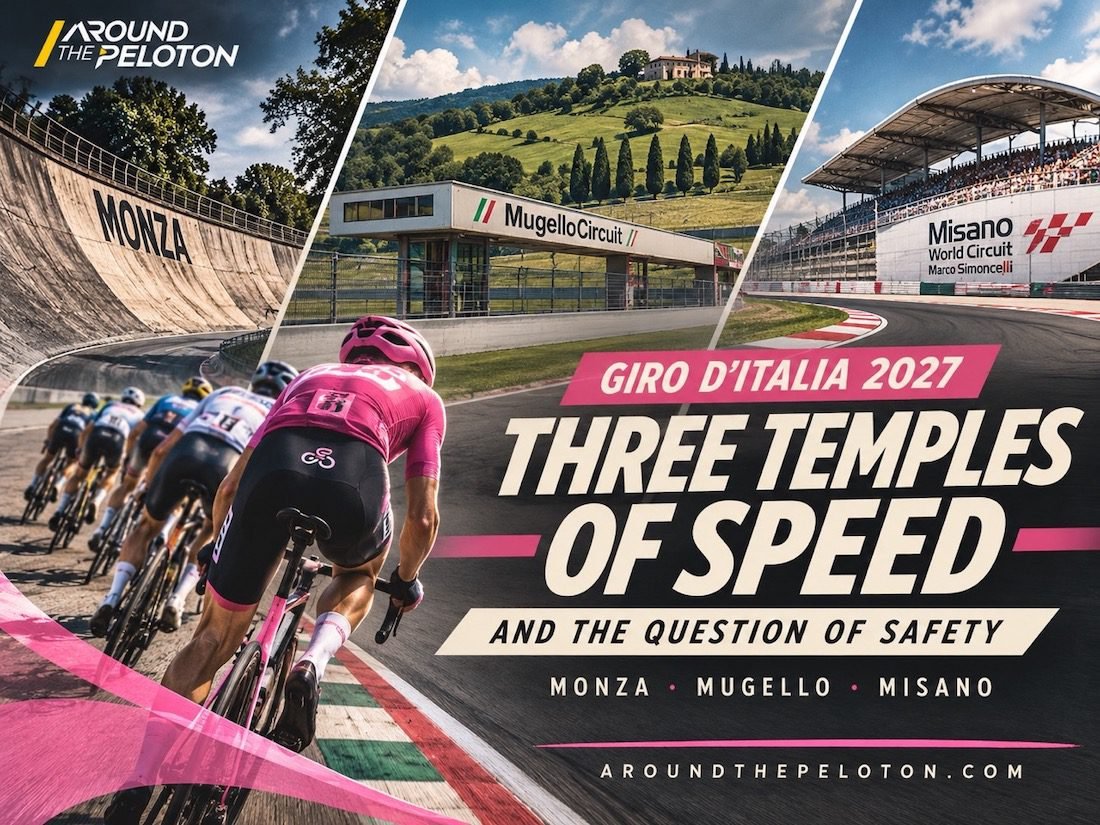

From the mountain roads of Mugello to the legendary circuits of Misano and Monza, the Giro d’Italia 2027 brings two Italian sporting traditions together, reopening a debate about speed, danger and the future of professional cycling.
Giro d’Italia 2027 | Stage 4: Misano, 11 May · 151 km | Stage 11: Mugello, 19 May · 220 km | Stage 15: Monza–Milan ITT, 23 May · 37.3 km
Long before Mugello became one of the world’s most celebrated motor racing circuits, its races unfolded across the public roads of Tuscany. Drivers accelerated through villages, negotiated the bends of the Apennine foothills and raced along mountain roads built for ordinary traffic rather than machines travelling at extraordinary speeds. The landscape was magnificent, the competition unforgiving, and the distinction between a racing circuit and the surrounding countryside barely existed.
A century later, motorsport has largely retreated from those roads into purpose-built venues, while professional cycling continues to race across them. In May 2027, the Giro d’Italia will briefly reverse that relationship, bringing the peloton inside three of Italy’s most famous circuits: Misano, Mugello and Monza.

Their inclusion is more than an opportunity to celebrate the country’s motorsport heritage. The Giro’s organisers have presented the decision as part of a wider effort to improve rider safety, particularly during high-speed finishes where a moment of hesitation or a poorly designed corner can have serious consequences.
A permanent circuit offers controlled access, smooth asphalt and space designed for competition, removing many obstacles found on ordinary roads. Yet a racetrack built for cars and motorcycles does not necessarily provide the ideal environment for nearly two hundred cyclists fighting for position.
The 2027 Giro therefore brings together two sports with a shared history of speed and danger, but very different relationships with the roads on which they compete.
Why the Giro Is Turning to Motorsport
The three circuits will appear at different moments in the 2027 race. Stage 4 travels from Argenta to the Misano World Circuit Marco Simoncelli on 11 May, covering 151 kilometres before an anticipated sprint finish. On 19 May, Stage 11 crosses central Italy from Gualdo Tadino to the Mugello Circuit, where another fast finish is expected after 220 kilometres, the longest stage of the race.
Monza has a different role. On 23 May, Stage 15 begins at the Autodromo Nazionale Monza before continuing toward Milan in a 37.3-kilometre individual time trial. Unlike Misano and Mugello, it will not host a mass sprint, an important distinction when considering the initiative’s safety benefits.
Luca Guercilena, cycling director of RCS Sports & Events, has connected the choice of circuits to discussions with riders and teams about dangerous finishes. He has also proposed using motorsport venues as secure training environments for young cyclists, allowing children and youth teams to practise away from ordinary traffic.
Those concerns acquired particular urgency on 14 May 2026, during Stage 6 from Paestum to Naples. As rain dampened the cobbles near Piazza del Plebiscito, a crash on the final corner disrupted the anticipated sprint, involving Dylan Groenewegen and Jonathan Milan among others. Davide Ballerini avoided the fallen riders and accelerated toward his first Giro stage victory.
Milan subsequently questioned why organisers continued to select complicated sprint finishes, arguing that even a little rain could turn such an approach into chaos. His reaction reflected a frustration shared by riders who must negotiate the final kilometres at racing speed rather than examine them from a course map.
For the Giro, the circuits offer an opportunity to demonstrate that course design can be part of the solution, while also bringing attention to the broader challenge of making cycling safer beyond professional competition.
Misano: Speed, Remembrance and the Adriatic Coast
The Misano World Circuit Marco Simoncelli stands near the Adriatic coast, between the seaside resorts of Misano Adriatico and Riccione, in a region where motorcycle racing has become an essential part of local identity.
Emilia-Romagna is often described as Italy’s Motor Valley, a territory whose workshops, manufacturers and racing teams have contributed enormously to the development of Italian motorsport. Bologna and Modena are internationally associated with Ducati, Ferrari and Lamborghini, while the Adriatic coastline has produced generations of motorcycle racers and devoted supporters.

Misano belongs to this wider culture, where racing extends beyond the circuit into the engineering workshops, local businesses and communities surrounding it. Opened in 1972, the venue developed into one of Italy’s major motorcycle racing destinations, attracting international competitions and helping establish the Adriatic coast as an important centre of the sport.
Its history also contains reminders of the consequences of speed. In 1993, American motorcycle champion Wayne Rainey suffered a devastating accident at Misano, leaving him paralysed and ending his career. One of the defining riders of his generation, Rainey became closely associated with an era when motorcycle racing was confronting the need for improved circuit design and medical response.
Following substantial redevelopment, MotoGP returned to Misano in 2007. The modernisation included reversing the racing direction, extending the track and widening its surface, demonstrating how even an established circuit could be substantially redesigned to meet changing requirements.
Five years later, the venue was renamed in memory of Marco Simoncelli, the Italian rider from nearby Coriano who died following an accident during the 2011 Malaysian Grand Prix at Sepang. Simoncelli’s death did not occur at Misano, but the dedication reflects the profound connection between the rider, his community and the sport.
Unlike Mugello and Monza, Misano does not have a clearly documented previous Giro stage finish inside its motor racing circuit. Its significance in 2027 comes instead from the meeting of two sporting cultures: the Giro’s tradition of racing through Italian towns and countryside, and a region where motorcycle competition has become an enduring part of local identity.
When the peloton enters Misano, it will arrive at a venue whose history embodies both the exhilaration of competition and the responsibility that accompanies it. The circuit offers the organisers a controlled racing environment, while its past provides a reminder that safety is never a permanent achievement but something that must continually evolve.
Mugello: From Mountain Roads to a Permanent Circuit
If Misano represents the culture of Italian motorcycle racing, Mugello offers something even closer to cycling’s own history: a motorsport tradition born on the same public roads that cyclists continue to use.
The first Mugello motor race took place in 1914, and later editions became associated with a formidable road circuit of approximately 66 kilometres through the Tuscan countryside north of Florence. The route passed through Scarperia, Firenzuola and the Futa Pass, crossing wooded hills, mountain villages and roads climbing toward the Apennines.

Drivers accelerated along open sections before encountering narrow bends, changing gradients and settlements where the road remained part of everyday life. Unlike modern permanent circuits, the course offered little separation between competition and the surrounding territory.
Among the competitors was Enzo Ferrari, who won his class at Mugello in 1921 driving an Alfa Romeo, long before the company bearing his name became one of the most recognisable symbols of Italian engineering.
The old Mugello races belonged to the same sporting world as the Targa Florio in Sicily and the Mille Miglia across the Italian peninsula. These competitions transformed public highways into enormous racing circuits, combining extraordinary landscapes with risks that became increasingly difficult to justify as vehicle performance improved.
The transition toward permanent circuits was neither immediate nor universal, but it reflected a fundamental change in motorsport. Rather than accepting the limitations of ordinary roads, organisers increasingly sought environments where surfaces, spectator areas, emergency access and surrounding infrastructure could be controlled.
The modern Mugello Circuit opened in 1974 near Scarperia, preserving the region’s motorsport identity while relocating competition into a purpose-built venue. Ferrari acquired the circuit in 1988, and Mugello subsequently became an important testing and racing facility, particularly for motorcycles.
Its modern layout remains closely connected to the landscape. The track rises and falls through the Tuscan hills, with sweeping corners and significant elevation changes that distinguish it from flatter circuits. MotoGP has made the venue internationally famous, while Formula One arrived in 2020 for the Tuscan Grand Prix, marking Ferrari’s thousandth Formula One World Championship race.
The Giro also has a remarkable history here. On 28 May 1977, Freddy Maertens won the morning half-stage from Forlì to Mugello, but crashed during the finishing sprint and fractured his wrist, forcing him to abandon the race. That afternoon, Marino Basso won a separate 79-kilometre half-stage contested entirely within the circuit.
Thirty years later, in 2007, Alessandro Petacchi crossed the finish line first at Mugello after the stage from Spoleto, beating Thor Hushovd and Paolo Bettini in a bunch sprint. The 2027 arrival will therefore be the circuit’s fourth Giro stage finish, counting the two 1977 half-stages separately, across three editions: 1977, 2007 and 2027.
Maertens’ accident adds a sobering dimension to the return. Even on a purpose-built racing surface, one of the strongest sprinters of his generation suffered an injury that ended his participation in the Giro. The venue’s history therefore offers both an example of cycling’s willingness to experiment with circuits and a reminder of the limitations of that approach.
The historical contrast remains remarkable. Motorsport once raced across the mountain roads surrounding Mugello before moving into a permanent circuit, while cycling still celebrates those same roads as the essential setting of its greatest competitions.
The riders of Stage 11 will travel 220 kilometres before reaching the circuit, crossing a region whose landscape and history have shaped both sports. Only at the end will they exchange the ordinary highway for asphalt designed specifically for racing.
Monza: A Century at the Temple of Speed
The Autodromo Nazionale Monza occupies a singular place in Italian sporting history. Built in 1922 within the royal park north of Milan, it became the world’s third purpose-built motor racing circuit, following Brooklands in Britain and Indianapolis in the United States.
Monza was conceived during an era when automobile racing represented technological ambition as much as sporting competition. Its long straights and fast corners allowed manufacturers to test the limits of their machines, while the Italian Grand Prix helped establish the circuit as one of the most important venues in international motorsport.

The surviving banked sections of its historic oval remain among the most evocative monuments of that period. Their steep concrete curves recall an age when speed was pursued with extraordinary determination, often before the consequences of that ambition were fully understood.
The circuit’s nickname, the Temple of Speed, reflects both its technical character and its emotional significance to Italian motorsport supporters. Ferrari’s relationship with Monza has made the venue particularly important to generations of spectators, while its history includes fatal accidents and repeated modifications intended to improve safety.
Monza has already witnessed an important moment in Giro history. In 2017, the centenary edition began its final individual time trial at the circuit before continuing to Milan, where Tom Dumoulin overturned his deficit to Nairo Quintana and secured overall victory.
Ten years later, the Giro will return for another race against the clock, although the 37.3-kilometre stage will take place at the end of the second week rather than on the final day.
Unlike Misano and Mugello, Monza will not test the safety of a mass sprint. Riders will depart individually, with the competition shaped by pacing, aerodynamics and the ability to maintain speed over the route toward Milan.
Its contribution to the Giro’s three-circuit programme is therefore primarily historical and symbolic, connecting cycling with a venue that has spent more than a century exploring the possibilities and consequences of speed.
Are Motor Racing Circuits Really Safer for Cyclists?
The apparent advantages of a permanent racing circuit are considerable. Ordinary urban roads contain roundabouts, traffic islands, road markings, parked vehicles and changes in surface quality, all of which can become dangerous when a peloton approaches a finish at high speed.

The debate is also taking place within a changing regulatory framework. The UCI’s 2026 finish-safety standards require a finishing straight of at least 200 metres, with a consistent road width and particular attention to avoiding obstacles in the final kilometre. Continuous protective barriers are required around the finish, including at least 300 metres before and 100 metres beyond the line.
These measures address identifiable hazards, but they cannot eliminate the risks created when dozens of riders accelerate together toward the same finishing point.
The clearest warning came during Stage 4 of the 2023 Tour de France, which finished at the Circuit Paul Armagnac in Nogaro, southwestern France. Several crashes disrupted the closing kilometres before Jasper Philipsen won the sprint, despite the event taking place on a venue designed for motor racing.
The incidents highlighted difficulties involving the approach, a relatively narrow entrance and the sequence of corners. Rather than demonstrating that the circuit’s width caused the crashes, Nogaro showed how the transition from ordinary roads to a racing venue could itself become part of the problem.
Mathieu van der Poel, who had helped lead out Philipsen, questioned the assumption afterward, arguing that a circuit was not necessarily safer than an ordinary road finish. Jasper De Buyst also highlighted the unusual transition from a narrow entrance to the much wider racing surface.
Their observations exposed a fundamental difference between motorsport and professional cycling. Cyclists frequently travel in tightly packed groups, relying on small changes of position and continuous adjustments to maintain balance and speed. During a sprint, those movements become more aggressive as teams attempt to deliver their leaders toward the front.
A wide circuit may provide additional room, but it can also allow more teams to contest the same positions simultaneously. Conversely, a narrow approach may encourage an orderly formation while creating dangerous congestion if the road suddenly contracts.
The essential issue is therefore not simply the amount of available asphalt, but how the riders reach it and how the final kilometres influence their behaviour.
For the 2027 Giro, the most useful lessons may emerge from the details of the Misano and Mugello finishes: the design of the entrances, the placement of corners, the length of the final straight and the measures taken to avoid unnecessary obstacles.
Professional cycling cannot eliminate the risks inherent in competition. It can, however, distinguish those risks from dangers introduced by preventable weaknesses in course design.
Beyond the Finish Line: What the Giro Can Change
The Giro’s decision is significant because it treats safety as part of race planning rather than merely a subject discussed after an accident. By selecting three internationally recognised motorsport venues, the organisers have created an opportunity to examine how controlled racing environments might contribute to safer professional cycling.
The limitations are equally important. Two sprint finishes represent only a small part of a Grand Tour covering thousands of kilometres, and the success of the initiative cannot be measured simply by whether the riders reach the finish without crashing.
Its greater value may lie in identifying principles that can be applied elsewhere: predictable approaches, consistent surfaces, carefully positioned barriers and the removal of unnecessary obstacles from high-speed sections.

Guercilena’s broader proposal to use circuits as training environments for young cyclists also connects the initiative with a challenge extending beyond professional sport. A venue separated from ordinary traffic may offer children and developing riders opportunities that are difficult to reproduce on public roads, although access, cost and local infrastructure will determine how widely those benefits can be shared.
There is a historical irony in the Giro’s return to Mugello. A century ago, motor racing embraced the public roads of Tuscany before increasingly moving into dedicated venues where the conditions of competition could be controlled. Cycling, by contrast, has retained those roads as the foundation of its identity, drawing much of its cultural significance from the landscapes, villages and communities through which the peloton travels.
Misano, Mugello and Monza will not change that tradition, nor should they. The Giro belongs to the roads of Italy, and its relationship with the country would be diminished if competition were confined to permanent circuits.
But for a few kilometres in May 2027, the peloton will enter places built by another sport’s long experience of speed, danger and technical progress. The real measure of the experiment will not be what happens inside their gates, but whether the lessons can follow the riders when they return to the roads beyond them.