
From the crowded mountain climbs of the Tour de France to the cobbled roads of Flanders, the essential rules of roadside cycling etiquette, and why respecting them matters to every rider.
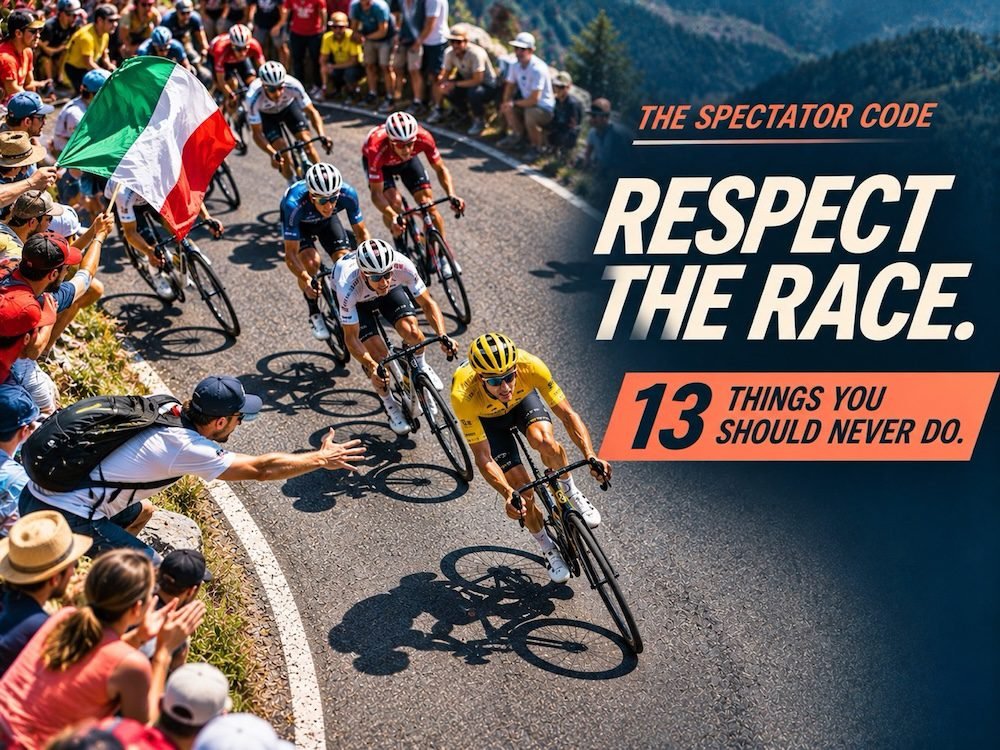
There is a moment on a mountain stage when the sound of the crowd begins to travel up the road before the riders appear. Motorcycles emerge around a bend, followed by the race leaders, their faces marked by the effort of the climb. Spectators who have waited for hours lean forward to see them, and for a few seconds the distance between professional athletes and the people cheering them can be measured in centimetres.
It is one of the extraordinary privileges of watching road cycling. In most major sports, spectators are separated from competitors by stands, fences or carefully controlled boundaries. Cycling takes place on public roads, passing through villages, farmland, mountain valleys and city centres, where thousands of people can experience the race without entering a stadium. The Basque crowds on the Pyrenean climbs, the supporters gathered on the Oude Kwaremont during the Tour of Flanders and the enormous gatherings on Alpe d’Huez are as much a part of cycling’s cultural landscape as the roads themselves.
But the absence of a physical barrier does not mean the absence of a boundary. A rider fighting to maintain balance on a steep gradient, a sprinter travelling at more than 60 kilometres per hour or a descending cyclist approaching a blind corner cannot afford to negotiate with spectators who have moved into the road. What looks harmless from the roadside can become dangerous in an instant.
Professional cycling has learned this through painful experience. Crashes involving spectators, collisions with race motorcycles and incidents caused by signs, flags and other objects have repeatedly demonstrated how quickly enthusiasm can interfere with competition. The responsibility is not limited to organisers, police or race marshals. It belongs to everyone who chooses to stand beside the course.
These thirteen rules are not intended to discourage the passion that makes cycling special. They explain how to preserve it without placing riders, fellow spectators or the communities hosting the race at unnecessary risk.
1. Never Touch, Grab or Push a Rider
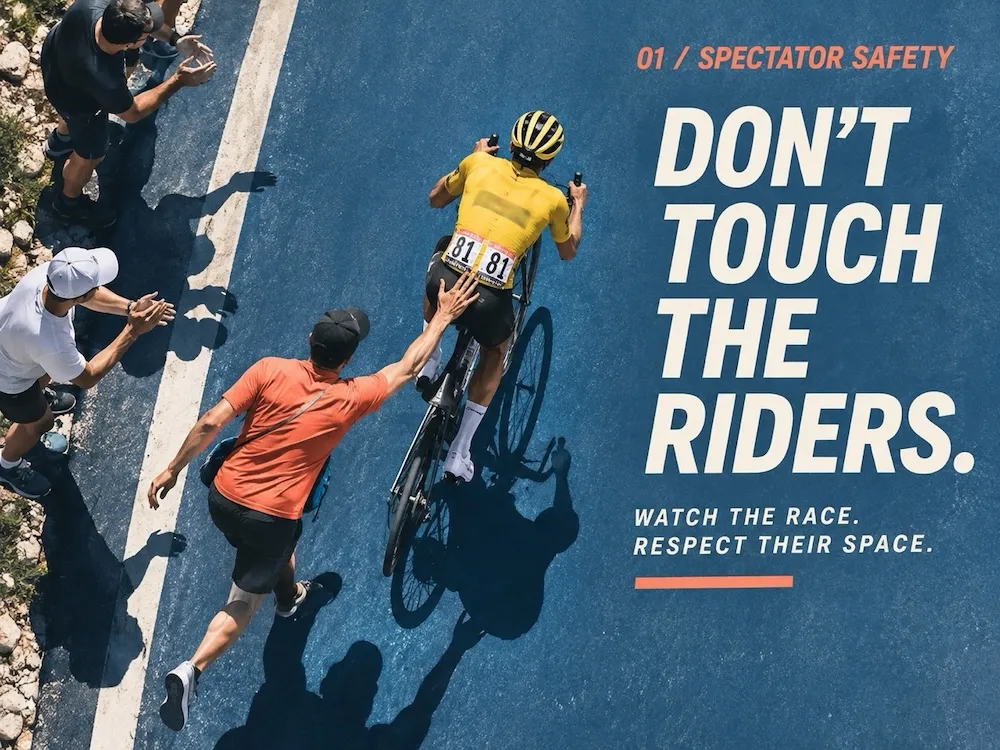
On a steep mountain climb, a rider may be travelling slowly enough for spectators to walk beside them. Their shoulders move with each pedal stroke, their breathing becomes audible and the effort of maintaining forward momentum is visible in every movement. For someone standing nearby, placing a hand against the rider’s back can seem like a natural gesture of encouragement, but it is also one of the easiest ways to interfere with the race.
A cyclist climbing at low speed is often balancing carefully while applying considerable force through the pedals. Unexpected contact can alter that balance, particularly when the rider is standing out of the saddle or moving across the road to negotiate the gradient. A push that appears helpful may send the bicycle towards another competitor, a roadside barrier or the spectators themselves.
There is also a sporting consequence. Cycling regulations restrict outside assistance, and physical help from a spectator can create questions about fairness or expose a competitor to disciplinary action, depending on the circumstances and applicable rules. An unsolicited push does not automatically mean a rider will be penalised, but spectators should never place competitors in a position where their conduct becomes a matter for the race jury.
Grabbing a rider’s arm, touching their helmet or reaching towards their bicycle is equally unacceptable. A rider can hear the crowd, recognise familiar team colours and draw motivation from supporters without anyone making physical contact.
2. Never Run Alongside or Behind Riders
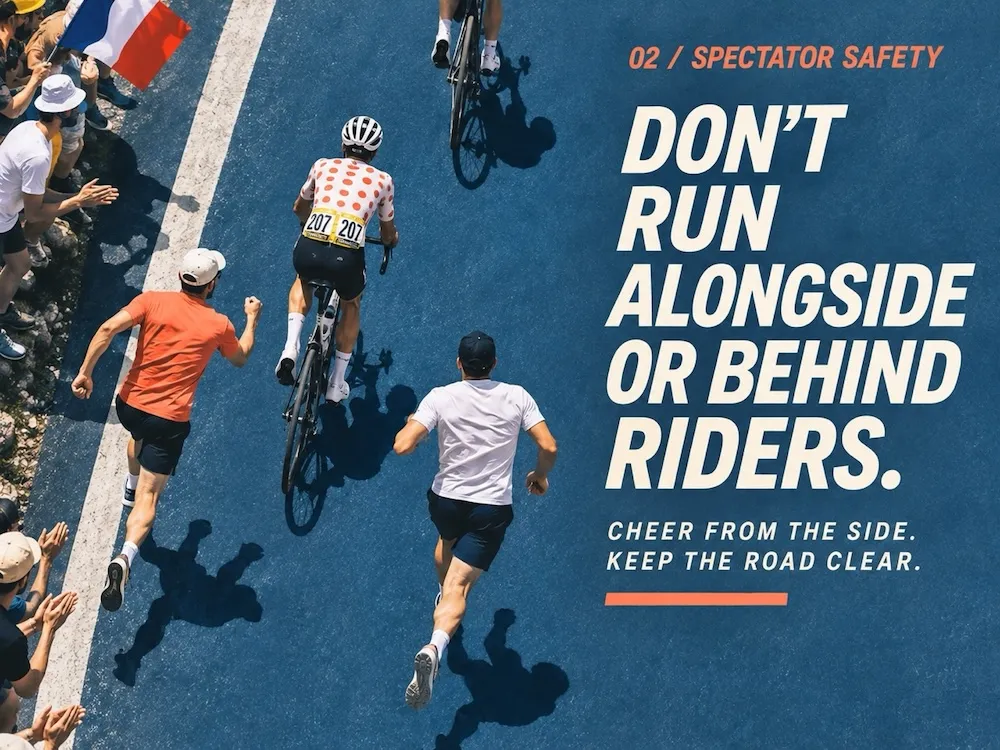
Few images are more closely associated with Tour de France mountain stages than spectators running beside exhausted cyclists. Some wear elaborate costumes, others carry flags, and a few appear determined to remain on television for as long as possible. On climbs such as Alpe d’Huez or the Col du Tourmalet, these scenes have become so familiar that they are sometimes treated as an ordinary part of the spectacle, despite the danger they create.
A rider climbing at ten kilometres per hour is still competing under considerable physical strain. They may suddenly stand on the pedals, change their line to avoid a rough patch or accelerate in response to an attack. Someone running alongside them cannot reliably anticipate those movements, particularly while looking towards a camera or attempting to stay ahead of the bicycle.
The problem becomes more serious when several spectators begin running together. One person moves forward, others follow, and the space available to riders gradually disappears. A runner who stumbles may fall directly into the path of the race, while people attempting to avoid one another can collide with competitors or accompanying motorcycles.
The danger is not confined to the riders. During Stage 4 of the 2024 Tour de France, on the Col du Galibier, a spectator running alongside the race was pushed down a roadside slope by another spectator. The confrontation was captured on video and demonstrated how quickly the behaviour of one person can provoke a dangerous reaction from others in an already crowded environment. There was no reported rider crash associated with the episode, but it exposed the risks created when spectators abandon their positions to follow the race.
Running behind riders creates another hazard because the course remains active for following cyclists and race vehicles. The mountains already provide enough drama through the competition itself, and supporters can create an extraordinary atmosphere without forcing the athletes to navigate through the people cheering them.
3. Never Light Flares or Smoke Bombs
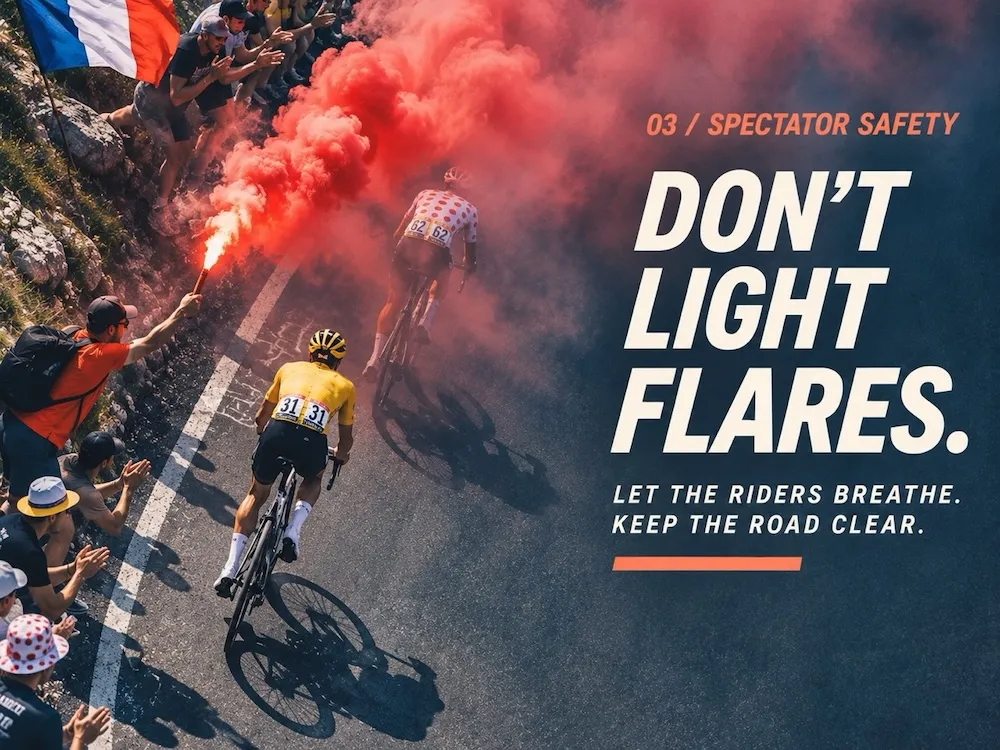
Coloured smoke can produce striking images when a peloton climbs through a crowd, particularly on the steep roads of the Alps or Pyrenees. Supporters sometimes use flares to display national colours or create a dramatic backdrop for television cameras, but the visual effect can conceal substantial risks.
A cyclist approaching a cloud of smoke may suddenly lose sight of the road surface, the rider ahead or the entrance to a corner. On a mountain climb, where competitors are already breathing heavily, smoke can cause irritation and make an intense physical effort more uncomfortable.
Burning flares present a separate danger. They produce substantial heat, and a device held close to a passing cyclist can cause burns or ignite clothing and other materials. Sparks, discarded pyrotechnics and hot residue also threaten spectators standing nearby, particularly in tightly packed crowds where moving away may be difficult.
Many summer races cross forests, grasslands and mountain pastures where vegetation can become dry. Introducing an ignition source into these environments creates a risk that extends beyond the race itself, potentially affecting surrounding landscapes and communities.
Flags, jerseys and roadside decorations already provide the colours that make cycling crowds distinctive. A mountain climb filled with cheering supporters needs no smoke to become memorable.
4. Never Wave Flags, Banners or Phones Into the Road
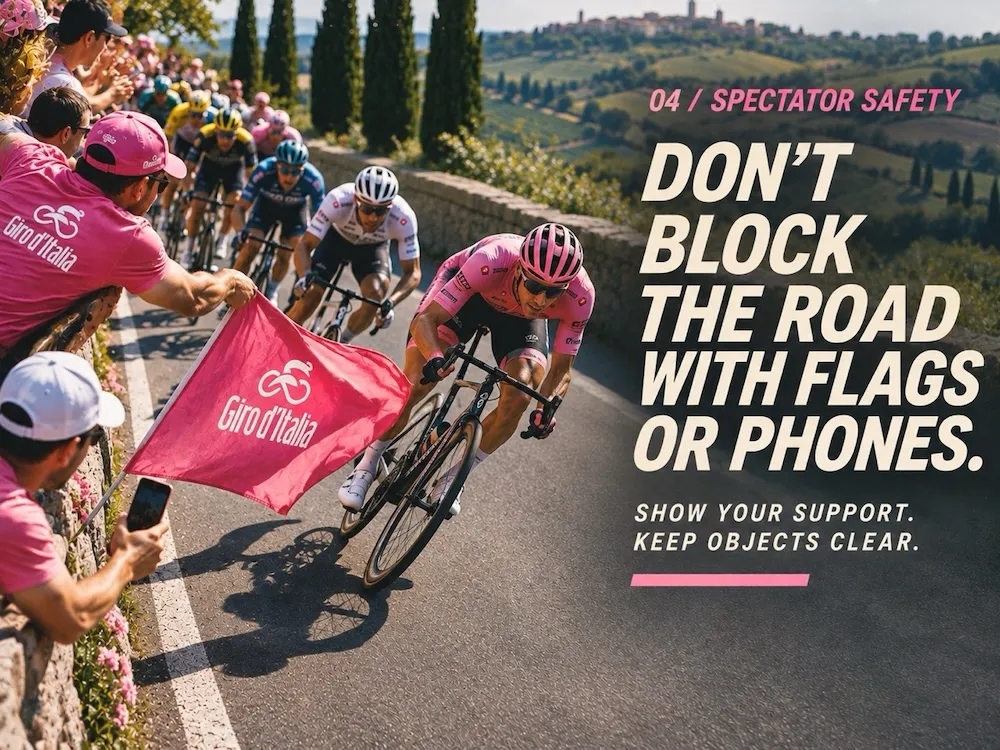
Flags have accompanied cycling for generations. Basque supporters bring their ikurriñas to the Pyrenees, Belgian fans line the cobbled roads of Flanders with national colours, and mountain passes throughout the Grand Tours become temporary displays of regional identity. These traditions contribute to the character of each race, but the objects spectators carry must remain outside the riders’ path.
A loose flag can catch a handlebar or become entangled with a bicycle, while a rigid pole creates an obstacle that a rider may not notice until it is too late. Mobile phones have introduced another problem, with spectators leaning forward to capture photographs while concentrating on their screens rather than the approaching cyclists.
The opening stage of the 2021 Tour de France demonstrated the consequences. A spectator holding a cardboard sign reading Allez Opi-Omi extended it into the road as the peloton approached. Tony Martin struck the sign, triggering a major crash involving numerous riders and causing injuries that affected the race well beyond the incident itself. The spectator was subsequently fined €1,200 by a French court.
Two years later, another spectator-related incident disrupted the 2023 Tour de France. During Stage 15, Sepp Kuss collided with a spectator’s outstretched arm near the roadside, triggering a crash involving several riders, including Nathan van Hooydonck and Egan Bernal. The episode again demonstrated how little space exists between a moving peloton and the public, and how quickly an intrusion into that space can affect multiple competitors.
Neither incident required a spectator deliberately attempting to injure a rider. That is precisely what makes them important examples: ordinary objects and momentary inattention can produce consequences entirely disproportionate to the original action.
Flags, photographs and banners remain welcome parts of cycling culture, provided they stay securely controlled and completely clear of the racing corridor.
5. Never Throw Objects at Riders
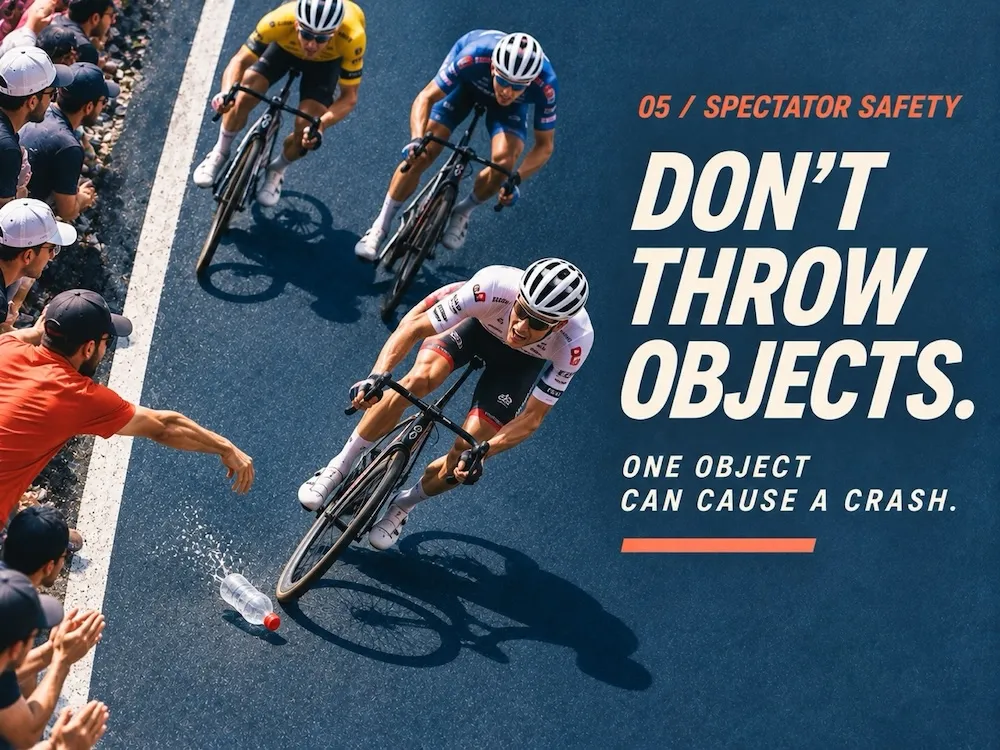
With approximately 33 kilometres remaining in Paris–Roubaix on 13 April 2025, Mathieu van der Poel was struck in the face by a water bottle thrown from the roadside. He was riding at racing speed over one of cycling’s most demanding courses, where the combination of cobblestones, fatigue and intense concentration already leaves little margin for error.
The incident was widely condemned, and the UCI announced that it would pursue the legal avenues available to it. It was a reminder that an object which appears ordinary in a spectator’s hand can become dangerous when thrown towards an athlete travelling at speed.
The risks are particularly severe during sprint finishes, when riders may exceed 60 kilometres per hour while travelling only centimetres apart. A bottle, piece of food or other object entering the road can force a sudden reaction, potentially affecting several competitors who never see the original obstacle. Even on mountain climbs, where speeds are lower, something thrown towards a cyclist can disrupt balance or remain on the road for following riders and motorcycles.
Liquids are not harmless simply because they lack the impact of a solid object. A drink striking a rider’s face can temporarily obstruct vision, while sticky substances may interfere with equipment or leave residue on the road.
The Van der Poel incident demonstrates why throwing objects cannot be dismissed as a joke or an expression of frustration. Whether the intended target is a race leader, a rival or a passing group, spectators have no justification for introducing an avoidable hazard into the competition.
6. Never Spray Riders With Water
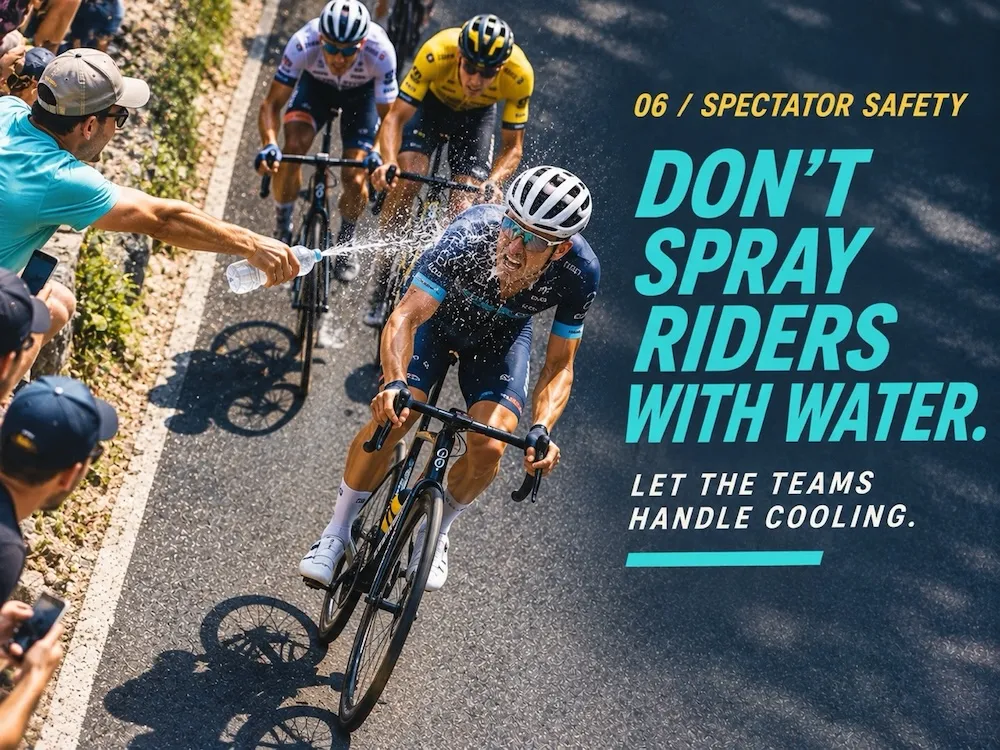
On a hot summer afternoon, the sight of cyclists struggling up a long climb can make spectators want to help. Temperatures may exceed 30 degrees Celsius, the road can offer little shade, and riders who have already spent hours racing may appear desperate for relief. Some supporters respond by spraying water from bottles, hoses or other containers as the competitors pass.
Although the intention may be generous, unexpected spraying can interfere with a rider’s concentration and control. Water directed towards the face may temporarily obstruct vision, particularly when it strikes sunglasses, while a sudden spray can provoke an instinctive movement at a moment when the cyclist needs to maintain balance.
The consequences can extend beyond the intended recipient. On a crowded climb, several competitors may pass together, and water aimed at one rider can strike others who are approaching a corner or concentrating on the wheel ahead. Spraying the road surface may also create localised changes in grip, especially where the surface is already slippery.
Professional teams have established procedures for hydration and cooling, including bottles supplied through authorised feeding arrangements and cooling methods used during hot stages. Race organisers may also provide specific arrangements for extreme conditions, but spectators should not independently decide when or how to cool passing competitors.
The responsible approach is to leave hydration and cooling to the riders, their teams and authorised personnel. A rider’s exhaustion may inspire sympathy, but protecting their concentration is more valuable than an unexpected shower.
7. Never Cross the Road While the Race Is Passing
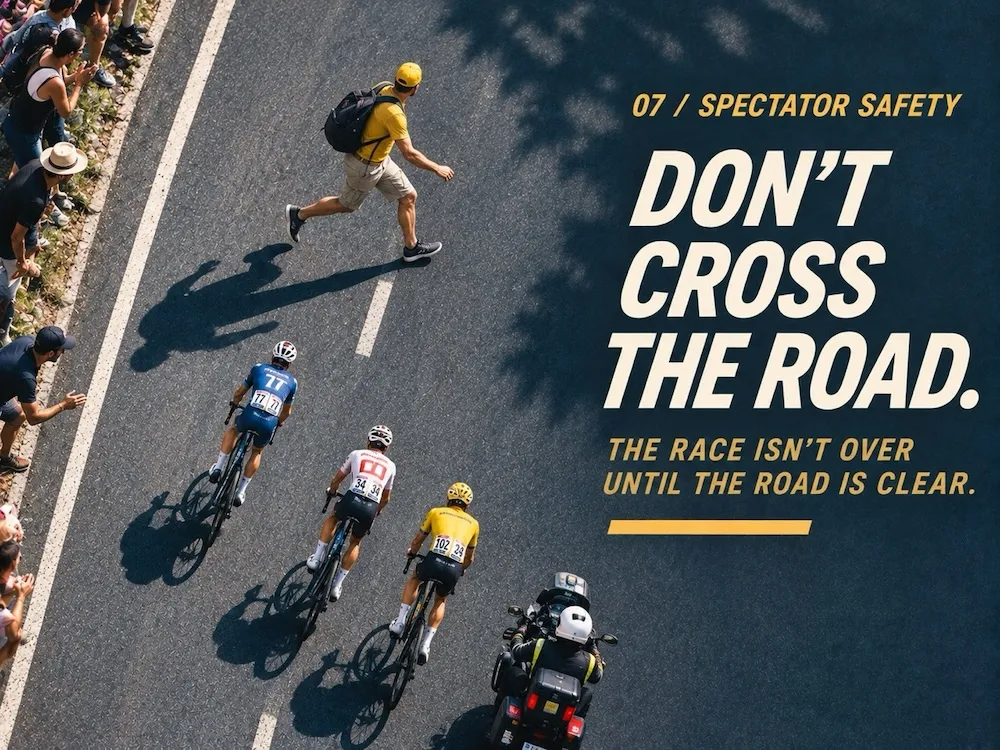
A cycling race rarely passes as one uninterrupted group. On flat stages, the peloton may be followed by riders who have suffered mechanical problems, while mountain stages can scatter competitors across several kilometres of road. Between them travel motorcycles, medical vehicles, team cars and officials, all operating within a moving race convoy.
These gaps can be deceptive. The leading riders may disappear around a corner, leaving the road apparently empty for several minutes. Someone waiting on the opposite side may decide that this is the opportunity to cross, unaware that another group is approaching or that a race vehicle is about to emerge from behind the bend.
The danger is especially serious on descents. Riders may travel at more than 70 kilometres per hour, covering nearly twenty metres every second, and a pedestrian stepping into the road can leave insufficient distance for braking or evasive action.
Race marshals and police manage crossings where they are permitted, and their instructions must take precedence over individual judgement. Even when a spectator can see a long stretch of apparently empty road, that does not mean the course has reopened. The race continues until the authorised personnel responsible for the road confirm otherwise.
8. Never Obstruct the Course, Even to Encourage Riders
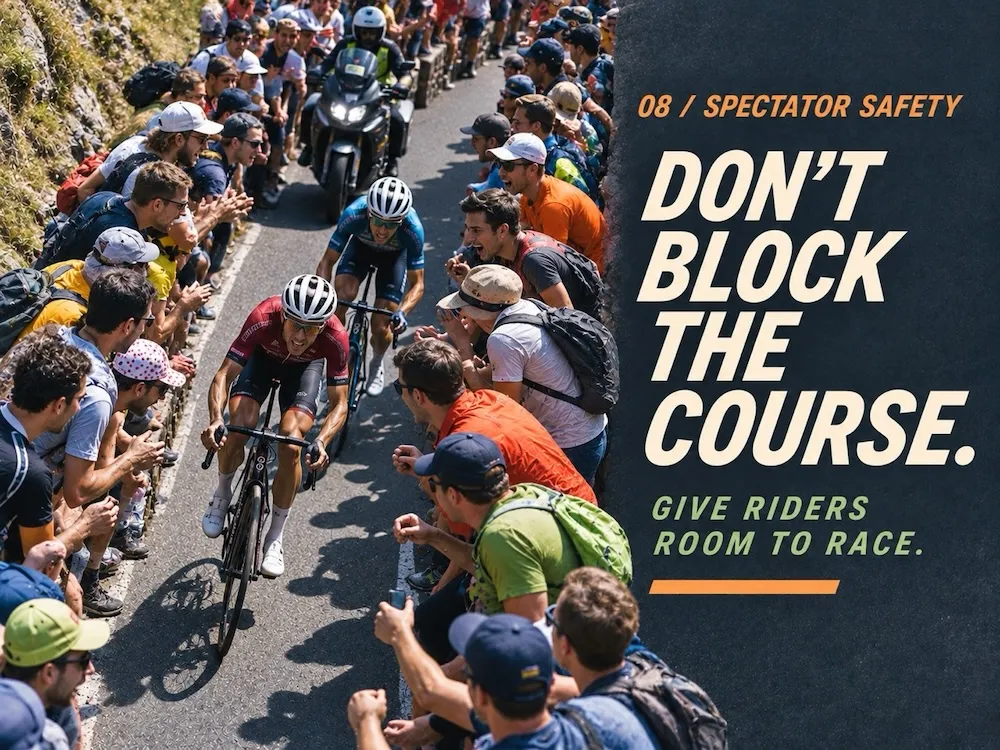
Some of cycling’s most recognisable mountain images show competitors passing through a narrow corridor of spectators, with crowds opening only as the riders approach. The atmosphere can be extraordinary, but the available space is often much smaller than it appears on television.
A cyclist climbing a steep road needs room to maintain balance, overtake another rider or change position in response to the gradient. Race motorcycles and support vehicles require additional clearance, particularly when the road is already occupied by spectators standing beyond its edges.
The 2016 Tour de France provided a dramatic illustration on Mont Ventoux. During a crowded mountain stage, a television motorcycle was forced to stop, and Richie Porte collided with it. Chris Froome and Bauke Mollema were also involved in the resulting crash. Froome’s bicycle was damaged, and the race leader was briefly seen running uphill without a functioning machine.
The immediate obstacle was the stopped motorcycle, not a spectator making direct contact with a rider. However, the congestion surrounding the race contributed to the circumstances in which the vehicle stopped, demonstrating how restricted space can affect both competitors and the convoy accompanying them.
Another serious episode occurred on Alpe d’Huez during the 2018 Tour de France, when Vincenzo Nibali crashed amid a dense crowd. He suffered a fractured vertebra and was forced to abandon the race. Contemporary accounts differed over the precise cause, with explanations involving spectator contact, a camera strap and the proximity of a motorcycle. The exact mechanism remains disputed, but the incident renewed concerns about the limited space available to competitors on famous mountain climbs.
These episodes illustrate why keeping the road clear is not simply a matter of convenience. Riders need space to compete, while officials, motorcycles and medical personnel must be able to move without negotiating through a crowd.
Where barriers are installed, remain behind them. On open mountain roads, where physical separation may be limited, spectators must exercise even greater restraint. The crowd should provide the atmosphere around the race, not determine the width of the road available to it.
9. Never Insult, Intimidate or Abuse Competitors
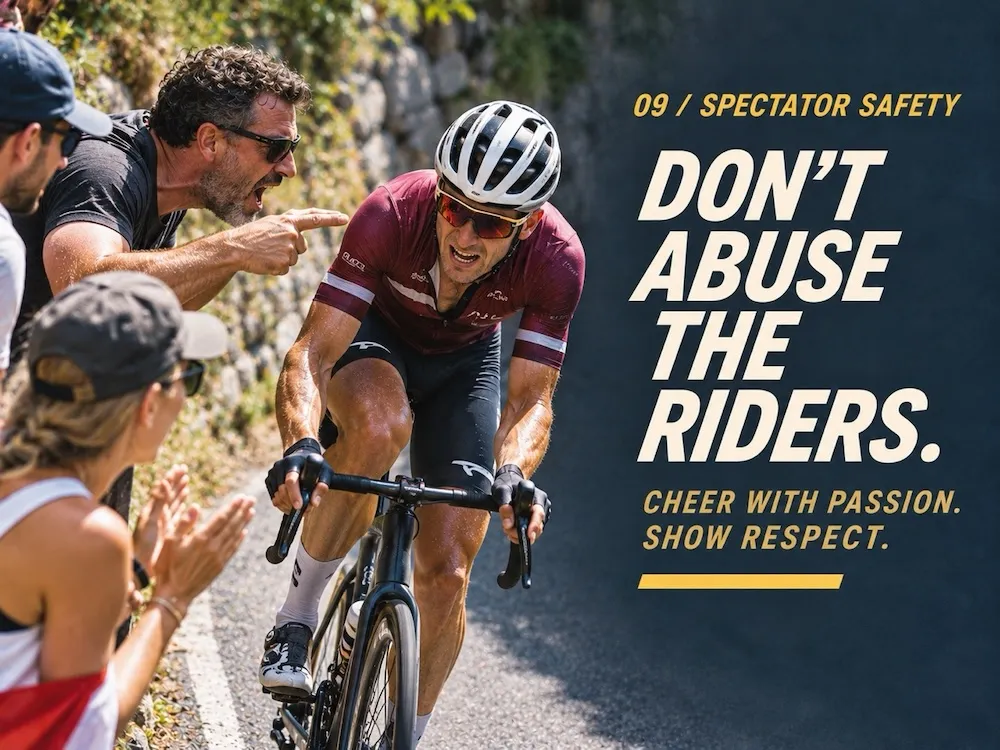
Cycling has always inspired strong loyalties. Supporters identify with national champions, regional teams and riders whose personalities or racing styles have captured their imagination. The rivalries between great champions have often been intensified by the passions of the crowds following them, but that enthusiasm should never become an excuse for hostility.
Unlike athletes competing inside a stadium, cyclists may spend kilometres passing within touching distance of spectators. A rider climbing a mountain cannot retreat from someone shouting abuse directly beside them, while an aggressive gesture or threatening movement can become a distraction during an already demanding physical effort.
The difference between passionate support and intimidation is not difficult to recognise. Chanting a rider’s name, displaying team colours and encouraging an attack belong to cycling’s traditions. Threatening competitors, directing personal abuse towards them or attempting to provoke a reaction does not.
Consider the riders arriving long after the leaders on a mountain stage. Some are domestiques who have spent the day protecting teammates, while others are sprinters fighting to remain within the time limit. Their struggle may receive little television coverage, yet they are completing the same climbs and facing the same weather as the riders competing for victory.
The tradition of encouraging these competitors is one of the most admirable aspects of roadside cycling. Spectators who remain to applaud the final riders recognise effort rather than celebrating only success, preserving a culture in which admiration for one champion does not require contempt for another.
10. Never Leave Litter or Damage the Environment
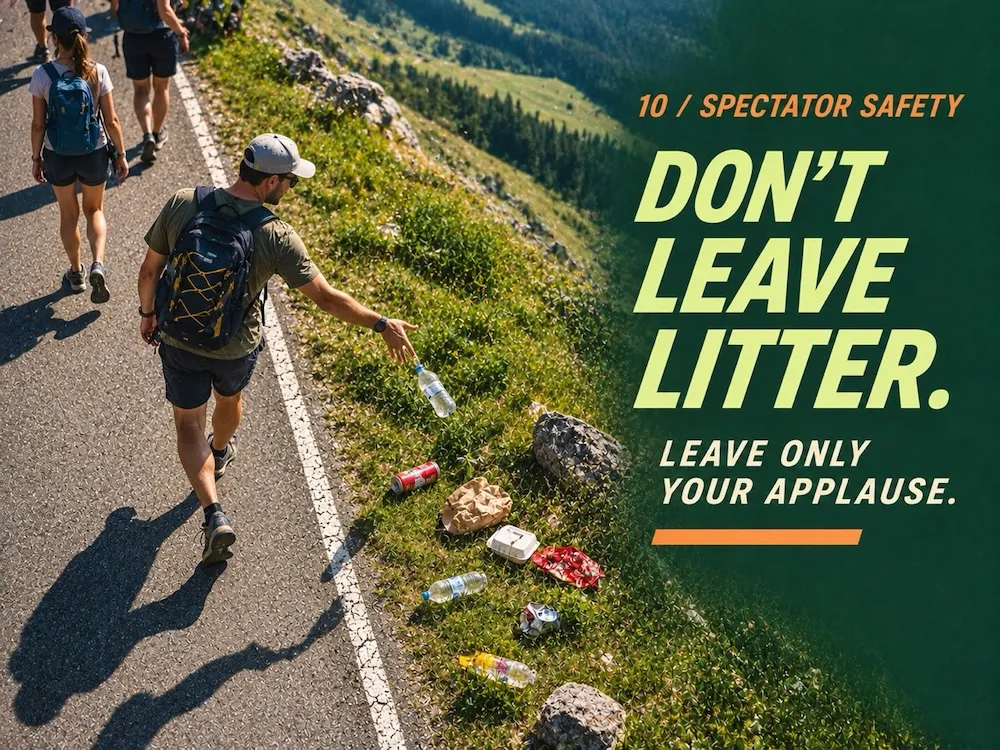
The great cycling races pass through landscapes that belong to communities long after the peloton has moved on. The mountain pastures of the Alps, the valleys of the Pyrenees, the vineyards of Tuscany and the agricultural roads of northern France are not temporary sporting arenas. They are working environments, natural habitats and places where people live.
A major race can bring thousands of spectators to locations that ordinarily receive far fewer visitors. Many arrive early, carrying food, drinks, clothing and equipment for a day beside the road. Without care, the aftermath can include discarded packaging, plastic bottles and other rubbish scattered across fields, ditches and mountain slopes.
The consequences were particularly visible after the 2026 Tour de France passed through the Col du Haag above Geishouse in Alsace. Spectators left discarded packaging, cans and other waste along the mountain road, forcing local volunteers to undertake an extensive clean-up. According to regional reporting, approximately one tonne of rubbish was collected, an extraordinary burden for a community that had welcomed the race only days earlier. The episode illustrated how the excitement of a single sporting event can leave environmental and logistical problems for residents long after the peloton has departed.
The damage is not limited to litter. Spectators who climb fences, enter farmland without permission or park vehicles on sensitive ground can interfere with agricultural work and damage private property. In mountain areas, trampling vegetation or leaving established paths can contribute to erosion and disturb fragile environments.
Cycling’s relationship with these landscapes is central to its appeal. The roads of the Tour de France, Giro d’Italia and Vuelta a España are memorable partly because they reveal the geography, culture and character of the regions through which they pass.
Respecting those places is therefore part of respecting the sport itself. Take rubbish away, use designated facilities, remain on permitted access routes and avoid damaging the property or land of local residents. The best spectators leave behind their applause, not their waste.
11. Never Leave Children or Pets Unattended Near the Course
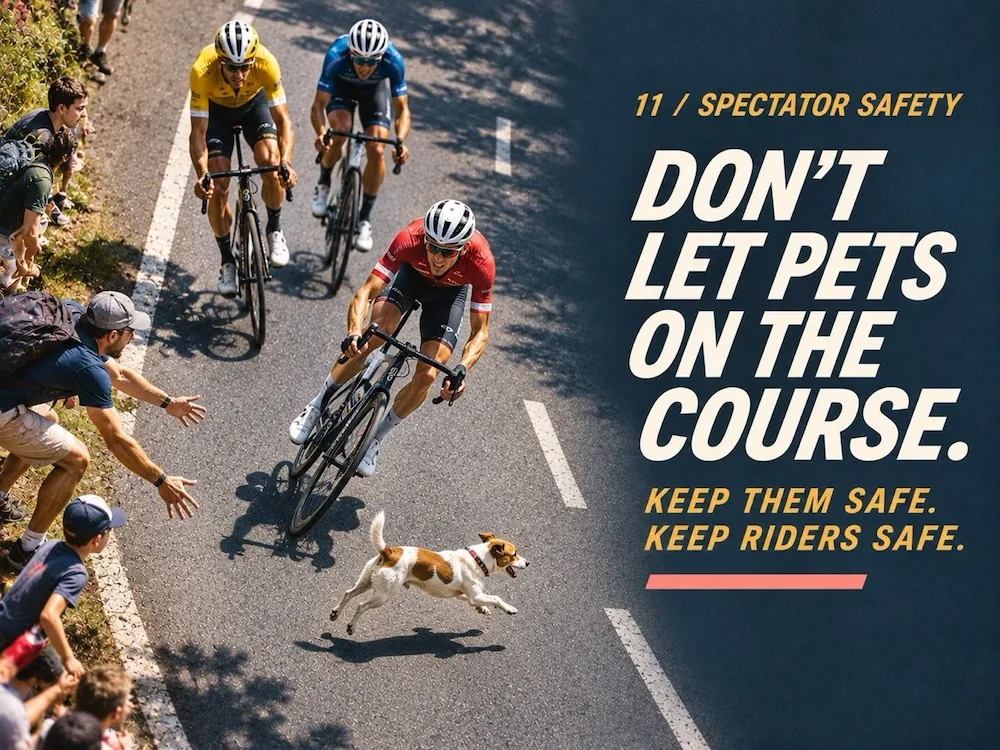
For many cycling supporters, attending a race is a family tradition. Children watch the publicity caravan, collect souvenirs and wait beside the road for the first glimpse of the peloton, often experiencing professional cycling at close range for the first time. Those memories can inspire a lifelong interest in the sport, but the roadside demands constant supervision.
A young child may not understand the speed of an approaching cyclist or the danger of stepping forward to retrieve an object. The excitement of seeing a favourite rider can lead to sudden movements, particularly when crowds begin reacting to the approaching race. Adults should keep children close and position them safely behind barriers where available, particularly near corners, descents and areas where visibility is limited.
Pets introduce another form of unpredictability. During Stage 12 of the 2022 Tour de France, Yves Lampaert crashed after a dog entered the course. The incident left him with a bleeding thigh injury and illustrated how an animal’s sudden movement can disrupt a race even when there is no deliberate interference by its owner.
A dog that is normally calm may react differently to helicopters, motorcycles, shouting crowds or cyclists passing at speed. If an animal runs onto the road, riders may be forced to brake or swerve, potentially causing a crash involving several competitors.
Dogs should be securely restrained and kept away from the course. In particularly crowded locations, where controlling an animal may become difficult, leaving pets at home can be the more responsible choice.
A family day at the races should remain enjoyable for everyone, including the competitors whose safety depends on spectators keeping children and animals under control.
12. Never Fly Unauthorised Drones Near the Race
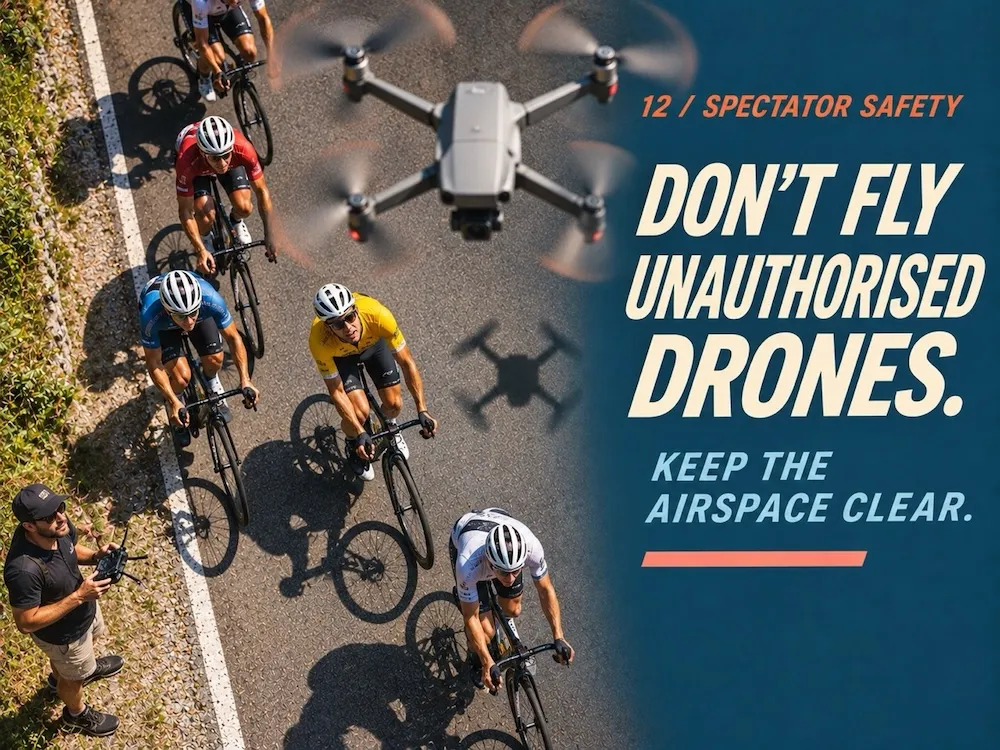
The availability of small consumer drones has made aerial photography accessible to almost anyone, and the landscapes surrounding major cycling races offer tempting opportunities for dramatic images. A mountain road winding through the Alps or a peloton crossing open countryside may appear ideal for filming from above, but a professional race is not an appropriate setting for an unauthorised drone flight.
This is not merely a theoretical concern. On 16 July 2024, during Stage 16 of the Tour de France, French authorities identified an unauthorised drone operating above the finish area in Nîmes. Its operator was arrested, and the incident led to legal proceedings. Even without a collision, the episode illustrated why major cycling events regulate aircraft operating near competitors and spectators.
The problem is not simply whether the operator can control the aircraft under normal conditions. A drone may lose power, encounter unexpected wind or suffer a technical failure, and an uncontrolled descent towards a road filled with cyclists or spectators can have serious consequences.
Professional races may also involve helicopters, authorised aerial filming and emergency operations. Unauthorised aircraft can interfere with these activities, while temporary airspace restrictions may extend beyond the immediate course.
The UCI permits drone filming under specific operational and safety conditions, including separation requirements from riders and spectators. Those provisions apply to authorised operations and do not constitute permission for recreational spectators to launch drones near a race.
National aviation rules, local restrictions and event-specific regulations must all be respected. Permission to fly a drone in ordinary circumstances does not necessarily extend to a professional sporting event, regardless of how open or isolated the surrounding landscape may appear.
13. Never Stand in Dangerous Positions
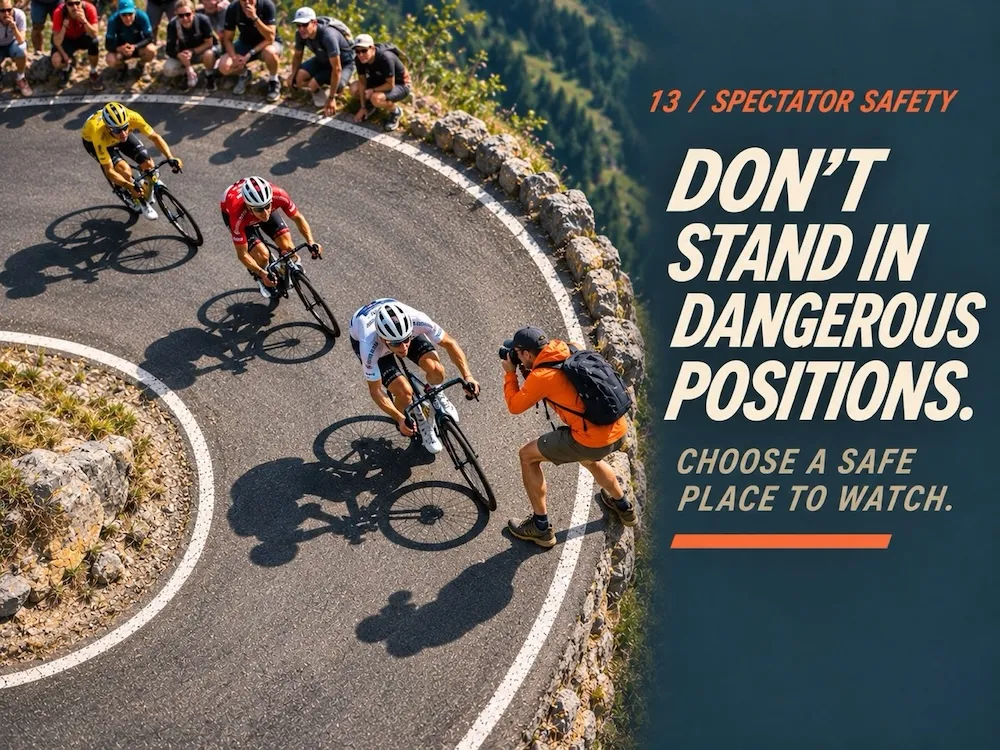
Finding the right place to watch a race is part of the experience. Some spectators prefer a steep mountain gradient where the riders pass slowly, while others choose a technical descent, a cobbled climb or the approach to a sprint finish. Each location offers a different perspective, but the quality of the view should never be the only consideration.
The outside of a fast corner is particularly hazardous. If a cyclist loses control, their momentum may carry them towards the edge of the road, leaving anyone standing in that area exposed to the consequences. The exit of a downhill bend can be especially dangerous because riders may be accelerating while still completing the turn.
Blind corners and narrow descents require additional caution. A spectator standing where approaching riders cannot see them may leave insufficient room for evasive action, while locations immediately beyond a crest can conceal the speed and direction of the race until the competitors are very close.
Mountain roads introduce further difficulties because spectators sometimes gather on steep banks, loose ground or exposed slopes. A person who slips may fall towards the course, while a crowd standing on unstable terrain can make it difficult for individuals to move safely.
The safest positions are generally those with clear visibility, stable ground and sufficient separation from the racing corridor, preferably behind official barriers. Avoid the outside of fast bends, the exits of technical descents, narrow bridges and other locations where a rider or vehicle leaving its intended line could reach spectators.
A memorable view of the race is worth finding, but no photograph justifies standing where a mistake by a rider, spectator or vehicle could cause serious injury.
Why Mountain Stages Demand Greater Responsibility
Mountain stages combine several conditions rarely encountered together elsewhere in professional sport: steep gradients, narrow roads, enormous crowds and competitors moving at dramatically different speeds. A summit finish may attract thousands of spectators to a relatively short stretch of tarmac, often in locations where access roads, parking facilities and emergency routes are limited.
The contrast between climbing and descending is especially important. On steep gradients, cyclists may move slowly enough for spectators to keep pace on foot, yet those are often the moments when riders have the least energy available to respond to unexpected obstacles. Descending creates the opposite problem, with competitors approaching corners at high speed and using much of the available road to establish their racing line.

The geography of mountain roads also complicates crowd management. Blind bends restrict visibility, steep banks limit safe standing areas, and narrow sections can make it difficult for officials or emergency vehicles to reach an incident. Weather conditions may change quickly with altitude, affecting both the riders and the people waiting beside the road.
For spectators, preparation matters as much as enthusiasm. Arriving early, respecting road closures, following marshals’ instructions and remaining in a safe position until the course reopens are essential parts of attending a mountain stage responsibly.
How to Be a Great Cycling Spectator
The best roadside supporters understand that their contribution is not measured by how close they can get to a rider or how prominently they appear on television. It is measured by the atmosphere they help create, the respect they show the competitors and the care they take of the place hosting the event.
A good spectator chooses a safe viewing position, prepares for the weather and accepts that road closures and restrictions are necessary. They keep children and animals under control, secure their flags and belongings, and pay attention to the instructions of officials rather than relying on their own judgement about whether the road is clear.

Beyond these practical responsibilities lies something more important to cycling’s identity. A roadside crowd is not limited to supporters of one team or one nation. People who have travelled from different countries can stand together for hours, sharing the anticipation of the approaching race and recognising the extraordinary effort required to compete at the highest level.
That shared experience is part of what makes cycling different. The most respected supporters know how to celebrate their favourites without diminishing their rivals, and how to contribute to the atmosphere without demanding a place in the spectacle themselves.
When Spectator Behaviour Has Consequences
Dangerous spectator behaviour can have consequences beyond the race itself. Depending on national laws, local regulations and the circumstances of an incident, offenders may be removed from the course, fined or prosecuted. The 2021 Allez Opi-Omi crash and the unauthorised drone flight at the 2024 Tour de France demonstrate that these are not merely theoretical possibilities. Organisers and authorities may also impose event-specific restrictions, making it essential for spectators to follow official instructions.
The Road Belongs to the Riders

Long after the television helicopters have moved on and the leading riders have disappeared towards the finish, a mountain road may still be occupied by competitors fighting simply to complete the stage. Their jerseys are open, their faces show the accumulated fatigue of the day, and the time gaps separating them from the leaders may already be substantial.
For the spectators who remain, the temptation to move closer is unnecessary. The riders can hear the encouragement from the roadside, and they understand what it means when people who have waited for hours continue applauding the final competitors.
That is the privilege of watching professional cycling so closely. The crowd can become part of a rider’s experience without becoming an obstacle in their path, preserving the remarkable connection between athletes and spectators that few other major sports can offer.
The most memorable supporter on a mountain is not necessarily the one who runs the farthest, shouts the loudest or gets closest to the camera. Sometimes it is simply the person who stays until the last rider has passed, applauds their effort and leaves them the road.
Credits
1. Tour de France Crowds Above Cray, 2014. Photograph by David Medcalf (2014), originally published on Geograph Britain and Ireland and sourced from Wikimedia Commons (https://commons.wikimedia.org/wiki/File:Tour_de_France_crowds_above_Cray_-_geograph.org.uk_-_4074661.jpg), licensed under the Creative Commons Attribution-ShareAlike 2.0 Generic license (https://creativecommons.org/licenses/by-sa/2.0/deed.en).
2. Tour de France 2020 at Col des Brosses. Photograph by Chabe01 (2020), sourced from Wikimedia Commons (https://commons.wikimedia.org/wiki/File:14e_%C3%89tape_Tour_France_2020_-_Col_Brosses_-_Montromant_(FR69)_-_2020-09-12_-_62.jpg), licensed under the Creative Commons Attribution-ShareAlike 4.0 International license (https://creativecommons.org/licenses/by-sa/4.0/deed.en).
3. Vuelta a España 2022, Trescasas. Photograph by Arturo Francisco Barbero (2022), sourced from Wikimedia Commons (https://commons.wikimedia.org/wiki/File:Vuelta_a_Espa%C3%B1a.jpg), licensed under the Creative Commons Attribution-ShareAlike 4.0 International license (https://creativecommons.org/licenses/by-sa/4.0/deed.en).