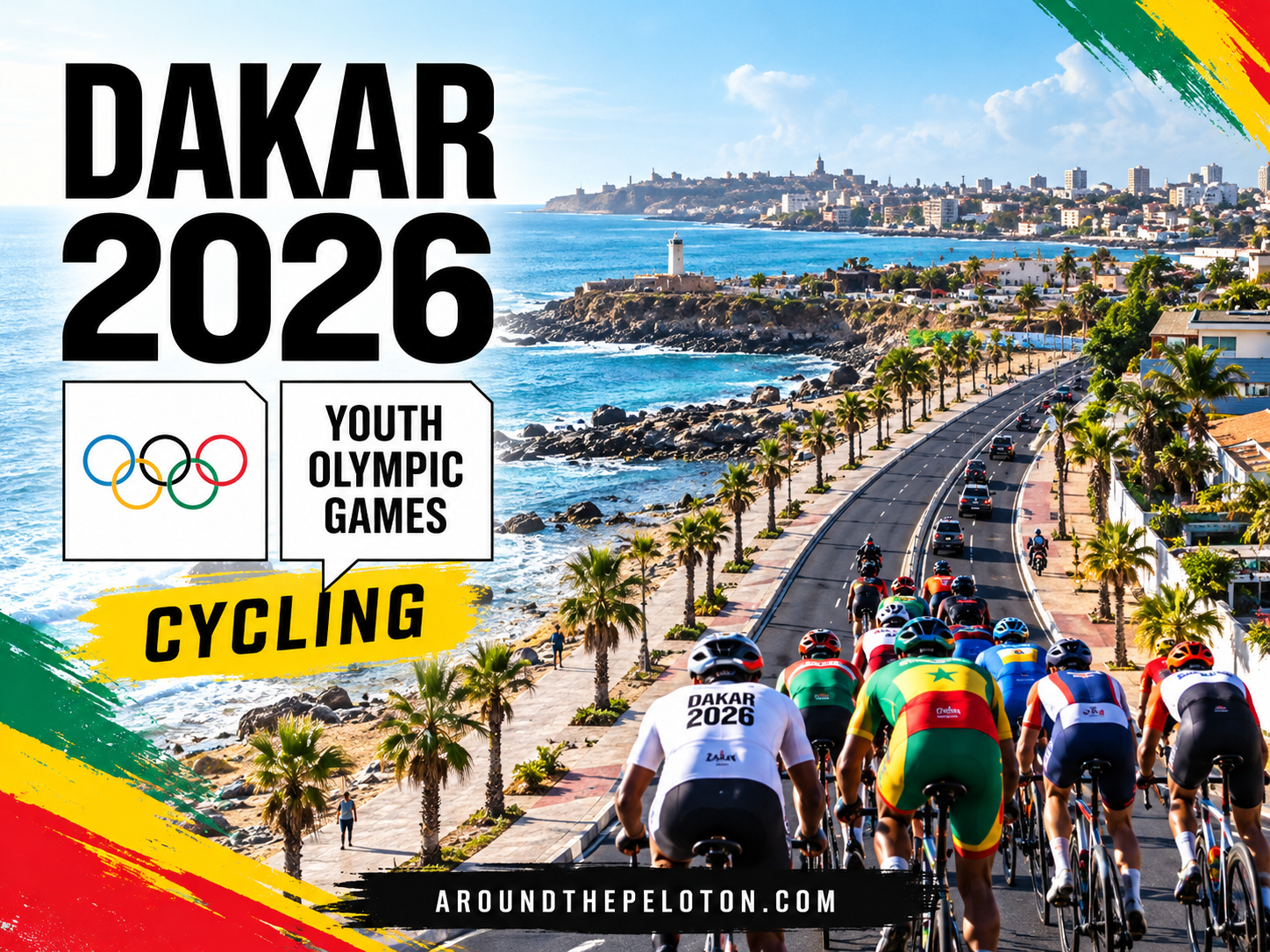

8 & 10 November 2026 | Dakar, Senegal | Men’s Road Race & Individual Time Trial | Corniche Ouest
At the westernmost edge of mainland Africa, the city of Dakar faces an ocean that has shaped its history for centuries. Fishing boats still leave its beaches for the Atlantic, cargo vessels approach the harbour on the peninsula’s eastern side, and the volcanic hills of the Mamelles rise above neighbourhoods that have expanded across much of the surrounding land. Dakar’s position has made it a place of maritime exchange, colonial ambition, political change and cultural reinvention, with each period leaving its own mark on the capital of Senegal.
In November 2026, another chapter begins when Dakar becomes the first African host of an Olympic sporting event. The fourth Summer Youth Olympic Games will bring young athletes from around the world to Senegal, including 42 male cyclists scheduled to compete in a road race on Sunday, 8 November, and an individual time trial on Tuesday, 10 November. Both events will use Corniche Ouest, the coastal boulevard overlooking the Atlantic, as their start and finish venue.
The men’s cycling programme will unfold against a landscape unlike those traditionally associated with European road racing. Dakar occupies the Cap-Vert Peninsula, a volcanic projection into the Atlantic where rocky headlands, fishing beaches and densely populated neighbourhoods exist within a relatively compact area. The ocean is a constant presence, although the character of the coast changes considerably between its exposed western shore and the more sheltered waters to the east.

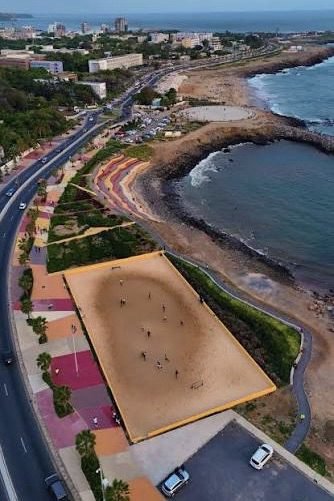
Corniche Ouest in Dakar, Senegal, a scenic coastal road overlooking the Atlantic Ocean, where the city’s urban landscape meets the rocky shoreline of the Cap-Vert Peninsula.
(Photo: Mouhamadou86 / CC BY-SA 4.0 / Source: Wikimedia Commons, File: La corniche Ouest de Dakar.jpg)
Beyond the sporting programme, Dakar offers a history that extends from the Lébou communities of the peninsula to the French colonial capital of West Africa, and from the intellectual ambitions of Senegal’s first president, Léopold Sédar Senghor, to the contemporary music and art that have made the city an important cultural centre. The arrival of Olympic cycling provides an occasion to explore those connections, beginning with the geography that made Dakar a meeting place between the continent and the sea.
Dakar: Where Africa Meets the Atlantic
The Cap-Vert Peninsula
Dakar occupies the Cap-Vert Peninsula, whose western extremity forms the westernmost point of mainland Africa. The name dates to Portuguese navigation along the West African coast in the fifteenth century, when European mariners began recording the headlands, bays and settlements that marked their journeys southward.

The peninsula extends into the Atlantic from the Senegalese mainland, giving Dakar a geographical character distinct from much of the surrounding country. On its western side, the coastline faces the open ocean, with rocky shores and beaches exposed to Atlantic conditions. To the east, the peninsula helps shelter the waters around Dakar’s principal harbour, a natural advantage that would later contribute to the city’s commercial and political importance.
The land beneath Dakar is equally distinctive. Its western districts occupy part of a volcanic landscape, with geological formations that interrupt the otherwise relatively low coastal terrain. The Mamelles, two prominent hills above the neighbourhood of Ouakam, are among the most recognisable surviving features of this history, rising above the city and offering broad views across the Atlantic.
These hills belong to a landscape shaped over geological timescales, long before the first fishing settlements appeared on the peninsula. Yet their influence remains visible in the present-day city, where roads, neighbourhoods and coastal developments must negotiate changes in elevation and the irregular shape of the shoreline.
Corniche Ouest follows part of this western coastal setting. It is a boulevard associated with ocean views, public spaces and some of Dakar’s best-known landmarks, making it an appropriate venue for a competition intended to bring Olympic sport into the life of the host city.
The precise streets and distances of the men’s cycling courses have not been established in the publicly available documentation used for this feature. Their confirmed setting, however, places the competition within a coastal landscape that has influenced Dakar’s development from its earliest communities to the modern capital.
The Lébou: A City Before the Capital
Fishing Communities and the Atlantic Coast
Long before Dakar became an administrative centre or an international port, the Cap-Vert Peninsula was home to communities whose lives depended on the sea. Among them were the Lébou, a Wolof-speaking people whose settlements and maritime traditions remain closely associated with the peninsula.

Fishing formed an important part of Lébou livelihoods, alongside agriculture, trade and local forms of political and religious organisation. Coastal settlements developed around beaches and landing places where boats could be launched into the Atlantic, while markets connected the fishing communities with people living farther inland.
The modern city has absorbed much of this older geography, but traces of it remain visible along the shore. At Soumbédioune, one of Dakar’s best-known fishing harbours, long wooden pirogues gather on the beach, often decorated with brightly coloured patterns, names and religious inscriptions. Their painted hulls are immediately recognisable, yet their importance is practical rather than decorative: these vessels support the work of fishermen whose activities connect the ocean to Dakar’s markets and households.
The return of the boats is only one part of a larger economic process. Fish must be landed, sorted, transported and sold, involving traders, processors and families whose livelihoods depend on the daily catch. The harbour is therefore both a working place and a social space, where the rhythms of the Atlantic shape the movement of people and goods.
These traditions have persisted through substantial changes in Senegal’s fishing industry. Industrial competition, pressure on fish stocks and the economic difficulties facing small-scale fisheries have complicated the lives of coastal communities, while urban development has placed additional demands on land traditionally used for maritime activities.

The persistence of the pirogue should not be confused with an unchanged past. Dakar’s fishing communities continue to adapt to new technologies, markets and environmental pressures, even as the boats and landing places preserve a visible connection to the peninsula’s older history.
This is an essential starting point for understanding Dakar. The city was not created when European powers established their presence on the coast; it developed around communities that already possessed their own economic relationships, cultural traditions and institutions. The Atlantic had been a source of livelihood and connection long before it became a highway for colonial trade.
Gorée: The Atlantic’s Darker History
An Island of Trade and Remembrance
A short distance off Dakar’s eastern coastline lies Gorée Island, a small place whose history reaches far beyond its physical size. Its buildings, narrow streets and waterfront recall centuries during which European powers competed for commercial and strategic influence along the West African coast.

(Photo: Ifremer / Photographer and license unverified / Source: Wikimedia Commons, File: Île de Gorée au large du Sénégal (Ifremer 00562-67450 – 42178).jpg)
Portuguese, Dutch, British and French interests all shaped the island’s history, while its position within Atlantic trading networks connected it to the wider systems of commerce and colonial expansion that transformed the region. Among those systems was the trafficking of enslaved Africans, one of the most devastating chapters in the history of the Atlantic world.
Today, Gorée is internationally associated with the memory of slavery, particularly through the House of Slaves and its Door of No Return. The building has become a powerful place of remembrance, visited by people seeking to understand the human consequences of forced displacement and the long history of Atlantic slavery.
Historians have debated the precise role and scale of the House of Slaves within the wider trade, and its symbolic importance should not be mistaken for proof that it was among the principal embarkation points for enslaved Africans. Gorée nevertheless remains a significant historical site, reflecting the wider presence of slavery and colonial commerce in the region.

UNESCO inscribed the island on the World Heritage List in 1978, recognising its historical and commemorative significance. Its preservation has made it one of Senegal’s most prominent places of historical memory, where the physical remains of the colonial period coexist with contemporary efforts to confront that past.
Gorée lies outside the confirmed cycling venue, but its story belongs to the same Atlantic geography that shaped Dakar. The ocean brought exchange and opportunity, yet it also connected the coast to systems of exploitation and coercion whose consequences extended across continents.
The contrast is important when considering the international celebration surrounding the Youth Olympic Games. Dakar’s welcome to young athletes from around the world takes place in a city whose history includes both cultural encounters and profound inequalities, making its contemporary role as an Olympic host part of a much longer story of relationships across the Atlantic.
From Colonial Port to West African Capital
A Harbour That Changed the City
Dakar’s emergence as a major urban centre accelerated during the nineteenth century, when French colonial authorities expanded their presence on the Cap-Vert Peninsula. The harbour’s sheltered position and access to Atlantic shipping routes made it increasingly valuable for trade, administration and the movement of people between West Africa and Europe.
The French established Dakar as a colonial settlement in 1857, and the city grew as port facilities, roads and administrative buildings were developed. In 1902, Dakar replaced Saint-Louis as the capital of French West Africa, the federation through which France governed much of its colonial territory in the region.
That decision transformed Dakar’s political and economic role. Government departments, commercial enterprises and transport infrastructure concentrated in the city, while migrants from different parts of West Africa contributed to its expanding population and increasingly diverse urban life.
Railways strengthened the port’s importance by connecting it to agricultural regions inland. Groundnuts became a major export crop within the colonial economy, and transport networks were organised in part to move produce from the interior toward the coast. Later connections with Bamako extended Dakar’s commercial reach across a much larger part of West Africa.

(Historical postcard: Original photographer unknown / Digitised by John Atherton / CC BY-SA 2.0 / Source: Wikimedia Commons, File: Harbor, Dakar, Sénégal (West Africa), c. 1905 (7792576026).jpg)
These developments brought investment and employment, but their benefits were distributed unevenly. Colonial infrastructure served the priorities of French administration and export trade, while African communities experienced political restrictions, economic disparities and unequal access to services.
Dakar also became a centre of resistance, debate and intellectual activity. Workers, students, journalists and political organisers participated in movements that challenged colonial authority and demanded greater representation, while the city’s educational institutions and cultural networks contributed to a growing discussion about African identity and independence.
By the middle of the twentieth century, Dakar was no longer simply a port governed from elsewhere. It had become one of the important political and intellectual centres of French-speaking West Africa, preparing the ground for the changes that would follow Senegalese independence in 1960.
Léopold Sédar Senghor: Culture as a National Project
A Poet in the Presidency
When Senegal became independent in 1960, Léopold Sédar Senghor became the country’s first president. His background was unusual for a head of state: he was not only a politician but also a poet, essayist and one of the principal intellectual figures associated with Négritude, a movement that developed among Black French-speaking writers and thinkers during the colonial period.
Senghor was born in Joal, on Senegal’s coast, in 1906 and later studied in France. His experiences in Europe, including his engagement with French intellectual life and the racial hierarchies of colonial society, contributed to his thinking about African cultural identity.
Together with figures including Aimé Césaire and Léon-Gontran Damas, Senghor helped articulate Négritude as a response to the denigration of Black cultures under colonialism. The movement affirmed African and diasporic cultural expression, although its ideas and essentialist tendencies would also attract criticism from later generations of writers and scholars.

As president, Senghor placed culture at the centre of Senegal’s national ambitions. He regarded artistic expression, literature and intellectual exchange as essential components of independence, arguing that political sovereignty should be accompanied by recognition of African cultural achievement.
That vision took a particularly visible form in Dakar in April 1966, when the city hosted the First World Festival of Negro Arts. Artists, writers, musicians and performers from Africa and the wider Black diaspora gathered in Senegal for an event intended to celebrate cultural creativity and strengthen international connections.
The festival brought an extraordinary range of artistic expression to Dakar, including exhibitions, concerts, theatre and discussions about African identity. It also positioned the young Senegalese republic as a cultural meeting place, giving the city an international role that extended beyond politics and commerce.
The event was not without political tensions or disagreements about how African culture should be represented. Nevertheless, it became an important moment in the history of postcolonial cultural exchange, demonstrating how a newly independent country could use art to express its place in the world.
For Dakar, the 1966 festival established a precedent that still resonates. The city had once been an administrative capital within a colonial federation; under Senghor, it sought to become a capital of African cultural expression, welcoming participants from across continents on terms defined by an independent Senegal.
Sixty years later, the Youth Olympic Games bring another international gathering to Dakar. The participants and purpose are different, but the ambition to present Senegal as a place of encounter, creativity and exchange provides a meaningful connection between the two events.
The Mamelles: Two Hills, Two Eras
The Lighthouse and the African Renaissance Monument
Above the northwestern districts of Dakar, the Mamelles hills offer two contrasting expressions of the city’s relationship with history. One summit carries a nineteenth-century lighthouse associated with maritime navigation, while the other is occupied by an enormous twenty-first-century monument intended to express African renewal.

(Photo: Jeff Attaway / CC BY 2.0 / Source: Wikimedia Commons, File: Dakar-Mamelles cliff.jpg)
The Phare des Mamelles stands on elevated volcanic ground overlooking the Atlantic. Its position made it an important aid to vessels navigating the approaches to Dakar, particularly as the city’s port developed into a major centre of maritime traffic.
The lighthouse belongs to an era when European shipping networks were expanding along the West African coast and reliable navigation became increasingly important for commercial and naval vessels. Its practical function reflects the peninsula’s long-standing role as a maritime landmark, while its elevated position reveals the distinctive topography of Dakar’s western shoreline.

Nearby, the African Renaissance Monument presents a very different vision. Inaugurated in 2010 under President Abdoulaye Wade, the bronze sculpture depicts a man, woman and child emerging from the hillside and looking outward toward the horizon.
The monument was conceived as a statement about African renewal and the continent’s future, drawing on themes of independence, identity and collective aspiration. Its enormous scale makes it one of the most prominent landmarks in Dakar, visible from considerable distances across the surrounding neighbourhoods.
Its construction also generated substantial controversy. Critics questioned the project’s expense, artistic choices and political symbolism, while supporters viewed it as an ambitious declaration of African confidence. The debate reflected broader disagreements about how public resources should be used and who has the authority to define national identity through monumental art.

The two Mamelles hills therefore represent different moments in Dakar’s development. The lighthouse emerged from the demands of navigation and maritime commerce during the colonial era, while the African Renaissance Monument belongs to a period in which Senegalese political leaders sought to express the continent’s future through public sculpture.
Neither landmark needs to be presented as a confirmed point on the cycling course to be relevant. Together, they explain how Dakar’s geography has repeatedly acquired new meanings, from guiding ships along the Atlantic coast to serving as a platform for debates about African identity.
A Capital of Music, Art and Teranga
The Cultural Life of Modern Dakar
The cultural ambitions associated with Senghor did not end with his presidency. Dakar continued to develop as a centre of music, visual art, literature and popular culture, shaped by Senegal’s diverse communities and by exchanges with other parts of Africa, Europe and the Americas.

Music has been particularly influential. Mbalax, the popular Senegalese genre associated internationally with Youssou N’Dour, developed through the interaction of traditional percussion, modern instruments and changing urban tastes. Its rhythms draw on Senegalese drumming traditions, while its evolution reflects Dakar’s role as a place where local musical practices encounter international influences.
Youssou N’Dour’s career offers one example of how the city’s cultural life has reached audiences far beyond Senegal. Emerging from Dakar’s music scene, he developed a distinctive sound that brought Senegalese musical traditions into dialogue with global popular music, while remaining closely associated with the city and its cultural identity.
Visual art has also become central to Dakar’s international reputation. The Dakar Biennale, widely known as Dak’Art, developed into one of the most important recurring exhibitions devoted to contemporary African art, providing a platform for artists from across the continent and its diaspora.
The city’s artistic life extends beyond formal institutions, with galleries, workshops, street art and performance spaces contributing to a cultural environment in which different generations continue to debate the meaning of African modernity.
Senegalese social life is also frequently associated with teranga, a Wolof concept often translated as hospitality but carrying a broader sense of generosity, welcome and responsibility toward others. The idea has become an important part of Senegal’s public identity, particularly in the way the country presents itself to international visitors.
For the Youth Olympic Games, that tradition provides a cultural framework for welcoming young athletes and spectators. The event is intended to extend beyond competition, creating opportunities for exchange and participation in a country whose history has repeatedly been shaped by encounters across borders.
The connection with the 1966 festival is particularly revealing. Senghor’s Dakar sought to bring artists and intellectuals together to demonstrate the cultural possibilities of an independent Africa; the Dakar of 2026 will welcome young competitors through an international sporting event, offering another opportunity to present Senegalese society to a global audience.
Olympic Cycling on Corniche Ouest
Sunday, 8 November | Men’s Road Race
The men’s road race is scheduled for Sunday, 8 November, with Corniche Ouest serving as the confirmed start and finish venue. It will bring together young riders representing different national cycling programmes, competing for one of the medals awarded during Dakar’s historic Youth Olympic Games.
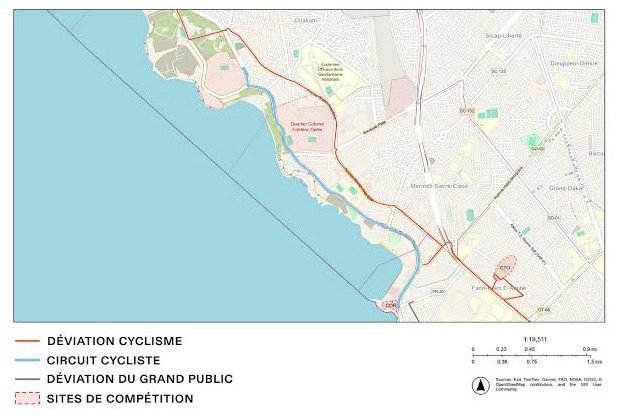
Road racing has a particular ability to connect sport with place. Unlike competitions held entirely inside a stadium, a road race temporarily transforms ordinary streets into a sporting arena, allowing spectators to encounter the riders within a familiar urban environment.
In Dakar, that relationship will be especially significant because the competition takes place during the first Olympic event hosted on African soil. The riders will compete in a city whose roads and neighbourhoods belong to a much wider history of maritime trade, colonial development and post-independence transformation.
The official race distance, circuit length and number of laps have not been confirmed in the accessible technical material, so the course cannot yet be described in the kilometre-by-kilometre manner used for Around the Peloton’s conventional route guides.
The confirmed Corniche Ouest setting nevertheless provides a distinctive context. The coastal boulevard places the race within Dakar’s Atlantic landscape, where the sea, volcanic terrain and urban development have shaped the city’s identity.
For the young competitors, the road race will also be an unusual international experience. Olympic competition brings together athletes from countries with different cycling infrastructures and sporting traditions, creating an environment in which emerging riders can measure themselves against opponents they may rarely encounter elsewhere.
Tuesday, 10 November | Men’s Individual Time Trial
The men’s individual time trial follows on Tuesday, 10 November, again using Corniche Ouest as the confirmed venue. The same 42 male riders are scheduled to compete, giving them a second opportunity to pursue an Olympic medal in a discipline with very different demands.
Where the road race involves direct competition, group dynamics and tactical decisions, the individual time trial is a more isolated test. Riders start separately and compete against the clock, relying on pacing, aerodynamic efficiency and the ability to maintain a sustained effort without the shelter of a peloton.
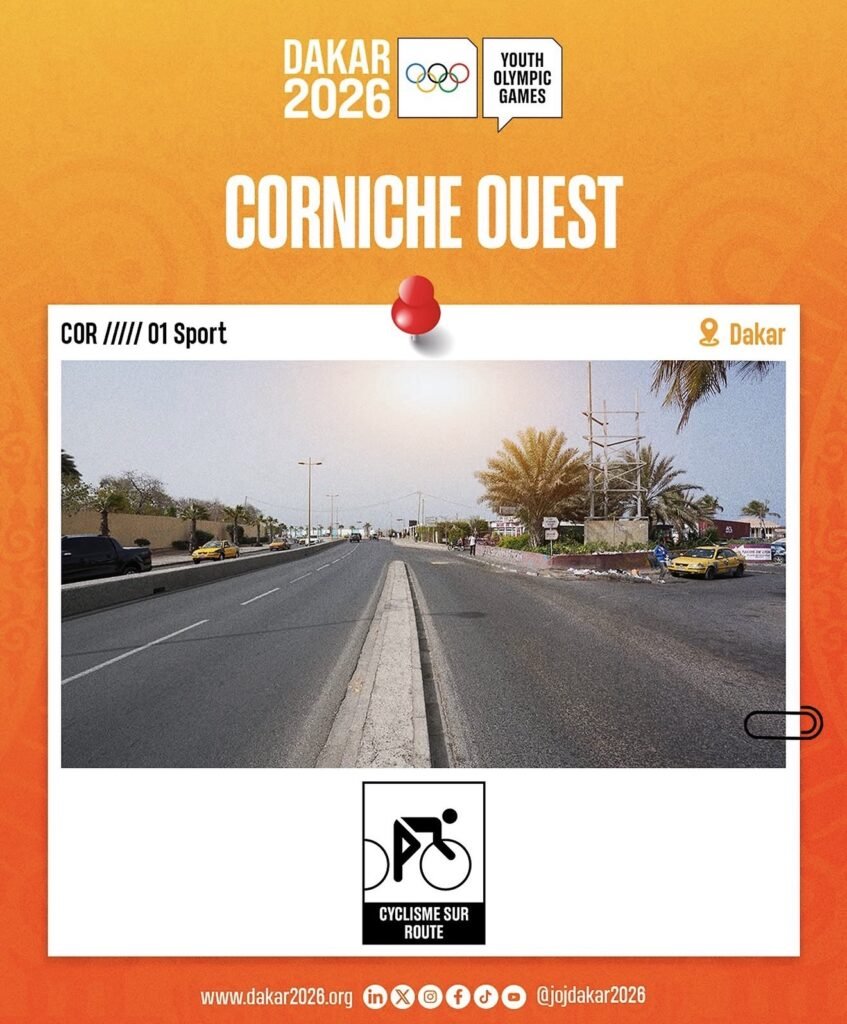
The precise demands of Dakar’s course will depend on its eventual confirmed distance, elevation profile and street layout. Coastal winds could become relevant, but their influence cannot be assessed reliably without knowing the course orientation and conditions on the day.
The distinction between the two disciplines adds interest to the men’s programme. A rider capable of navigating the tactical demands of the road race may not necessarily possess the same strengths as a specialist against the clock, while the requirement to contest both events places an emphasis on versatility.
For Dakar, the time trial extends Olympic cycling’s presence along the Atlantic coastline, bringing a second form of road competition to the same host-city setting.
Dakar 2026: A New Chapter at the Edge of the Continent
The Youth Olympic Games arrive in Dakar sixty years after Senghor’s World Festival of Negro Arts brought artists, writers and performers from Africa and the diaspora to the Senegalese capital. The two events belong to different eras and pursue different objectives, yet both reflect a desire to place Dakar at the centre of an international gathering and present African achievement to a wider world.
That ambition has developed within a city whose history is more complicated than any single celebration can express. The Lébou fishing communities established maritime traditions long before the modern capital existed, while the Atlantic connected the region to trade, slavery and colonial expansion. French rule transformed Dakar into an administrative and commercial centre, and independence created opportunities for Senegalese leaders, artists and citizens to redefine its identity.
The city that welcomes the young cyclists in November carries all these histories. Its fishing harbours remain active, its colonial buildings recall an earlier political order, and its modern monuments express competing ideas about the continent’s past and future. The Mamelles still rise above the Atlantic, while the coastline continues to shape the daily life of communities living beside it.
When the men’s road race begins on 8 November, the riders will enter a sporting competition whose significance extends beyond its result. Two days later, the individual time trial will offer another contest against the clock, but the larger occasion will remain the same: the Olympic movement arriving in Africa for the first time as a host of the Games.
In 1966, Dakar welcomed artists who came to assert the importance of African culture within a world still shaped by the legacy of colonialism. In 2026, it will welcome young athletes whose performances belong to the future of international sport. Between those two moments lies six decades of political change, cultural development and urban growth, all unfolding in a city whose position on the Atlantic has continued to connect Senegal with the wider world.
The cyclists will arrive to race, but Dakar offers them something beyond a finish line: a place where the continent meets the ocean, where older maritime traditions coexist with a modern capital, and where an Olympic debut becomes part of a much longer history of people gathering at Africa’s western edge.