

The Japan Cup occupies an unusual place on the professional cycling calendar. By the middle of October, the great European stage races are long finished and most of the autumn classics have already disappeared into history for another year, yet thousands of kilometres to the east professional cycling gathers again in Utsunomiya, where the northern edge of Japan’s Kantō Plain begins to meet the wooded uplands of Tochigi Prefecture. There is no journey across the country waiting for the peloton here, no succession of provinces and no long road carrying the riders between distant cities. Almost everything happens within a few wooded kilometres on Utsunomiya’s northwestern edge, beneath the slopes of Mount Kogashi.
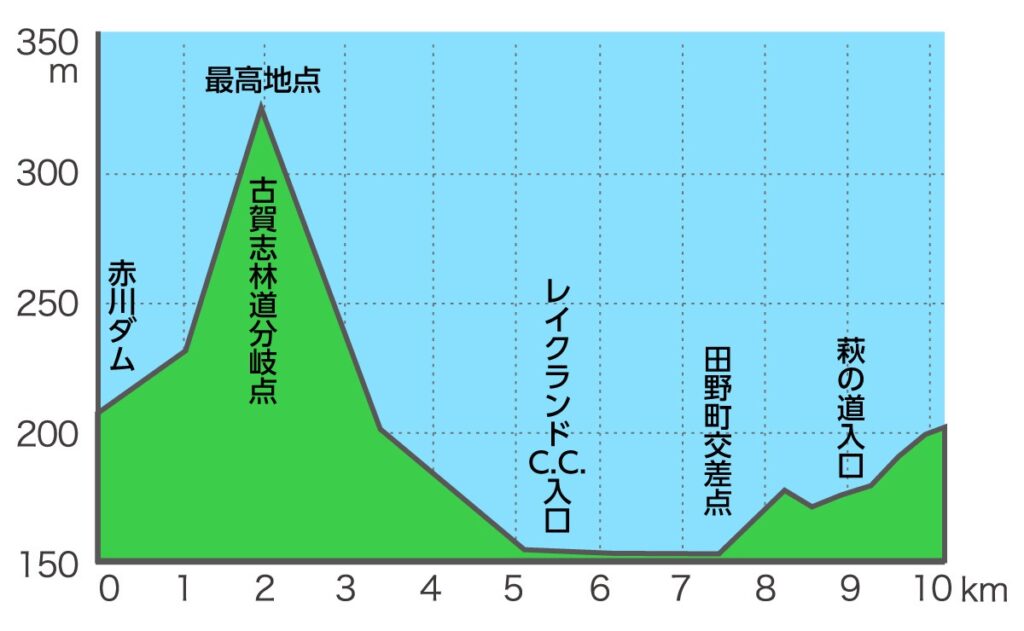
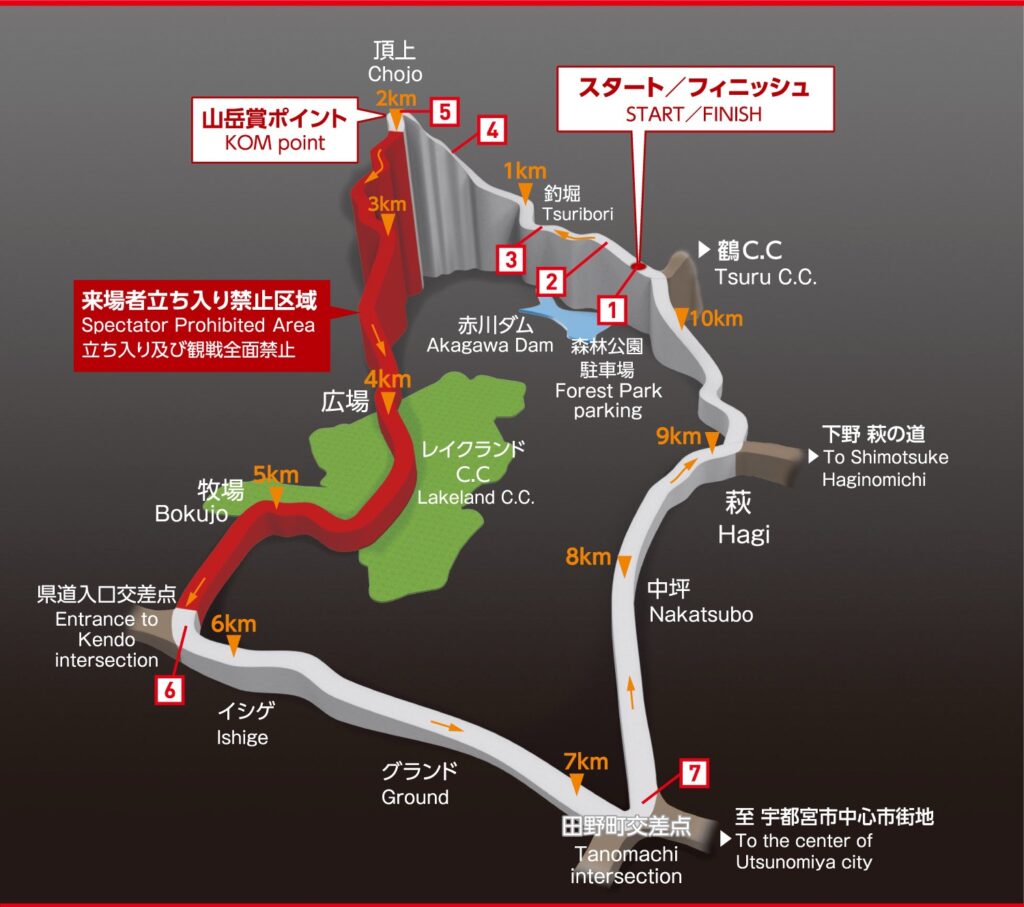
On Sunday 18 October, the riders will cover 144.2 kilometres by completing fourteen laps of a circuit measuring just 10.3 kilometres. Kogashi rises only 583 metres above sea level, but its forest road has become one of the most recognisable pieces of racing terrain in Japanese cycling, with spectators gathering beneath the trees as the peloton climbs past them repeatedly. The first ascent comes with fresh legs and an almost complete field; the last arrives after thirteen previous passages through the same forest.

These roads also carry a history far larger than their geographical footprint suggests. Utsunomiya hosted the 1990 UCI Road World Championships, the first road championships ever held in Asia, and the Japan Cup was established two years later to preserve the legacy of that event. More than three decades of racing have since accumulated around the same mountain, reservoir and handful of roads, turning a compact circuit into one of the enduring meeting places between Japanese and international professional cycling.
–144.2 km | Utsunomiya Forest Park
The riders begin northwest of central Utsunomiya, the capital of Tochigi Prefecture and a city situated roughly 100 kilometres north of Tokyo. Utsunomiya stands close to the northern edge of the Kantō Plain, the enormous lowland containing Tokyo and much of Japan’s largest concentration of population, but the western side of the city already looks towards a different geographical world. Flat urban and agricultural country begins to fragment into terraces and wooded hills before rising towards the mountain landscapes of northern Tochigi and Nikkō.
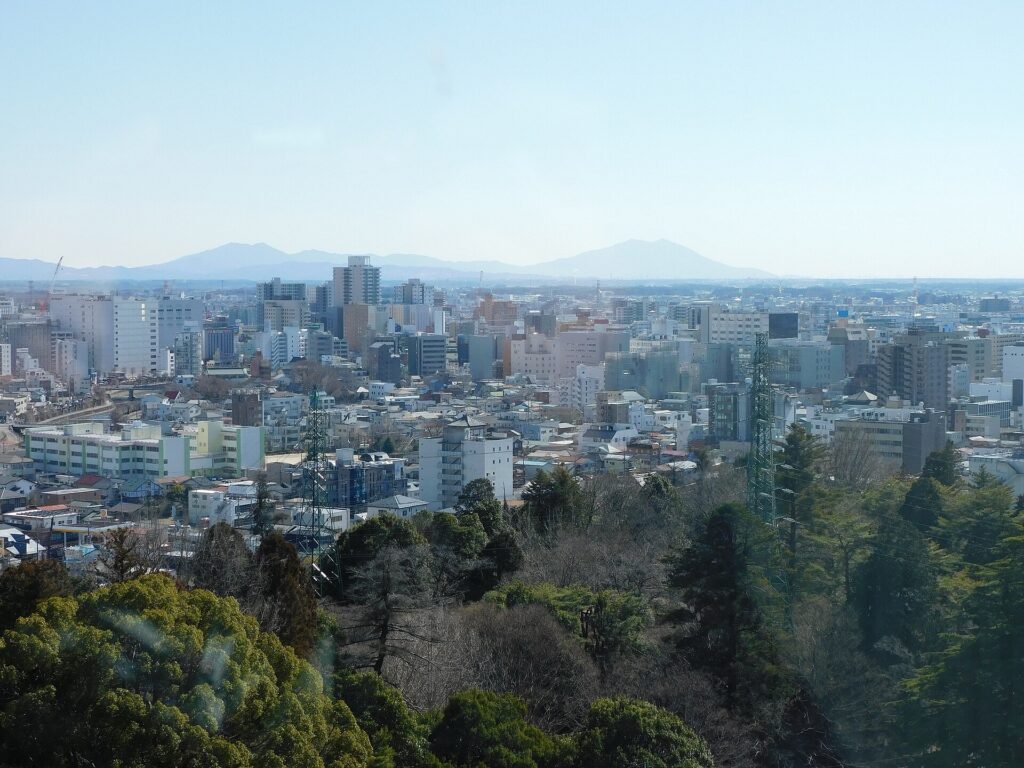
Central Utsunomiya, Tochigi Prefecture, seen looking southeast from Utsunomiya Tower, with Mount Tsukuba faintly visible in the distance. Photograph: Miyuki Meinaka, 2021. Licensed under CC BY-SA 4.0. Source: Wikimedia Commons
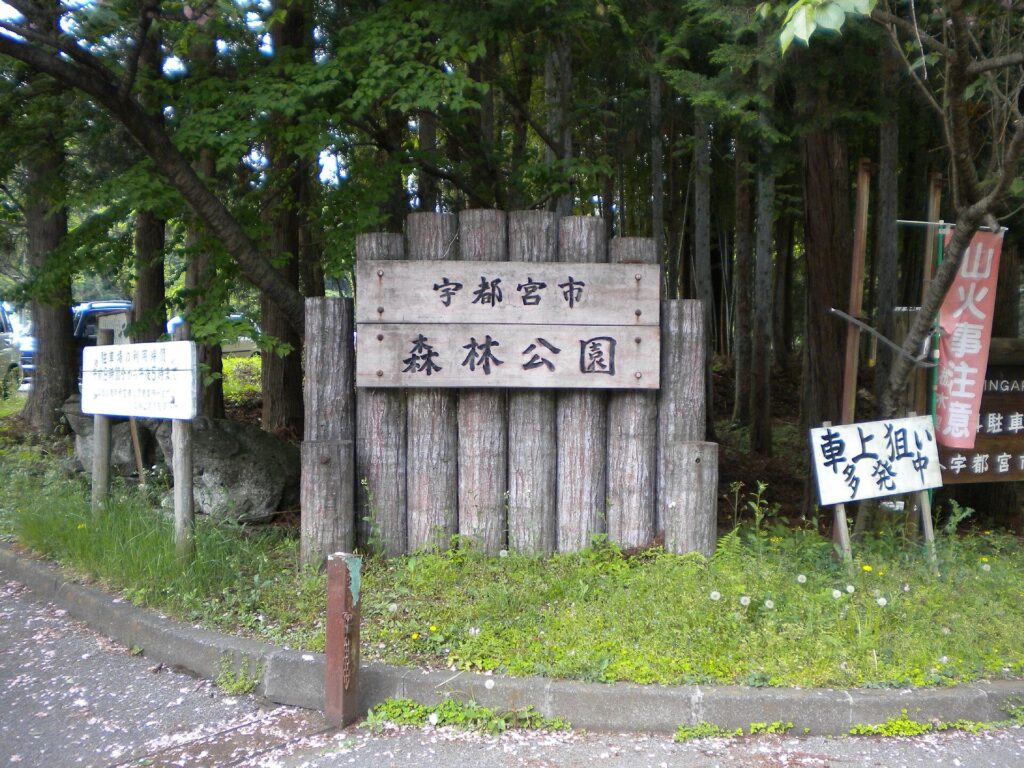
Utsunomiya Forest Park occupies this transition. Opened in 1979 and extending across roughly 500 hectares around Mount Kogashi, the park combines woodland, exposed rock, recreational roads and hiking routes around the waters of Akagawa Dam. The reservoir forms its visual centre, with Kogashi rising immediately beyond it and, in calm conditions, reflected across the surface of the water. Central Utsunomiya lies only a relatively short distance away, yet from the lakeside the dense city has almost completely disappeared.
The relationship between plain and mountain has helped make this western edge of Utsunomiya particularly suited to cycling. Much of the urban area occupies comparatively flat terrain, while harder roads begin almost immediately to the west. The Japan Cup exploits that transition completely: from the start beside Forest Park, the peloton will complete fourteen laps of the same 10.3-kilometre circuit, repeatedly climbing into Kogashi before descending towards the lower country around Tano and Hagi and returning to the reservoir.
The circuit will therefore be travelled here in detail only once. Every road encountered on this opening lap will return throughout the afternoon, but the riders passing over it will become progressively fewer and more tired.
–141 km | Mount Kogashi and the Forest Road
The road turns away from the lower ground and enters the forest beneath Mount Kogashi, whose summit reaches 582.8 metres. That altitude is modest beside the great ranges of central Japan, where peaks rise beyond 3,000 metres, but Kogashi stands sufficiently apart from the surrounding plain to dominate western Utsunomiya. Together with neighbouring Ontake and Akaiwa, it forms a compact group of wooded summits between the Kantō lowlands and the increasingly mountainous interior of Tochigi.
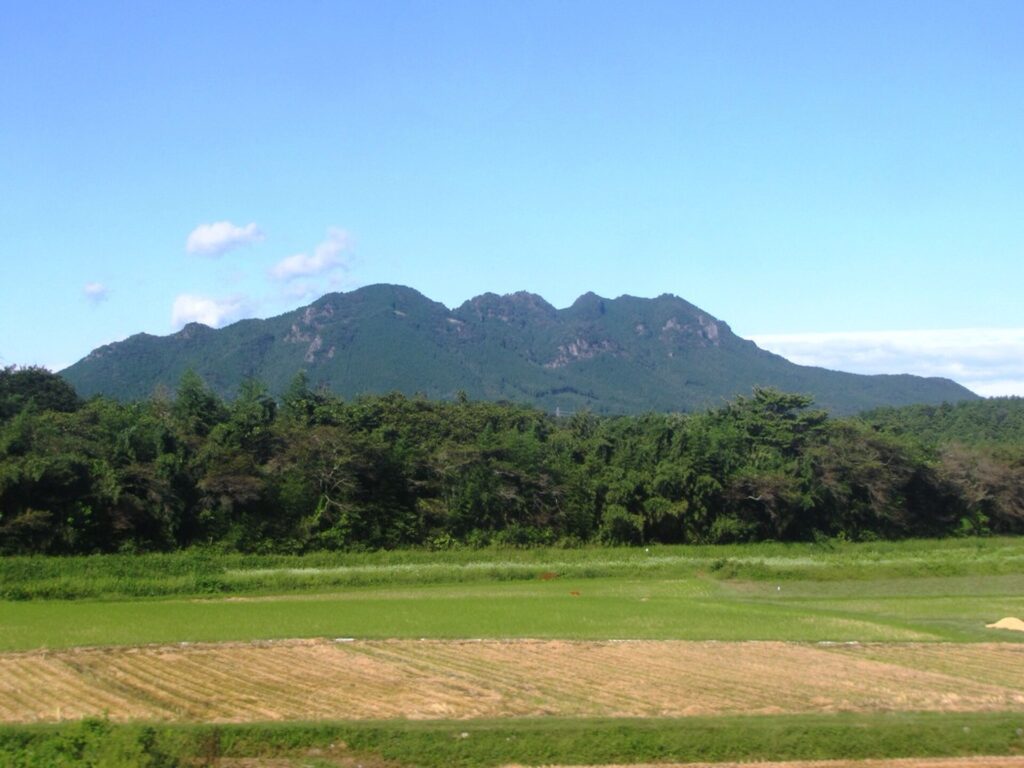
Mount Kogashi, the wooded mountain around which the Japan Cup circuit is built, viewed from the northern outskirts of Kanuma. Photo by 駅弁, licensed under CC BY 3.0, via Wikimedia Commons
Beneath the forest lies a much older landscape. Parts of the massif contain Jurassic chert, an exceptionally hard silica-rich sedimentary rock formed from microscopic marine organisms accumulating on an ancient ocean floor. Geological processes later incorporated these deposits into the developing Japanese archipelago, where uplift and erosion exposed them in the ridges around Kogashi. The resistant rock contributes to a surprisingly rugged mountain, with broken ridges, exposed sections and substantial cliffs that have made the area popular with climbers as well as hikers.
Walking routes climb from Forest Park towards the summit and continue across the neighbouring ridges. In spring, katakuri, the Japanese dogtooth violet, produces purple flowers across parts of the woodland floor before the canopy closes above them; by October, the broadleaf forest is beginning its transition towards autumn colour. The Japan Cup consequently reaches Kogashi at a moment when the mountain itself is changing season.
The peloton meets it through the Kogashi Forest Road. The principal climbing section extends for a little over a kilometre at an average gradient above eight percent, reaching the King of the Mountains point before the course turns towards the descent. Its numbers would barely distinguish it among the great climbs of professional cycling, but fourteen ascents create a very different calculation.
–141 km | The Kogashi Summit
The upper forest road has become the emotional centre of the Japan Cup. Spectators gather closely beneath the trees, where the slower speed of the climbing riders brings the professional peloton within metres of the crowd. A supporter standing here does not watch the race disappear permanently after a single passage; the same riders return again and again, initially in a large group and later divided into increasingly small fragments.
The scene has acquired more than three decades of memory, but its connection with international cycling predates the Japan Cup itself. Before an annual professional race existed here, Utsunomiya had already brought the world’s leading road riders into this landscape for an event without precedent in Asia.
1990 | The First Road World Championships in Asia
In September 1990, Utsunomiya hosted the UCI Road World Championships, becoming the first Asian location to stage the road championships. Professional cycling remained overwhelmingly centred on Europe, and even its World Championships had only occasionally travelled beyond the sport’s traditional geographical heartland. Japan was becoming increasingly prominent on the international sporting stage, but its domestic road-racing culture remained small beside those of France, Italy, Belgium, Spain and the Netherlands.
The men’s professional road race covered 261 kilometres and assembled an exceptional field. Greg LeMond arrived as reigning world champion and had won his third Tour de France earlier that summer, while Gianni Bugno was completing the season in which he had dominated the Giro d’Italia. Sean Kelly remained one of the outstanding classics riders of his generation, Maurizio Fondriest had already worn the rainbow jersey, and Miguel Induráin was approaching the period in which he would win five consecutive Tours de France.
The course gradually dismantled that field. Of 145 starters, only 57 were classified at the finish, and the decisive move eventually produced an entirely Belgian front. Rudy Dhaenens and Dirk De Wolf escaped and reached the finish together, eight seconds ahead of the pursuing group, with Dhaenens defeating his compatriot for the rainbow jersey. Bugno took bronze ahead of LeMond and Kelly.
For Dhaenens, Utsunomiya became the defining victory of his career. For the city, the championships left something less immediate but more durable. The world’s leading professional riders had raced through the western hills of Utsunomiya, and when the rainbow jerseys departed, local organisers sought a way to preserve that connection.
1992 | A Race Grows from the Worlds
The first Japan Cup was held in 1992 specifically as a memorial to the World Championships. The new event returned professional cycling to the Forest Park landscape and established the circuit that would become its permanent home, although the earliest configuration differed from the modern course and was initially ridden in the opposite direction.
Its international ambitions were visible immediately. Former world champion Maurizio Fondriest and Uzbek sprinter Djamolidine Abdoujaparov were among the riders at the inaugural edition, while Japanese professionals were attempting to establish themselves within a sport whose strongest teams and development structures remained concentrated in Europe. Belgian Hendrik Redant became the first winner after escaping with American Bart Bowen and defeating him at the finish, with Laurent Madouas more than three minutes behind in third.
Masatoshi Ichikawa finished seventh. His result carried particular significance at a time when Japanese professionals competing regularly in Europe remained exceptional. Ichikawa had already crossed the cultural and sporting divide between Japanese racing and the European peloton, precisely the distance that the new event in Utsunomiya was beginning to narrow.
The race quickly acquired a rider closely associated with its early history. Claudio Chiappucci arrived as one of the defining attacking cyclists of the early 1990s, twice runner-up at the Tour de France, a challenger at the Giro d’Italia and winner of Milan-San Remo. He won the Japan Cup in 1993, returned to win again in 1994 and completed a third consecutive victory in 1995, a sequence that remains unmatched.
Kogashi suited a rider whose reputation had been built on attacking whenever the road rose. The mountain offered nothing resembling the altitude of the Alps where Chiappucci had produced some of his most famous performances, but repeated ascents through the forest created their own form of attrition.
–~139 km | Down from Kogashi
Beyond the summit, the circuit drops rapidly through the forest. The demands change immediately as climbing gives way to speed, positioning and technical descending, with bends arriving while the riders are still carrying momentum from the upper slopes. A rider losing contact near the summit must descend well enough to recover, while a small group crossing Kogashi with an advantage can use these kilometres to make the separation more difficult to close.
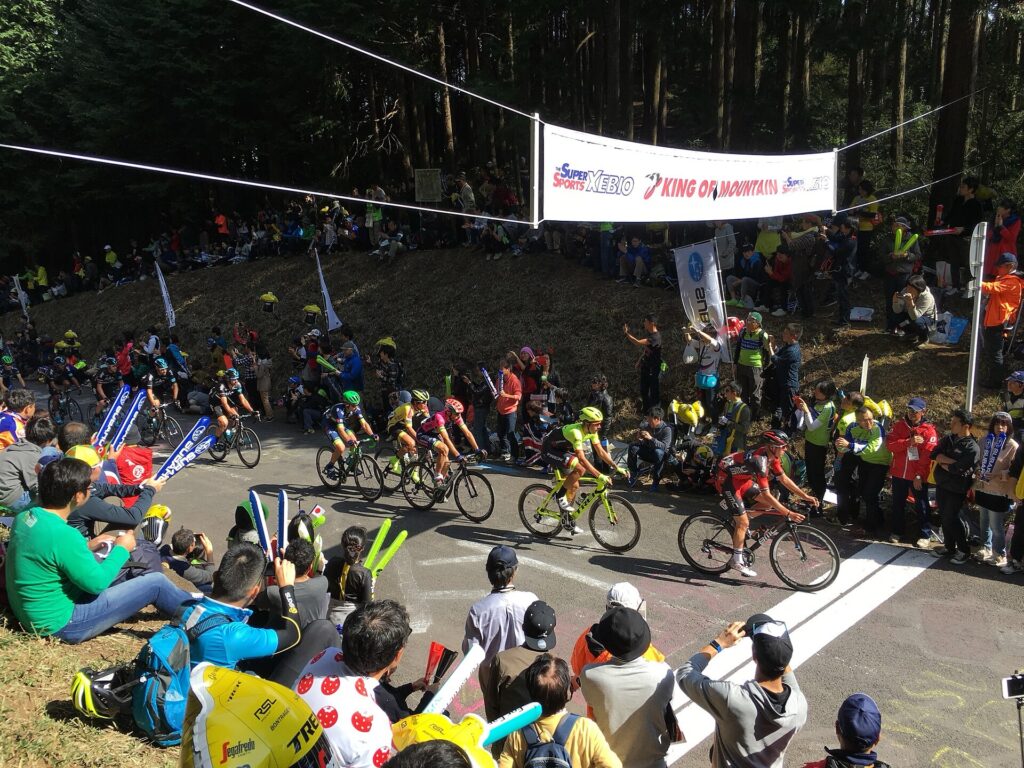
The peloton crests the Kogashi hill during the 2016 Japan Cup Cycle Road Race, on the wooded circuit around Utsunomiya Forest Park. Photo by Fukumoto, licensed under CC BY-SA 4.0, via Wikimedia Commons
Near the bottom, the course reaches the prefectural road and changes direction sharply. The enclosed forest begins to open, and within a short distance the race moves from the wooded slopes of Kogashi into the settled country lying beneath them.
–~137 km | Tano: Where the Plain Meets the Hills
Tano belongs to the western edge of Utsunomiya rather than forming a separate destination on the route, but its landscape reveals the geographical position of the entire race. Houses, small cultivated areas and broader roads replace the enclosed forest, while Kogashi remains immediately behind the riders. The immense Kantō Plain reaches northwards towards Utsunomiya before beginning to break against the uplands of Tochigi.
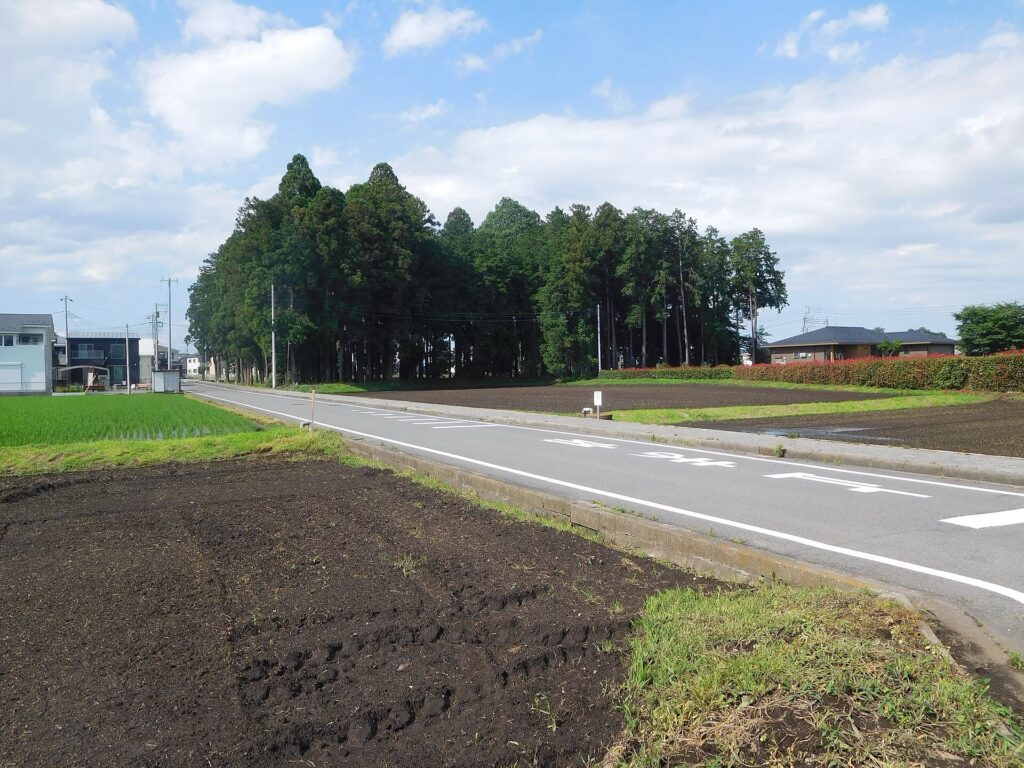
Agricultural land and woodland in Komanyu, on Utsunomiya’s western outskirts near Tanomachi, where the Kantō Plain begins to meet the wooded hills of the Japan Cup circuit. Photo by Miyuki Meinaka, licensed under CC BY-SA 4.0, via Wikimedia Commons
The circuit crosses that boundary repeatedly. It leaves the inhabited lower ground, climbs into Kogashi’s forest and then descends back towards settlement, compressing the transition between plain and mountain into a few kilometres. A peloton stretched into a line above can begin to reform around Tano, where the faster roads favour organised pursuit before the terrain folds towards the next section.
–~135 km | Hagi Road and the 1996 World Cup
Hagi Road entered the circuit when the Japan Cup became the final round of the UCI Road World Cup in 1996, only five years after the race had been created. The World Cup was then the principal season-long competition linking many of professional cycling’s major one-day races, and its arrival in Utsunomiya marked an extraordinary rise for an event that had begun as a memorial to the championships held six years earlier.
The field reflected that status. Mapei, Motorola, ONCE, Telekom, Rabobank, Saeco, Festina, Carrera, Lotto and US Postal were among the teams travelling to Japan, bringing a concentration of international professionals rarely encountered in Asia at the time. Daisuke Imanaka, then racing in Europe with Team Polti, later remembered the edition as an important bridge between Japanese riders and the European professional world in which he himself was competing.
Switzerland’s Mauro Gianetti won the race ahead of Pascal Hervé and Andrea Peron, with Andrea Tafi and Davide Rebellin among the leading riders immediately behind. The Japan Cup did not remain part of the World Cup, but Hagi Road remained on the circuit, leaving a physical trace of the year when Utsunomiya briefly became the final destination of one of professional cycling’s most important season-long competitions.
The following edition provided a different landmark. Yoshiyuki Abe, a Japanese professional riding for the formidable Mapei team, reached the decisive phase with teammate Andrea Tafi and defending winner Gianetti before taking the victory. Abe remains the only Japanese rider to have won the main Japan Cup road race, a result made particularly significant by the fact that he achieved it while competing inside one of Europe’s strongest professional structures.
–~134 km | The Lower Roads
The course now begins curling back towards Forest Park. Kogashi is behind the riders, but the climbing has not entirely finished. Older descriptions of the circuit draw attention to a later rise beside the pond and Tsuru Country Club, a section capable of feeling particularly severe after the climb, descent and accelerations through Tano and Hagi.
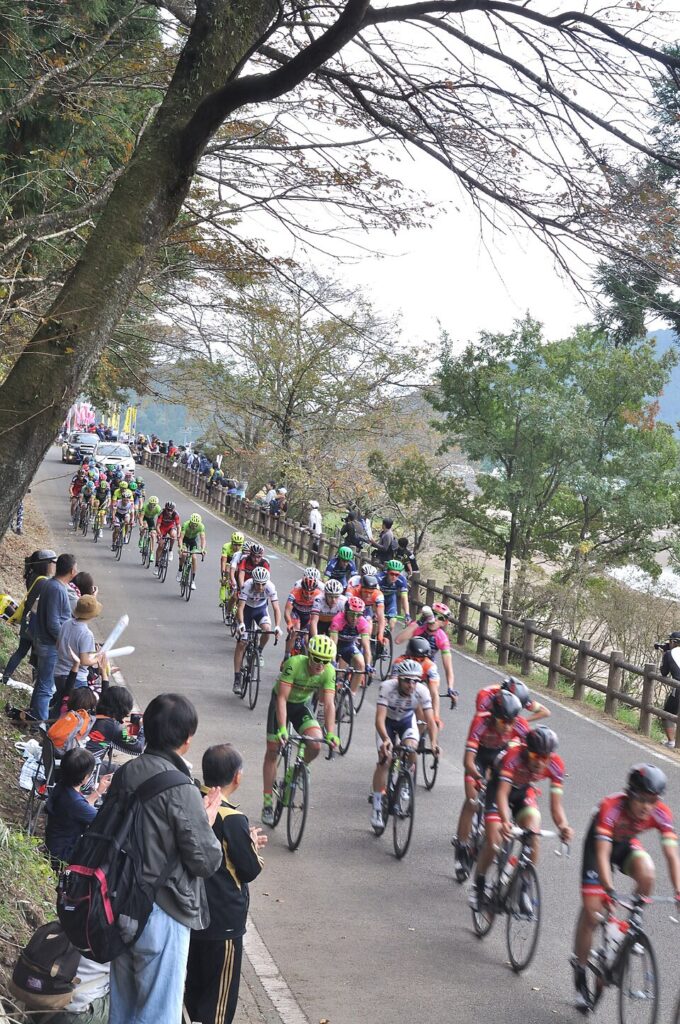
The Japan Cup peloton races beside Akagawa Dam near Utsunomiya Forest Park during the 2016 edition. Photo by Ocdp, licensed under CC BY-SA 4.0, via Wikimedia Commons
The reservoir landscape gradually returns beyond this final sequence of rolling roads. Trees close around the course again, Akagawa Dam comes back into the geography of the race and the slopes of Kogashi reappear beyond the water. After little more than ten kilometres, the circuit has returned almost exactly to its starting point.
–133.9 km | First Lap Completed
The peloton crosses the line after 10.3 kilometres with the complete geography of the Japan Cup already behind it once: Forest Park and Akagawa Dam, the climb through Kogashi, the descent, Tano, Hagi and the lower roads returning towards the reservoir. The second lap immediately sends the riders back into the same sequence, followed by a third and then a fourth.
Early in the race, the mountain can still accommodate a substantial peloton. Riders losing a few metres near the summit may recover them below, while teams have enough numbers to organise pursuit across the faster roads. Along Kogashi, spectators see much the same landscape every few minutes but a subtly changing race, with breakaways gaining or losing ground and the main field beginning to stretch more noticeably on each ascent.
–103.0 km | Four Laps Gone
After four circuits, 41.2 kilometres have been completed and Kogashi has already been climbed four times. The repeated passage begins to distinguish the Japan Cup from a race containing a single decisive ascent. There is no opportunity to leave the mountain permanently behind, because every return to Forest Park simply begins another approach towards it.
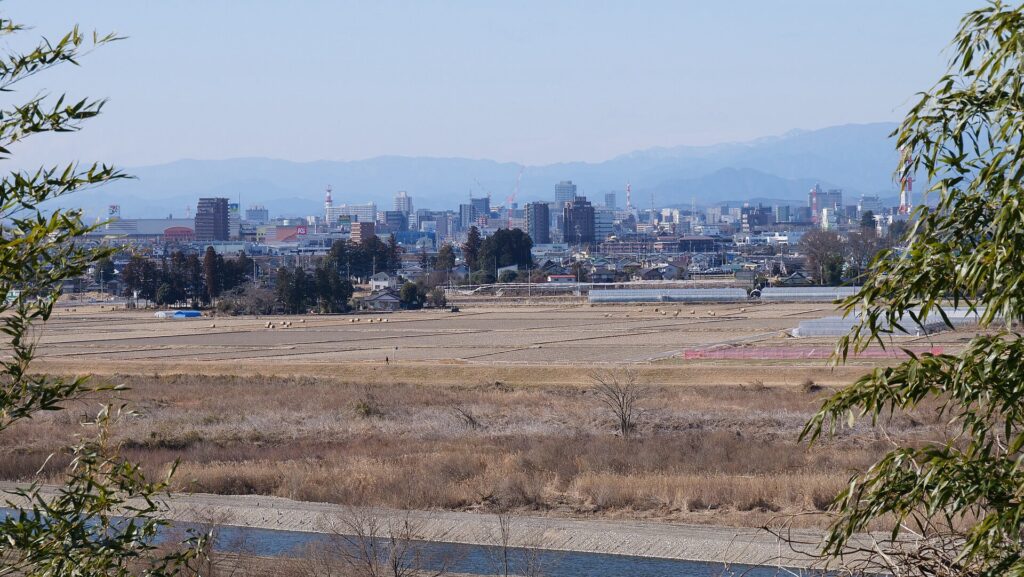
Utsunomiya seen from the ruins of Tobiyama Castle, its urban landscape spreading across the northern Kantō Plain. Photo by シンプルですけど機能的なベッド, licensed under CC BY-SA 4.0, via Wikimedia Commons
This landscape has also become inseparable from Utsunomiya’s wider cycling identity. The city has developed bicycle-oriented policies since the early twenty-first century, while Utsunomiya Blitzen created a locally rooted professional team connected directly to the community. Since 2010, the Japan Cup criterium has carried the international peloton through central Utsunomiya on the day before the road race, linking the urban centre with the forest circuit used on Sunday.
Those developments have helped turn the Japan Cup weekend into a large local event rather than an isolated professional race. Spectators gather around Forest Park and especially on Kogashi, where repeated passages allow them to watch the race evolve in a way impossible on a long point-to-point course. The mountain road becomes progressively louder as the decisive laps approach.
–72.1 km | Halfway Through the Fourteen Laps
Seven laps have been completed when the riders cross the line with 72.1 kilometres remaining. Kogashi has now appeared seven times, and the accumulated climbing begins to alter the composition of the peloton more visibly. Groups that rejoined easily during the opening circuits require greater effort to return, while riders repeatedly forced to chase after the summit begin paying for those accelerations.
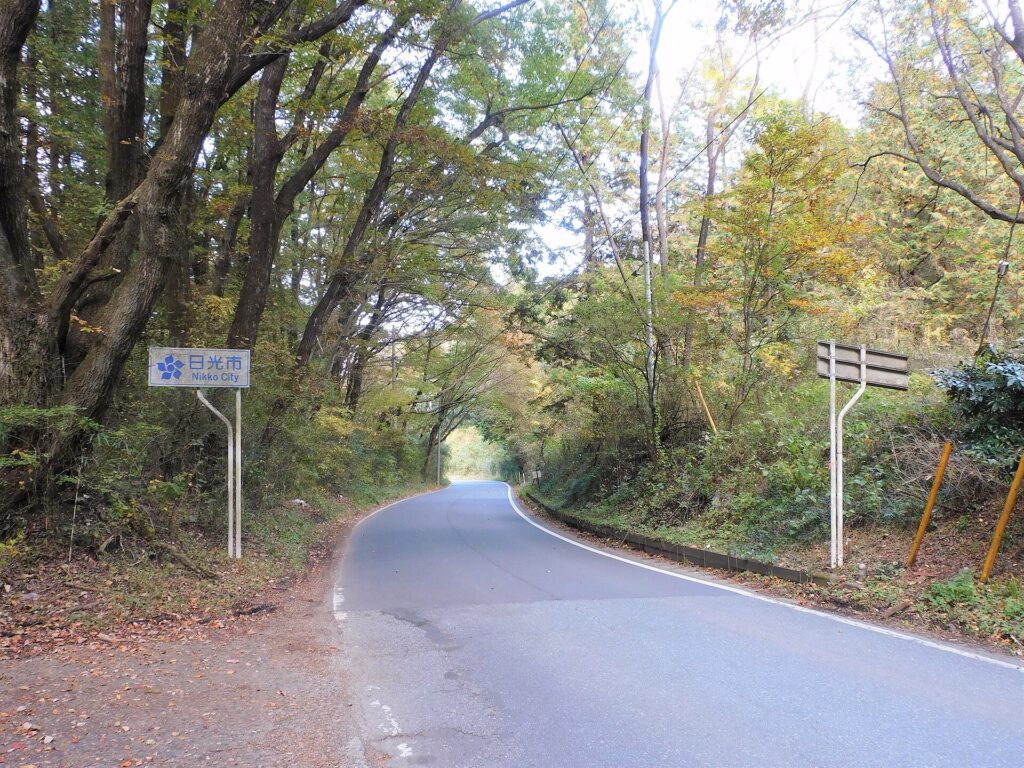
A rural road at the boundary of Utsunomiya, where the northern Kantō Plain gives way to the wooded foothills. Photo by Miyuki Meinaka, licensed under CC BY-SA 4.0, via Wikimedia Commons
The setting remains unchanged. The reservoir still lies beneath the forest, the same spectators occupy the Kogashi road and Tano continues to provide the transition back towards the plain. What looked compact and manageable on the first circuit has acquired weight through repetition, with each familiar road arriving a little sooner than tired legs would prefer.
The Japan Cup’s October position has brought an extraordinary range of international riders into this pattern over the decades. Winners have included Gilberto Simoni, Damiano Cunego, Ivan Basso, Dan Martin, Bauke Mollema and Rui Costa, connecting the wooded circuit outside Utsunomiya with Grand Tour champions, a world champion and some of the strongest climbers and one-day racers of their generations.
–41.2 km | Four Laps Remaining
With four circuits left, the race enters a different phase. Kogashi is no longer simply accumulating fatigue; every ascent can now create a group capable of surviving to the finish. Team numbers have diminished, and riders who could rely on several companions during the opening hour may find themselves increasingly exposed.
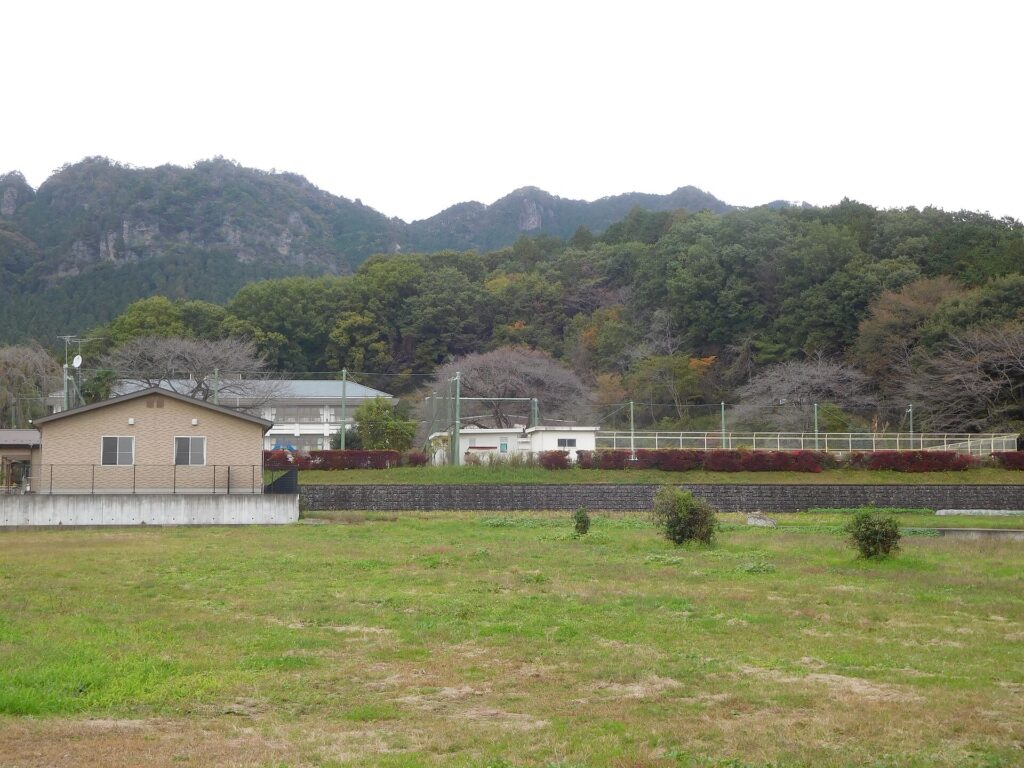
Mount Kogashi rises above the western outskirts forming the mountainous centrepiece of the Japan Cup circuit. Photo by Miyuki Meinaka, licensed under CC BY-SA 4.0, via Wikimedia Commons
The descent and lower roads consequently become more important as well. A small group gaining separation near the summit can carry speed towards Tano, while chasers must decide how much energy to spend before another ascent arrives. Hagi and the late rise towards Forest Park continue to interrupt recovery, and the crossing of the line now brings Kogashi back within only a few minutes.
–20.6 km | Two Laps Remaining
Two circuits remain when the peloton returns to Forest Park with 20.6 kilometres to race. The leading group is likely to be considerably smaller than the field that first climbed Kogashi more than two hours earlier, and the mountain offers only two remaining opportunities to create decisive separation.
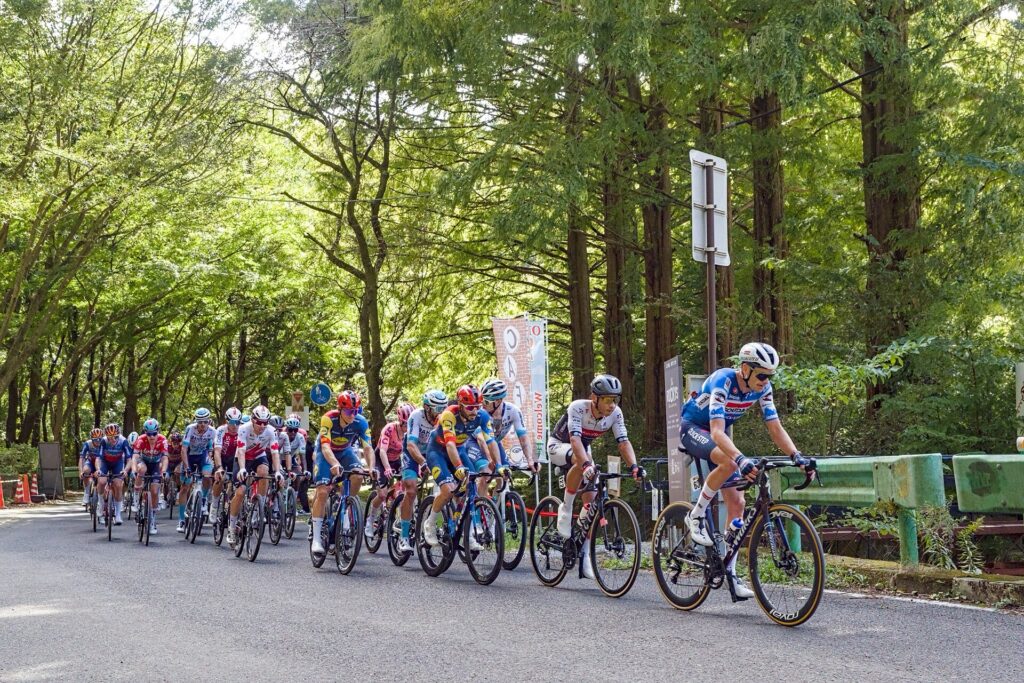
The peloton races through the wooded Utsunomiya circuit during the 2024 Japan Cup Cycle Road Race. Photo by Fukumoto, licensed under CC BY-SA 4.0, via Wikimedia Commons
The penultimate ascent can be as important as the final one. An attack here forces rivals to chase through the descent, Tano and Hagi before they have even reached the bell, while a team retaining several riders can use the faster roads to bring the race back together. By the time Forest Park returns, those calculations have consumed another 10.3 kilometres.
The bell announces the final lap.
–10.3 km | The Fourteenth Circuit
The riders begin the last circuit with 133.9 kilometres completed. Every corner ahead has been taken thirteen times, every gradient has been measured repeatedly in the legs and the descent from Kogashi has already been ridden under almost every possible tactical condition. The final lap contains no unfamiliar road, only familiar roads reached with very different reserves of strength.
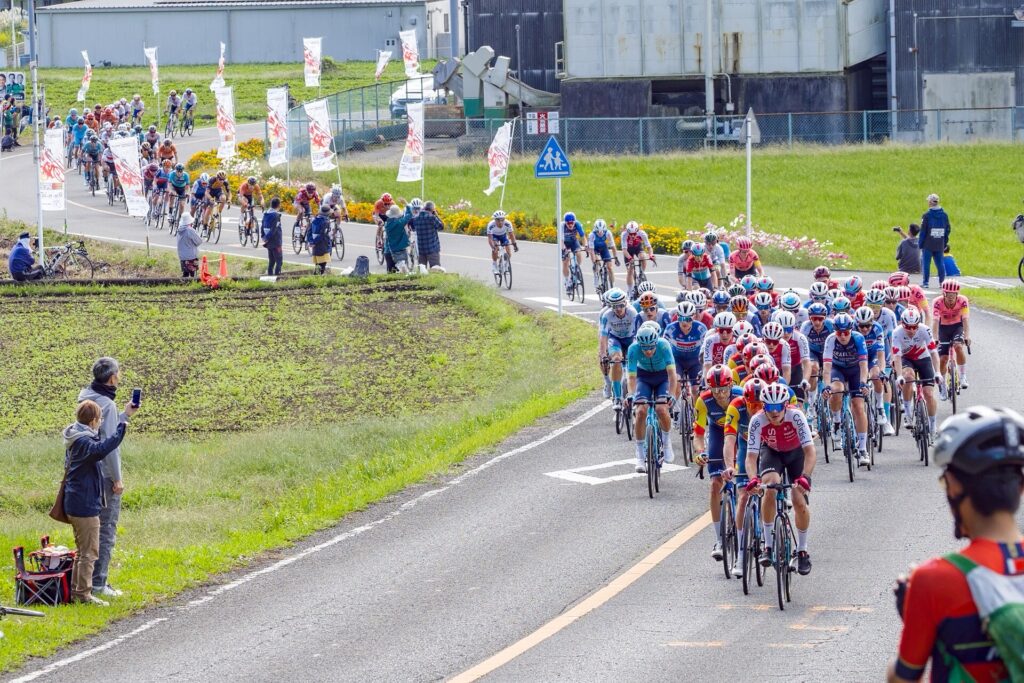
The peloton passes spectators on the wooded Utsunomiya circuit during the 2024 Japan Cup Cycle Road Race. Photo by Fukumoto, licensed under CC BY-SA 4.0, via Wikimedia Commons
Forest Park recedes once more as the course turns towards the mountain. There is no longer any reason to conserve energy for another passage, and riders still capable of winning know that Kogashi provides the clearest opportunity to prevent the race from being decided on the faster roads below.
–~7 km | Kogashi for the Fourteenth Time
The final ascent begins beneath the same trees that enclosed the opening passage, but the peloton arriving here bears little resemblance to the group that climbed through more than three hours earlier. Thirteen previous ascents have accumulated in the legs, while the crowd lining the road has watched the field gradually fragment on every return.
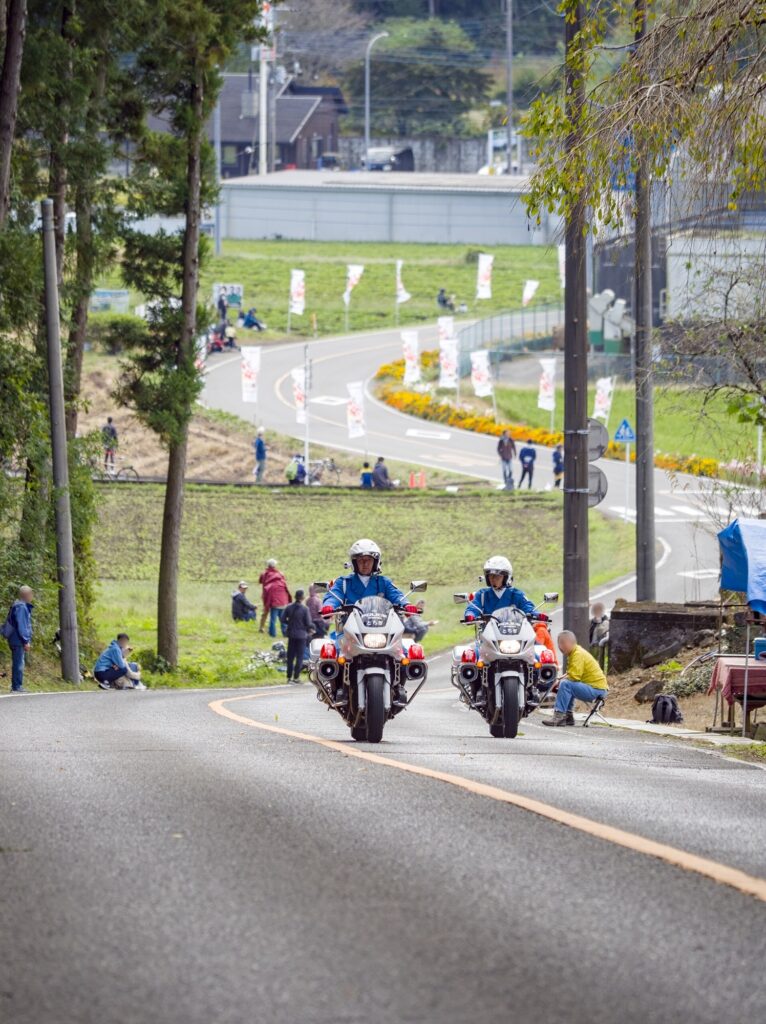
Police motorcycles lead the race convoy through the Utsunomiya circuit during the 2024 Japan Cup Cycle Road Race. Photo by Fukumoto, licensed under CC BY-SA 4.0, via Wikimedia Commons
The gradient is steep enough for a strong climber to create separation but short enough to make timing critical. An attacker needs to establish a useful advantage before the summit, while anyone losing contact knows that the following descent provides only a limited opportunity to recover. In 2025, Lenny Martinez used precisely this part of the circuit to make the final difference, leaving Kogashi with the advantage that carried him to victory.
The road has accumulated its own memories since the World Championships first brought elite international cycling to Utsunomiya in 1990. Chiappucci’s three victories, the World Cup field of 1996, Abe’s Japanese success and the generations that followed all passed through this same forest. The 2026 peloton reaches the summit once more, but this time there is no fifteenth ascent waiting beyond the finish.
–~5 km | The Final Descent
The road drops away from Kogashi and immediately changes the tactical problem. A rider carrying an advantage must descend cleanly and preserve enough speed through the lower roads, while a chasing group has to organise quickly before the terrain flattens. Several potential winners looking at one another can lose the race here as easily as a lone leader can win it.
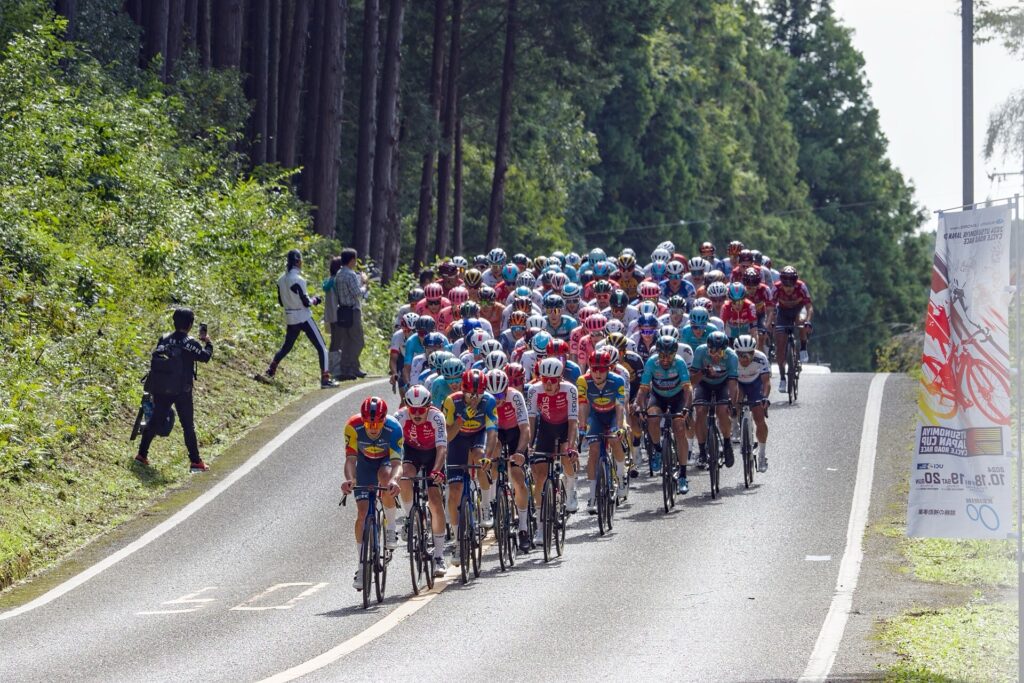
The peloton sweeps through the forest roads of Utsunomiya during the 2024 Japan Cup Cycle Road Race. Photo by Fukumoto, licensed under CC BY-SA 4.0, via Wikimedia Commons
The prefectural road arrives and the mountain begins to recede behind the riders. Tano lies ahead, bringing the race back towards the inhabited edge of Utsunomiya for the last time.
–~3 km | Tano and Hagi
Tano passes for the fourteenth time with the principal climb completed. The roads that allowed groups to reorganise earlier in the afternoon now offer the final opportunity for pursuit, while Hagi follows with only a few kilometres remaining. The section introduced for the 1996 World Cup has become so thoroughly absorbed into the modern circuit that its historical origin is almost invisible beneath the rhythm of the race.
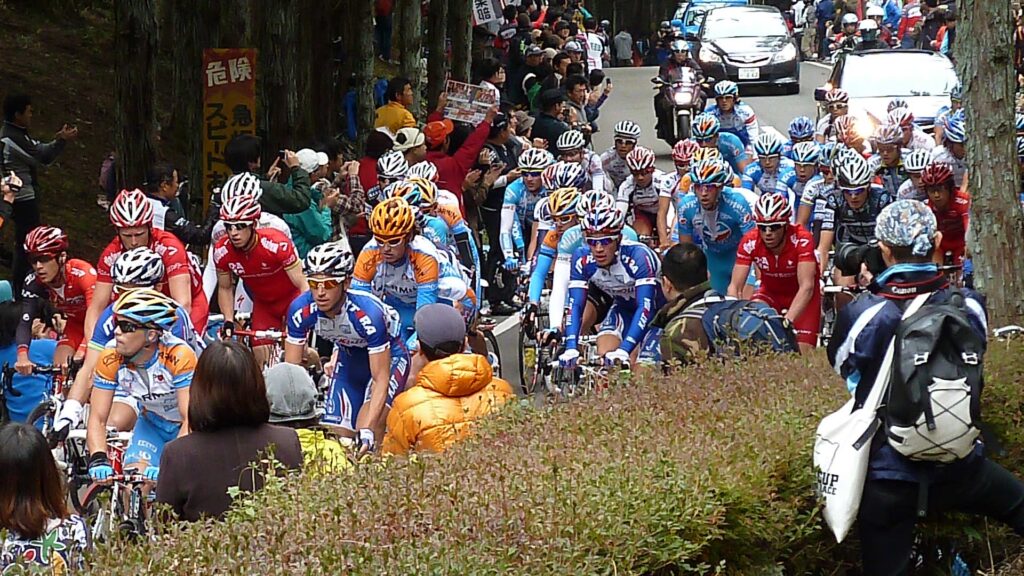
The peloton passes Hagi on the approach to the finish in Utsunomiya. Photo: SpringField1967/Wikimedia Commons, CC BY-SA 3.0.
The final rolling roads close the loop around the reservoir. Forest Park returns through the trees, but after thirteen previous crossings that merely began another lap, the familiar landscape finally carries the riders towards the end.
FINISH | Utsunomiya Forest Park
The winner reaches the line beside the same forest and reservoir from which the peloton departed 144.2 kilometres earlier. Mount Kogashi still rises above Akagawa Dam, and the riders have never travelled far from this small corner of Tochigi, yet the roads around them contain more than three decades of international racing layered upon the legacy of the 1990 World Championships.
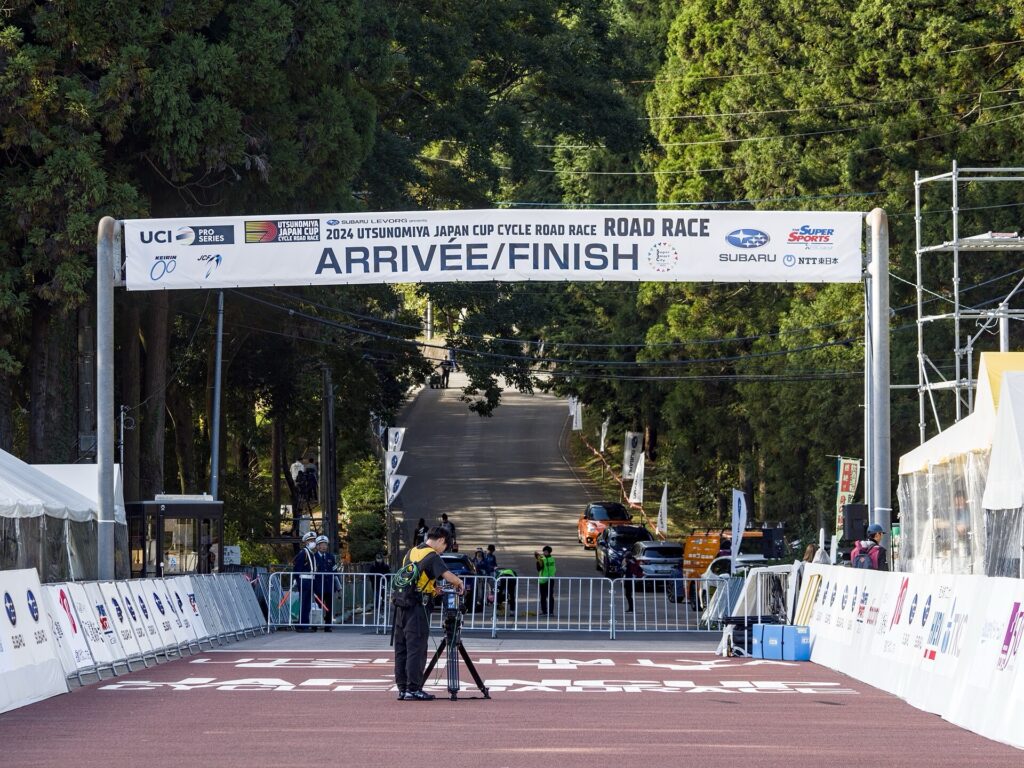
The start and finish area in Utsunomiya Forest Park after the 2024 Japan Cup Cycle Road Race. Photo by Fukumoto, licensed under CC BY-SA 4.0, via Wikimedia Commons
The first Japan Cup preserved that championship landscape rather than allowing it to become a one-off episode. Chiappucci gave the young race an international star closely associated with its formative years, the World Cup arrived in 1996, Yoshiyuki Abe produced the race’s only Japanese victory a year later, and subsequent generations brought Grand Tour winners and world champions back to the same forest. Around them, Utsunomiya developed its own cycling culture until the annual return of the peloton became part of the identity of the city rather than simply a memory of the championships it once hosted.
Fourteen laps eventually bring the race back to the exact landscape from which it started, but Kogashi has changed through accumulation. A short forest climb has become fourteen ascents, a crowd has watched a complete race unfold from almost the same roadside and a circuit of only 10.3 kilometres has connected the first Road World Championships in Asia with more than thirty years of professional cycling in Utsunomiya. On the map, the Japan Cup has travelled in circles. Beneath Mount Kogashi, those circles have become history.