
Cycling’s Lost World | Italy | 1902–1961 | 38 editions
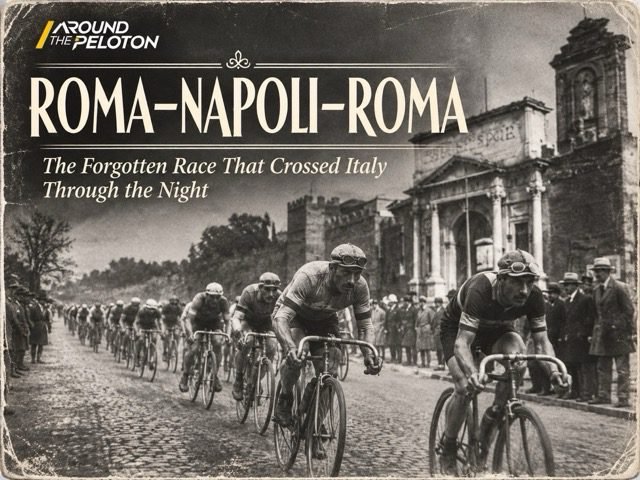
In September 1902, a seventeen-year-old cyclist from Asti arrived in Rome carrying ambitions considerably greater than his financial means. Giovanni Gerbi had purchased a third-class railway ticket to the capital, but he had no money for the journey home. His immediate concern, however, was a bicycle race of extraordinary proportions: a journey of approximately 450 to 460 kilometres from Rome to Naples and back, following the roads of central and southern Italy through an entire day and much of the night.
Gerbi finished fourth, behind Ferdinand Grammel, a German cyclist living in Rome who won the inaugural competition. Yet the young Italian’s difficulties were far from over. With his remaining money exhausted, he accepted a challenge against a local rider at the Velodrome of Porta Salaria, wagering his bicycle against his opponent’s. Gerbi won and believed he had secured a valuable prize, although he would discover only after returning to Asti that the bicycle did not belong to the defeated rider and had to be returned. His journey north required assistance from the authorities, and the long railway trip was undertaken with little food and considerable uncertainty.

Such adventures belonged to an age when competitive cycling offered opportunities for extraordinary achievement but few guarantees of security. The strongest riders might earn public admiration without possessing enough money to travel between competitions, while the roads themselves demanded a degree of independence and endurance that modern professional racing rarely requires.
The event that brought Gerbi to Rome was Roma–Napoli–Roma, one of the most remarkable forgotten races in Italian cycling. Established in 1902, it would be contested in two distinct periods: 26 editions between 1902 and 1934, followed by 12 editions during its postwar revival from 1950 to 1961. Across those 38 editions, the race passed through political upheaval, two world wars and profound changes in the organisation of professional sport.
Its history followed the transformation of Italy itself. The earliest competitors struggled across rough highways in darkness, while their successors raced before enormous crowds in a country increasingly shaped by industry, motor vehicles and commercial spectacle. By the time the final winner crossed the line, the competition had become almost unrecognisable, although its name still recalled the formidable journey that had inspired it.
1902: A Race Across Italy’s Old Roads
The first Roma–Napoli–Roma began on 19 September 1902 and finished the following day, coinciding with the anniversary of the Breach of Porta Pia, when Italian troops entered Rome in 1870 and brought the remaining Papal States under the authority of the Kingdom of Italy. The anniversary carried considerable significance in a nation whose political unification remained relatively recent, and the new competition was immediately associated with one of the defining dates of modern Italian history.

Even the precise distance of that inaugural race has become a matter of historical interpretation. Museo del Ciclismo records approximately 450 kilometres, while the detailed reconstruction by Delfino Petrucci gives 460 kilometres and a winning time of 23 hours, 33 minutes and 15 seconds. Both figures describe an undertaking of extraordinary scale, particularly when considered against the conditions of the roads and bicycles available at the beginning of the twentieth century.
The competitors did not simply travel south to Naples and retrace their outward journey. From Rome, they followed the inland corridor through Lazio and Campania, passing Cassino and Capua before reaching the southern turning point. The return brought them north along the Tyrrhenian side of the peninsula, through Mondragone, Formia and Terracina, before the route climbed inland toward Velletri and Albano on its final approach to the capital.
Much of the road network remained poorly suited to fast cycling. Loose stones, mud and irregular surfaces threatened punctures and damaged equipment, while darkness made it difficult to anticipate hazards. A mechanical problem could consume valuable time, and riders who became separated from their competitors often found themselves travelling alone through the countryside.
Grammel completed the journey ahead of Alfredo Jacorossi and Enzo Spadoni, with Gerbi fourth. Their performances belonged to a period when a bicycle race could still resemble an expedition, and when reaching the finish was itself an achievement worthy of recognition.
Cassino, Naples and the Coastal Road Home
The roads followed by the original Roma–Napoli–Roma crossed a landscape whose history reached far beyond the relatively young Italian kingdom. South of Rome, the route approached Cassino, situated near the Liri valley beneath the mountain crowned by Montecassino Abbey. Founded by Benedict of Nursia in the sixth century, the monastery became one of the most influential religious institutions in Western Europe, while the surrounding valley remained an important corridor between central and southern Italy.
Beyond Cassino lay Capua, a name associated with the ancient world and the great Roman roads that connected the capital with the south. The Via Appia, begun in 312 BCE, had helped transform the movement of armies, goods and travellers across the peninsula, establishing routes whose importance endured long after the fall of the Roman Empire.
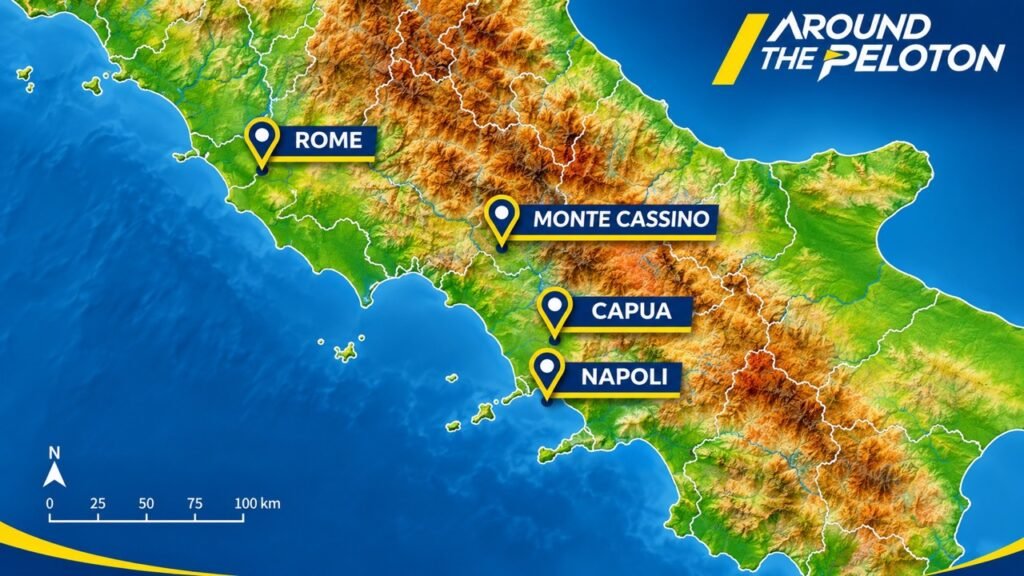
For the cyclists of 1902, these places offered little opportunity to contemplate their historical significance. The road continued relentlessly south, and every hour brought another stretch of uneven surface, another village and another uncertainty about the condition of the route ahead.
Naples eventually appeared as the southern turning point, its crowded streets and busy port providing a dramatic contrast with the agricultural countryside crossed earlier in the journey. The city had been the capital of the Kingdom of the Two Sicilies before Italian unification, and its commercial life remained deeply connected to the sea and the surrounding region.
Yet the riders had no opportunity to regard their arrival as the completion of a journey. They still faced the return to Rome, with hundreds of kilometres already accumulated in their legs.
The coastal route brought the riders toward Terracina, where the Tyrrhenian plain meets the limestone mountains of southern Lazio. Above the town, the ancient sanctuary of Jupiter Anxur stood on Monte Sant’Angelo, overlooking a stretch of coastline that had been strategically important since Roman times.
Farther north, the route entered the Alban Hills, where the volcanic landscape, elevated settlements and agricultural slopes introduced a final change in terrain at a moment when exhaustion would have made even modest gradients difficult.
The geography explains something essential about the original race. Its difficulty did not come from a single celebrated mountain or spectacular obstacle, but from the accumulation of distance, imperfect roads and changing terrain across an entire day and night. Naples was not the destination. It was the point at which the long journey home began.
Giovanni Gerbi: The Red Devil’s Revenge
Giovanni Gerbi would become one of the first great personalities of Italian cycling, earning the nickname Diavolo Rosso, the Red Devil, through a combination of aggressive racing, stubborn endurance and an unmistakable competitive temperament.
Born in Asti in 1885, he belonged to a generation of cyclists whose careers developed before the sport possessed the financial structures and organised support that would later become familiar. Success depended as much on determination and improvisation as on physical ability, and Gerbi’s early experiences at Roma–Napoli–Roma reflected that uncertain existence.
In 1906, the race brought him another humiliation. Returning north near Capua, he slipped in mud and fell into a ditch, an accident that left him exhausted and unable to continue effectively. Seeking shelter at an inn, he discovered that his accommodation was infested with bedbugs, turning an already miserable evening into a night of discomfort, arguments and frustration.

According to the surviving account, Gerbi vowed that he would never return to the region. Twelve months later, he was back on the same roads, determined to achieve the victory that had previously escaped him.
The 1907 edition would provide the success he had been pursuing. Gerbi faced experienced rivals across the long journey south and the return toward Rome, where the coastal roads and inland climbs demanded the same combination of endurance and tactical judgement that had distinguished the competition since its foundation.
The route through southern Lazio included the difficult country around Minturno and Itri, where the road climbed away from the coastal plain into the limestone hills. In a race of such length, the ability to maintain strength through the final hours could prove decisive, particularly when competitors were separated by substantial distances and reliable information about their rivals was difficult to obtain.
Gerbi eventually returned to Rome victorious, completing one of the most demanding performances of his career.
On 20 September 1907, he won Roma–Napoli–Roma over 460 kilometres in 20 hours, 56 minutes and 13 seconds, maintaining an average speed of approximately 21.97 kilometres per hour. Of the thirty riders who started, only eleven were classified as finishers, while Alfredo Jacobini reached Rome more than two hours behind the winner and Umberto Zoffoli took third place.
The official classification also exposed the difficulties of regulating such an immense competition. Carlo Galetti, who crossed the finish line second, was disqualified for using an automobile, while Raffaele Ferretti was excluded after failing to sign the control sheet in Naples. Luigi Ganna, who would later win the inaugural Giro d’Italia, was disqualified following an irregular wheel change.
These incidents reveal the fragile boundary between legitimate assistance and sporting misconduct in an era when competitors could be scattered across hundreds of kilometres of public roads. Officials relied on checkpoints and regulations that were difficult to enforce consistently, particularly when the race continued through darkness and the riders travelled far beyond immediate observation.
Gerbi’s victory demonstrated his extraordinary endurance, but the disputes surrounding the classification also revealed why the original format was becoming increasingly difficult to sustain.
1908: The End of Racing Through the Night
In 1908, the Italian cycling federation prohibited overnight racing, a decision that forced the organisers of Roma–Napoli–Roma to reconsider the continuous journey that had defined its earliest editions. The race could no longer be organised in the same uninterrupted format, and the solution was to divide the distance into stages.
The change altered more than the timetable. Riders could now reach an organised finish, recover overnight and begin the following stage under conditions that were easier to supervise. The competition also became more accessible to spectators, who could gather at scheduled departures and arrivals rather than waiting for exhausted cyclists to pass through at unpredictable hours.
For newspapers and bicycle manufacturers, the new format offered additional opportunities. Daily results created an unfolding sporting narrative, while stage finishes allowed sponsors and organisers to present the riders before larger crowds.
The creation of the Giro d’Italia in 1909 would accelerate this development, establishing a model of multi-stage racing that combined endurance with publicity, regional participation and commercial organisation.
Roma–Napoli–Roma adapted to the changing environment, experimenting with different formats and itineraries. By 1913, the competition followed a two-stage route through Rieti and Umbria rather than the traditional journey between Rome and Naples, demonstrating how its historical identity had begun to outlive the geographical course from which its name originated.
The original race had been conceived as a single immense journey. Its successors were becoming competitions shaped by regulations, stage classifications and the growing expectations of a national sporting audience.
The Corsa del XX Settembre: Cycling and Italian Identity
Roma–Napoli–Roma was also known as the Corsa del XX Settembre, the Race of 20 September, a name formally associated with editions held between 1919 and 1927. The date commemorated the capture of Rome in 1870, a decisive event in the completion of Italian unification and the establishment of the capital under the authority of the new kingdom.
The race’s original journey between Rome and Naples connected cities that had belonged to different political systems before unification, passing through territories where local identities remained strong despite the growing influence of national institutions. Road cycling was particularly suited to this landscape because its competitions travelled through communities rather than remaining confined to stadiums, allowing spectators to encounter national sporting figures in the streets of their own towns.
During the Fascist period, the relationship between sport and political power became more explicit. The regime promoted competitions associated with its own identity, and Roma–Napoli–Roma faced increasing pressure from Predappio–Roma, an event benefiting from political patronage and closely associated with Benito Mussolini’s birthplace.
The rival race enjoyed advantages that Roma–Napoli–Roma, despite its older patriotic associations, could not easily match. Historical accounts identify this competition as one of the factors contributing to the older event’s decline during the early 1930s, alongside organisational difficulties and the increasingly demanding economics of professional racing.
A competition that had once celebrated a defining moment in Italian unification was now struggling for attention within a sporting culture shaped by a different political order.
Girardengo and the Rise of the Italian Champions
The early decades of Roma–Napoli–Roma coincided with the emergence of professional cyclists whose reputations extended far beyond the towns and regions in which they had first competed. The generation of Gerbi, Carlo Galetti, Luigi Ganna and Eberardo Pavesi had helped establish road racing in Italy, but the years that followed produced champions whose victories were reported and celebrated throughout the country.
Among them, Costante Girardengo established the most successful record in Roma–Napoli–Roma’s history, winning five editions. Known as Italy’s first Campionissimo, Girardengo became one of the earliest cyclists to achieve the status of a national sporting celebrity, his performances in the Giro d’Italia, Milano–Sanremo and other major competitions followed by an audience that extended well beyond his native Piedmont.

His repeated success at Roma–Napoli–Roma demonstrated that the event retained considerable prestige even as its format changed. For a rider whose career was defined by major victories across the Italian calendar, the race remained an important competition rather than a relic of cycling’s pioneering years.
The changes in distance during the interwar period also reveal how substantially the event had evolved. Girardengo won the 1925 edition over 299 kilometres, while Alfredo Binda claimed victory the following year over 224 kilometres in 8 hours, 8 minutes and 8 seconds. These distances were far removed from the uninterrupted 460-kilometre journey of 1902, illustrating the organisers’ willingness to reshape the competition while preserving its historical identity.
Other leading professionals, including Learco Guerra, would also become associated with its later editions, reflecting the strength of Italian cycling during the interwar period.
Yet the very success of the sport created new difficulties for older competitions. Major races increasingly required substantial financial resources, sophisticated organisation and reliable commercial support, while the enormous distances that had once distinguished Roma–Napoli–Roma became harder to reconcile with the expectations of teams and organisers.
The race retained its reputation, but its position within the national calendar was no longer secure.
1934: Learco Guerra and the End of the First Era
The final edition of the original Roma–Napoli–Roma took place in 1934, with victory going to Learco Guerra, one of the most powerful riders of his generation.
Known as Locomotiva Umana, the Human Locomotive, Guerra had won the world road championship in 1931 and would claim the Giro d’Italia in 1934. His strength lay in his ability to sustain formidable speeds, a quality particularly suited to the long distances that remained part of Roma–Napoli–Roma’s identity.
The last prewar edition covered 462.6 kilometres, with the riders departing from the Tor Pignattara area of Rome at one o’clock in the morning. Despite the changes introduced after the 1908 prohibition on overnight racing, the competition had returned to a format that still retained much of its original severity. The surviving historical account records the early departure but does not establish when or why the earlier restriction ceased to apply.

The contest began to take shape near Ferentino, a town in the hills southeast of Rome whose ancient walls and position above the Sacco valley reflected its long history as a settlement along the routes connecting the capital with southern Lazio. Guerra helped initiate the decisive racing action, contributing to the formation of the breakaway that would shape the remainder of the competition.
The leading riders continued through the long journey before returning to Rome, where the finish awaited at the Motovelodromo Appio. After five laps of the track, Guerra secured victory in a sprint ahead of Umberto Guarducci and Isidoro Piubellini, all three credited with the same finishing time.
It was a fitting sporting finale for the first era of Roma–Napoli–Roma. The event that had once attracted an impoverished Giovanni Gerbi now welcomed celebrated professionals whose achievements filled national newspapers, yet the formidable distance and physical demands of the original competition remained central to its identity.
After 26 editions between 1902 and 1934, Roma–Napoli–Roma disappeared from the calendar. Sixteen years would pass before the name returned, and the Italy that welcomed its revival would be profoundly different.
1950: When Lambrettas Entered the Race
On 20 April 1950, Roma–Napoli–Roma returned to the roads of Italy, although the competition now bore little resemblance to the immense endurance contest of its early years. Revived as the Gran Premio Ciclomotoristico, the event combined conventional road racing with sections paced by 125 cc Lambretta scooters, bringing the growing culture of motorised transport directly into professional cycling.
Postwar Italy was rebuilding its economy and infrastructure, and the scooter had become one of the most visible symbols of the country’s industrial recovery. Manufactured by Innocenti, the Lambretta offered an affordable form of personal transport and represented a new relationship between Italians and the roads they travelled.
Its appearance in a professional cycling race was therefore more than a technical innovation. The scooters connected the event with an industry eager to demonstrate its products before large audiences, while the riders could achieve speeds that would have been impossible to sustain without aerodynamic assistance.
The 1950 competition covered approximately 471 kilometres over two stages, each divided into two half-stages. Two of the four sections incorporated Lambretta pacing, while the others were contested without motorised pacers, creating an unusual combination of racing disciplines within the same general classification.
A local historical account describes the race passing through Santa Maria Capua Vetere on 20 April, where spectators gathered along the Appian road to watch Fausto Coppi, Gino Bartali and the other leading professionals. Before the cyclists arrived, advertising vehicles promoting Chinotto Neri and Lamette Tre Stelle moved through the town, attracting children eager to collect promotional gifts.
The riders followed amid the noise of scooters and the excitement surrounding the visiting champions. The Frosinone–Naples section was won by Serse Coppi, Fausto’s younger brother, who reached the finish at the Arenaccia velodrome in Naples.
Serse had already established himself as a talented professional, notably sharing victory in the controversial 1949 Paris–Roubaix, but his career would end tragically the following year. In June 1951, he died after a crash at the Giro del Piemonte, leaving the 1950 Roma–Napoli–Roma among the victories of a career cut short.
The overall competition was won by Jean Robic, ahead of Fausto Coppi and Louison Bobet. Its passage through Campania revealed a new kind of sporting occasion, combining celebrated cyclists, advertising vehicles and modern machinery in a travelling spectacle that belonged unmistakably to postwar Italy.
Alfredo Martini and the Terracina Road: Racing at 80 km/h
The most striking evidence of the revived race’s character comes from an account of its motor-paced sections, when cyclists followed scooters at speeds far beyond those normally associated with road racing.
During the 1950 edition, Carlo Gambacurta served as a pacer for Alfredo Martini, the Italian professional who would later become one of the most respected national team coaches in cycling history. More than twenty-five years afterward, the two men met in Pescara in 1977 and recalled their experiences on the roads of southern Lazio.
According to an account preserved by Gambacurta’s son Agostino, Martini and his pacer remembered travelling at approximately 70 km/h along the straight road near Terracina. Even at that speed, they were overtaken by Rik Van Steenbergen, the Belgian champion, who reportedly passed them at approximately 75 to 80 km/h.

The figures come from a recollection recorded many years after the event rather than an official timing record, but they offer an extraordinary glimpse into the conditions of the competition.
Riding close behind a motorised pacer demanded precision and concentration. The cyclist benefited from the reduced wind resistance created by the scooter, but maintaining that position required complete trust in the person controlling the vehicle ahead. At such speeds, a sudden movement or mechanical failure could have serious consequences.
The Terracina road had already appeared in the history of Roma–Napoli–Roma as part of the coastal return of the original 1902 route. Almost half a century later, the same geographical corridor had become the setting for a very different kind of challenge, one in which the limiting factor was no longer simply how long a rider could endure, but how safely he could exploit the speed made possible by motorised pacing.
The Champions and Spectacle of the 1950s
The Gran Premio Ciclomotoristico continued to attract leading European professionals throughout the 1950s, its unusual format offering both a competitive challenge and an opportunity for prominent riders to appear before enthusiastic Italian crowds.
Fiorenzo Magni won the 1952 edition over 718.6 kilometres in 19 hours, 0 minutes and 17 seconds, averaging approximately 37.812 kilometres per hour. Stan Ockers finished second, eighteen seconds behind, followed by Jean Robic and Gino Bartali.
The classification reflected the strength of the field. Magni had already established himself through victories in the Giro d’Italia and Tour of Flanders, while Bartali and Robic were among the most recognisable figures in European cycling.
Yet the character of the event is perhaps better understood through the images preserved in an Italian newsreel from 1955, which shows cyclists and motorcyclists racing together on roads through Campania.
The camera follows riders moving along the road behind motorised pacers, with Fausto Coppi visible close to a motorcycle and Bruno Monti among the competitors. At the stage finishes, spectators crowd around the cyclists, while banners, photographs of champions and promotional displays occupy the surrounding space.
The scenes capture a form of professional cycling in which the race itself was inseparable from the public occasion surrounding it. For towns along the route, the arrival of the competition brought internationally recognised athletes, unusual machinery and commercial publicity into streets normally occupied by everyday traffic and local life.
By the middle of the decade, the event was increasingly identified as the Gran Premio Ciclomotoristico delle Nazioni, a title reflecting its international field and the distinctive combination of conventional and motor-paced racing. Historical sources do not consistently distinguish formal changes of name from promotional usage, but the designation became established during the competition’s final years.
Louison Bobet won in 1959 and 1960, adding his name to a list of champions that extended from the pioneers of Italian road racing to the leading international professionals of the postwar period.
The race had travelled far beyond its original geographical and sporting boundaries. What began as a contest between Rome and Naples had become a touring spectacle of central and southern Italy, shaped by motorised pacing, commercial sponsorship and the presence of some of Europe’s most celebrated cyclists.
1961: The Final Journey
The last Roma–Napoli–Roma took place between 25 April and 1 May 1961, by which time the event was known as the Gran Premio Ciclomotoristico delle Nazioni.
The competition covered 1,340.3 kilometres over seven stages, two of which were divided into separate sections. Its itinerary extended across central and southern Italy, beginning in Rome and travelling through L’Aquila, Teramo and Pescara before continuing from Ortona toward Foggia, Campobasso, Salerno, Castellammare di Stabia and Caserta.
The final stage carried the riders from Caserta to Castel Fusano, near Rome, completing a journey that bore little geographical resemblance to the original race.
Jean Graczyk won the general classification ahead of Graziano Battistini and Hilaire Couvreur. The Frenchman had already established himself as an accomplished professional, with major victories and success in the Tour de France points classification, and his triumph gave the event a final international winner.

There would be no further edition. The reasons for the race’s disappearance cannot be attributed confidently to a single documented cause. Organisational demands, commercial pressures and competition within the professional calendar formed part of the environment in which it operated, but its long history had already demonstrated how difficult it could be to preserve an event whose format and identity were continually changing.
When Graczyk completed the final stage in 1961, Roma–Napoli–Roma had reached its 38th and final edition. Its name remained connected to the journey between Rome and Naples, but the competition itself had become something far removed from the undertaking that brought Giovanni Gerbi to the capital almost sixty years earlier.
The Race That Belonged to Two Different Worlds
The history of Roma–Napoli–Roma can be understood through two journeys separated by almost half a century.
In 1902, Giovanni Gerbi travelled to Rome without enough money to return home, raced hundreds of kilometres through the countryside and eventually depended on the assistance of strangers to make his way back to Asti.
In 1950, Alfredo Martini followed a Lambretta along the road near Terracina at approximately 70 km/h, watching Rik Van Steenbergen disappear ahead at a speed that would have astonished the pioneers of the original competition.
Both men belonged to the same race, although their experiences reflected profoundly different Italies. Gerbi competed in a country where roads remained difficult and professional cycling offered uncertain rewards. Martini raced in a nation rebuilding after war, where scooters, industrial manufacturers and commercial publicity had become part of everyday life.
Roma–Napoli–Roma survived for decades by changing with that world, until its final disappearance in 1961.
The roads between Rome and Naples remain, crossing the valleys of Lazio, the historic towns of Campania and the coastal landscapes of the Tyrrhenian Sea. Travellers still pass through Cassino, Capua, Formia and Terracina, often without knowing that these places once belonged to one of the most demanding competitions in European cycling.
And somewhere along those roads, the history of Roma–Napoli–Roma still holds two remarkable images. Giovanni Gerbi arriving in Rome in 1902 with a third-class railway ticket and no money for the journey home, beginning a relationship with the race that would culminate in his victory five years later, after 460 kilometres and just under twenty-one hours in the saddle. And Alfredo Martini following a Lambretta along the road near Terracina at a speed the Red Devil of Asti could scarcely have imagined.
Credits
01. Ferdinand Grammel. Historical portrait sourced from Wikimedia Commons (https://commons.wikimedia.org/wiki/File:Ferdinand_Grammel.png). Public Domain.
02. Porta Pia, Rome. Historical photograph by an unknown photographer (1900), sourced from Wikimedia Commons (https://commons.wikimedia.org/wiki/File:Porta_Pia_900.jpg), designated public domain under PD-Italy and PD-1996 (https://commons.wikimedia.org/wiki/Template:PD-Italy and https://commons.wikimedia.org/wiki/Template:PD-1996).
03. Giovanni Gerbi at the 1905 Giro di Lombardia. Photograph by an unknown photographer (1905), sourced from Wikimedia Commons (https://commons.wikimedia.org/wiki/File:Giovanni_Gerbi_Giro_di_Lombardia_1905.png), designated public domain under PD-Italy (https://commons.wikimedia.org/wiki/Template:PD-Italy) and PD-1996 (https://commons.wikimedia.org/wiki/Template:PD-1996).
04. Costante Girardengo, Winner of Milano–Torino 1919. Historical photograph (1919), sourced from Wikimedia Commons (https://commons.wikimedia.org/wiki/File:Costante_Girardengo_vainqueur_de_Milan-Turin,_le_23_avril_1919_(troisième_de_ses_cinq_victoires_en_dix_ans).jpg), designated public domain under PD-old-70 (https://commons.wikimedia.org/wiki/Template:PD-old-70) and PD-US-expired (https://commons.wikimedia.org/wiki/Template:PD-US-expired).
05. Learco Guerra at Sospel, Tour de France 1930. Photograph by Agence Rol (17 July 1930), sourced from Wikimedia Commons (https://commons.wikimedia.org/wiki/File:Learco_Guerra_1930_Sospel.jpg), identified as a public-domain historical press photograph. See https://commons.wikimedia.org/wiki/Template:PD-France and https://commons.wikimedia.org/wiki/Template:PD-1996. Public Domain.
06. Alfredo Martini at the 1950 Giro d’Italia. Photograph by La Presse (25 May 1950), sourced from Wikimedia Commons (https://commons.wikimedia.org/wiki/File:Alfredo_Martini,_1950_Giro_d%27Italia,_stage_2_02.jpg), designated public domain in Italy under PD-Italy (https://commons.wikimedia.org/wiki/Template:PD-Italy), pursuant to the 20-year protection term for ordinary photographs
07. Jean Graczyk, circa 1966. Historical photograph, sourced from Wikimedia Commons (https://commons.wikimedia.org/wiki/File:Jean_Graczyk_c1966.jpg). Public Domain