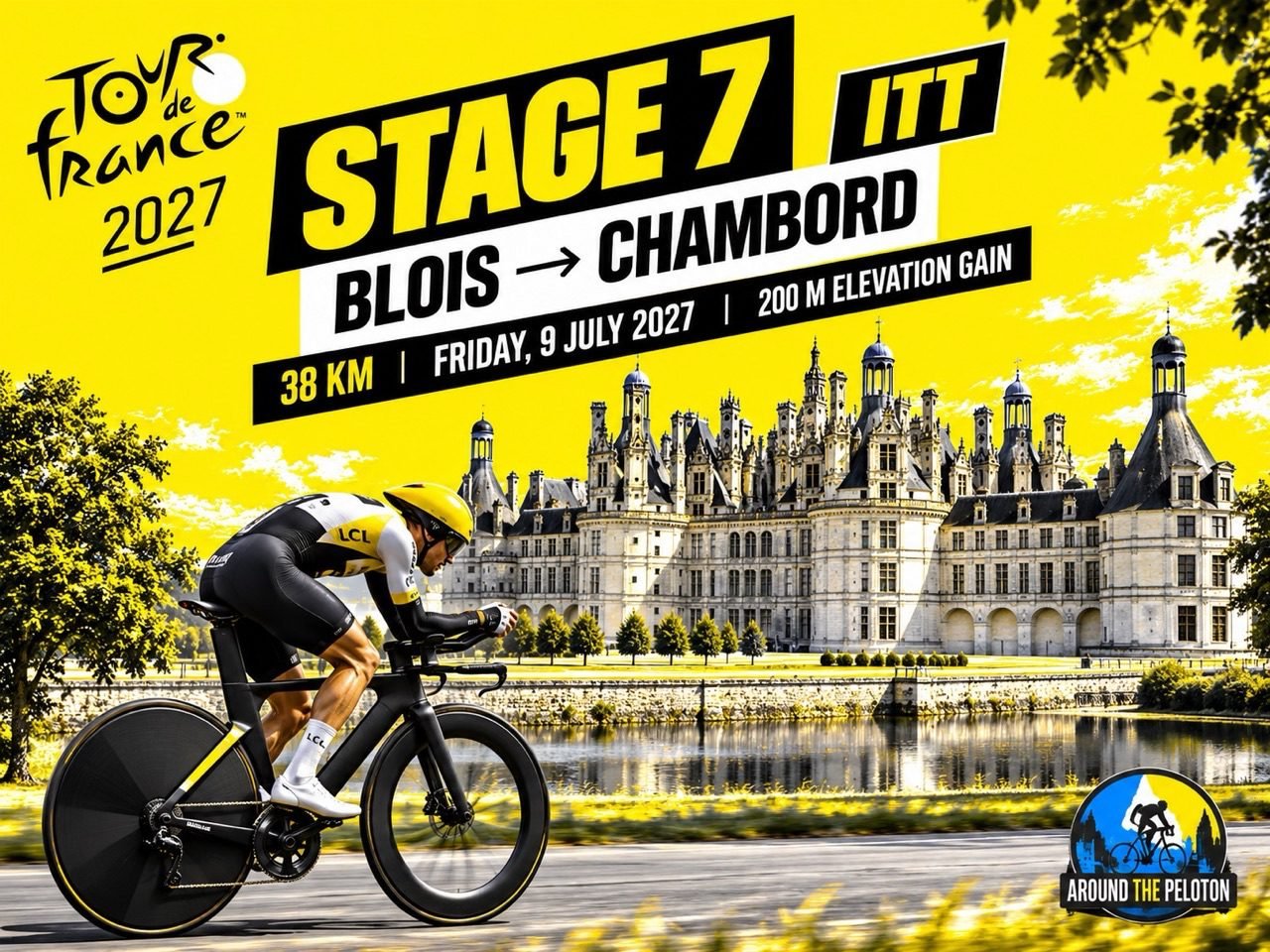

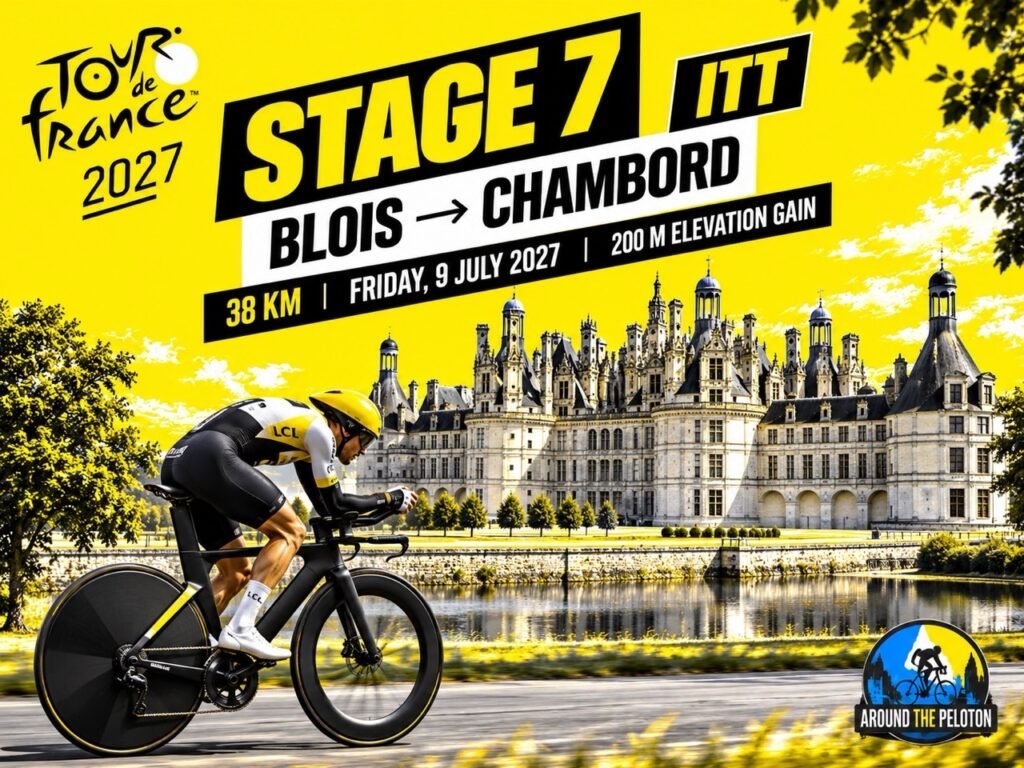
The first individual time trial of the 2027 Tour de France takes the riders from the royal city of Blois to the magnificent Château de Chambord. Over 38 kilometres, the route follows a southern loop through the Loire Valley, passing Renaissance estates, historic villages and the wooded landscape of Sologne. There are no mountains to climb and no teammates to provide shelter. The battle is against the clock, with two demanding stages waiting beyond the finish.
Stage 7 | Friday, 9 July 2027 | Blois → Chambord | 38 km | 200 m elevation gain | Individual Time Trial
On 24 July 1992, Miguel Indurain arrived in Blois having delivered another demonstration of the ability that would make him one of cycling’s greatest time trialists. The Spaniard had already established his authority over the Tour de France, but the nineteenth stage, a 64-kilometre individual time trial from Tours to Blois, offered another opportunity to underline his superiority.
Indurain completed the course in 1 hour, 13 minutes and 21 seconds, averaging more than 52 kilometres per hour. Gianni Bugno, the reigning world champion, finished forty seconds behind, while Claudio Chiappucci, whose aggressive climbing had made him one of the race’s principal challengers, conceded two minutes and fifty-three seconds. The victory strengthened Indurain’s overall lead over Chiappucci to four minutes and thirty-five seconds, bringing him another step closer to his second consecutive Tour de France title.
Thirty-five years later, the Tour returns to Blois for another race against the clock, although the direction is reversed and the distance reduced to 38 kilometres. Rather than finishing beneath the city’s royal château, the 2027 riders will begin there and travel towards Chambord, following a circuitous route through some of the Loire Valley’s most historically significant countryside.
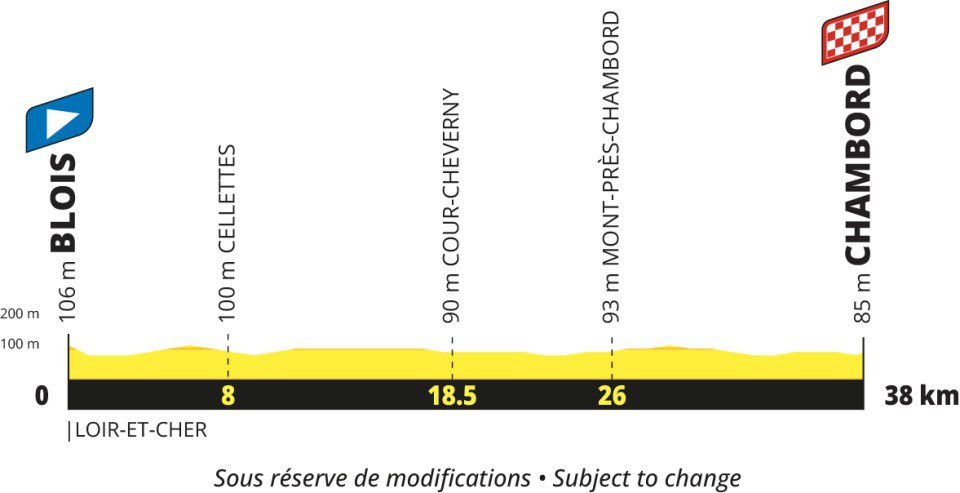
The two châteaux lie less than twenty kilometres apart by direct distance, but the stage takes a much longer southern loop. From Blois, the route heads towards Cellettes and Cour-Cheverny before turning east through Mont-près-Chambord and approaching the Château de Chambord. This deliberate diversion introduces the riders to the wooded estates, vineyards and villages that distinguish the region from the more familiar riverfront landscape of the Loire itself.
It is a relatively flat course, with only 200 metres of accumulated climbing, but that simplicity makes it potentially decisive. An individual time trial strips away the tactical shelter of the peloton. Each rider follows the same roads alone, separated from competitors by their starting times and measured against them through an unforgiving clock.
For the general classification contenders, this will be the first substantial opportunity to gain or lose time directly against one another. Yet the result cannot be considered in isolation. The following two days bring a long, hilly stage to Le Creusot and a mountain finish on the Grand Colombier, creating a three-day sequence in which the balance between time-trial ability, recovery and climbing strength could begin to shape the entire race.
–38 km | Blois: A Royal City Where History Was Made Behind Closed Doors
Blois rises above the northern bank of the Loire, its historic centre arranged along steep streets that lead towards the Royal Château. For centuries, the city occupied an important position on the river, serving as a commercial centre and later a residence of the French monarchy.

The Château Royal de Blois is unusual among the great Loire castles because it brings together several distinct periods of French architecture within a single courtyard. Its surviving buildings include medieval structures, the Gothic wing constructed under Louis XII, the Renaissance apartments of François I and the classical wing commissioned by Gaston, Duke of Orléans, during the seventeenth century.
Walking into the courtyard is therefore something like entering an architectural history of France. Each façade reflects the ambitions of a different ruler, while the changing styles reveal how royal power, artistic taste and political authority developed across several centuries.
The most striking architectural feature is the monumental spiral staircase of the François I wing, whose open structure and elaborate stone decoration embody the artistic confidence of the French Renaissance. The château was intended to impress visitors, but behind its impressive façades the French monarchy also experienced some of its most dangerous political crises.
The Assassination of the Duke of Guise
On 23 December 1588, during the French Wars of Religion, King Henri III ordered the assassination of Henri I, Duke of Guise, one of the most powerful political figures in the kingdom.
Guise was a leading figure of the Catholic League, whose influence threatened the king’s authority. Following the Day of the Barricades in Paris earlier that year, Henri III had been forced to withdraw from the capital, while Guise’s political position appeared increasingly secure.

The king summoned his rival to Blois during a meeting of the Estates General. On the morning of 23 December, Guise entered the royal apartments, where members of the king’s personal guard attacked and killed him. His brother, the Cardinal of Lorraine, was executed the following day.
The killings were intended to restore royal authority, but instead intensified the crisis. Less than eight months later, Henri III himself was assassinated, bringing an end to the Valois dynasty and opening the way for Henri IV, the first Bourbon king of France.
The château preserves the memory of these events alongside its Renaissance architecture, reminding visitors that the Loire’s royal residences were centres of political intrigue as well as artistic achievement.
Blois and the Tour de France: Indurain’s 1992 Masterclass
Blois also has a cycling history that predates the modern Tour. Achille Colas, born in the city, finished eighth in the 1904 Tour de France, only the second edition of the race. Local cycling organisations were already active before the twentieth century, organising competitions around the town and its famous château.
The city’s relationship with professional cycling continued through Paris–Tours, the Tour du Loir-et-Cher and several Tour de France appearances. Its association with individual time trials is particularly appropriate for 2027, with Indurain’s 1992 victory providing the clearest historical parallel.
The Spaniard’s performance that July was not an isolated achievement. A year earlier, he had won his first Tour de France, and he would eventually claim five consecutive titles between 1991 and 1995. His success was built on an exceptional combination of climbing consistency, physical endurance and efficiency against the clock.
The stage into Blois reinforced that pattern. By extending his advantage over Chiappucci to four minutes and thirty-five seconds, Indurain left his principal rival with almost no realistic opportunity to overturn the classification before Paris.
The 2027 riders will leave Blois individually, each carrying different ambitions towards Chambord. Some will seek the stage victory, while others will concentrate on limiting losses that could become difficult to recover during the following stages.
–30 km | Cellettes: The Man Who Collected the Faces of European History
Eight kilometres after leaving Blois, the course reaches Cellettes at approximately 100 metres above sea level. The town lies along the Beuvron River, where the Loire’s broad valley begins to give way to wooded estates and agricultural land.
The surrounding countryside contains several historic residences, but the Château de Beauregard offers a particularly remarkable story. Its greatest treasure is not a monumental staircase or a royal bedroom, but a gallery containing 327 portraits of figures who shaped the political history of Europe.

The collection was created through the ambitions of Paul Ardier, a former royal treasurer who acquired Beauregard in 1617. Having served under Henri IV, Ardier belonged to the administrative world of the French monarchy, where financial management and political connections could provide considerable influence and wealth.
His retirement from public service did not diminish his interest in the personalities who had shaped European affairs.
Paul Ardier and the Gallery of Illustrious Figures
Ardier began assembling a remarkable visual history of rulers, military commanders, diplomats and political figures. Rather than organising the collection around a single royal family, he sought to represent the interconnected political world of France and its European neighbours.
The resulting Galerie des Illustres, or Gallery of Illustrious Figures, became one of the most unusual historical collections of its time. Its 327 portraits span the period from 1328 to 1643 and represent figures from twenty-six nationalities, including French monarchs, English rulers, Ottoman leaders and prominent personalities from across Europe.

The project continued through several generations of Ardier’s descendants, creating a gallery that reflected both historical curiosity and the desire to organise the past into a coherent narrative.
The portraits were arranged chronologically, allowing visitors to follow the succession of reigns and political events across more than three centuries. Above them, an elaborate ceiling decorated with blue pigment and gilded ornament added a sense of ceremonial grandeur, while the gallery’s floor contained thousands of Delft ceramic tiles depicting military subjects.
Beauregard was effectively an early attempt to create a visual encyclopaedia of European political history. At a time before photography, newspapers with extensive illustrations or modern museums, portraits provided one of the most important ways of preserving the appearance and reputation of powerful individuals.
The collection also reveals the interests of its creator. Ardier did not simply record those he admired; he assembled people whose actions had shaped the world in which he had lived and worked. His gallery reflects the political imagination of seventeenth-century Europe, when royal succession, religious conflict and diplomatic alliances could change the balance of power across the continent.
Beyond Cellettes, the route continues towards Cour-Cheverny, with the surrounding countryside increasingly defined by woodland, vineyards and noble estates. The landscape feels far removed from the crowded royal streets of Blois, although many of its historic properties were created by people whose fortunes depended on the same monarchy.
–19.5 km | Cour-Cheverny: The Château That Became Tintin’s Home
The second half of the time trial begins near Cour-Cheverny, at approximately 90 metres above sea level. The village stands in a landscape historically associated with agriculture, vineyards and aristocratic estates, where substantial country houses developed alongside the larger royal residences of the Loire Valley.
The route passes through the Cheverny area, where the Château de Cheverny is one of the stage’s notable historical landmarks. The organisers identify the château along the route towards Chambord, although the precise road-level passage remains to be established. Unlike Blois, whose appearance reflects centuries of rebuilding, Cheverny is celebrated for the coherence of its classical architecture and the unusually complete preservation of its interiors.

The estate has been connected to the Hurault family for more than six centuries, although ownership changed hands during parts of that history. The present château was built during the seventeenth century, creating an elegant residence distinguished by its pale stone façade, regular proportions and richly furnished rooms.
Its owners opened Cheverny to the public in 1922, making it an early example of a privately owned French château welcoming visitors on a regular basis. The building remains inhabited by descendants of the family today. Yet Cheverny’s influence extends far beyond French architectural history.
From Cheverny to Marlinspike Hall
The château provided the architectural inspiration for one of the most famous fictional residences in European comics: Marlinspike Hall, known in French as Château de Moulinsart, in Hergé’s The Adventures of Tintin.
Hergé, the Belgian artist who created Tintin, borrowed the château’s balanced proportions and recognisable central façade for the fictional home of Captain Haddock. He simplified the original building by removing its two outer wings, creating a smaller residence that remained immediately identifiable to readers familiar with Cheverny.
Marlinspike Hall became a recurring setting in the series, appearing in adventures involving Tintin, Snowy, Captain Haddock and Professor Calculus. Its drawing-room, surrounding grounds and distinctive architecture helped make the fictional estate one of the most familiar locations in twentieth-century European illustration.
The real château eventually embraced the connection, establishing an exhibition devoted to Tintin and the fictional world of Marlinspike Hall.
It is a revealing example of how the Loire Valley’s architectural heritage has continued to influence popular culture long after its original aristocratic purpose diminished.
The riders are now approaching the eastern portion of the stage’s southern loop. With 19.5 kilometres remaining, the course begins to turn towards Mont-près-Chambord, leaving the Cheverny area behind and heading into the increasingly wooded landscape surrounding the royal estate.
–12 km | Mont-près-Chambord: The Forest of the French Kings
Mont-près-Chambord marks the final intermediate location identified on the stage profile, at approximately 93 metres above sea level.
The village lies close to the vast wooded estate surrounding Chambord, where the landscape reflects a royal tradition that was central to the political and social life of Renaissance France.
For the monarchy, hunting was more than recreation. It expressed privilege, wealth and authority, while providing occasions for rulers to strengthen relationships with nobles, ambassadors and other influential members of the court.

The forest surrounding Chambord developed within this tradition. Its extensive woodland and game populations offered the conditions required for royal hunting, while the estate’s enclosure created a landscape separated from ordinary agricultural activity.
Over time, the surrounding wall reached approximately 32 kilometres in length, making Chambord one of Europe’s largest enclosed parks.
The forest remains central to the identity of the estate. Deer, wild boar and numerous bird species inhabit its woodland, clearings and wetlands, while the long enclosure preserves the unusual scale of a landscape designed around royal pursuits.
The final approach to the château carries the riders into the estate itself. According to the organisers’ description, the last three kilometres take place within Chambord’s grounds, bringing the competition into direct contact with the extraordinary architectural setting awaiting at the finish.
For the riders, this will be the closing phase of a sustained individual effort. The terrain remains gentle, but the remaining kilometres will test their ability to maintain speed after more than half an hour of racing.
The setting also begins to change. Instead of the historic streets of Blois and the villages of the Beuvron valley, the route approaches a vast wooded estate created around the ambitions of one Renaissance king.
0 km | Chambord: The Renaissance Dream of François I

Chambord is one of the most extraordinary architectural achievements of the French Renaissance. Rising above the surrounding forest, the château combines monumental towers, intricate rooftops, chimneys, terraces and elaborate stonework into a building unlike any other royal residence in France.
Construction began in 1519 under François I, one of the central figures of the French Renaissance. The king had been deeply influenced by Italian architecture and artistic ideas, particularly during his military campaigns in Italy, and sought to create a residence expressing his power, wealth and cultural ambitions.
The location was chosen partly for its hunting opportunities. Chambord stood within the wooded landscape of Sologne, offering extensive territory for royal pursuits while remaining connected to other important residences in the Loire Valley.

François I intended the château to be more than a practical residence. Its architecture was designed to astonish visitors, combining elements associated with medieval fortresses and the emerging artistic language of the Renaissance. Massive corner towers and defensive-looking walls recalled older military buildings, while the interior organisation and ornamental details revealed a more experimental approach to space and design.
The result was a royal project whose scale exceeded its practical requirements. Chambord was not designed primarily as an everyday administrative centre, but as a demonstration of what royal ambition and artistic imagination could achieve.
Leonardo da Vinci and the Double-Helix Staircase

Among Chambord’s most remarkable features is its central double-helix staircase, composed of two intertwined stairways that allow people to ascend and descend without necessarily meeting.
The design has long been associated with Leonardo da Vinci, who spent the final years of his life in France under the patronage of François I. Leonardo died in 1519, the same year construction began at Chambord, and his notebooks contain architectural ideas that bear striking similarities to elements of the château.
The identity of Chambord’s principal architect remains uncertain, and there is no definitive documentary proof that Leonardo personally designed the staircase. Nevertheless, its unusual structure reflects the intellectual environment in which Renaissance architects and engineers experimented with geometry, movement and spatial organisation.

The staircase occupies the central keep, connecting the principal floors and extending towards the rooftop terraces. Its two intertwined flights create an architectural experience that still surprises visitors centuries after its construction.
The image is particularly appropriate for the Tour’s visit. Two people can follow separate paths through the same structure without meeting, just as the riders will cover the same roads at different moments, their performances connected through the clock rather than direct competition.
Chambord During the Second World War: The Château That Saved Masterpieces
One of Chambord’s most remarkable historical episodes occurred more than four centuries after François I began its construction.
In August 1939, as Europe moved towards war, French museum authorities began evacuating important artworks from Paris. Officials feared that bombing, occupation or deliberate destruction could threaten collections whose cultural importance extended far beyond France.
The operation had been prepared for years. Museums identified vulnerable objects, developed packing procedures and selected buildings in the countryside that might provide safer temporary accommodation.

Chambord was chosen as an important reception centre because of its enormous interior spaces and relatively isolated location. Convoys carrying paintings, sculptures, tapestries and other treasures travelled from Paris towards the Loire Valley, transforming the former royal residence into a vast temporary repository.
Among the works brought to Chambord was Leonardo da Vinci’s Mona Lisa, removed from the Louvre in August 1939. Eugène Delacroix’s Liberty Leading the People and the medieval tapestry series The Lady and the Unicorn were also among the masterpieces sheltered at the château.
The evacuation was an extraordinary logistical undertaking. Thousands of objects had to be carefully packed, loaded onto vehicles, transported across France, recorded and protected in buildings never designed to function as modern museum storage facilities.
Jacques Jaujard, director of the French national museums, played a central role in coordinating the evacuation. At Chambord, Pierre Schommer and other heritage officials oversaw the difficult task of protecting the collections while responding to the changing military situation.
By June 1944, the château contained approximately 4,000 cubic metres of crates, making it the largest of the wartime art repositories established in France.
The danger was real. On 22 June 1944, an American aircraft crashed in the château gardens, narrowly avoiding the historic building and the valuable works stored within it.
The surrounding village suffered a more direct tragedy that August. On 21 August 1944, a retreating German column killed nine inhabitants and set fire to part of Chambord village, threatening the château itself.
Despite these dangers, the collections survived. The return of artworks from Chambord began in June 1945 and continued until the end of 1949.
The story transformed the château’s historical meaning. A building conceived as an expression of royal magnificence had become a refuge for cultural heritage, protected not by kings or armies but by the determined work of museum professionals and ordinary people.
A Royal Château That Never Stopped Changing
Although François I initiated Chambord’s construction, the building continued to evolve under later rulers. Its interiors, gardens and surrounding estate were repeatedly modified, while Louis XIV used the château for royal visits and entertainment.
In October 1670, Molière’s Le Bourgeois gentilhomme received its first performance at Chambord before Louis XIV and his court, connecting the residence to one of the defining figures of French theatre.

Acquired by the French state in 1930, Chambord eventually became one of the most internationally recognised monuments of the Loire Valley. Its architectural significance is reflected in its UNESCO World Heritage status, while the surrounding estate remains an important natural landscape.
On 9 July 2027, the château will provide the finish to a different demonstration of human ingenuity. The riders arriving beneath its towers will depend on modern engineering, aerodynamic equipment and their own physical capabilities, completing a journey through a landscape shaped by centuries of political and artistic ambition.
Stage 7 Analysis: A Time Trial Before Two Difficult Days
The Blois to Chambord time trial arrives at a strategically important moment in the 2027 Tour de France. The 38-kilometre course is substantial enough to create meaningful gaps between general classification contenders, but its greatest significance may become clear during the two stages that follow.
Saturday’s Stage 8 covers 224 kilometres on a hilly route to Le Creusot, providing opportunities for aggressive racing and tactical pressure. Sunday’s Stage 9 brings the first major mountain confrontation, with a 162-kilometre stage finishing on the Grand Colombier.
Together, the three stages create an early examination of three different abilities: sustained individual power, resistance to repeated changes in terrain and climbing strength on a major summit finish.
Who Should Benefit in Blois?
The relatively flat profile favours powerful time-trial specialists capable of sustaining high speeds over an extended effort. Aerodynamic efficiency will be especially important, while riders who rely more heavily on their climbing ability may struggle to match the strongest specialists.
A rider who gains a significant advantage on Friday can approach the following stages from a position of strength. However, that advantage could also make them a tactical target, particularly if rivals attempt to exploit the hilly terrain towards Le Creusot.
The key is the balance between immediate gains and the effort required to defend them. A rider who performs exceptionally well in the time trial but struggles with recovery could find the next two days increasingly difficult.
The Stage 8 and Stage 9 Consequences
Stage 8 offers opportunities for riders who wish to attack before the mountains. Its long distance and hilly terrain may encourage teams to make the race more selective, although the outcome will depend on the profile’s decisive climbs and the composition of the breakaway.
The following day, the Grand Colombier provides a much clearer opportunity for climbers to respond. A sustained mountain finish can create time differences through physical superiority rather than aerodynamic efficiency, allowing riders who lost time in Blois to attempt to recover it.
This makes the time trial particularly important for competitors with different strengths. A powerful all-rounder could establish an advantage on Friday and defend it through the weekend, while a specialist climber may be willing to concede some time knowing that the Grand Colombier provides an opportunity to reverse the situation.
The race could also reward riders who avoid extremes: competitors capable of performing consistently across all three stages, rather than dominating one and suffering badly in another.
My Prediction: A Powerful All-Rounder Should Gain Time
My pick is a powerful general classification contender with proven time-trial ability, rather than a pure specialist whose primary objective is the stage victory. Without a confirmed 2027 start list and current form, naming an individual winner would be premature.
The likely scenario is that the strongest all-rounders gain time over the more climbing-oriented contenders, although the relatively moderate distance should prevent the stage from becoming decisive on its own.
The greatest danger for a specialist climber would be losing enough time to feel compelled to attack during Stage 8, potentially spending valuable energy before the Grand Colombier. Conversely, a rider who gains time in Blois may be able to approach the weekend more conservatively.
The stage is therefore unlikely to settle the general classification, but it could strongly influence the way the leading teams race over the following forty-eight hours.
From Blois to Chambord: The Measure of Time
Stage 7 covers only 38 kilometres, but the journey from Blois to Chambord passes through more than five centuries of French history.
The riders begin beneath the walls of a royal château where political rivals were assassinated, travel through countryside associated with an extraordinary collection of European portraits, pass a residence that inspired one of the most familiar buildings in modern comics and approach a Renaissance masterpiece that once sheltered some of the world’s greatest artworks from the destruction of war.
These buildings have endured because successive generations found reasons to preserve them. Some were created to demonstrate royal power, others to record the past, and one became an unexpected sanctuary when the survival of Europe’s artistic heritage was in danger.
The cyclists arriving at Chambord will be concerned with a far shorter measure of time. Their performances will be separated by minutes and seconds, recorded with precision and immediately compared against those of their rivals.
Yet the setting offers a wider perspective. In 1992, Miguel Indurain reached Blois after an extraordinary display of power that helped define his era. Thirty-five years later, another generation will cross the Loire Valley in the opposite direction, creating its own chapter in the history of a landscape that has witnessed centuries of human ambition.
At Chambord, beneath the towers of François I’s Renaissance dream, the clock will stop for each rider. The results will belong to the Tour de France, but the road will remain part of a much older story.
Credits
01. Blois and the Loire River. Photograph by David Iliff (2011), sourced from Wikimedia Commons, licensed under the Creative Commons Attribution-ShareAlike 3.0 Unported license (CC BY-SA 3.0)
02. Assassination of the Duke of Guise, 1588. Painting by Paul Delaroche (1834), held in the Musée Condé at the Château de Chantilly, sourced from Wikimedia Commons via Google Art Project, identified as Public Domain under the Creative Commons Public Domain Mark 1.0 (PDM 1.0)
03. Château de Beauregard, Cellettes. Photograph by Manfred Heyde (2007), sourced from Wikimedia Commons, licensed under the Creative Commons Attribution-ShareAlike 3.0 Unported license (CC BY-SA 3.0).
04. Galerie des Illustres, Château de Beauregard. Photograph by Rolf Kranz (2026), sourced from Wikimedia Commons, licensed under the Creative Commons Attribution-ShareAlike 4.0 International license (CC BY-SA 4.0).
05. Château de Cheverny, Loire Valley. Photograph by Krzysztof Golik (2018), sourced from Wikimedia Commons, licensed under the Creative Commons Attribution-ShareAlike 4.0 International license (CC BY-SA 4.0).
06. The Pool (Memory of the Forest of Chambord). Painting by Théodore Rousseau (1839), held in the Metropolitan Museum of Art, Robert Lehman Collection, sourced from Wikimedia Commons, released under the Creative Commons CC0 1.0 Universal Public Domain Dedication (CC0 1.0).
07. Château de Chambord, Northwest Façade. Photograph by Benh Lieu Song (2012), sourced from Wikimedia Commons, licensed under the Creative Commons Attribution-ShareAlike 3.0 Unported license (CC BY-SA 3.0).
08. Francis I Receives the Last Breaths of Leonardo da Vinci. Painting by Jean-Auguste-Dominique Ingres (1818), held in the Petit Palais, Paris, sourced from Wikimedia Commons, identified as Public Domain under the Creative Commons Public Domain Mark 1.0 (PDM 1.0).
09. Double-Helix Staircase, Château de Chambord. Photograph by Zairon (2018), sourced from Wikimedia Commons, licensed under the Creative Commons Attribution-ShareAlike 4.0 International license (CC BY-SA 4.0).
10. Double-Helix Staircase, Château de Chambord. Photograph by Daabomb101 (2006), sourced from Wikimedia Commons, licensed under the Creative Commons Attribution-ShareAlike 3.0 Unported license (CC BY-SA 3.0).
11. Evacuation of the Louvre Collections, 1939–1940. Historical map (1939–1940), author unidentified, sourced from Wikimedia Commons, released under the Creative Commons CC0 1.0 Universal Public Domain Dedication (CC0 1.0).
12. Château de Chambord, Ground-Floor Plan (1682). Historical architectural drawing (1682), artist unidentified, preserved in the Bibliothèque nationale de France, Department of Prints and Photography, sourced from Wikimedia Commons, identified as Public Domain under the Creative Commons Public Domain Mark 1.0 (PDM 1.0).