

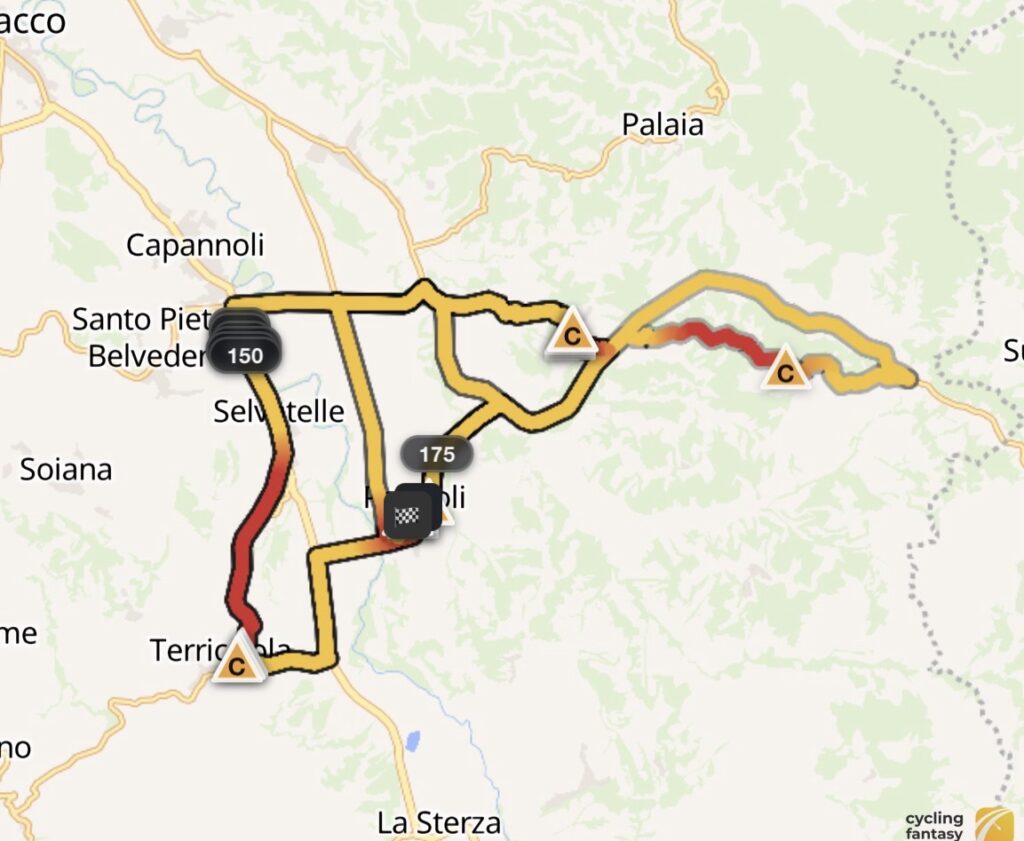
The Coppa Sabatini has belonged to Peccioli from the beginning. The race was created in 1952 in memory of Giuseppe Sabatini, a cyclist from the town who raced professionally in the years before the Second World War and died in 1951 at only 36. Initially contested by amateurs and independents, the event became a professional race in 1959 and gradually established itself among the traditional one-day races of the Italian calendar. More than seven decades later, its geography still reflects those local origins. The race does not simply choose Peccioli as a convenient start and finish. It spends almost the entire day within the landscape surrounding the town, repeatedly leaving its ridge, circling through neighbouring villages and returning towards the place where Giuseppe Sabatini grew up.
That makes the Coppa Sabatini quite different from the Giro della Toscana held the previous day. While the Giro travels across the Valdera before reaching east towards the Arno and Monte Serra, the Sabatini remains much closer to Peccioli. Its territory is compact, but within these few hills are historical layers extending far beyond the medieval Tuscany visible from the road. Beneath Terricciola are chambers excavated by the Etruscans more than two thousand years ago. Near Legoli, a Renaissance painter escaping an epidemic in Pisa left a remarkable cycle of frescoes in the countryside. At Montefoscoli, a celebrated surgeon built a classical temple dedicated to the Roman goddess of medicine, while the farms around it preserve the physical inheritance of the sharecropping system that shaped rural Tuscany well into the modern era.
The structure of the 2026 course encourages the riders to encounter these places repeatedly. An opening 36.8-kilometre section carries the peloton through Legoli, Montefoscoli and Terricciola before returning towards Peccioli. Five laps of a 24.84-kilometre circuit then revisit Montefoscoli, Terricciola and the surrounding hills, accumulating fatigue across roads that are rarely high but almost never completely flat. The race eventually contracts into three shorter circuits of 12.2 kilometres around Peccioli before the finish on Via Mazzini. By then, nearly 2,750 metres of climbing will have accumulated without the race ever approaching a major mountain.
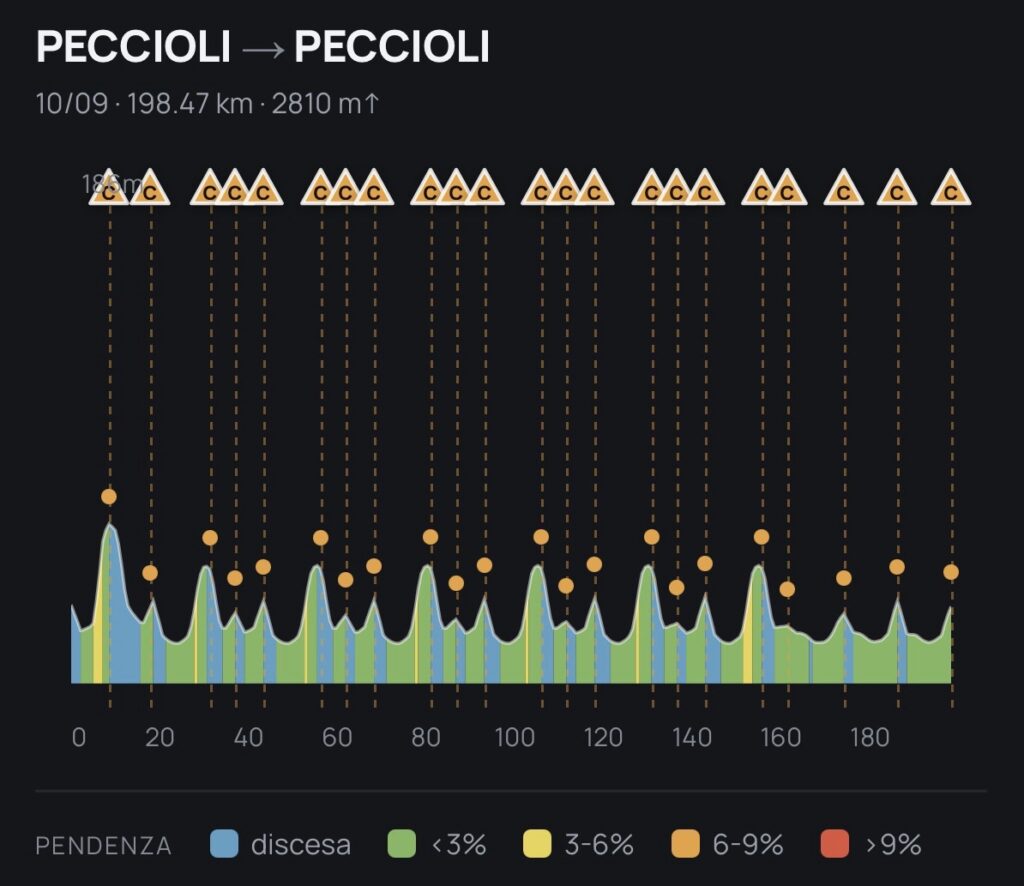
The repeated passages are central to the character of the Sabatini. Peccioli never really disappears from the geography of the day. Its bell tower remains part of the surrounding skyline, villages encountered during the opening hour return later in very different racing circumstances, and modest gradients become progressively more selective as the kilometres accumulate. Rather than crossing Tuscany in search of a distant destination, the race spends nearly 200 kilometres within a remarkably small area, following roads through a countryside where ancient burial grounds, agricultural estates, vineyards, religious buildings and modern architecture coexist within only a few kilometres of one another. The Coppa Sabatini was created to remember a cyclist from this community, and seventy-four editions later it still brings professional cycling back onto the roads that surrounded his home.
START · Peccioli, a Hill Town Looking in Both Directions
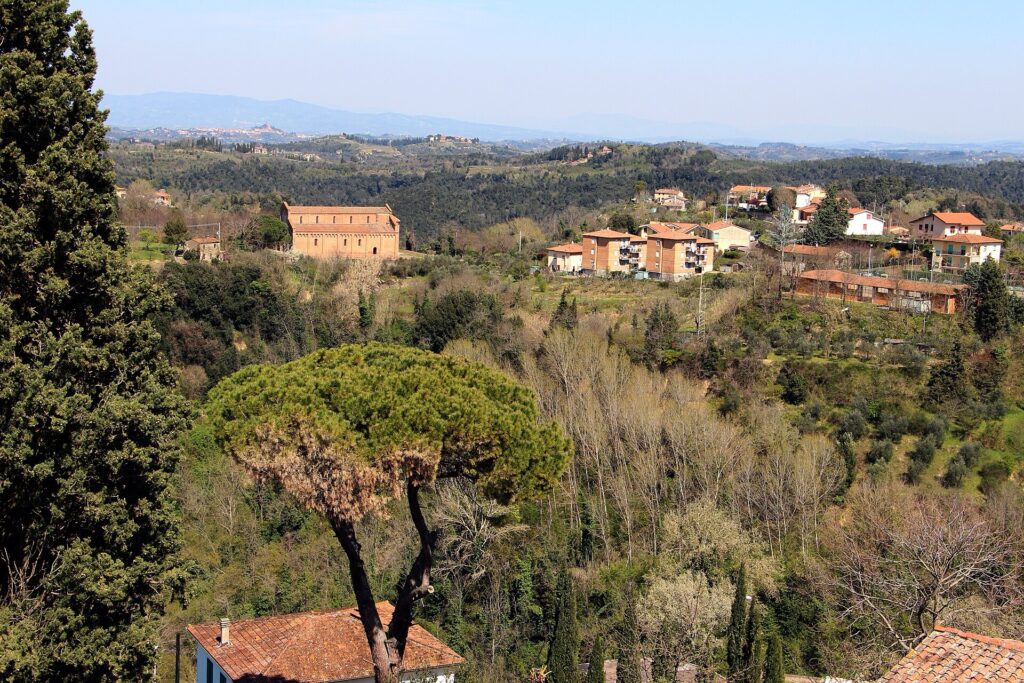
Peccioli occupies a ridge above the Era valley, its historic centre rising naturally above the agricultural countryside surrounding it. Elevation gave settlements such as this practical advantages long before the view became part of their attraction. From the hill it was possible to watch roads and cultivated land, while the valleys below connected communities between Pisa, Volterra and the interior of Tuscany. The medieval town visible today is only the latest substantial settlement in a territory inhabited and organised many centuries earlier.
Archaeological investigation around Ortaglia, close to Peccioli, has revealed an important Etruscan presence dating from roughly the sixth to the third centuries BC. Excavations uncovered religious material, votive objects and imported Attic pottery, including fine Greek ceramics that demonstrate connections reaching far beyond inland Tuscany. Among the most significant finds is a red-figure kylix associated with the circle of Makron, one of the important vase painters working in Athens during the early fifth century BC. An object produced in the Greek world eventually reached a community in these Pisan hills, evidence of the commercial and cultural networks through which Etruscan Tuscany participated in the wider Mediterranean.
Other archaeological sites around Peccioli extend the chronology still further. At Santa Mustiola, near Ghizzano, excavations have revealed occupation spanning Roman, Lombard and medieval periods. Rather than belonging to a single lost civilisation, the countryside around Peccioli was repeatedly inhabited and reorganised as political systems, religions and patterns of settlement changed. Material from these sites is now preserved in the town’s archaeological collections, allowing objects that spent centuries beneath the surrounding hills to return to the community above them.
Peccioli has become equally notable for the way it treats much more recent history. Contemporary architecture and art have been inserted deliberately into the old town rather than hidden beyond it, creating a dialogue between inherited buildings and modern interventions. The Palazzo Senza Tempo illustrates that approach particularly well. Its history is connected with an agricultural estate once associated with prominent Florentine families including the Salviati, but a modern transformation by architect Mario Cucinella introduced exhibition spaces and a large panoramic terrace extending towards the Valdera. Renaissance property, agricultural history and contemporary architecture now occupy different layers of the same complex.
This willingness to place different periods beside one another appears throughout Peccioli, from its archaeological collections to its public art and contemporary architecture. The town has not attempted to preserve itself as an image of an exclusively medieval Tuscany. Ancient objects, old agricultural structures and modern design remain visible together, making Peccioli an appropriate centre for a race whose circuits continually return to the same landscape while revealing different parts of its history.
-190 km · Legoli and Benozzo Gozzoli’s Escape from the Plague
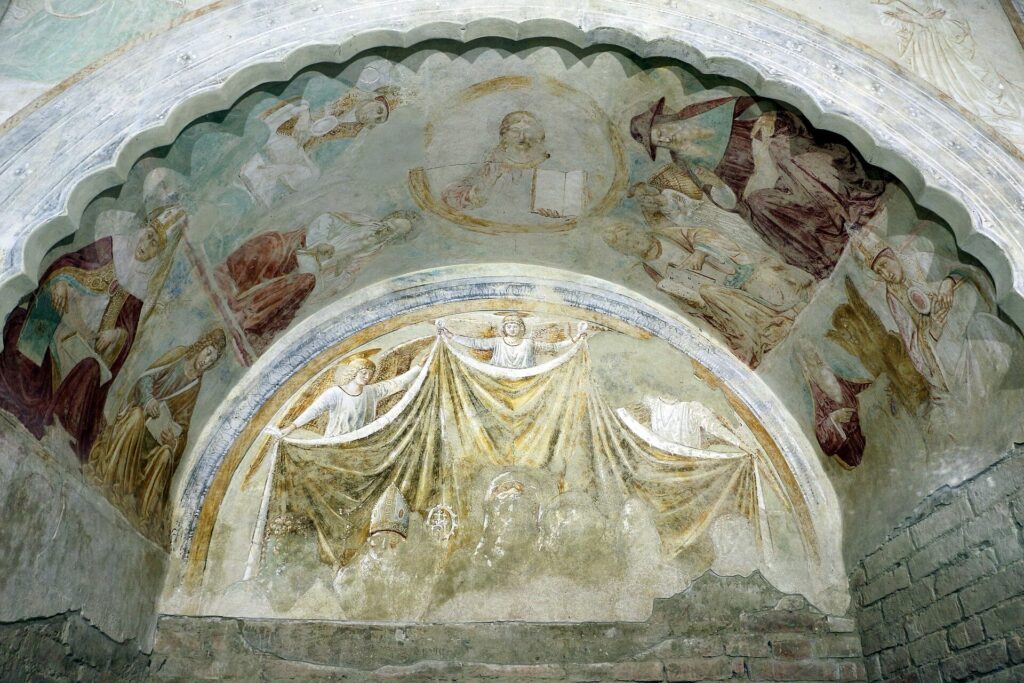
The opening kilometres lead towards Legoli, a small village whose most important artistic treasure exists partly because of one of the recurring catastrophes of pre-modern European life. In 1478, the Florentine painter Benozzo Gozzoli was working in Pisa, where he had spent years decorating the Camposanto Monumentale with an enormous cycle of Old Testament frescoes. By then he was already an established artist whose career had included work alongside Fra Angelico and the celebrated Journey of the Magi in Florence’s Palazzo Medici, one of the most recognisable painted visions of Renaissance courtly life.
An outbreak of plague disrupted that work and drove Gozzoli away from Pisa into the surrounding countryside. Epidemic disease remained a recurrent presence in Renaissance Italy, and leaving an infected city was one of the few protective measures available to people with the means and opportunity to do so. Gozzoli eventually reached the territory around Legoli, where his displacement did not stop his work. Instead, he decorated a roadside tabernacle with religious scenes whose subjects acquired additional meaning in a society living with the possibility of sudden epidemic death.
The surviving paintings include the Crucifixion, the Martyrdom of Saint Sebastian, the Incredulity of Saint Thomas and other sacred scenes. Saint Sebastian was particularly significant because his cult had become closely associated with protection against plague. Medieval and Renaissance Christians frequently invoked him during epidemics, and his appearance in a work created while Gozzoli was sheltering from disease gives the frescoes a connection with the circumstances in which they were painted rather than leaving them as purely devotional images detached from contemporary life.
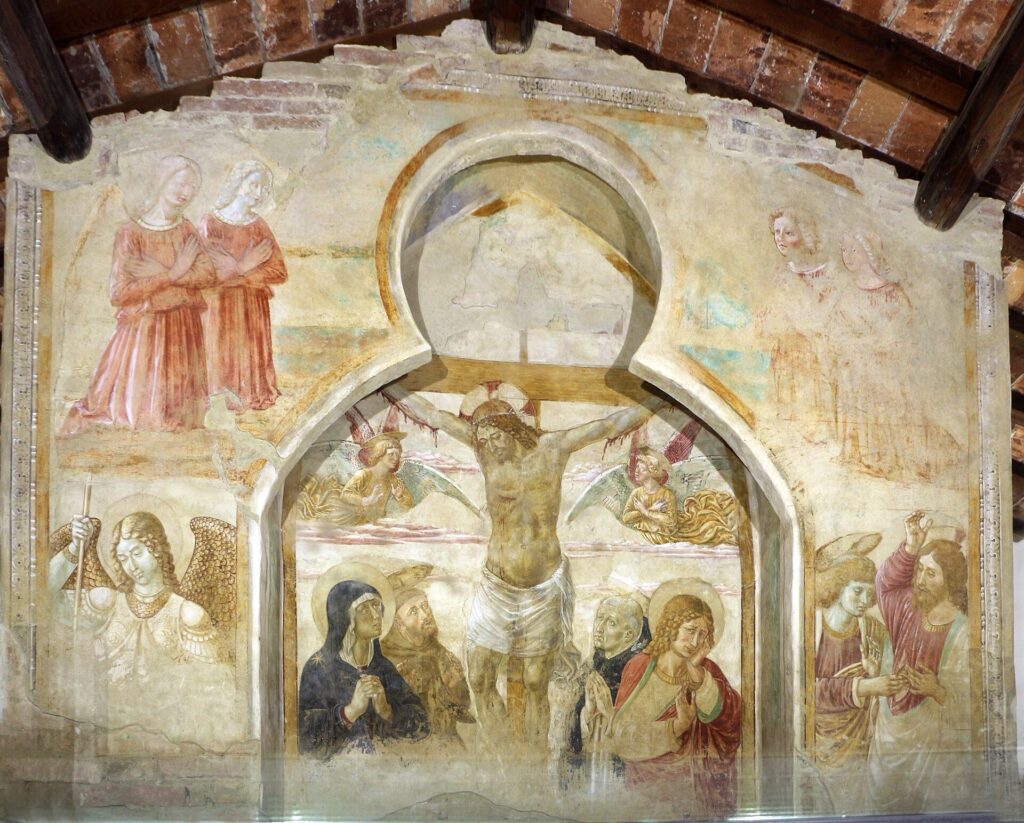
During the 19th century, the Oratory of Santa Caterina was constructed around the tabernacle to protect the frescoes, effectively turning a later building into a shell around a Renaissance work created for a completely different setting. The result is one of the more unusual artistic encounters on the course. Renaissance painting is normally associated with the monumental churches and palaces of Florence, Pisa and Siena, yet here an important painter left work in a small rural settlement precisely because circumstances had forced him away from the city. The Coppa Sabatini reaches Legoli only a few kilometres after leaving Peccioli, passing a place whose artistic importance began with another journey out of town almost 550 years earlier.
Montefoscoli · The Working Landscape Behind the Tuscan Countryside
From Legoli the route turns towards Montefoscoli, which becomes one of the recurring places of the afternoon. The peloton passes through during the opening section and returns on each of the five principal circuits, spending much of the race among the vineyards, olive groves, woodland and farm buildings surrounding the village.
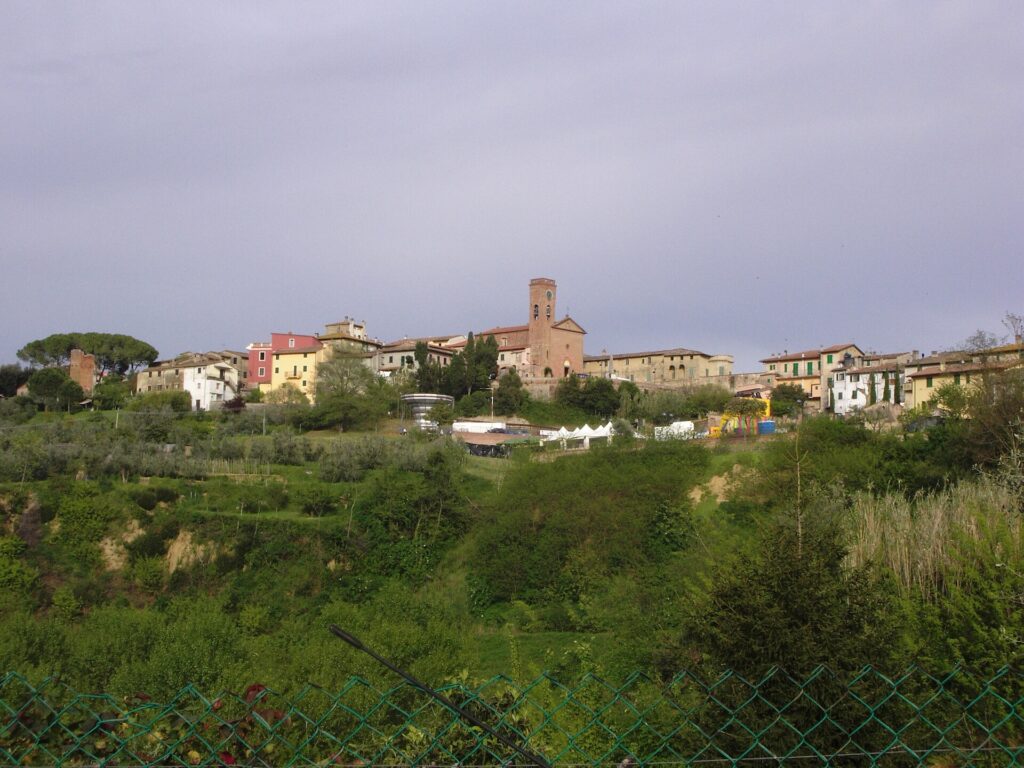
This is the landscape that helped create the international image of rural Tuscany, but its apparent harmony conceals an agricultural system based on demanding and continuous labour. For centuries, much of central Tuscany was organised through mezzadria, the sharecropping system in which landowners provided farms while peasant families supplied labour, with agricultural production divided according to established agreements. The system became deeply embedded in the social geography of Tuscany and survived in recognisable form until the transformation of Italian agriculture during the 20th century.
Mezzadria helped produce the dispersed pattern of farmhouses that remains one of the characteristic features of the region. Rather than concentrating all agricultural workers inside villages, families often lived directly on the farms they cultivated. Their work extended across the agricultural year and involved much more than the crops now most closely associated with Tuscany. Grain had to be planted and harvested, vines tended and grapes pressed, olives gathered and taken to mills, animals cared for, tools repaired and food preserved. Households depended upon several activities at once, adapting their labour to the different seasons and elevations of the surrounding land.
At Montefoscoli, the Museo della Civiltà Contadina preserves elements of this world within spaces connected to the former Vaccà Berlinghieri estate. Agricultural implements, wine-making equipment, carts, workshops and storage areas document the practical economy behind the countryside. Their importance lies precisely in their ordinariness. Much of Tuscany’s historical tourism concentrates on exceptional artists, aristocratic families and monumental buildings, while the landscape itself was created and maintained primarily by people whose names rarely entered written history.
The race repeatedly crosses the physical inheritance of their work. Field boundaries, terraces, olive groves, farmhouses and rural roads survive after the social system that organised them has largely disappeared. What modern visitors experience as an aesthetic landscape was also a workplace shaped by generations of families whose livelihoods depended upon extracting as much as possible from difficult hills. Montefoscoli preserves that history particularly well, while just outside the village another building leads into a very different part of Tuscan society.
Montefoscoli · The Temple of Minerva Medica
In woodland near Montefoscoli stands the Temple of Minerva Medica, a small neoclassical building whose Ionic portico and classical proportions can initially suggest an ancient sanctuary. It was actually constructed between 1821 and 1823, when surgeon Andrea Vaccà Berlinghieri commissioned it in memory of his father, Francesco Vaccà Berlinghieri, himself a physician and professor of medicine at the University of Pisa.
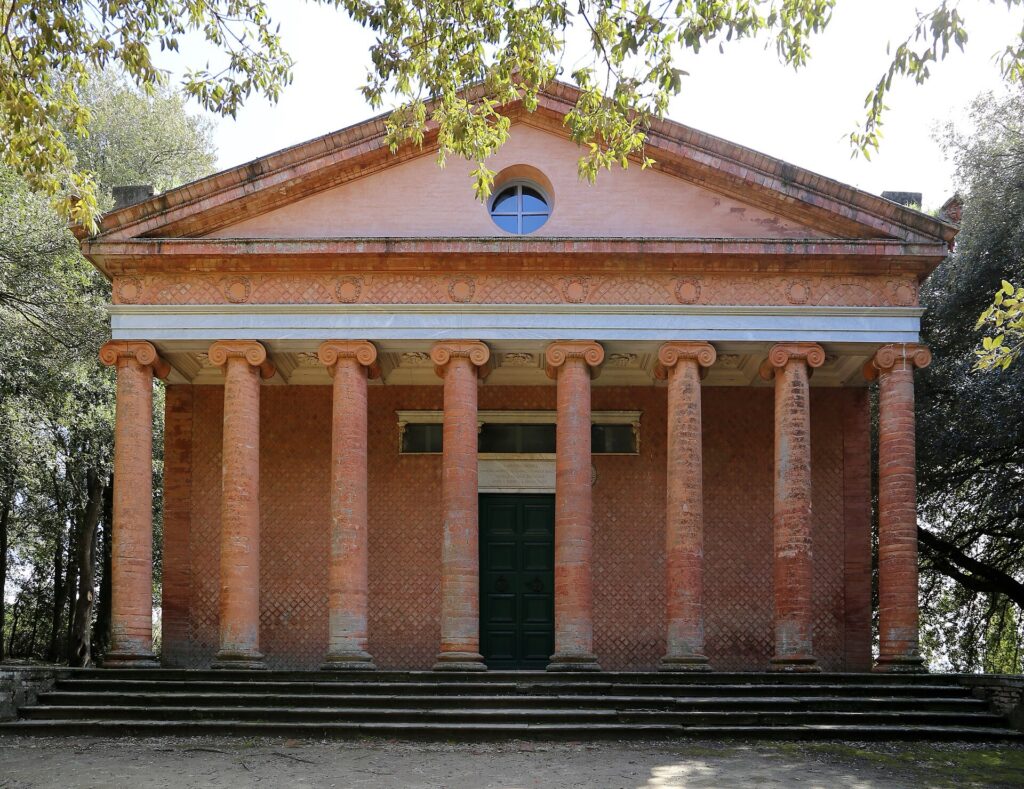
The choice of Minerva was deliberate. In the Roman world, Minerva Medica represented the goddess in her association with medicine, healing and wisdom, and the dedication connected the profession shared by father and son with the classical intellectual tradition admired by educated Europeans of the period. Rather than constructing a conventional family monument, Andrea created a building in which architecture, medicine and commemoration were deliberately combined.
Andrea Vaccà Berlinghieri had become one of the notable Italian surgeons of the early 19th century. After studying medicine at Pisa, he travelled abroad to broaden his surgical knowledge before returning to teach and practise in Tuscany. His career belonged to a period when surgery was undergoing important changes but still operated before anaesthesia, antisepsis and many of the developments that would transform medicine later in the century. Surgical skill depended heavily upon anatomical knowledge, speed and experience, giving successful practitioners an intellectual and social status that helps explain the ambition of the monument at Montefoscoli.
The temple was also built during a politically unsettled period. Napoleonic rule had ended only a few years earlier, restoration governments had returned across the Italian peninsula and secret political societies were spreading ideas of constitutional government and national unity. Local traditions and later interpretations have connected the building with the Carbonari and with esoteric symbolism associated with secret societies. Some of these claims remain difficult to establish with the same certainty as the documented relationship between the temple and the Vaccà family, but they reflect the political atmosphere in which such an unusual private monument was created.
Even without those more speculative associations, the building is remarkable. The riders repeatedly pass through an agricultural village beside a classical temple built by a surgeon to honour another surgeon through the symbolism of a Roman goddess. Montefoscoli therefore contains two very different histories within the same rural landscape: the largely anonymous labour of generations of sharecroppers and the intellectual world of a prominent medical family whose interests extended from science to classical culture.
Terricciola · An Etruscan Landscape Beneath the Vineyards
From Montefoscoli the circuit reaches Terricciola, where vineyards cover the surrounding hills and wine remains central to local identity. The agricultural landscape is modern in its organisation, but the settlement sits above traces of communities that occupied these hills long before Roman power absorbed Etruscan Tuscany.
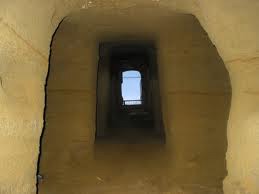
During the Etruscan period, this territory lay within the sphere of Volterra, one of the major cities of northern Etruria. Settlements developed on elevated ground between the Era and Cascina valleys, positions that offered control over agricultural territory and communication routes while connecting communities towards Pisa and the coast with the powerful inland centre at Volterra. Archaeological evidence suggests a countryside that was carefully occupied rather than a wilderness separating larger cities.
Some of the most evocative evidence survives underground. The Ipogeo del Belvedere originated as an Etruscan chamber tomb, cut into the natural deposits beneath Terricciola around the fourth century BC. Tombs of this type created enduring spaces for family burial within the same landscape inhabited by the living, while cremation urns, funerary markers and grave goods expressed identity and status. Discoveries in the surrounding territory include material whose origins reveal connections extending far beyond the immediate hills.
Among these are funerary markers made from Apuan marble, demonstrating a chain of extraction, craftsmanship and exchange connecting the marble districts farther north with workshops around Pisa and communities within Volterra’s territory. The objects travelled through an organised regional economy centuries before Roman roads imposed a new infrastructure upon Tuscany. Terricciola may appear today as a small wine town, but its ancient inhabitants participated in networks moving stone, ceramics, agricultural products and ideas across much larger distances.
The subterranean spaces continued to have value after Etruscan funerary practices disappeared. Chambers and tunnels could be adapted for storage, particularly in a wine-producing landscape where stable underground temperatures were useful, while other spaces acquired defensive purposes during later periods. During the Second World War, underground structures in the area were again valuable as shelter from aerial attack. The peloton encounters only the surface of this history, riding through vineyards and streets above spaces cut into the same hills more than two thousand years earlier.
Terricciola · Where an Ancient Sea Survives in the Hills
The geological history beneath Terricciola reaches incomparably further into the past. Parts of the surrounding territory contain sandy marine deposits and fossils left by environments that existed long before human settlement. Shells and other remains preserved within the sediments record periods when the relationship between land and sea around the Pisan territory looked profoundly different from the modern landscape.
Changes in sea level, sedimentation and tectonic activity gradually created the hills crossed by the race. Water retreated, sediments accumulated and erosion produced the rolling topography that eventually became suitable for settlement and agriculture. The Etruscans who excavated tombs into these hills were therefore cutting into geological material created by processes that preceded them by immense spans of time, while later farmers adapted the resulting soils to crops whose distribution still reflects variations in drainage, exposure and elevation.
The connection remains visible in the vineyards for which Terricciola is now known. Vines respond strongly to the physical properties of the ground in which they grow, so the ancient environmental history of these hills continues to influence their modern agricultural character. Professional cyclists experience the same geology in another form, through roads that continually rise and fall across terrain created on a timescale vastly longer than any of the human histories surrounding it.
The Muro di Greta · How the Pisan Hills Shape the Race
The larger circuits return towards Peccioli across the Muro di Greta, a short and much sharper ascent that concentrates the accumulated difficulty of the surrounding terrain. The climb is only about 900 metres long, but its average gradient is close to 11 percent and its steepest sections reach approximately 16 percent. Those numbers would make it noticeable even in isolation, while repeated passages after the constant climbing and descending around Montefoscoli and Terricciola make it progressively more important.
The Valdera does not need one enormous mountain to make the race difficult. Its terrain works through accumulation. Roads descend from one ridge only to rise towards another, and settlements frequently occupy elevated positions because the same hills that challenge cyclists offered earlier communities visibility, drainage and defensibility. The Muro di Greta is the most concentrated sporting expression of a geography the riders have been negotiating throughout the afternoon.
During the opening passages, a professional peloton can absorb a climb of this length without necessarily breaking apart. Later, the same gradient arrives after hours of repeated accelerations, positioning battles and smaller climbs that rarely appear individually decisive. Riders who crossed comfortably earlier can find themselves losing contact because their ability to respond has gradually been eroded by the terrain.
The Coppa Sabatini consequently derives its identity from the ordinary topography of its home territory rather than borrowing difficulty from a distant mountain. The hills that influenced where Etruscan communities buried their dead, where medieval settlements developed and where farmers cultivated their land now determine where the professional race begins to separate.
Peccioli · San Verano and the Bell Tower Above the Race
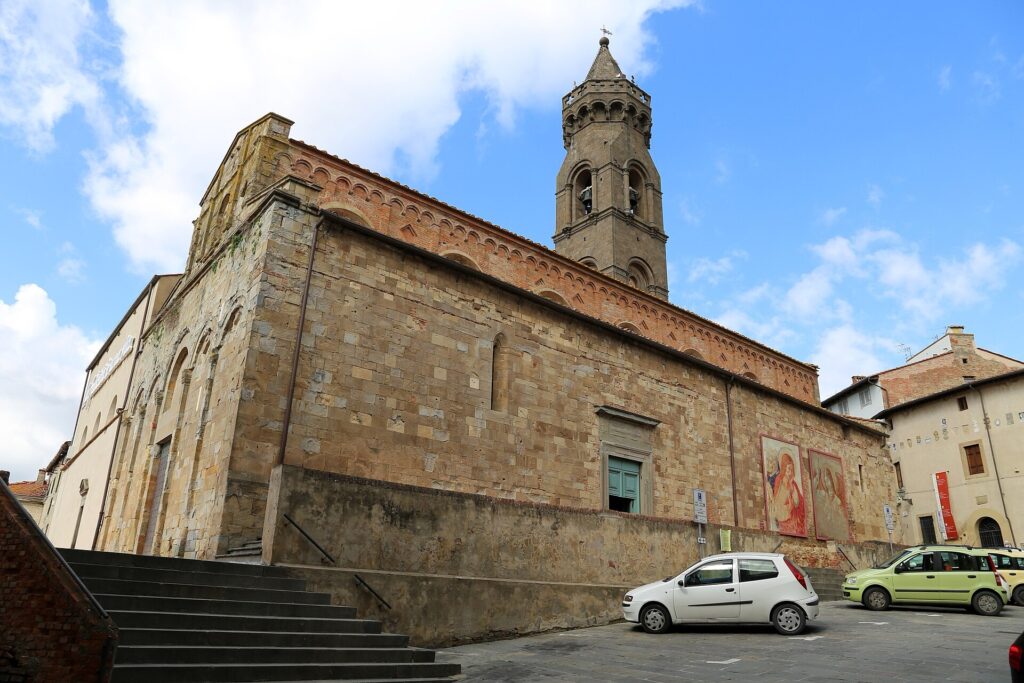
Every return towards Peccioli brings the riders back beneath the skyline of the Church of San Verano, whose bell tower rises prominently above the town. The church preserves a much older religious history, while the campanile itself belongs to the late 19th century and was designed by Luigi Bellincioni, a Tuscan engineer and architect responsible for several civic and religious buildings across the region.
The tower has long functioned as one of Peccioli’s most recognisable landmarks, but in 2026 it is also undergoing another stage in its history. A major restoration and accessibility project involves work on the bells and the insertion of a reversible modern structure intended to allow visitors to reach the upper levels. The intervention reflects the same willingness to place contemporary engineering inside historic architecture that can be seen elsewhere in the town.
Accessibility poses a particular problem for monuments such as this. Bell towers were built around stairs, narrow passages and functional requirements that took little account of who might eventually want to visit them. Preserving such a structure exactly as inherited can consequently protect its physical fabric while excluding many people from experiencing it. Peccioli’s solution attempts to reconcile conservation with the modern expectation that important public heritage should be accessible to a wider population.
The project fits naturally beside the contemporary transformation of Palazzo Senza Tempo and the artworks distributed throughout the municipality. New interventions are recognisably modern rather than disguised as historical additions, allowing the architecture to record another period of use. During the Coppa Sabatini, meanwhile, the campanile performs the much older function of a tower in a rural landscape. Riders leave Peccioli, descend into the surrounding country and eventually approach the ridge again, with the tower identifying the town before the road reaches it, just as church towers did for travellers long before road signs or GPS.
Peccioli · Why This Is the Coppa Sabatini
By the time the race has returned repeatedly to Peccioli, the name Sabatini carries the local meaning established at the start. Giuseppe Sabatini belonged to a generation of Italian cyclists whose careers unfolded through the political and military upheavals of the 1930s and 1940s. His death in 1951, at only 36, prompted his home community to establish the race bearing his name the following year.
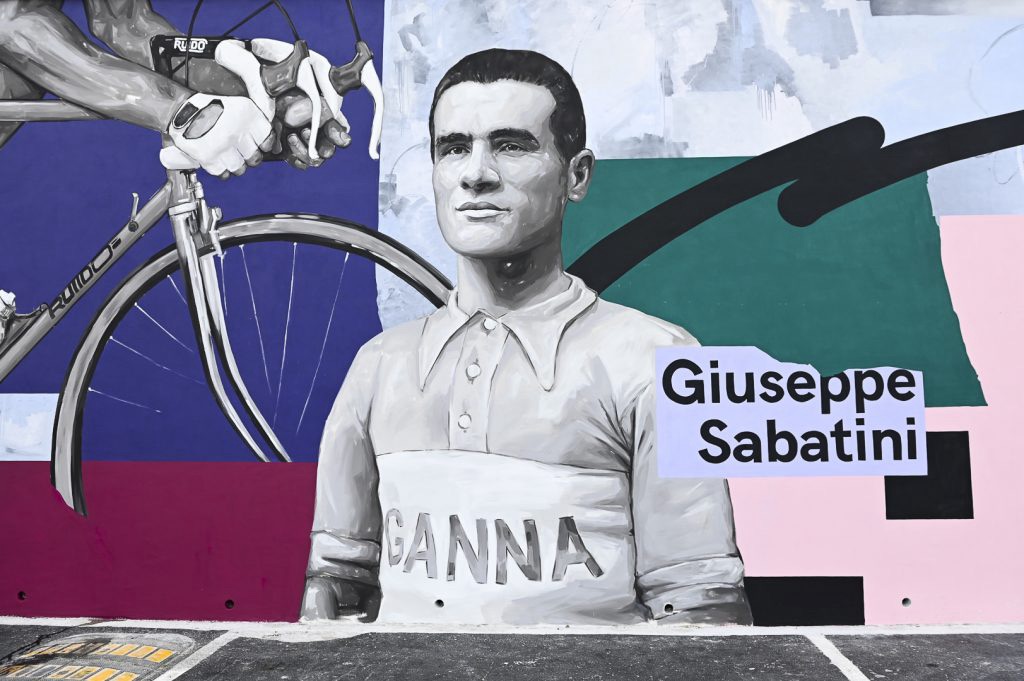
The first Coppa Sabatini was organised in 1952, initially for amateurs and independents. Its transition to professional competition in 1959 placed Peccioli within the dense network of Italian one-day races that became an important part of the country’s cycling culture. These events connected professional racing with relatively small communities, bringing leading riders onto roads far removed from the major cities and allowing local organisers to build traditions that could survive for generations.
Over the decades, the race attracted winners representing very different eras of professional cycling, while its course evolved with changing roads, regulations and sporting demands. What remained unusually stable was the association with Peccioli. The town did not merely provide a finish line to a race named after somebody who had once lived there. The repeated circuits kept the surrounding territory at the centre of the event, making the race itself part of the local cultural landscape.
That relationship helps explain how an event of this scale can survive for seventy-four editions. Professional cycling depends upon much more than the handful of races known internationally as monuments. Beneath them is a culture of regional events sustained by municipalities, organisers, sponsors, volunteers and spectators who repeatedly decide that a bicycle race is worth bringing back. The Coppa Sabatini began as one town’s memorial to one of its cyclists and gradually became something larger without losing the geographical connection that gave it a reason to exist.
FINAL CIRCUITS · The Race Closes Around Peccioli
After the five larger circuits through Montefoscoli and Terricciola have been completed, the course contracts into three shorter laps of approximately 12.2 kilometres around Peccioli. The villages that occupied much of the afternoon disappear from the itinerary, and the race becomes increasingly concentrated around the ridge where it began.
By this point the absence of a major mountain is almost irrelevant. Nearly 2,750 metres of climbing have accumulated through constant changes of elevation, and the repeated circuits have forced riders to accelerate on many of the same roads several times. The physical geography remains modest by the standards of Alpine racing, but the effort required to cross it after almost 200 kilometres is very different from what the same hills demanded during the opening hour.
The shortening of the course also changes the rhythm. Opportunities to recover diminish as the race repeatedly approaches Peccioli, while teams capable of keeping several riders in the front group gain increasing control over positioning. Each passage brings the finish closer and reduces the amount of road available to recover an unsuccessful attack. The hills no longer need to reveal anything new. Their effect comes from everything the riders have already done on them.
There is an appropriate historical symmetry in the way the race closes around Peccioli. The Sabatini has spent the day revisiting a small territory whose own history consists of different societies repeatedly finding new uses for the same landscape. Etruscan burial chambers became later storage spaces, agricultural estates became museums, old palaces acquired contemporary architecture and a hill town that once watched over its surrounding farmland became the centre of an international professional bicycle race.
FINISH · Peccioli and the Tuscany Beneath the Surface
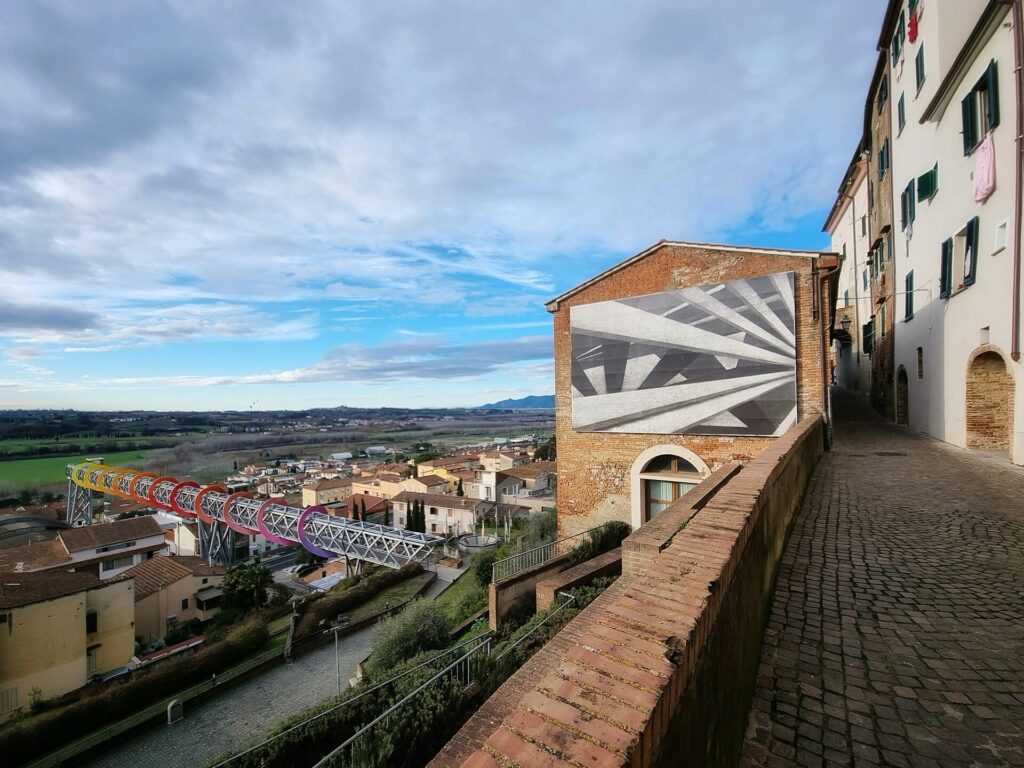
The Coppa Sabatini finishes on Via Mazzini after 197.6 kilometres, yet geographically it has never travelled particularly far from where it started. Instead of using distance to connect widely separated landscapes, the race has spent an afternoon returning to the same hills until their different historical layers begin to overlap.
At Legoli, an epidemic in Renaissance Pisa pushed Benozzo Gozzoli into the countryside and resulted in frescoes that preserve something of the religious response to plague. Around Montefoscoli, farm buildings and agricultural tools recall the sharecropping society responsible for much of the landscape now regarded as quintessentially Tuscan, while the Temple of Minerva Medica introduces the very different world of medicine, classical learning and the political uncertainty of early 19th-century Italy. Terricciola takes the chronology much farther back, with Etruscan chambers beneath a modern wine town and marine deposits preserving environments older than any human presence in Tuscany.
Peccioli gathers these periods within a single ridge. Etruscan objects excavated from the surrounding territory are preserved inside the modern town, medieval and later buildings define its historic centre, Bellincioni’s 19th-century campanile dominates the skyline, and contemporary architecture has been inserted among them without pretending to belong to an earlier age. The town has repeatedly treated history not as a finished landscape to be protected from the present, but as a sequence to which the present is still contributing.
The race itself has become part of that sequence. When the first Coppa Sabatini was organised in 1952, its purpose was intensely local: to remember Giuseppe Sabatini, a cyclist from Peccioli who had died the previous year. The event outlived the generation that knew him personally, moved into professional cycling and accumulated its own history, yet it continued returning to his home town and the countryside surrounding it.
That continuity is what distinguishes the Coppa Sabatini from the Giro della Toscana despite their proximity on the calendar and map. The Giro uses the Valdera as the beginning of a broader journey towards the Arno and Monte Serra. The Sabatini stays close to Peccioli, circling its hills until familiar roads reveal how much history can exist within a very small area. After almost 200 kilometres, the riders arrive back where Giuseppe Sabatini’s story began, while the landscape around the peloton has travelled much farther in time than the race ever did in distance.