
A Personal Note
There was never really a choice about where this article had to begin. Marco Pantani is the man who brought me to cycling. I have followed many sports, watched great athletes and teams, celebrated victories and lived through the strange emotional attachment that sport can create, but nothing else has ever come close to what Pantani made me feel on a bicycle. Not another sportsman, not another team, not another single moment in sport. He did not simply give me someone to support. He made me understand why cycling could become something much larger than a race.
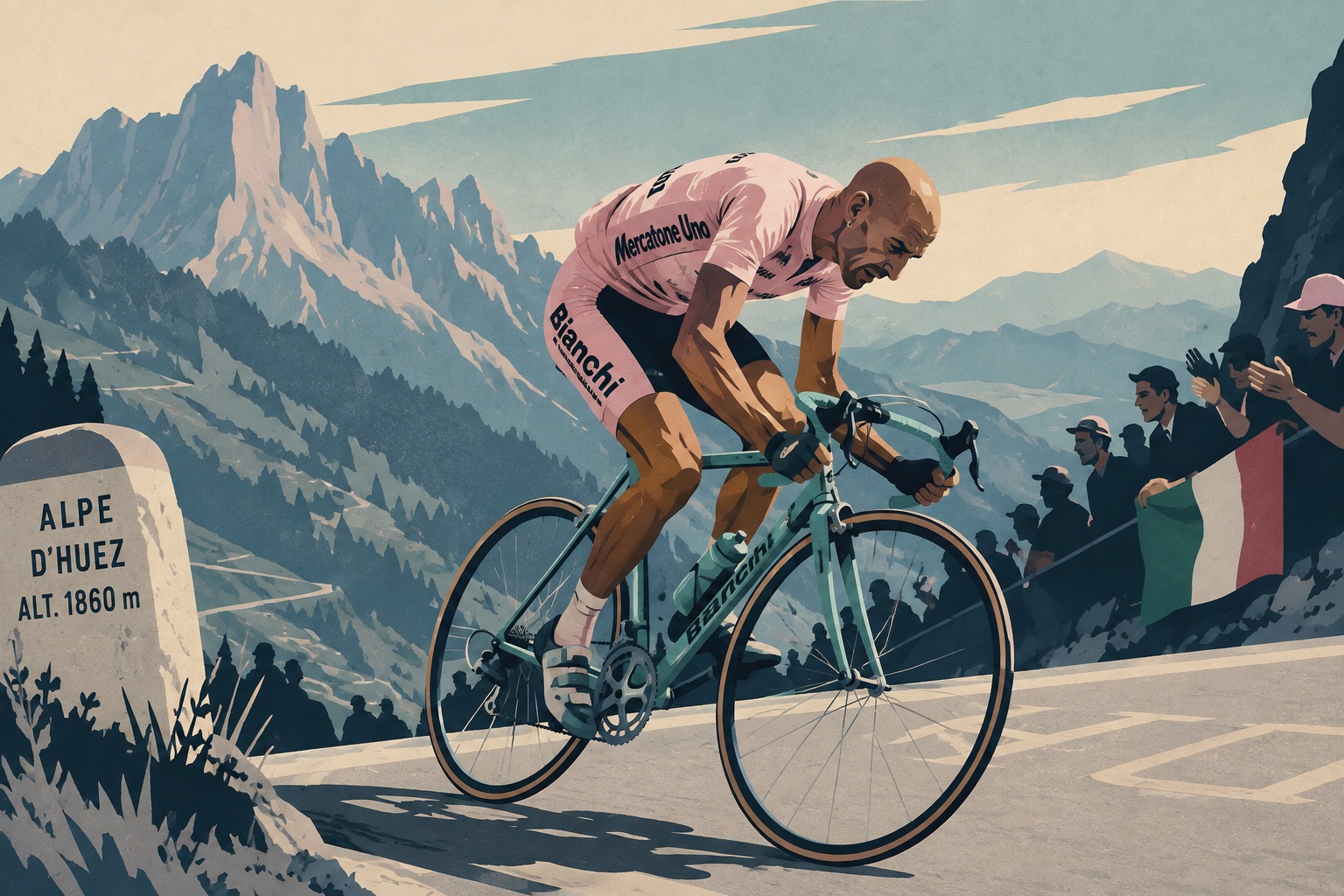
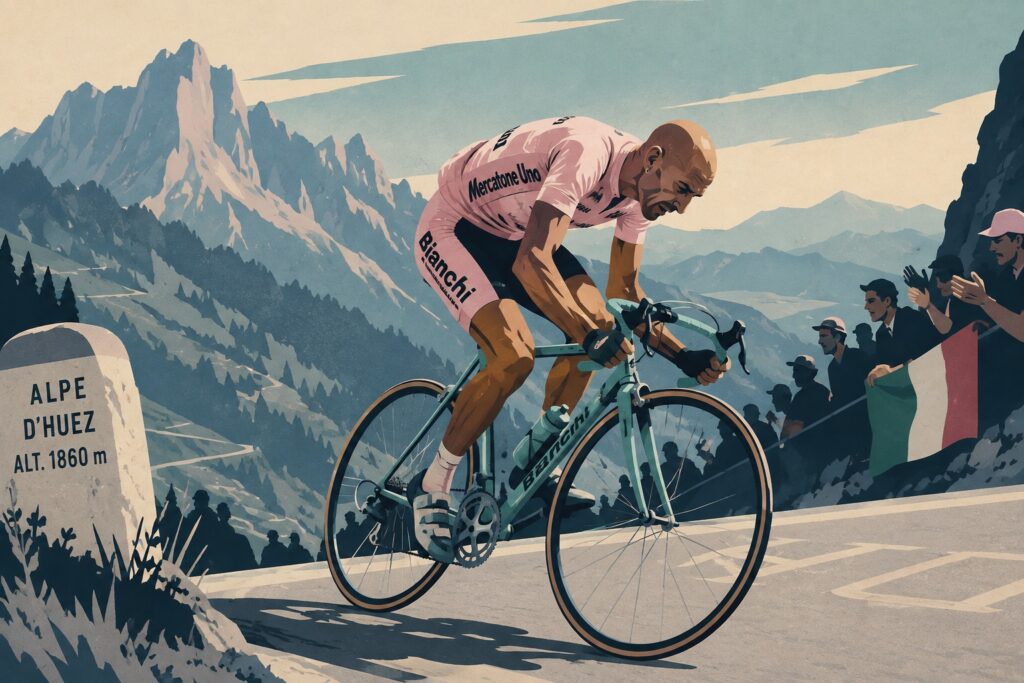
There was something about watching Pantani climb that was difficult to explain even while it was happening. He was small and fragile-looking among the machinery of professional cycling, yet when the road became steep the entire race seemed capable of changing around him. He attacked when attacking still appeared impossible, often from distances that made calculation seem secondary to instinct. The bandana disappeared, his hands moved to the drops, and suddenly everybody else seemed to be riding a different mountain. For those of us who lived those afternoons, the names became inseparable from him: Mortirolo, Alpe d’Huez, Oropa, Les Deux Alpes, the mountains of the Giro and Tour where the anticipation of what Pantani might do could become as powerful as what eventually happened.
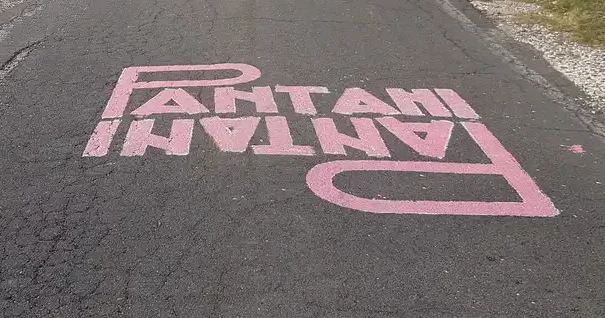
More than two decades have passed since he died, yet I still encounter him unexpectedly whenever I watch cycling. On an Alpine climb, a Pyrenean road or an Italian mountain, the television camera follows the peloton around a bend and there it is, written roughly in white paint or chalk across the asphalt: PANTANI. Sometimes it is fading. Sometimes somebody has written Pirata. Sometimes the letters occupy only a small piece of road among hundreds of names painted for riders who are racing today. Every time I see it, I feel something.
That is perhaps the clearest measure of what he left behind. The people writing his name on those roads are remembering a rider who has not raced since 2003 and who died in 2004. Entire generations of professionals have come and gone since then. Cycling itself has changed enormously. Yet somewhere, before another race arrives, somebody still kneels on the asphalt and writes Pantani.
Around the Peloton normally begins by looking beyond the race. This time the race itself is already an act of memory. The Memorial Marco Pantani exists because a place has refused to forget one of its own, and the 2026 route makes that relationship unusually physical. It begins beside the Adriatic at Riccione, disappears into the hills of Romagna and crosses roads belonging to the landscape in which Pantani grew and trained. It reaches Sogliano, where the memory of his training rides still survives, and Longiano, where a teenage Pantani was already winning races almost four decades ago. Eventually it returns to Cesenatico, passing the family home before entering a final circuit beside the town where he first joined a cycling club and discovered what happened when the road began to rise.
There are much older stories along the way. Verucchio takes us from an Iron Age community trading Baltic amber to the Malatesta dynasty and Dante. Sogliano preserves cheese underground according to a tradition documented since the Middle Ages. The hills around the Rubicon carry Roman history, medieval fortresses and a landscape shaped by the complicated geology of the Apennines. Cesenatico’s harbour was studied by Leonardo da Vinci more than five centuries before the town became inseparable from the most famous cyclist Romagna ever produced.
This time those histories share the road with another geography. We are not merely travelling through Romagna. We are travelling through part of the landscape in which Marco Pantani learned to become a cyclist.
START · Riccione and the Invention of the Adriatic Holiday
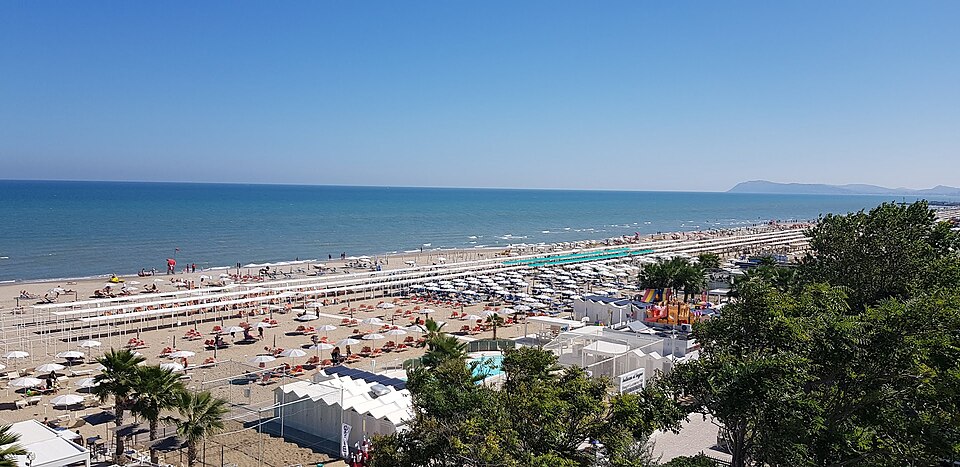
The Memorial begins in Riccione, although the opening kilometres are neutralised before the official racing start inland. It is a fitting place to begin a journey towards Cesenatico because Riccione belongs to the same Adriatic world of beaches, hotels and seaside tourism that shaped the modern identity of the Romagna coast.
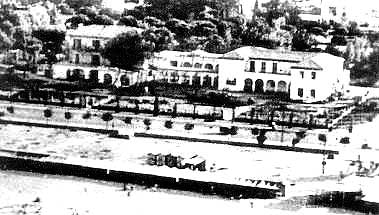
The Adriatic had always sustained fishing, maritime transport and coastal communities, but the transformation of towns such as Riccione into resorts required a comparatively modern change in the way Europeans understood leisure, health and the sea itself. During the second half of the 19th century, wealthy families increasingly began arriving for summer stays. Villas appeared near the coast, followed by hotels and bathing establishments, while railway connections made the Adriatic accessible to visitors from the growing cities of northern Italy. Riccione’s first hotel opened in 1901, and the settlement developed an identity distinct enough from neighbouring Rimini to become an independent municipality in 1922.
The architecture of that first resort survives in fragments among later hotels and apartment blocks. Liberty-style villas belong to a period when the summer holiday was still largely the preserve of families wealthy enough to establish seasonal residences surrounded by gardens. Mass tourism later transformed Riccione on an entirely different scale, filling the coastline with hotels, clubs and the infrastructure of a resort economy, but the older villas preserve the moment when the Italian seaside holiday was still being invented.
One building carries a darker association with modern Italian history. The villa now known as Villa Mussolini was constructed around 1890 and became associated with Benito Mussolini and his family during the Fascist dictatorship. The Mussolini family had been spending summers in Riccione since the 1920s, and Rachele Mussolini acquired the property in 1934. The resort consequently became one of the places where the dictator’s private family life intersected with the carefully managed public image of Fascist power. The Municipality of Riccione completed the acquisition of the property in 2026 with the intention of using it as a cultural venue, giving an uncomfortable historical site a civic function rather than allowing it to become primarily an object of political nostalgia.
Pantani belonged to the same Adriatic culture farther north at Cesenatico. The coast matters to his story because it makes his development as a climber seem, at first, almost contradictory. The Memorial begins almost at sea level, among hotels and flat avenues, then gradually leaves the Riviera behind and turns inland. That transition will define the entire day.
-157.6 km · Verucchio, Three Thousand Years Above the Marecchia
At race kilometre 34.9, with 157.6 kilometres remaining, the peloton reaches Verucchio, standing above the Marecchia valley. Its medieval silhouette dominates the approach, but archaeology has revealed that the hill was important more than a millennium before the Malatesta family established its power here.
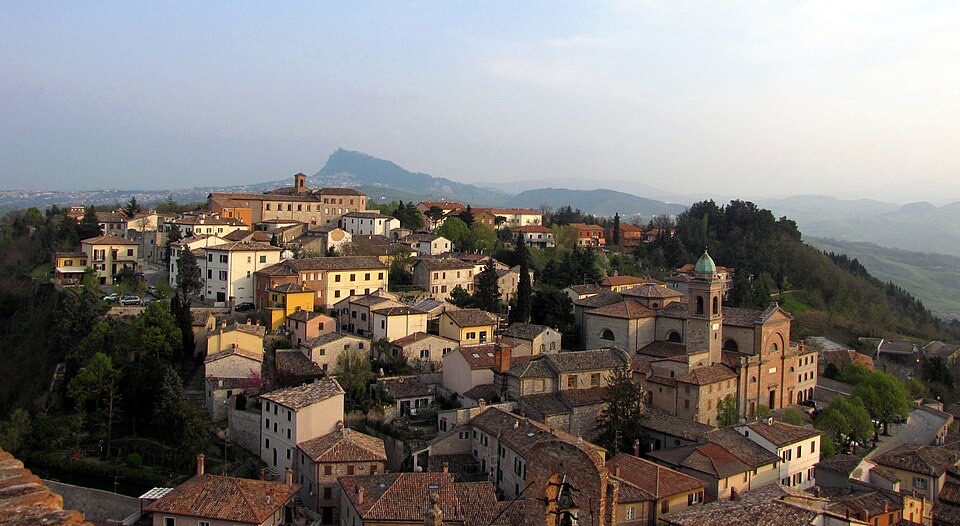
Between approximately the ninth and seventh centuries BC, Verucchio became one of the major centres associated with the Villanovan culture, the early Iron Age society generally understood as a formative phase of Etruscan civilisation. Excavations of the necropolises surrounding the town have uncovered hundreds of burials containing weapons, jewellery, ceramics, textiles and objects whose survival is exceptional.
Among the most remarkable finds are elaborately carved wooden thrones recovered from elite graves. Organic material normally disappears from archaeological sites of this age, but unusual burial conditions preserved wood and even fragments of textile. The result is an unusually intimate view of status, craftsmanship and clothing in Iron Age Italy, reconstructed not only from stone, pottery and metal but from materials that ordinarily vanish.
Amber reveals how far Verucchio’s connections extended. Large quantities discovered in the graves ultimately originated from the Baltic region, thousands of kilometres to the north. By the Iron Age, amber was moving south through long-distance exchange systems towards the Mediterranean, where it became a prestige material. Its presence above the Marecchia places this hill within networks reaching across much of Europe.
The geography explains why Verucchio mattered. From the heights, movement through the Marecchia corridor could be watched between the Adriatic plain and the Apennines. That strategic value outlived the Iron Age by many centuries. The same elevated position would later attract medieval lords whose power depended upon controlling roads, valleys and fortified places.
For the race, the change is immediate. The flat Riviera is now behind the peloton, and the country has begun to rise. The landscape no longer behaves like the coast from which the riders departed.
-157.6 km · Verucchio, the Malatesta, Dante and the Old Mastiff
Medieval Verucchio became closely associated with the Malatesta, the dynasty that would dominate Rimini and substantial territories across Romagna. Their rise was rooted not only in urban politics but in control of places such as this, where fortified heights commanded important routes through the countryside.
The figure most closely connected with the town is Malatesta da Verucchio, who lived through most of the 13th century and became lord of Rimini. Dante knew the family well enough to preserve its reputation in the Divine Comedy, referring to Malatesta and his son Malatestino as the mastiffs of Verucchio. The description belonged to a political world in which family alliances, factional violence and military force could determine the government of Italian cities.
The Malatesta story also leads into one of the most famous episodes in Dante’s Inferno. Malatesta da Verucchio’s sons included Gianciotto and Paolo Malatesta, whose lives became inseparable from Francesca da Rimini. Francesca was married to Gianciotto but, according to the literary tradition immortalised in Canto V, fell in love with Paolo. Their discovery and killing provided Dante with one of the Commedia’s most enduring encounters, transforming a dynastic tragedy from medieval Romagna into a story read for centuries far beyond Italy.
The precise historical circumstances remain less clear than the poem that preserved them, but Verucchio’s connection with the Malatesta is tangible. The Rocca Malatestiana still occupies the commanding position above the town, strengthened particularly under Sigismondo Pandolfo Malatesta during the 15th century. From its heights the Adriatic remains visible in the distance, so the strategic geography is still legible in the landscape itself.
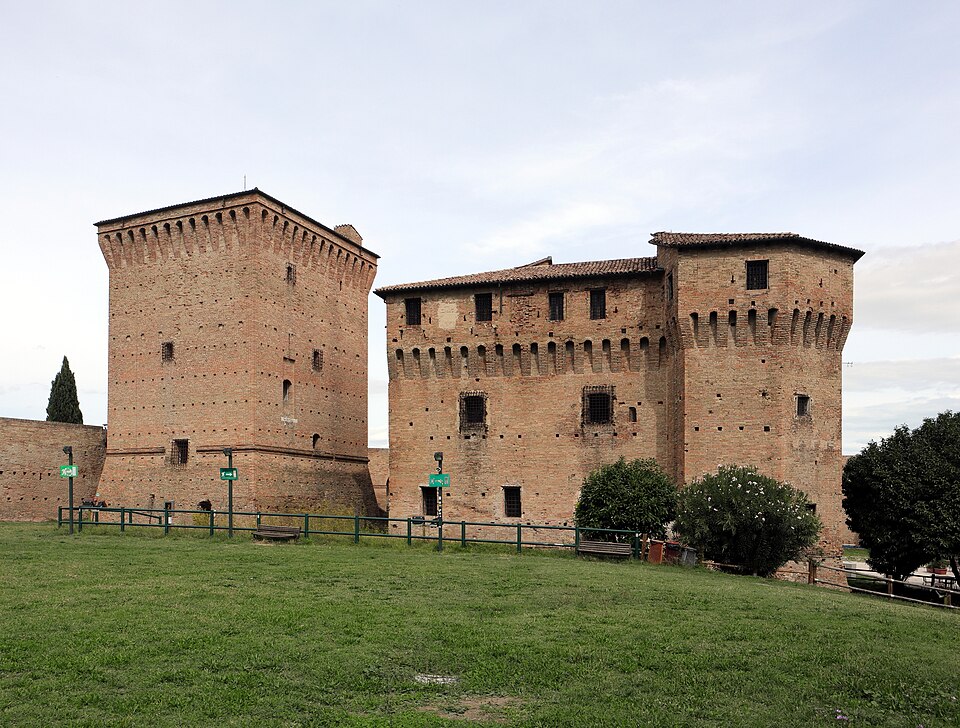
Cesenatico lies somewhere beyond that flat coastal margin. From up here the relationship between sea and hills becomes obvious, and with it the geography that shaped generations of riders from Romagna. The mountains were not outside the front door, but neither were they far away.
-150.2 km · The Marecchia Valley, a Corridor Through Moving Earth
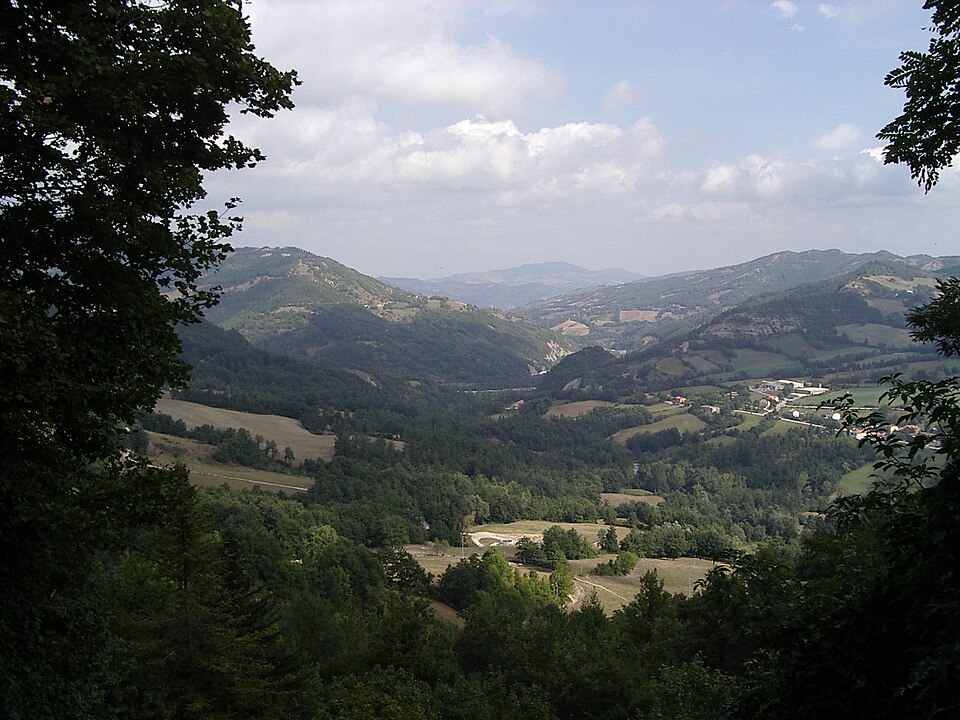
At Pietracuta, race kilometre 42.3 and 150.2 kilometres from the finish, the Memorial has entered the Marecchia valley more deeply. Here the landscape reveals another reason this part of Romagna produces such irregular roads.
The hills are not simply gentle foothills rising predictably towards the Apennines. The geology of the Marecchia valley is unusually complicated, involving rock masses transported during the formation of the Apennine system and later exposed through erosion. Resistant limestones and sandstones stand above softer clay-rich terrain, producing isolated rocky heights, abrupt changes of relief and the broken shapes that characterise much of the valley.
Those geological differences repeatedly became human geography. Fortified settlements occupied resistant hilltops where natural slopes improved defence and visibility, while roads and movement tended to follow the easier corridors below. The landscape consequently developed a rhythm of settlements above and traffic beneath, with ridges, valleys and hills continually forcing routes to change direction.
For a cyclist, the same geology translates into gradients. The advantage of this terrain was never one monumental climb but variety. Short ascents could be linked to longer ones, valleys to ridges, steep local roads to gentler approaches, producing hours of climbing without ever reaching Alpine altitude. For a young rider based on the Adriatic, that network of roads was enough to turn inland whenever the flat coast stopped being useful.
Pantani’s professional identity would later become inseparable from the great mountains of the Giro and Tour. The habits required to ride them had to be learned much closer to home.
-140.4 km · Passo delle Siepi, the First GPM
The first official mountain classification arrives at Passo delle Siepi, race kilometre 52.1, leaving 140.4 kilometres. The altitude is modest, but by now the Memorial has decisively left the coast behind.
Pantani’s introduction to organised cycling began almost accidentally. The youngsters of the G.C. Fausto Coppi di Cesenatico gathered for training near the apartment his family had acquired in Via dei Mille. Marco watched them and, at eleven years old, eventually decided to follow using the old, heavy women’s bicycle that his mother Tonina used for work.
He stayed with the group, despite the unsuitable bicycle and his lack of experience. More revealingly, when the road began to climb, he moved towards the front.
There was nothing legendary about the road beneath him that day. No famous pass, no television cameras, no crowd. What mattered was the discovery itself. The boy living beside the Adriatic found that climbing altered his relationship with the riders around him, and from that point the inland roads became something more than scenery.
Romagna did not offer Pantani an Alpine summit outside his door. It offered something more useful at that age: access. From Cesenatico, the flat road gradually gave way to hills where repeated climbing could become part of an ordinary training day. The Alps would eventually make his reputation, but the habit of climbing began on roads like these.
-120.1 km · Gorolo and the Hills of the Pirate
At race kilometre 72.4, 120.1 kilometres remain as the peloton reaches the GPM at Gorolo. The official presentation of the 2026 Memorial deliberately describes this part of the course as travelling through the hills where Pantani grew and trained, making the connection more than retrospective symbolism. The race has entered his cycling country.
The famous geography of Pantani is easy to list because television preserved it so vividly: Mortirolo, Alpe d’Huez, Oropa, Madonna di Campiglio, Les Deux Alpes. Those places belong to the public Pantani, the rider already known across Europe. Romagna belongs to an earlier phase, before his career had acquired those names.
His youth results show how quickly climbing became a defining advantage. Pantani began racing with the Fausto Coppi club at eleven. On 22 April 1984, at thirteen, he won alone at Case Castagnoli near Cesena. More victories followed during his youth, frequently on selective or climbing terrain, and the pattern became clearer as the level of competition rose.
Gorolo therefore does not need a specific legendary Pantani episode to justify its place in the story. Its importance comes from belonging to the wider terrain in which a local rider could train, race and discover what kind of cyclist he might become. The professional mountains came later.
-115.9 km · Sogliano al Rubicone and the Cheese Beneath the Town
At race kilometre 76.6, with 115.9 kilometres remaining, the route reaches Sogliano al Rubicone, where one of Romagna’s most distinctive food traditions takes place almost entirely beneath the road.
For centuries, wheels of cheese have been lowered into underground pits, sealed away and allowed to mature before being recovered in late autumn. The technique developed from the older problem of preserving food in an agricultural society where winter, taxation, insecurity and warfare could all threaten supplies.
The pits are excavated into the local rock and generally shaped like flasks. Their interiors are prepared and lined before cheeses, enclosed in cloth bags, are packed inside. Once sealed, the environment becomes humid, oxygen-poor and relatively stable in temperature. Pressure deforms the cheeses while fermentation alters their aroma, texture and flavour.
The result is Formaggio di Fossa di Sogliano DOP, now valued precisely because of a process that began as a form of practical storage. What was once a solution to scarcity became part of the region’s culinary identity.
Traditional opening of the pits takes place around 25 November, the feast of Saint Catherine, turning their reopening into a seasonal event. The Memorial passes in September, at a time when much of this local food culture is literally hidden beneath the town.
Sogliano also gives the Pantani story one of its strongest direct geographical connections. The local territory remembers him as a frequent cyclist on these roads, and nearby climbs have become incorporated into his posthumous landscape. The Salita della Cioca, with its sequence of hairpins, is locally associated with the Pirata, while the famous Barbotto carries a monument dedicated to him. Pantani is remembered here not simply because Cesenatico lies nearby, but because he actually belonged to the riding culture of these hills.
-115.9 km · Sogliano and the Rubicon, a River That Became a Boundary
The second half of the town’s name carries the story back more than two thousand years. Somewhere in this part of Romagna lay the Rubicon, the small river whose crossing in 49 BC became one of history’s most enduring political metaphors.
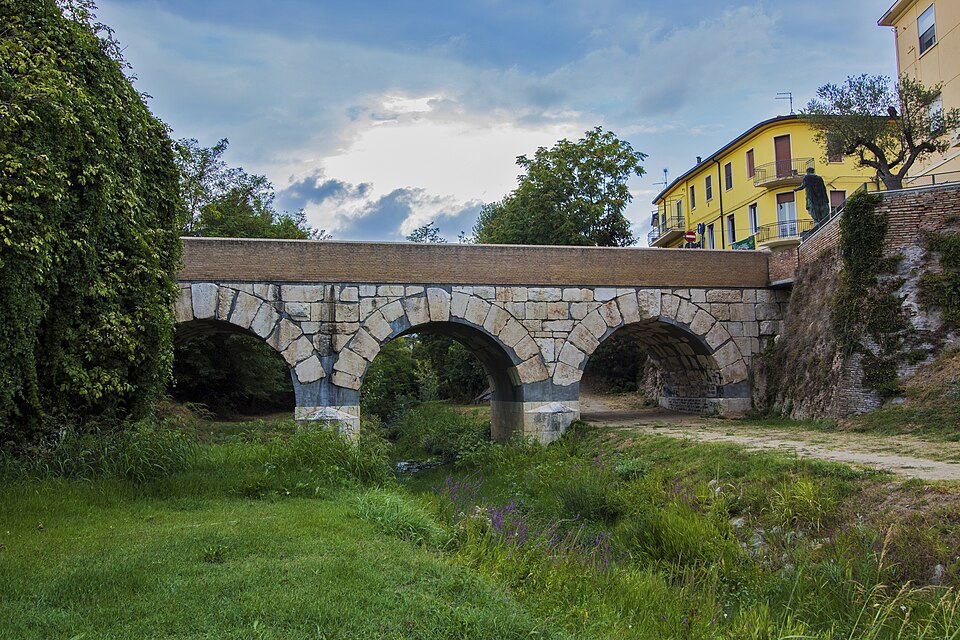
The river marked the boundary between Roman Italy and the province of Cisalpine Gaul. Julius Caesar was returning from his military command in Gaul while engaged in an escalating confrontation with Pompey and his political opponents in Rome. A Roman commander was not permitted simply to bring his provincial army into Italy. Crossing the boundary under arms therefore converted political crisis into civil war.
Ancient authors preserved the moment, and later tradition fixed it to the phrase alea iacta est, the die is cast. The crossing eventually became so famous that “crossing the Rubicon” survived long after the Roman Republic itself as shorthand for passing a point from which retreat is no longer possible.
The geographical irony is that the river’s exact identity was eventually lost. Watercourses changed, names shifted and the ancient evidence was insufficient to produce universal certainty. In the 20th century, the Fiumicino was officially renamed Rubicone, although scholarly discussion about the ancient boundary has remained more complicated than modern road signs suggest.
That uncertainty is part of what makes the story interesting. Caesar’s Rubicon mattered not because it was a mighty river but because humans had assigned political meaning to one bank and the other. The modern landscape does not preserve the event neatly, and that absence is itself a reminder of how unstable historical geography can be.
Pantani crossed this territory for altogether different reasons, usually without ceremony. The roads around Sogliano belonged to training, repetition and familiarity. One of antiquity’s most famous boundaries eventually became part of the everyday riding country of a cyclist from Cesenatico.
-104.6 km · Via Felloniche, First Passage
The first encounter with Via Felloniche comes at race kilometre 87.9, leaving 104.6 kilometres. It marks the beginning of the central sequence that will gradually reduce the race.
The climb is approximately 1.6 kilometres long at an average gradient of 9.5 percent, but the average conceals the violence of its opening section. The first 500 metres average around 14 percent, with ramps reaching 18 percent. By professional standards it is short, yet steep enough that the damage depends not only on the climb itself but on how often the riders are forced to return.
They will see it four times:
-104.6 km · first passage
-85.7 km · second passage
-66.8 km · third passage
-47.9 km · fourth and final passage
Between those passages the circuit also climbs through Roncofreddo and the surrounding hills. The race’s difficulty is therefore cumulative rather than monumental. It is built from repetition, from the gradual disappearance of recovery and from the knowledge that the same steep road will return later.
That suits this landscape. Pantani’s legend belongs to enormous mountains, but the development of any climber begins with repetition on smaller roads. A hill does not need two thousand metres of altitude to become useful if it can be linked to another, then another, and ridden again after fatigue has already begun to accumulate.
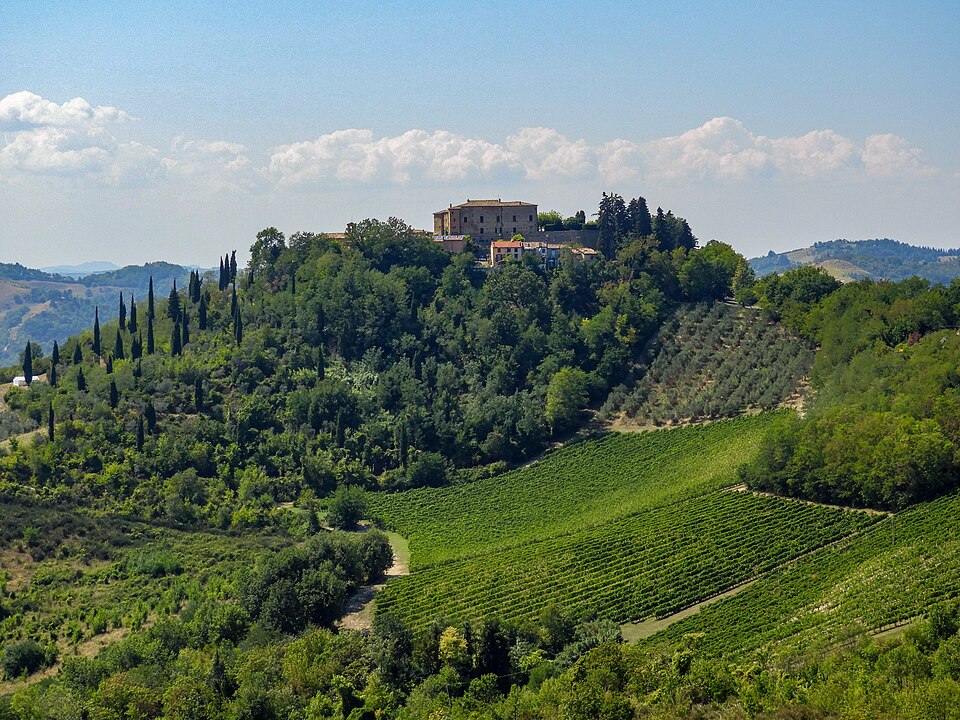
-102.4 to -40.4 km · Longiano and Roncofreddo, Where the Hills Become the Race
After the first Felloniche passage, the Memorial enters the repeated Longiano-Roncofreddo phase that defines the middle of the course. The succession continues until race kilometre 152.1, when 40.4 kilometres remain and the riders finally leave the hills behind.
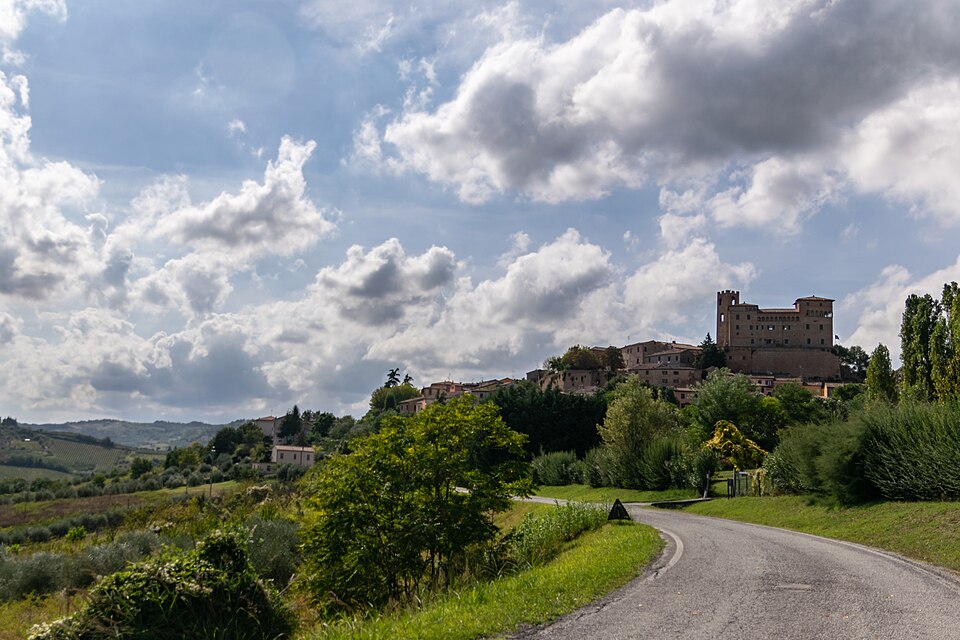
Longiano deserves attention beyond the sporting circuit. The town occupies high ground overlooking the Romagna plain, where control of roads between Cesena, Rimini and the surrounding valleys gave fortified sites considerable value during the Middle Ages. Its castle is documented from the 11th century and later passed into the orbit of the Malatesta, who controlled Longiano from the late 13th century until the 15th.
The view explains the attraction. To the east, the land falls towards the Adriatic, while inland the foothills become increasingly complicated. Medieval rulers could monitor movement across the plain from these heights, linking Longiano to the same political geography encountered earlier at Verucchio.
For the Memorial, however, Longiano carries a much more intimate piece of cycling history. In July 1987, a teenage Marco Pantani racing as a junior for the G.S. Fausto Coppi-Gelati Menne won the Trofeo Giorgetti-Balignano di Longiano. Later that season he also won the uphill Forlì-Montecoronato.
The professional peloton is therefore not simply passing through a hill town located near Pantani’s home. It is returning to a place where Pantani himself won before the Giro, before the Tour, before the bandana and before the rest of the cycling world knew his name.
His youth results reveal a gradual progression rather than the sudden appearance of an extraordinary professional climber. After the first win near Cesena in 1984 came victories at Serravalle, Val di Noce, Montefiorino, Savignano sul Rubicone and elsewhere. Longiano belongs to that apprenticeship, when the qualities later visible on the Mortirolo were already emerging on smaller roads close to home.
The race now spends more than sixty kilometres circulating through this terrain, repeatedly returning to the steep roads around Felloniche and Roncofreddo. Medieval geography and cycling geography overlap naturally here. Longiano’s fortress exists because elevation once produced political advantage. Pantani’s victory here mattered because the same hills produced sporting advantage for a young rider whose future would depend upon gradients.
-85.7 km · Via Felloniche, Second Passage
The second Felloniche comes at race kilometre 106.8, leaving 85.7 kilometres. The steep opening ramps are no longer a surprise. Riders know where the road bites and where the effort must be controlled.
Between the Felloniche passages comes the climb towards Roncofreddo, approximately 2.6 kilometres at 7.1 percent. Neither ascent is long enough to dominate the course by itself, but together they turn the circuit into a sequence of efforts with increasingly little space between them.
This is where the route begins to feel less like a collection of climbs and more like a landscape being ridden repeatedly. The roads loop through the same hills, return to the same gradients and expose riders to the same corners from a body that is less fresh each time. The terrain is modest in altitude but not in effect.
Pantani’s connection to this broader environment is better understood at that scale. We do not need to claim that every bend was one of his preferred training roads. What matters is that the Memorial has entered the kind of Romagna terrain that accompanied his development, while places within it such as Sogliano and Longiano preserve specific memories of his presence.
-66.8 km · Via Felloniche, Third Passage
At race kilometre 125.7, 66.8 kilometres remain, and Felloniche appears for the third time. By now the circuit has become familiar enough for the riders to anticipate every change of gradient, but familiarity offers little relief when fatigue has altered the effort required to cross it.
The repetition reveals something about cycling that geography alone cannot. The same road is never quite the same road twice. Gradient, surface and length remain unchanged, yet the rider arriving an hour later carries accumulated work into every metre. A climb that was manageable on the first passage can become decisive on the third simply because of what came before it.
That quality belongs naturally to Pantani’s home terrain. From the coast, a training day could be built not around one famous summit but around a sequence of hills, each adding another layer of effort before the long return to Cesenatico. Romagna did not need to imitate the Alps. It offered a different kind of preparation.
-47.9 km · Via Felloniche, the Last Passage
The fourth and final Felloniche comes at race kilometre 144.6, leaving 47.9 kilometres. The circuit has now extracted almost everything it can from the hills, and this is the last passage over the steepest road before the course turns decisively towards the coast.
The climb itself has not changed. It is still 1.6 kilometres, still brutally steep at the bottom, still capable of reaching 18 percent. What has changed is the condition in which the riders confront it. Three earlier passages, the climb through Roncofreddo and the accumulated terrain of the day now arrive with them.
A few kilometres later, the hills begin to disappear.
-40.4 km · Leaving the Hills, the Road Home
At race kilometre 152.1, exactly 40.4 kilometres remain, and the Memorial exits its decisive circuit for the final time. The change in terrain is immediate enough to feel almost geographical rather than sporting.
After hours of climbing, descending and turning through the Romagna hinterland, the road begins to open towards the Adriatic plain. The gradients soften, the horizon widens and the race gradually returns to the landscape from which Pantani always started his rides.
For him, this was the final part of countless training days. Cesenatico offered no mountain waiting beside the sea. The work happened inland, on roads reached by riding away from home, and the return meant watching those same hills gradually recede behind the bicycle.
Other routes farther into the Apennines became closely associated with his training, while Sogliano and Longiano preserve more specific traces of his presence. Together they form a Pantani geography very different from the famous mountains of the Giro and Tour. These were not the places where he became internationally known. They were the roads where cycling remained part of ordinary life.
The Memorial has spent most of the afternoon there before finally turning home.
-26 km · Sala di Cesenatico, the Hills Disappear
At race kilometre 166.5, only 26 kilometres remain, and the peloton passes Sala di Cesenatico. The profile has fallen back to little more than a handful of metres above sea level.
The hills that shaped the middle of the race are now behind the riders. Ahead lies the completely flat approach to Cesenatico and the finishing circuits beside the Adriatic.
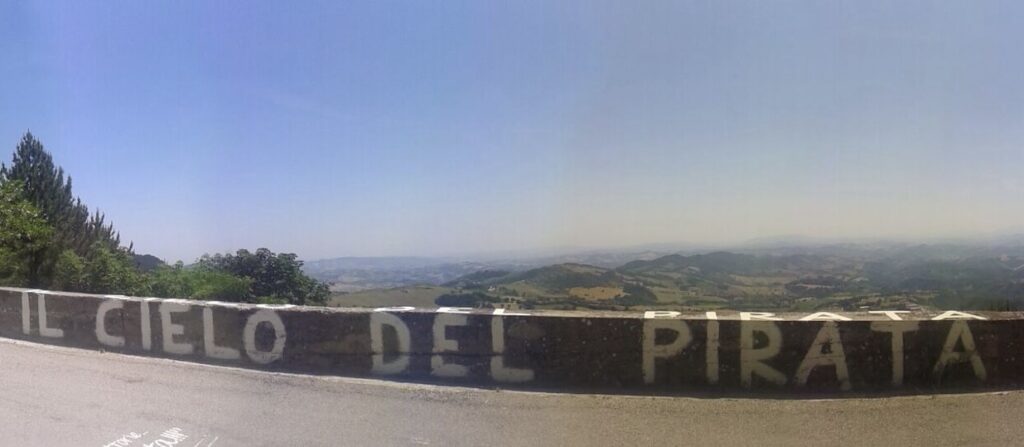
The geography makes Pantani’s origins unusually tangible. A rider could leave this plain in the morning, spend hours among the climbs crossed earlier by the Memorial and return to roads so flat that the landscape offers almost no visual clue of the terrain waiting inland. His climbing ability was never explained by living beneath a great mountain. The mountains had to be sought.
That daily movement between coast and hills is more important than repeating the paradox. By now the route has already shown how the relationship worked.
Cesenatico · Leonardo da Vinci and a Port Drawn in 1502
Before Cesenatico became Pantani’s town, its identity was inseparable from its harbour. The settlement developed as the maritime outlet of Cesena, connected with fishing and commerce along an Adriatic coast where shallow water and sediment continually complicated the maintenance of a functional port.
In 1502, that problem attracted one of the most extraordinary visitors in the town’s history. Leonardo da Vinci was travelling through Romagna in the service of Cesare Borgia, who employed him as an architect and military engineer while attempting to consolidate control over territories in central Italy.
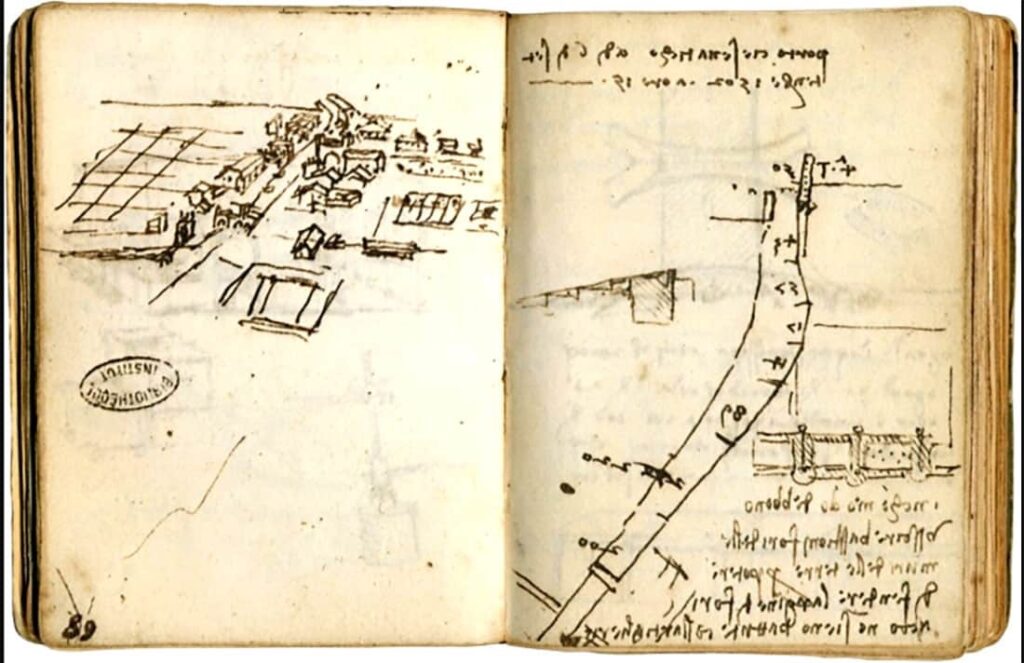
Leonardo reached Porto Cesenatico on 6 September 1502 and studied the harbour. In the notebook now known as Codex L, he produced drawings showing the port from different perspectives, recording dimensions and the relationship between the canal, structures and coastline. Leonardo was not looking at Cesenatico simply as an artist encountering a picturesque harbour. He was investigating it as an engineer.
The coastline he recorded was different from today’s. Sedimentation and centuries of engineering altered the relationship between harbour and sea, while the settlement expanded around the canal. A fortress associated with the old harbour landscape no longer survives, having been destroyed during the Second World War.
The Porto Canale nevertheless remains the central line of the historic town. Traditional boats, fishermen’s houses and maritime collections preserve an identity that predates both modern tourism and professional cycling. Restaurants and public spaces now occupy parts of a working landscape whose form was already interesting enough for Leonardo to record more than five centuries ago.
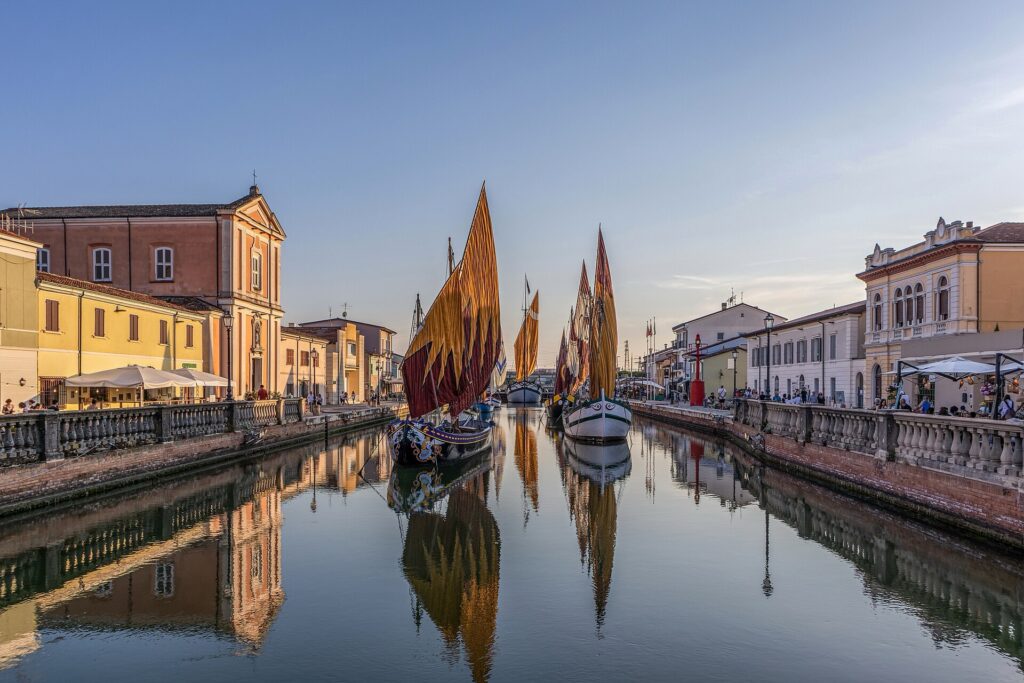
Pantani grew up beside this maritime world rather than beneath mountains. Television later fixed him permanently against Alpine peaks and crowds on steep roads, but Cesenatico preserves the other half of the story. Before the Mortirolo there was the Adriatic.
Cesenatico · The Fausto Coppi Club and the Boy on His Mother’s Bicycle
Pantani’s cycling story began in circumstances so ordinary that they become more striking with hindsight.
His family had acquired an apartment in Via dei Mille, and the youngsters of the G.C. Fausto Coppi di Cesenatico used the area nearby as a meeting point for training. Marco watched them gather and, at eleven years old, decided to follow.
He did not have a racing bicycle, so he used his mother’s old, heavy women’s bike. Despite the difference in equipment and his lack of experience, he remained with the group. When the road began to rise, he moved forward.
There was no professional team evaluating him, no famous summit and no audience waiting for an attack. There was only a child from Cesenatico discovering, on an ordinary club ride, that climbing changed the balance between him and the other riders.
He joined the Fausto Coppi club and began racing. On 22 April 1984, at thirteen, he won alone at Case Castagnoli near Cesena. Victories followed through the youth categories, including the 1987 success at Longiano already encountered by the Memorial. In the amateur ranks his progression carried him to third in the Giro d’Italia Dilettanti in 1990, second in 1991 and victory in 1992, the result that preceded his move into professional cycling.
The club still belongs to Cesenatico’s cycling life, and younger riders continue to learn the sport in a town where one of its most famous members first joined simply because he wanted to follow the older children on a ride. The scale has changed enormously, but the setting has not.
The House of Marco · A Race Passing Home
Before entering the finishing circuit, the 2026 Memorial follows its traditional passage in front of the Pantani family home. It is difficult to imagine another point where the distinction between race and memorial becomes thinner.
Professional cycling passes thousands of houses during a season. Most become anonymous scenery at television speed. Here one house alters the meaning of the road because the person being remembered belonged behind it, and because his relationship with cycling began almost outside it.
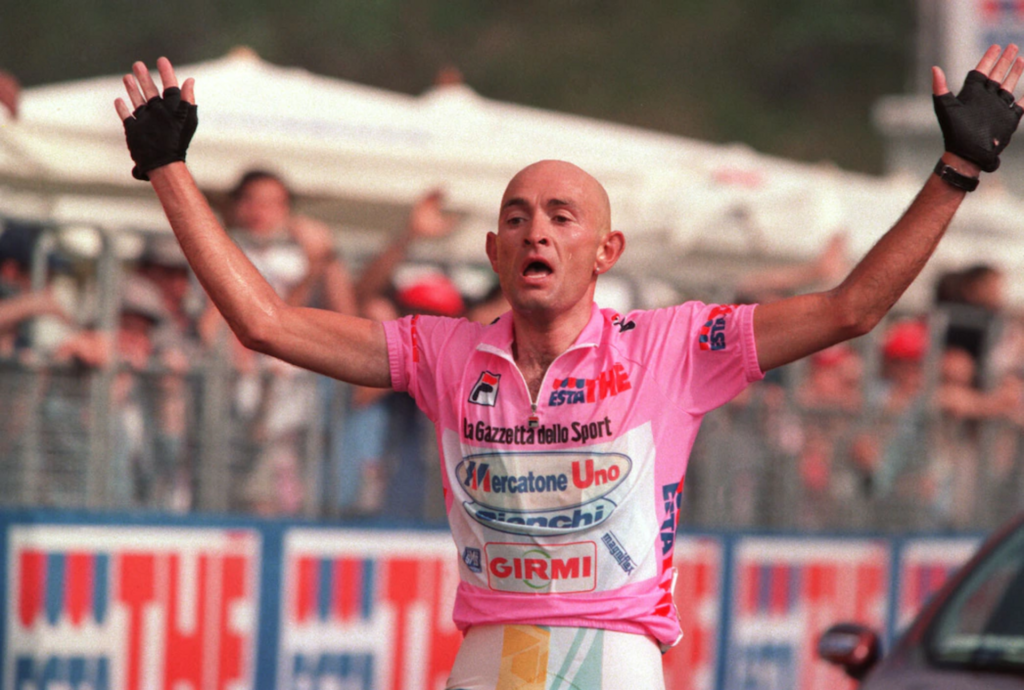
The Memorial has already visited places where Pantani trained and where he won as a teenager. Now the geography contracts from countryside to home. The Giro and Tour champion briefly recedes, and the boy watching the Fausto Coppi riders gathering nearby becomes visible again.
Pantani’s story after 1998 became painfully complicated. During the 1999 Giro, while leading the race and appearing close to another overall victory, he was excluded at Madonna di Campiglio after a haematocrit test returned a value above the permitted limit. What followed cannot be reduced cleanly to one sporting controversy. His relationship with racing, fame, suspicion and eventually his own life deteriorated. There were returns and moments when the old Pantani seemed briefly visible again, but the trajectory never returned to 1998.
On 14 February 2004, Marco Pantani was found dead in a hotel room in Rimini. He was 34.
The tragedy inevitably became part of how he is remembered, but it should not be allowed to consume everything that came before it. There was a boy in Cesenatico who borrowed his mother’s bicycle, an adolescent winning races on Romagna’s hills, an amateur who fought his way towards professional cycling, a rider who survived terrible injuries and eventually an athlete capable of making millions of people wait for the road to tilt upwards because something might happen when it did.
The Memorial passes the house before continuing to the finish. No grander gesture is required.
-20 km · First Passage Through Cesenatico
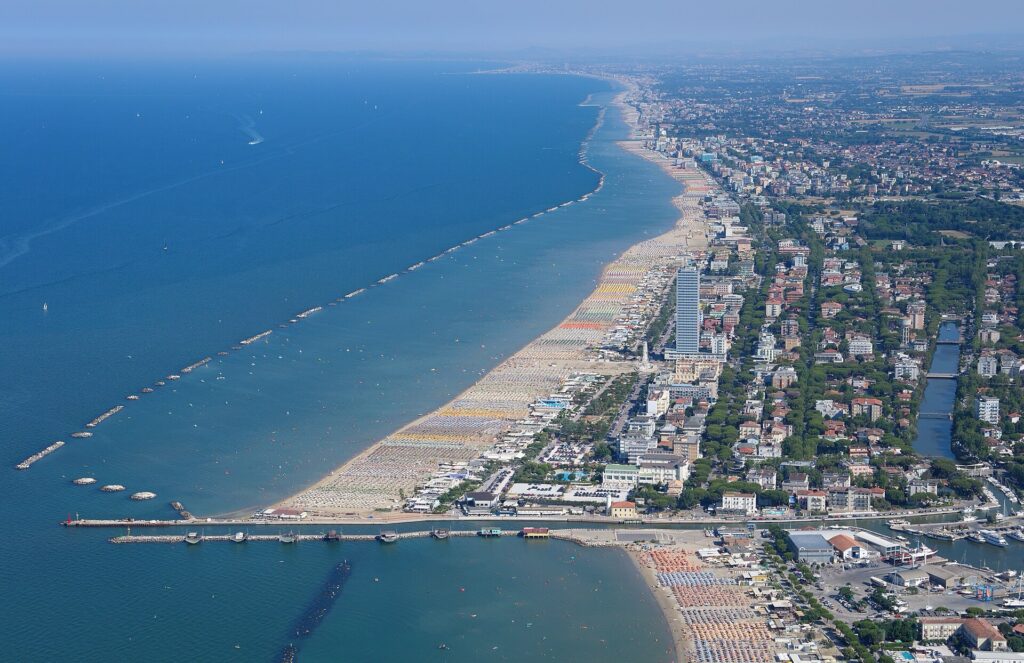
At race kilometre 172.5, exactly 20 kilometres remain. The riders reach Cesenatico and cross the finishing area for the first time, but the race is not over. Four flat circuits of five kilometres remain.
The kilometre sequence is now simple:
-20 km · four laps to go
-15 km · three laps to go
-10 km · two laps to go
-5 km · final lap
FINISH · Viale Carducci
The hills have completely disappeared. Riders who survived Verucchio, Passo delle Siepi, Gorolo, Roncofreddo and four passages of Felloniche must now adapt to an entirely different race of positioning, corners, speed and tactical calculation.
Cesenatico, however, contains enough history and memory that these final kilometres deserve to be read at a slower pace than the peloton will ride them.
-20 to -5 km · Spazio Pantani, the Mountains Brought Back to the Adriatic
Near Cesenatico railway station stands Spazio Pantani, created to preserve the material memory of Marco’s career through bicycles, jerseys, photographs, trophies, audiovisual material and personal objects.
The museum introduces an unusual geography into this completely flat town. Its spaces carry names such as Mortirolo, Alpe d’Huez and Bocchetta, mountains and climbs brought symbolically back to the Adriatic coast.
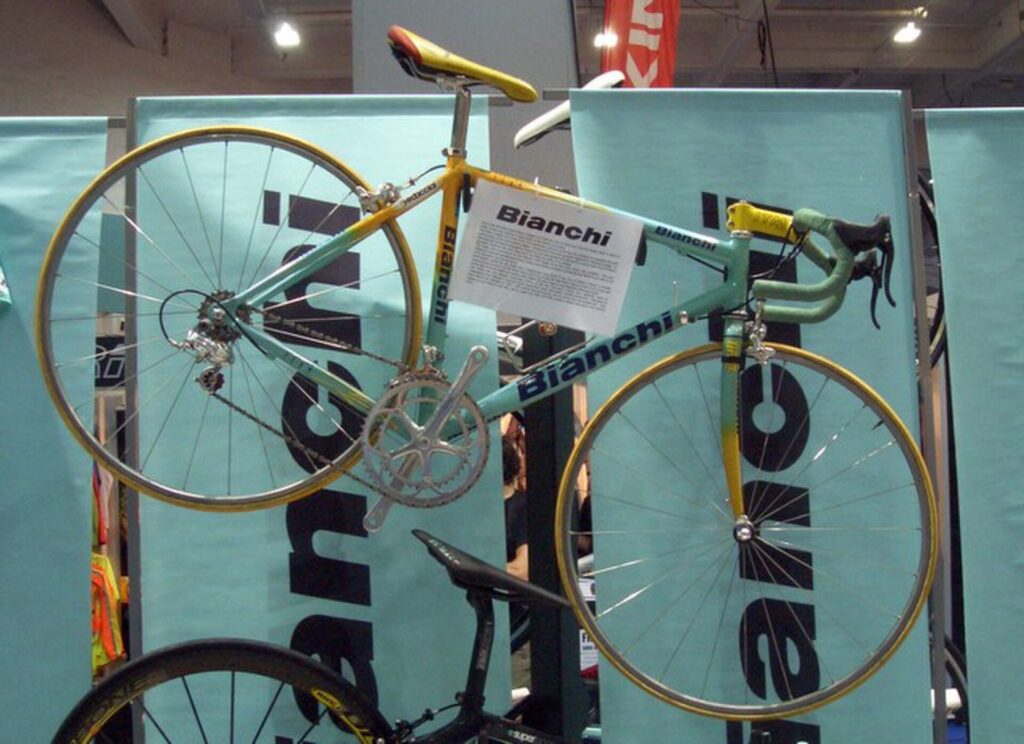
Mortirolo belongs above all to the moment when Pantani announced himself as an extraordinary professional climber. During the 1994 Giro d’Italia, the young Italian attacked on roads where Miguel Indurain, winner of the previous three Tours de France, suddenly looked vulnerable. Pantani finished second in that Giro and third in his first Tour only weeks later.
Alpe d’Huez became another Pantani landscape. By 1997 he was again capable of winning there after injuries had repeatedly interrupted his career. The following year everything converged.
In 1998, Pantani won the Giro d’Italia and then travelled to the Tour de France. On the stage to Les Deux Alpes, in cold rain across the Alps, he attacked from far enough out to overturn the race. Jan Ullrich cracked behind him, Pantani took the yellow jersey and eventually reached Paris as Tour champion.
He remains the last rider to have won the Giro d’Italia and Tour de France in the same season.
Inside Spazio Pantani, those mountains now sit within the memory of a seaside town. During Pantani’s life he travelled from Cesenatico towards the climbs that made him famous. The museum reverses that movement and brings those roads home.
-20 to -5 km · The Monument to Pantani, a Climber Beside the Sea
On the Cesenatico seafront, near the finishing circuit, stands the monument dedicated to Pantani. Its location creates one of the most appropriate contradictions in cycling memorials: one of the sport’s greatest climbers is commemorated almost at sea level.
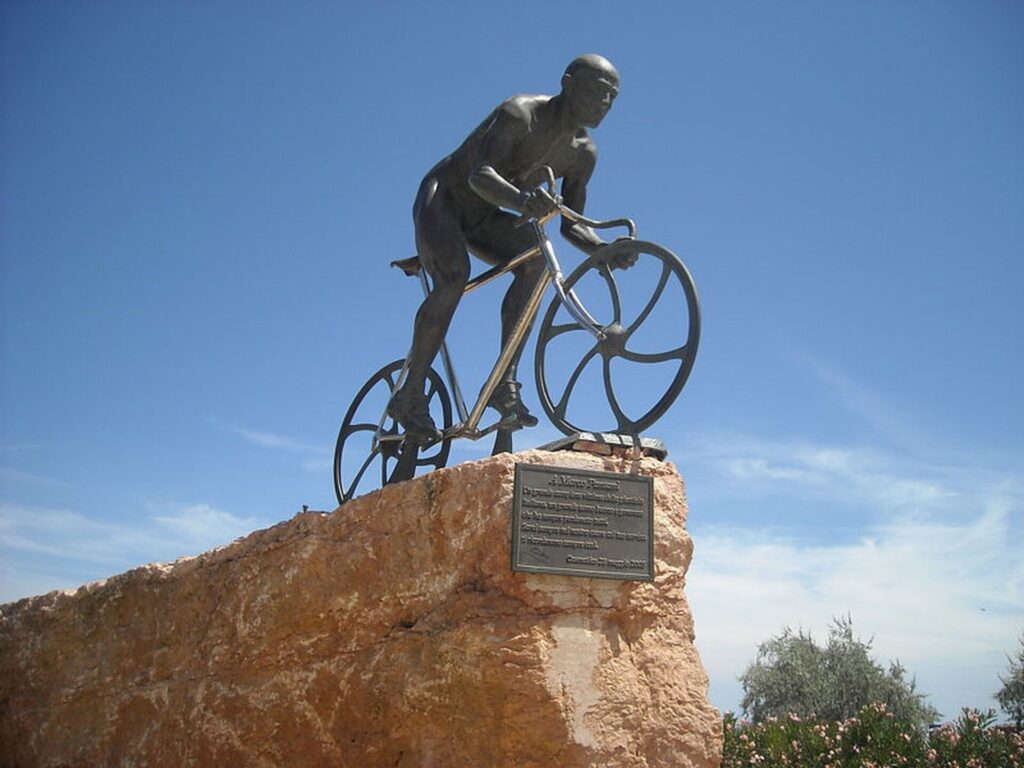
After following the Memorial route, the contradiction no longer seems strange. The road has demonstrated how closely the flat Adriatic plain is connected with the inland hills. Pantani’s development unfolded across both landscapes, with Cesenatico providing home and the hinterland providing the gradients on which his talent became useful.
Sogliano remembers him on its roads. Longiano preserves a victory by the teenage Pantani. The wider Romagna hills accompanied his development, while Cesenatico contained the family, the club and the daily life to which those rides returned.
His public geography eventually expanded far beyond Romagna. Mortirolo, Oropa, Alpe d’Huez and Les Deux Alpes became part of his career, and other mountains where he never raced now carry his name because spectators continue painting it on the asphalt.
That practice may be less formal than a monument, but it is more widespread. Cycling has no permanent stadium. The race arrives, barriers are erected, people gather and hours later almost everything disappears. The mountain remains, and sometimes the writing remains with it.
-5 km · Final Lap, Back Through Cesenatico
At five kilometres to go, the bell signals one final circuit. The Memorial has almost returned to the setting from which its story began, beside the Adriatic and among roads Pantani knew not as professional race terrain but as home.
Behind the riders lie the Villanovan graves and Baltic amber of Verucchio, the fortresses of the Malatesta, the complicated rocks of the Marecchia valley, the hidden cheese pits beneath Sogliano, the uncertain geography of Caesar’s Rubicon and the repeated steep roads around Longiano and Roncofreddo. Running through those histories is a more recent chronology: the boy joining the Fausto Coppi club, the junior winning at Longiano, the rider training through the Romagna hills and the professional who eventually carried that climbing ability to the great mountains of Europe.
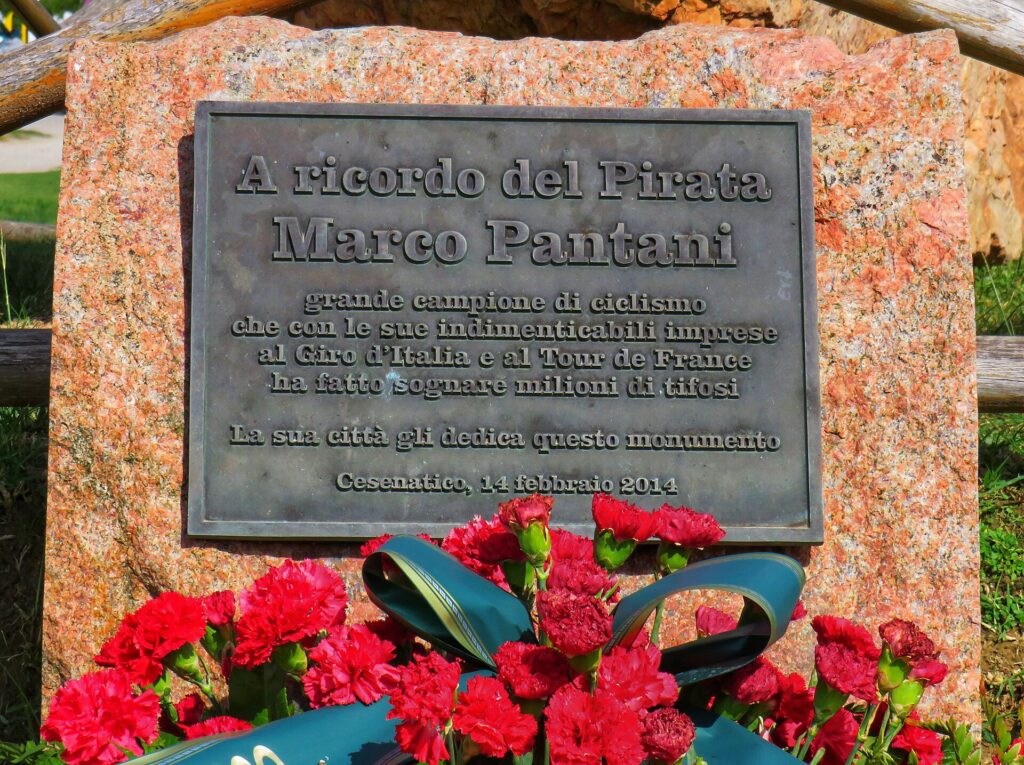
Pantani’s biography has not replaced the older stories along the course, nor does it need to be attached artificially to every village and monument. It appears where the geography genuinely supports it, sometimes directly, sometimes through the broader environment that shaped his development. By the time the peloton reaches Cesenatico again, the route has shown how those layers belong to the same territory.
The final kilometres are flat, but the landscape behind them has already done the explaining.
FINISH · Cesenatico, and a Name That Never Left the Road
The Memorial Marco Pantani finishes on Viale Carducci after 192.5 kilometres. The winner crosses the line close to the monument dedicated to the man whose name the race carries, after a journey that began on the Adriatic, climbed into the Romagna hills and eventually returned to Cesenatico.
Pantani’s presence survives formally here. It exists in Spazio Pantani, in the monument beside the sea, in cycling facilities carrying his name and in a professional race organised every year in his memory. Yet the route shows that remembrance is also embedded farther inland. Sogliano remembers the Pirata on its training roads. Longiano can look back to the teenager who won there in 1987. Across Romagna, roads that once formed ordinary training loops have become part of the geography through which his life is remembered.
Those local connections matter because they restore the years before fame. Before the Giro and Tour winner there was the boy on his mother’s bicycle. Before the Mortirolo there were the hills inland from Cesenatico. Before television commentators around the world learned that a mountain stage could change the moment Pantani attacked, there were people in Romagna already watching a very small young rider become difficult to follow when the road went uphill.
For me, however, the simplest memorial remains the most powerful. I can watch a race today that has nothing to do with Marco Pantani. Different riders, different teams, different bicycles, another generation entirely. The peloton reaches a mountain and the camera moves along the road ahead of it. There are flags, names, messages and layers of paint left by spectators. Among them, every so often, are the same seven letters: PANTANI.
For a moment I am back watching the rider who made me fall in love with cycling. I remember the anticipation when the road started climbing, the feeling that a race could change without warning, and the emotions that no athlete, team or sporting moment has ever quite managed to give me again.
More than twenty years have passed since Marco Pantani died. Many people standing beside today’s races never saw him compete live, yet somewhere before the peloton arrives, somebody still chooses a piece of asphalt and writes his name. I hope they never stop.