

Most road races begin with a peloton. The Chrono des Nations begins with a rider waiting alone on the starting ramp in Les Herbiers, watching the final seconds disappear from the clock before being released onto the roads of the Vendée.
There is no neutralised procession and no group in which to settle during the opening kilometres. Each rider follows essentially the same course, but the experience is intensely individual. Wind can change during the afternoon, temperatures move, fatigue arrives at different moments, and an effort that feels perfectly controlled after ten kilometres can prove fractionally too ambitious much later. In a discipline measured in seconds, that fraction is often enough.

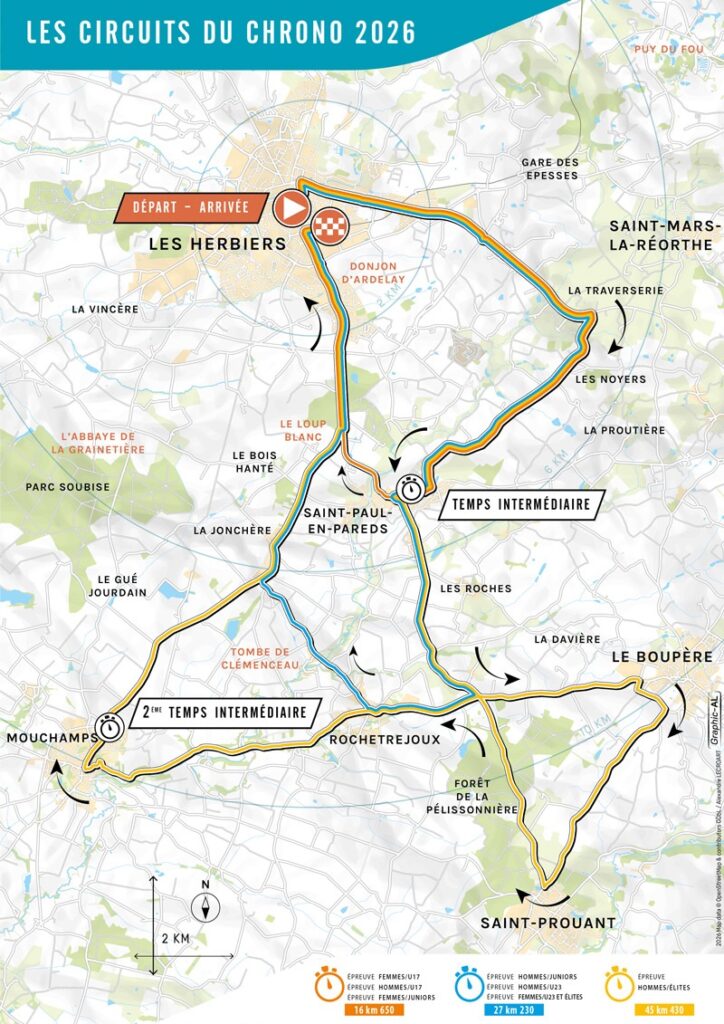
The elite men’s course covers approximately 45 kilometres through the rolling bocage around Les Herbiers before returning to the town. Its altitude is modest throughout, but the profile is rarely completely flat. Short rises, shallow descents, exposed stretches and frequent changes of direction complicate an exercise in which maintaining speed is only part of the problem. The deeper challenge is deciding where that speed is worth paying for.
That is why the Chrono des Nations occupies such an unusual position at the end of the European road season. Riders who have spent months reacting to attacks, wheels, teammates and tactics finish their year with much of that collective machinery stripped away. What remains is the bicycle, the road and a clock that measures every decision without caring how difficult it felt.
The road begins in Les Herbiers.
–45.43 km | Les Herbiers
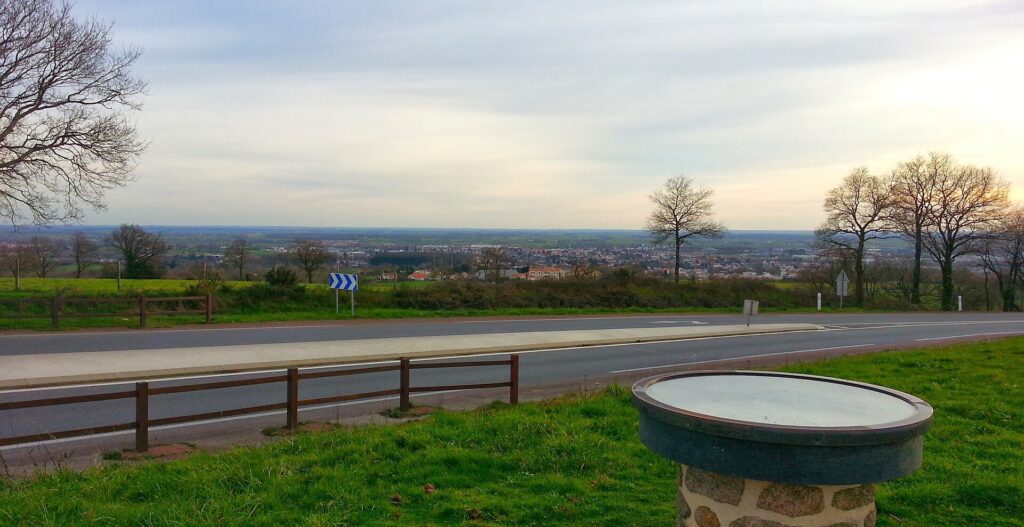
Les Herbiers stands in eastern Vendée, roughly between Nantes and La Roche-sur-Yon, within a landscape very different from the flat Atlantic marshes often associated with this part of western France.
This is the Haut-Bocage, where fields are divided by hedges, sunken lanes and small patches of woodland, and where the terrain rises and falls gently rather than opening into uninterrupted plains. Farms and villages appear frequently, but large towns are scarce. Visibility can suddenly contract between hedgerows before opening again across cultivated slopes, giving the countryside an enclosed quality even when the elevations remain low.
Les Herbiers itself developed from a rural centre into one of the more economically dynamic communities of the Vendée, but cycling has given the town an international recognition that its size would not otherwise suggest.
The first Chrono des Herbiers was organised in 1982, initially for amateurs. What began as a local time trial gradually expanded, adding women’s racing, under-23 and junior categories before joining the professional calendar during the 1990s. The result was something more substantial than an elite race appended to a town festival: Les Herbiers built an entire day around the discipline of riding against the clock.
Young riders leave the same starting environment hours before the professionals. Juniors and under-23 riders follow, the elite women race during the programme, and the elite men close the afternoon. Distances differ between categories, but the principle remains unchanged, and some competitors who first appeared here as teenagers have later returned as internationally recognised professionals.
Remco Evenepoel won the junior event in 2018. Joshua Tarling would also progress from junior success on these roads to victory in the elite race. Filippo Ganna competed at Les Herbiers during his development before becoming one of the defining time trialists of his generation.
The starting ramp can therefore record more than the result of a single afternoon. Over many editions, it has encountered riders at different stages of the same career.
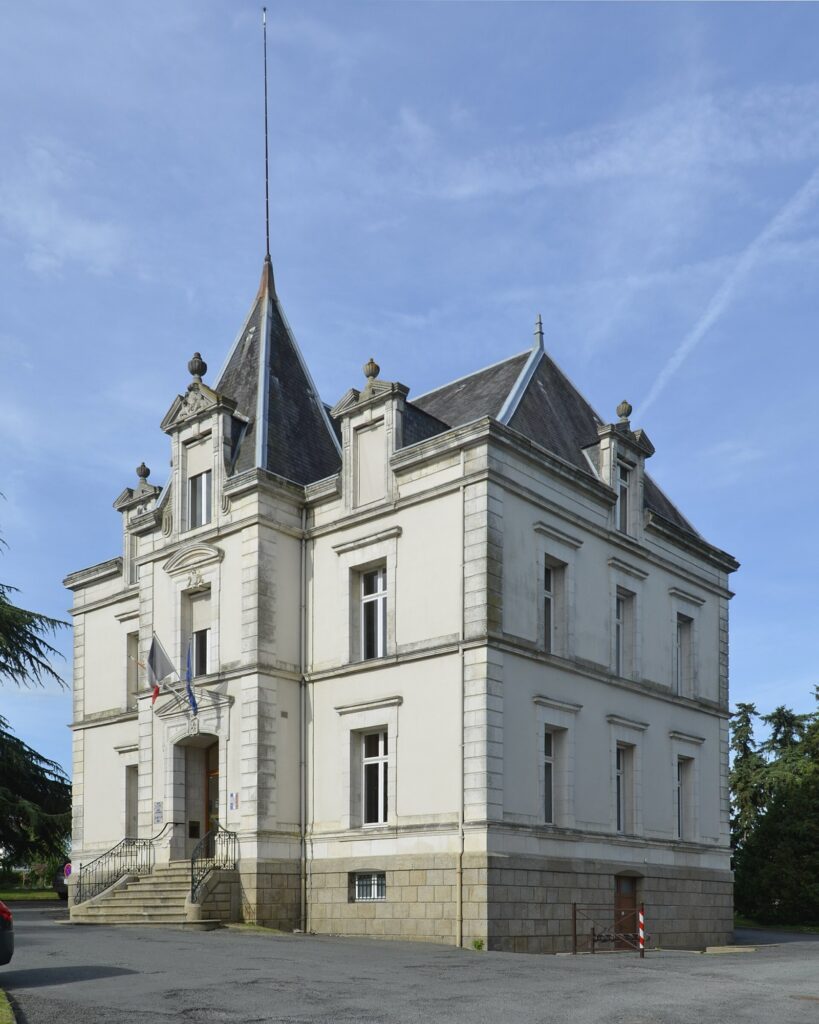
For the elite men, that journey begins outside the mairie before the course quickly leaves the town and enters the enclosed countryside of the Haut-Bocage.
–40 km | The Bocage
To understand these roads, it helps to understand the bocage.
The term describes an agricultural landscape divided into relatively small fields enclosed by hedges, earth banks, trees and lanes. It developed over centuries rather than according to a single plan, producing a countryside very different from the large open-field systems found elsewhere in France.
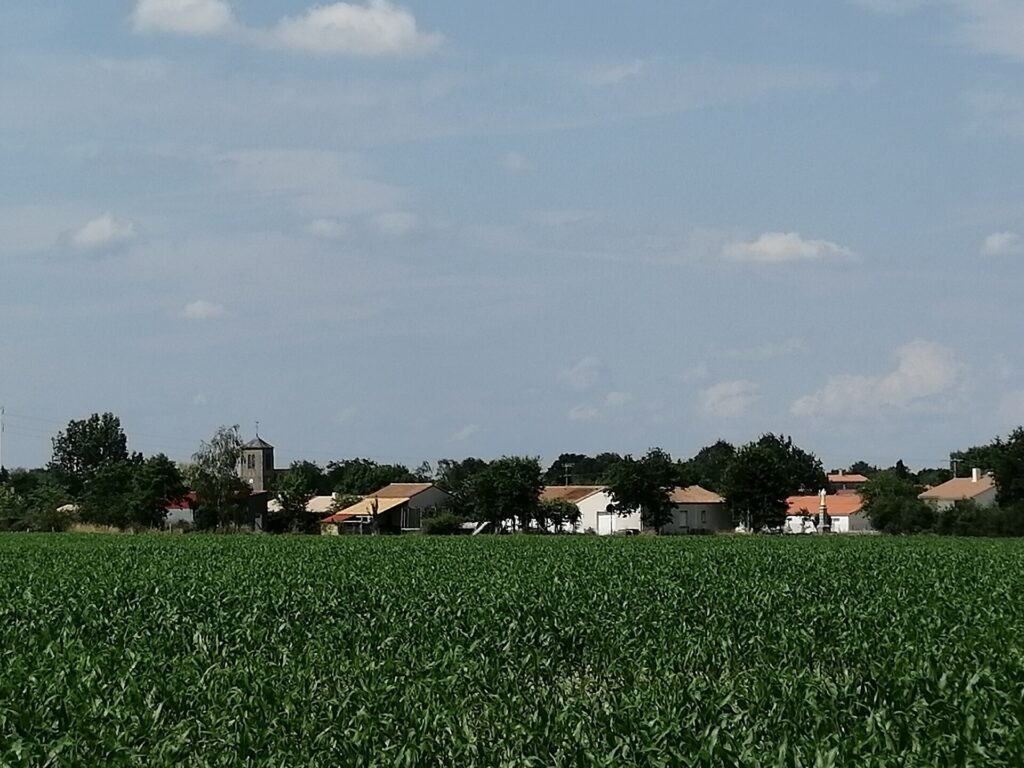
For farming communities, these boundaries served practical purposes. Hedgerows marked property, sheltered livestock, reduced erosion and protected fields from wind. Trees supplied timber and fuel, while the network of narrow roads connected scattered farms with villages and markets.
For a cyclist moving at time-trial speed, the same landscape produces a constantly changing relationship with the road. A sheltered lane can emerge suddenly onto an exposed section where the wind becomes important; a shallow descent encourages the rider to remain compact over the bicycle rather than chase additional power; another rise shifts the calculation towards effort again.
The physics behind that calculation are relatively simple even if executing it is not. At high speed, aerodynamic resistance consumes an enormous share of the rider’s power, so additional effort on a fast section often buys less time than the same effort on a slower rise. An efficient time trial is therefore not necessarily ridden at identical power from start to finish. The terrain determines where energy is most valuable.
On a perfectly flat course that problem can become almost abstract. In the Vendée bocage it is written directly into the landscape, because the road rarely holds one character for very long.
The route moves southeast towards Saint-Paul-en-Pareds.
–36 km | Saint-Paul-en-Pareds
Saint-Paul-en-Pareds belongs to the small rural communities scattered across the Haut-Bocage. Its stone buildings, surrounding farms and enclosed fields place the race firmly inside the inland Vendée rather than the coastal landscape farther west.
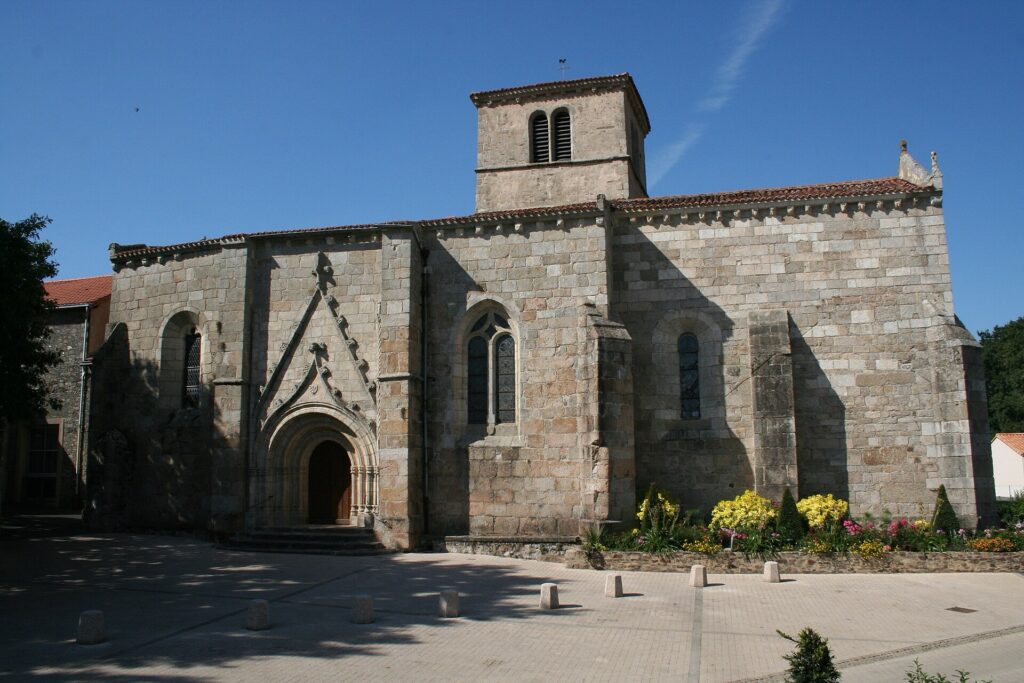
The name Pareds reaches into an older geography. The Pays de Pareds was a historic territory of the Vendée interior, associated with the country around the upper Lay valley and the settlements lying between the bocage and lower lands to the south.
At racing speed those historical boundaries are invisible, but the terrain they helped organise is not. Elevation comes in small increments rather than through a sustained climb, and speed rises and falls repeatedly as the course follows the contours of the countryside.
A rider who attacks every rise too aggressively will pay for it later; one who treats every gradient identically may leave time on the road. The skill lies in allowing the effort to follow the terrain without turning forty-five kilometres into a succession of uncontrolled accelerations.
By Saint-Paul-en-Pareds the opening rush has passed. The position on the bicycle has settled, breathing has found its pattern, and the rider begins discovering whether the pace chosen outside Les Herbiers can actually be sustained.
Beyond the village, the road continues towards Le Boupère.
–30 km | Le Boupère and the Interior Vendée
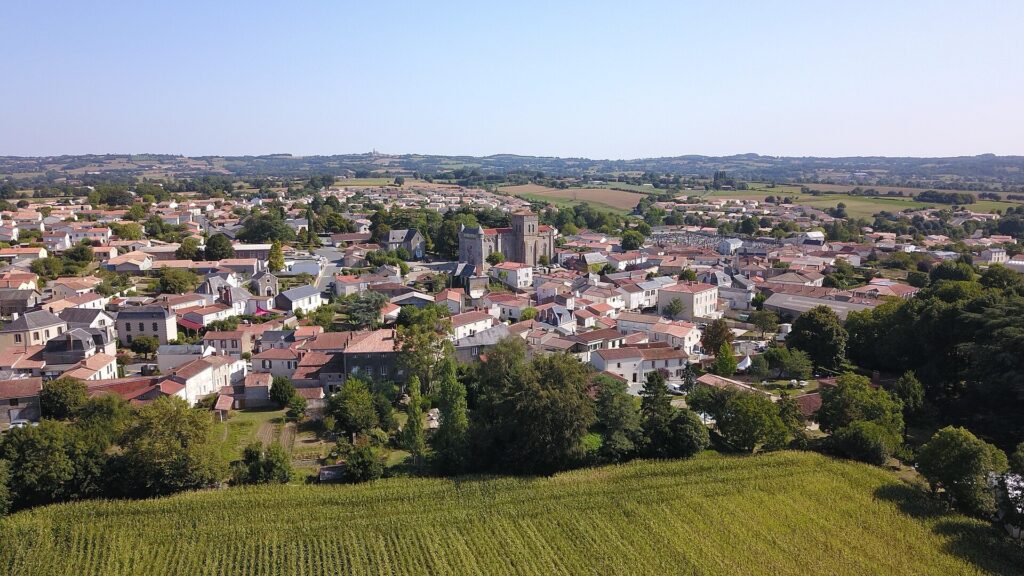
Le Boupère sits among the fields and hedges east of the main north-south routes through the department. Like many settlements in this part of the Vendée, its quiet scale gives little indication of how violently the surrounding countryside was transformed during the French Revolution.
In 1793, opposition to the revolutionary government erupted across much of the Vendée and neighbouring areas. Its causes were complex. Resistance to military conscription combined with anger over religious policy, particularly measures affecting the Catholic Church and clergy, as well as wider tensions between rural communities and revolutionary authority.
The uprising developed into what became known as the War in the Vendée.
Royalist and Catholic forces organised across a landscape whose bocage provided both protection and difficulty. Hedges, narrow lanes and dispersed settlements complicated conventional military movement, allowing local fighters familiar with the country to operate in terrain poorly suited to large formations.
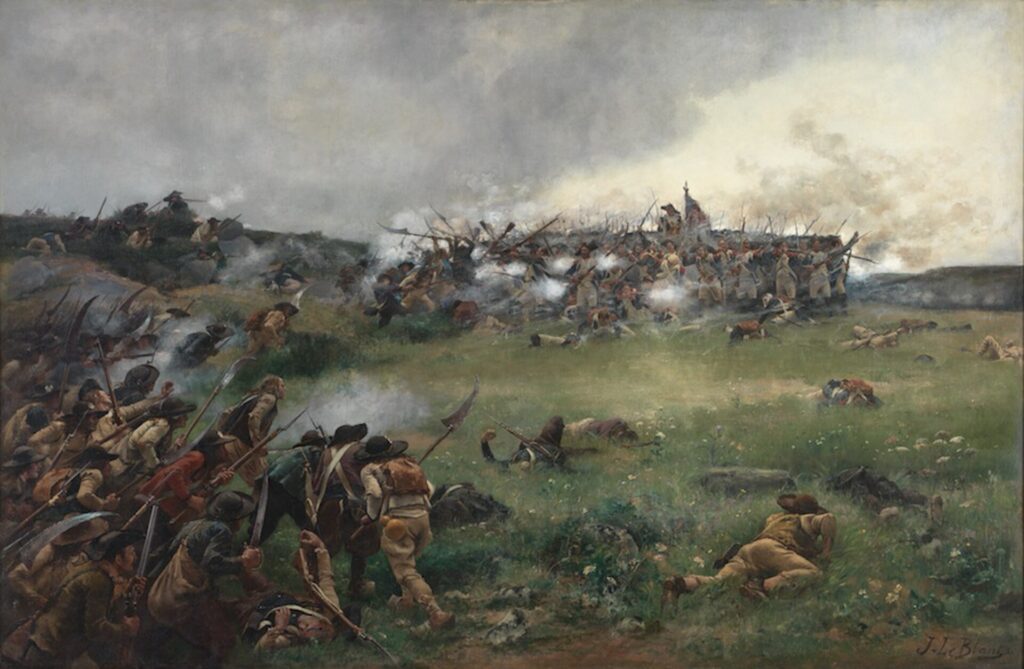
The conflict became exceptionally brutal. Republican forces and Vendéan insurgents committed violence, while civilians were caught inside a civil war that devastated communities across western France. During the repression that followed, Republican forces known as the colonnes infernales moved through parts of the Vendée in 1794, burning settlements and killing inhabitants in an attempt to destroy the remaining insurgency.
The landscape survived, but memories of the conflict became deeply embedded in regional history. Modern Vendée cannot be reduced to the war of 1793, yet the bocage through which the Chrono des Nations passes is not historically neutral scenery. The same enclosed geography that now interrupts the wind and shapes a cyclist’s pacing once influenced how armies could move, see and communicate.
The circumstances could hardly be more different today, but the structure of the land remains recognisable as the course turns through the countryside towards Saint-Prouant.
–23 km | Saint-Prouant and the Middle of the Effort
By Saint-Prouant, the time trial has entered its least forgiving phase.
The energy of the start has disappeared, but the finish remains too distant to offer much psychological relief. Enough of the course has passed for the rider to feel the consequences of the opening pace, while more than twenty kilometres remain for a small miscalculation to become progressively more expensive.
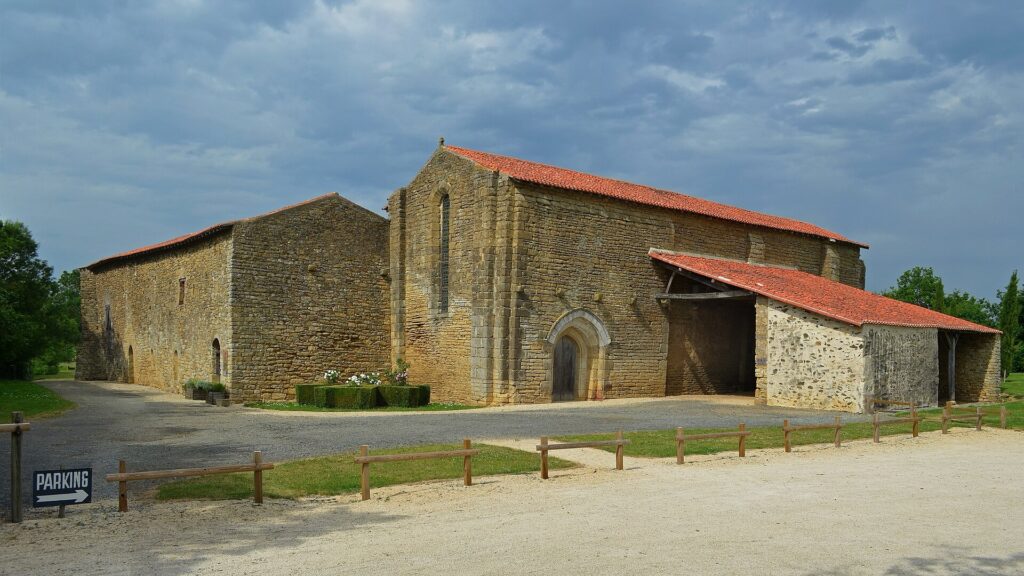
The village sits amid the same network of hedged fields and rolling roads that has accompanied the race from Les Herbiers. There is no monumental landmark here and no famous climb announcing where the race should be won. That apparent anonymity suits the discipline, because time trials are often decided on roads exactly like these.
As fatigue develops, maintaining the aerodynamic position becomes part of the physical effort rather than merely a technical choice. Shoulders that remained quiet during the opening kilometres begin to resist the position; corners require concentration when the easiest instinct would be to brake earlier; information from the head unit or team car must be interpreted without allowing numbers to dictate an effort the body can no longer sustain.
This is where the difference between a road race and a time trial becomes particularly clear. In a road race, much of the tension is visible from outside as attacks form, gaps open and groups organise a chase. Here, two riders separated by several minutes on the road may be engaged in a contest decided by seconds without ever seeing one another. Their race exists through intermediate times and information arriving from somewhere else on the course.
The kilometres continue through Rochetrejoux towards Mouchamps, and the calculation gradually changes. There is now less road left on which an excessive effort can be punished, so restraint begins to give way to commitment.
–15 km | Rochetrejoux and the Road to Mouchamps
Rochetrejoux lies deep in the agricultural Vendée, surrounded by the same bocage that has defined the route since the outskirts of Les Herbiers.
By this stage, the technical problem has become simpler in theory and harder in practice. The rider can afford to spend more of what remains, but fifteen kilometres are still long enough for an acceleration made too early to turn into a costly decline before the finish.
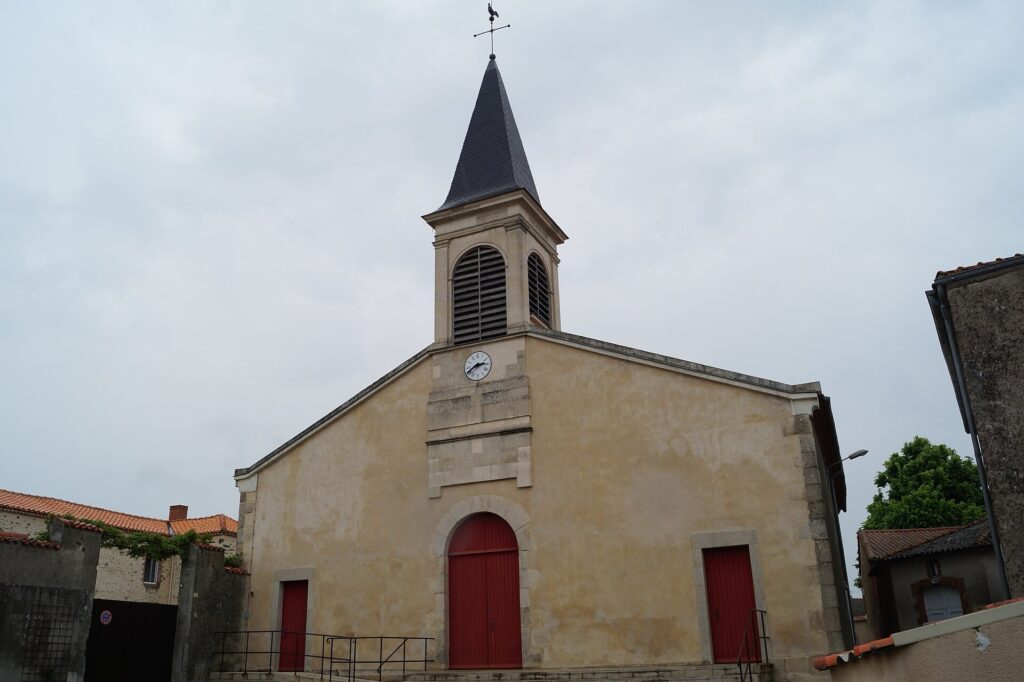
A well-paced rider can gradually allow the effort to rise. The aerodynamic position becomes harder to hold, every interruption to momentum feels more expensive, and corners that seemed straightforward during reconnaissance now arrive through the haze of sustained fatigue.
There is no abrupt transition between pacing and survival. One slowly becomes the other.
Ahead lies Mouchamps, where the quiet rural landscape contains one of the most unusual graves in modern French political history.
–10 km | Mouchamps and Georges Clemenceau
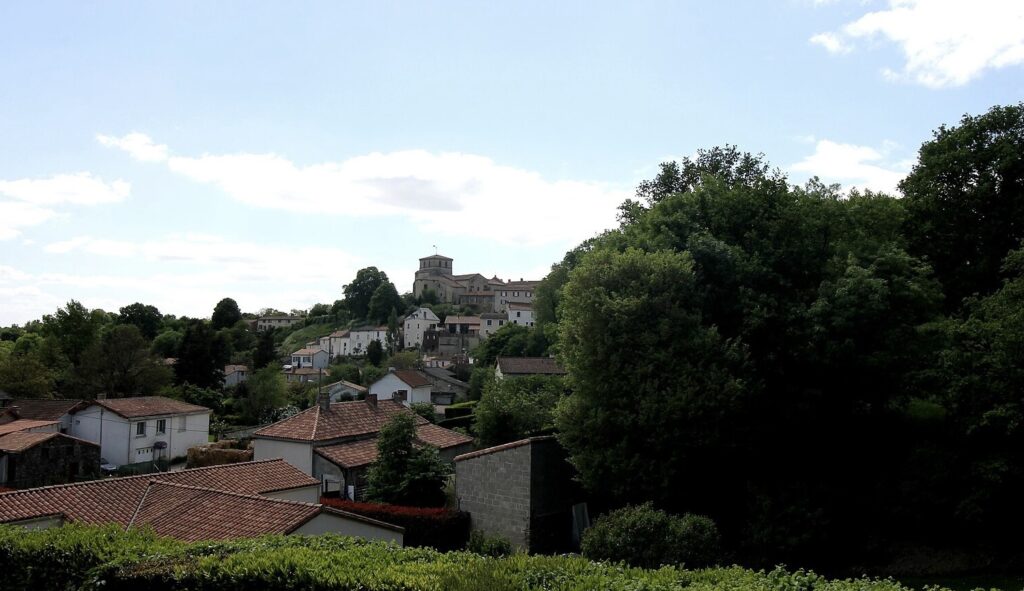
Georges Clemenceau could have been buried among the monuments of Paris. Instead, he lies in a wood outside Mouchamps.
Born in the Vendée in 1841, Clemenceau became one of the dominant political figures of the French Third Republic. A physician by training, he moved into journalism and politics and developed a reputation for combative republicanism that eventually produced his enduring nickname, “the Tiger.”
His career stretched across some of the most turbulent decades in modern French history. He opposed aspects of French colonial expansion when imperial policy enjoyed broad political support, became deeply involved in the Dreyfus affair and served as president of the Council, effectively prime minister, from 1906 to 1909.
His defining return to power came in 1917, after France had endured three years of the First World War. Enormous casualties, military mutinies and political exhaustion had placed the country under extreme strain when Clemenceau again became head of government. His determination to continue the war until victory made him one of the central political figures of its final year.
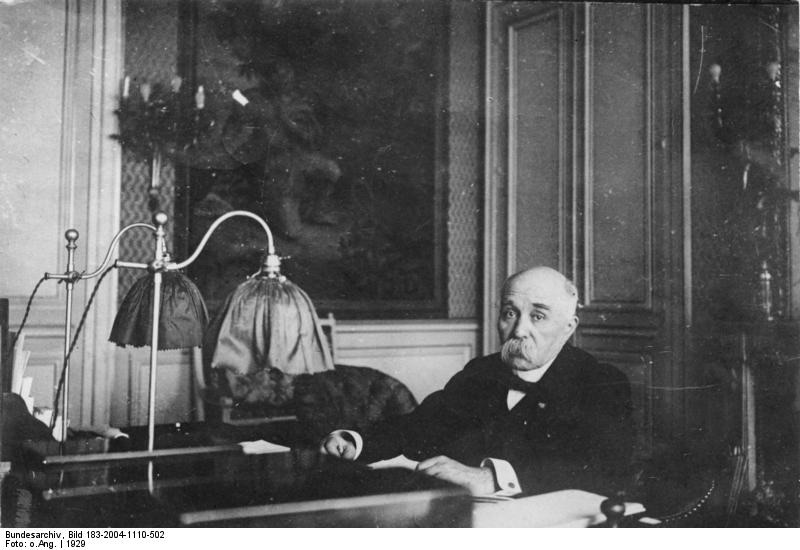
After the Armistice of 1918, he represented France at the Paris Peace Conference and became one of the principal figures involved in negotiations leading to the Treaty of Versailles. A career conducted at the highest levels of the French state might have suggested an equally monumental burial.
Clemenceau chose something very different.
His family had connections with the Colombier estate at Mouchamps, where his father Benjamin had been buried in a small wood in 1897. Georges wanted to lie beside him and left unusually clear instructions about the simplicity of his burial.
When Clemenceau died in Paris on 24 November 1929, his body was brought back to the Vendée. He was buried at the Colombier the following day without the elaborate state ceremony that might have been expected for the wartime leader of France. Father and son lie beside one another beneath the trees, accompanied by a stone sculpture of Minerva by François Sicard rather than a monumental mausoleum.
The restraint of the site is part of its power. One of the most forceful political personalities of the Third Republic rests in the rural Vendée, surrounded by woodland and agricultural country rather than the ceremonial architecture of the capital.
The Chrono des Nations passes through the same commune with roughly ten kilometres remaining. At this point the rider’s attention has contracted to a much smaller world, as the careful distribution of effort that began in Les Herbiers finally gives way to the need to spend whatever remains.
–8 km | The Final Effort
A well-ridden time trial can look deceptively calm from the roadside. The upper body remains relatively still, cadence appears controlled and the bicycle follows an efficient line through the road, even when the rider inside that position is approaching the limit of what can be sustained.
The final kilometres expose whether the earlier calculations were correct.
A rider who has judged the course well can now increase the effort because the consequences of going beyond a sustainable level will arrive only after the finish. On the remaining rises, power can climb; on faster roads, the priority remains preserving aerodynamic efficiency and carrying speed. Every unnecessary touch of the brakes or movement out of position becomes more frustrating because there are fewer kilometres left over which to recover the loss.
Modern time trialling has turned that pursuit of small advantages into an unusually sophisticated discipline. Riders and teams study aerodynamic drag, skinsuits, helmets, extension positions, tyre pressures, rolling resistance and the precise characteristics of the course. Yet none of those gains exists independently of the athlete. An aerodynamically aggressive position is valuable only if the rider can breathe, produce power and maintain it under fatigue.
By the time Les Herbiers begins to reappear, the theoretical work of engineers, coaches and reconnaissance has been reduced to something much more immediate: whether the rider can continue holding the position and producing the required effort for a few more minutes.
The modern equipment belongs to the twenty-first century, but the fundamental test is much older.
That history is carried in the race’s name.
From the Grand Prix des Nations to the Chrono des Nations
The name “des Nations” carries weight in cycling because Les Herbiers inherited it rather than invented it.
For much of the twentieth century, the Grand Prix des Nations was one of the most prestigious individual time trials in professional cycling. Created in 1932, it became a reference point for the discipline decades before the road world championships introduced an individual time trial for elite men.
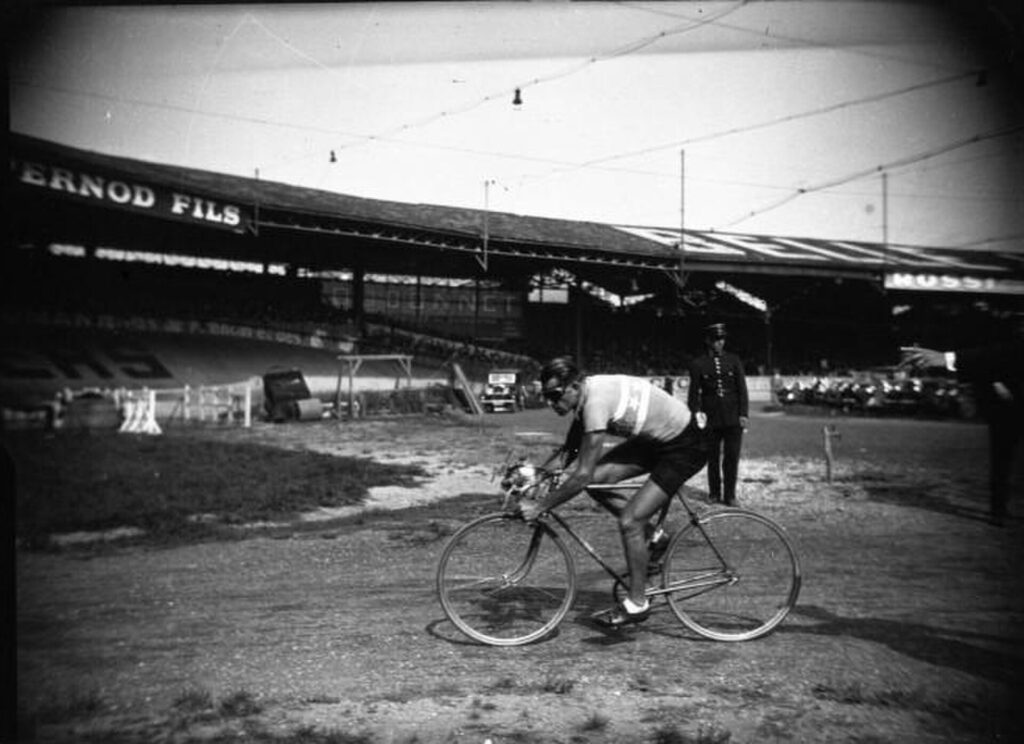
Its distances were often formidable by modern standards. Winning required not merely aerodynamic speed but the ability to sustain an individual effort over courses long enough to resemble abbreviated road stages rather than the forty-to-fifty-kilometre tests familiar today.
No rider became more closely associated with the event than Jacques Anquetil.
Anquetil won the Grand Prix des Nations nine times between 1953 and 1966. His first victory came when he was only nineteen, before he had won a Tour de France, and helped announce the arrival of a rider whose extraordinary ability against the clock would become central to his career.
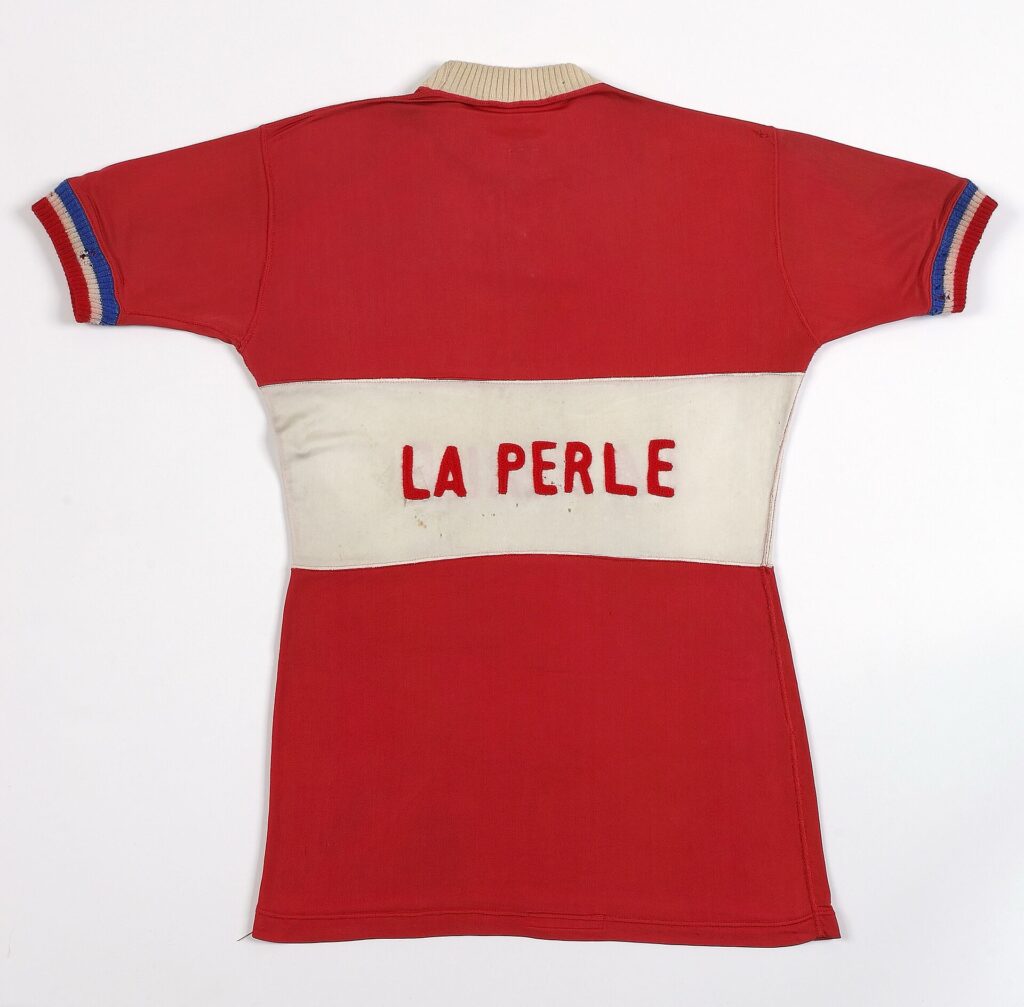
His smooth pedalling action and precise regulation of sustained effort suited the discipline perfectly. Time-trial dominance became so fundamental to his identity that the nickname “Monsieur Chrono” followed him through a career that eventually included five victories in the Tour de France.
The Grand Prix des Nations passed through different eras and organisers before disappearing after 2004. Two years later, the established Chrono des Herbiers adopted the Chrono des Nations name.
The continuity should not be exaggerated. The modern race at Les Herbiers is not literally the same event that Anquetil dominated, and its local history began independently in 1982. What survives is a deliberate inheritance of the great French tradition of the individual time trial.
That distinction makes the modern event more interesting rather than less. Les Herbiers had already spent more than two decades developing its own time-trial culture before taking the Nations name. It introduced a women’s event in 1987, an under-23 category in 1993 and junior racing later in the decade. In 1995, the town even hosted the first French national individual time-trial championship, won by Thierry Marie.
By 2006, the Vendée did not need an old name to teach it how to organise a race against the clock. The name instead connected an established local tradition with a much older national one. That connection remains visible every October.
Les Herbiers and the Specialists
Time trialling has changed dramatically since Anquetil’s era, although the fundamental problem remains recognisable: one rider must cover a fixed distance alone in less time than everyone else.
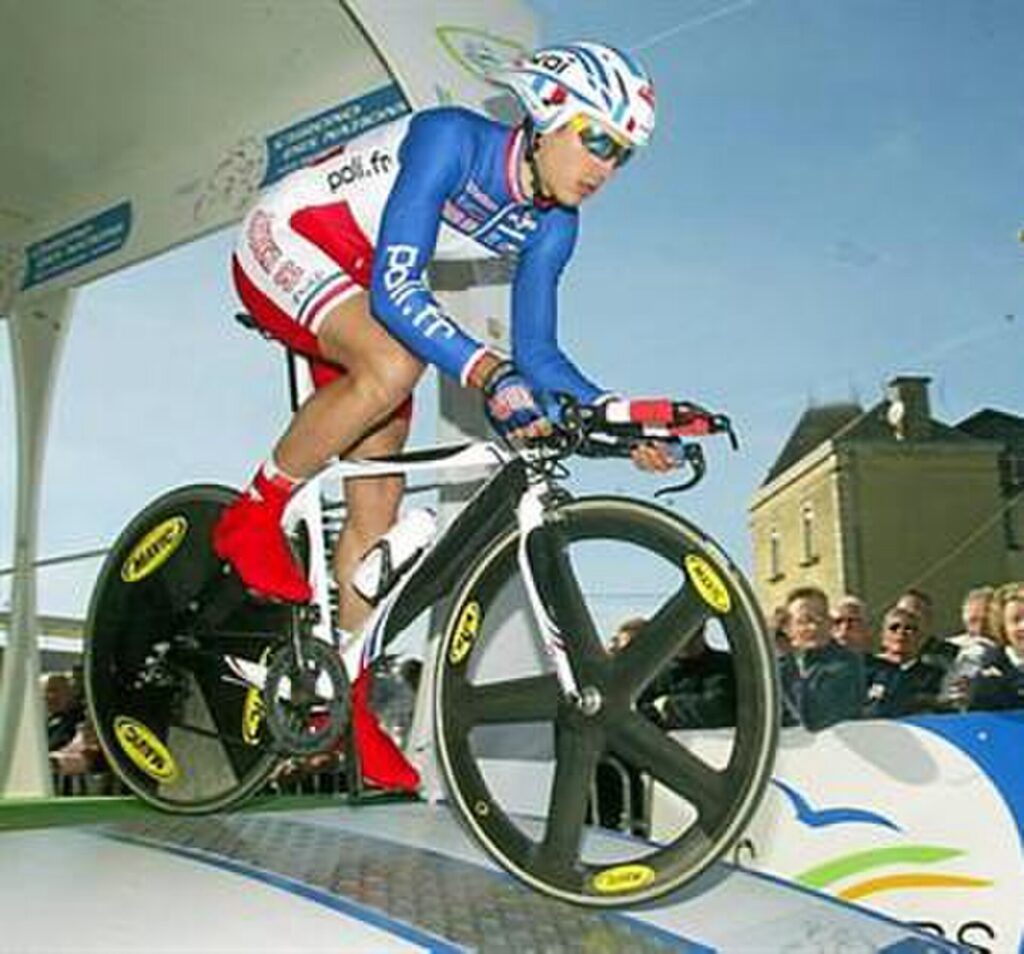
Everything surrounding that problem has become more sophisticated. Modern specialists spend enormous effort refining aerodynamics in wind tunnels and velodromes. Skinsuits are engineered around airflow, helmets interact with individual riding positions, and tyre pressure, wheel choice and drivetrain efficiency are analysed at levels that would have been unimaginable during the great age of the Grand Prix des Nations.
Les Herbiers has consequently become a meeting place for riders whose careers trace the evolution of the modern discipline. Tony Martin raced here during the era when his immense sustained power made him one of the defining time trialists of the 2010s. Filippo Ganna appeared first as a young rider before becoming an elite world champion against the clock, while Remco Evenepoel won here as a junior before developing into one of the outstanding specialists of his generation.
Joshua Tarling provides perhaps the clearest recent example of the event’s unusual continuity between age categories. He won at Les Herbiers as a junior and later returned to win the elite race, taking another victory in 2025 ahead of Jay Vine and Stefan Küng.
The roads had not fundamentally changed between those appearances, but the rider certainly had. That is one of the quieter pleasures of an event containing categories from youth racing to the professional elite: the same place can record an athlete before the wider cycling world knows the name, then encounter that rider again after world championships, Grand Tours and professional victories have completely altered its significance.
By late afternoon, the elite men are the final riders left to be measured.
FINISH · Les Herbiers
The finish at Les Herbiers provides a very different kind of resolution from a mountain summit or a mass sprint. Riders arrive separately, each bringing an individual contest to an end before the road briefly empties and attention shifts to whoever is still somewhere out in the bocage.
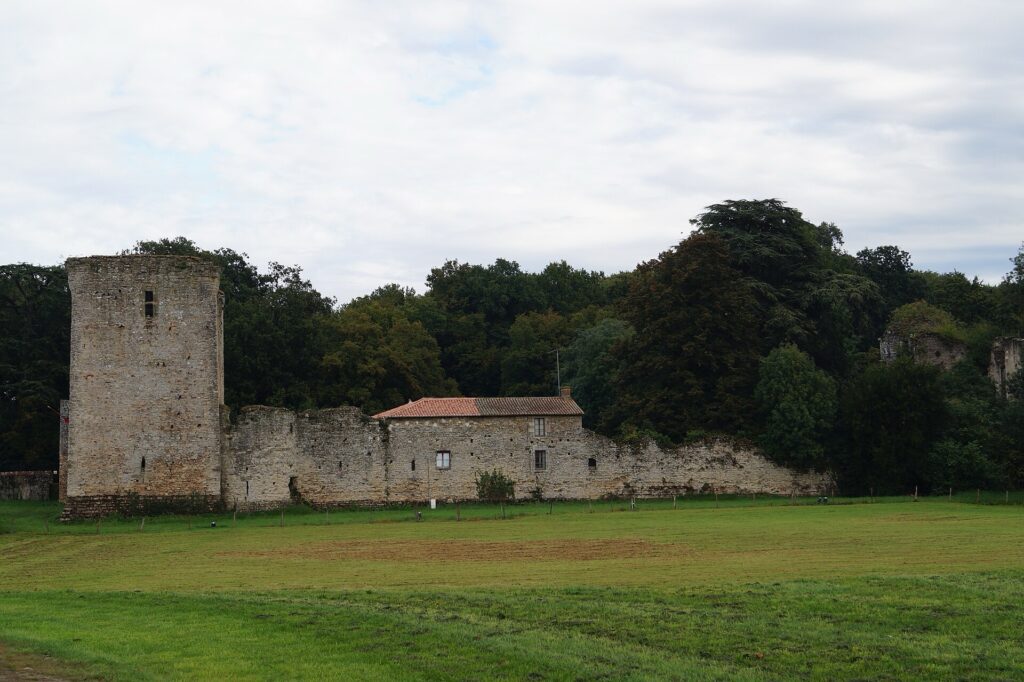
Dozens of races have occupied the same roads during the afternoon without ever physically becoming one race. Their relationships exist through intermediate times, projected standings and the clock waiting at the finish.
The Vendée is particularly suited to that kind of contest because its difficulty rarely announces itself theatrically. There is no Stelvio, Koppenberg or Carrefour de l’Arbre here. The challenge is accumulated through smaller details: a rise ridden slightly too hard, a stretch where the wind changes the cost of speed, a corner that interrupts momentum, or an aerodynamic position that becomes progressively harder to maintain.
Over forty-five kilometres, those details become the race.
The longer history carried by the name extends far beyond these roads. Jacques Anquetil’s nine victories in the old Grand Prix des Nations belong to another event and another era, but they helped establish the individual time trial as something capable of carrying prestige in its own right. Les Herbiers then built a tradition of its own from 1982 onwards before becoming the modern home of that older French idea.
There is something fitting about the European road season reaching this point after months of racing built around collective movement. Teams have controlled breakaways, domestiques have sheltered leaders, lead-out trains have organised sprints and climbers have attacked from groups on the great mountains. At Les Herbiers, most of that disappears.
The final riders leave town individually and pass through the hedged fields of the Vendée with no wheel they are permitted to follow. Mouchamps, the history of the bocage and the villages along the course remain beside them, but during the final kilometres the rider’s world becomes increasingly narrow: breathing, position, the changing road and the knowledge that every second being lost or gained is permanent.
When the rider reaches Les Herbiers again, the landscape has made a complete circle while the clock has done only one thing.
It has kept running.