
Slovenia is a small country built around transitions. The Adriatic world reaches its western edge, the Pannonian Plain approaches from the east, limestone karst occupies much of the south and west, and the Alps rise across the north. Between them, rivers, mountain passes and narrow valleys have channelled people through a territory that spent centuries at the meeting point of larger political and cultural worlds. Germanic, Romance, Slavic and Habsburg influences overlap here without erasing the distinctly Slovenian identity that emerged among them.
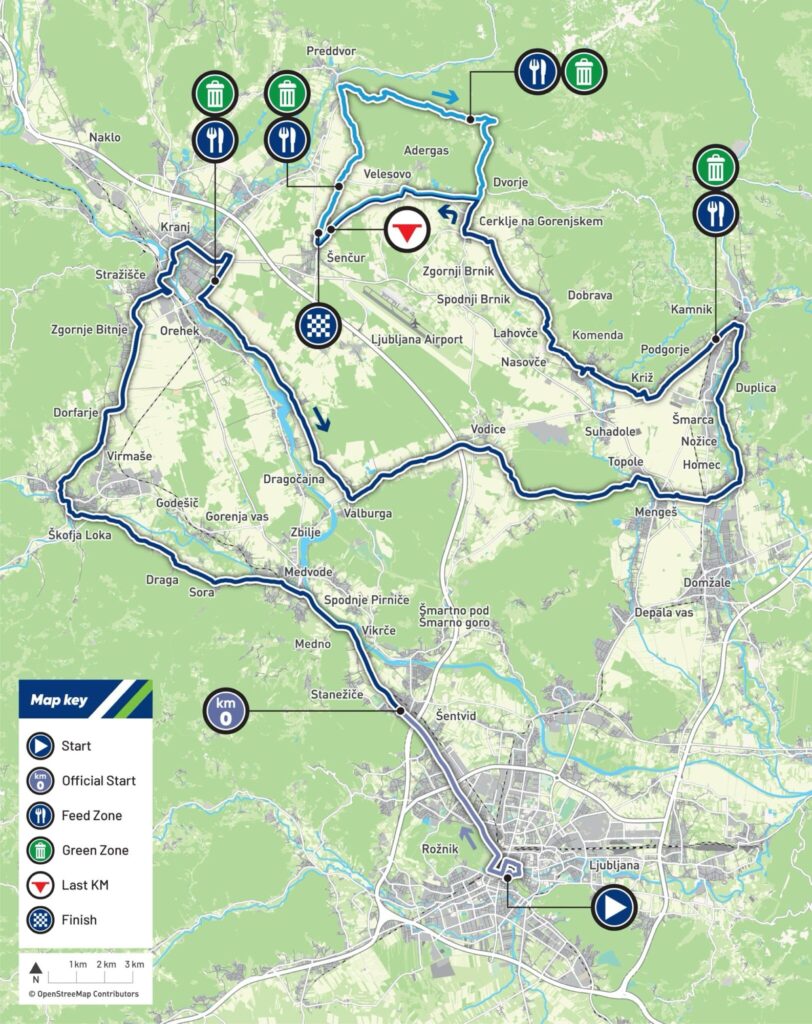
On 4 October 2026, the men’s elite European road championship will cross one of the most revealing parts of that landscape. The 196.3-kilometre race begins ceremonially in Ljubljana before kilometre zero at Šentvid, travels northwest through the Sava basin towards Škofja Loka and Kranj, then turns east across central Slovenia through the country around Mengeš, Kamnik and Komenda. From Cerklje na Gorenjskem, the mountains that have remained on the horizon move directly into the race. The peloton reaches Šenčur and enters a 22.1-kilometre circuit to be completed five times, each lap climbing through Olševek towards Možjanca before crossing the high ground beneath the Kamnik-Savinja Alps.
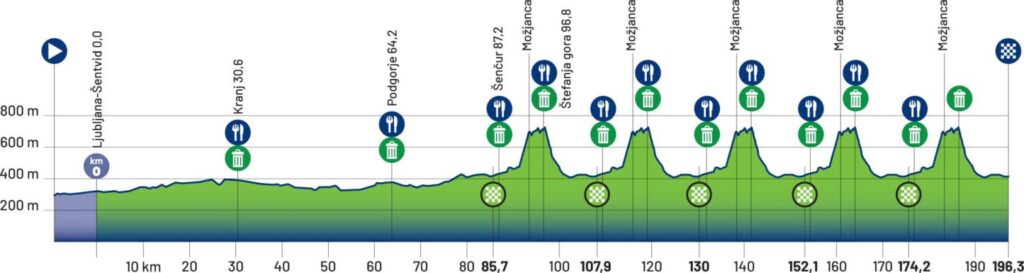
The circuit contains 367 metres of climbing per lap. Its decisive ascent to Možjanca measures 2.1 kilometres at an average of 10.2 percent and reaches 15.8 percent, but the road does not simply crest and descend. Narrow rolling terrain continues towards Štefanja Gora before a technical descent towards the lower station of the Krvavec cable car and a fast return across the valley towards Šenčur. Across five passages, almost the entire difficulty of the championship is concentrated into the final half of the race.
There is another reason this particular European Championship matters. Slovenia is hosting the UEC Road European Championships for the first time, little more than three decades after becoming an independent country and during a period in which Slovenian riders have transformed their country’s position within professional cycling. The championships will be the largest cycling event staged in independent Slovenia, with fourteen races and more than 800 riders expected across the programme.
The road to the European jersey therefore begins in a capital that itself emerged from centuries of political change and finishes beneath mountains that have become deeply connected with modern Slovenian cycling.
–196.3 km | Ljubljana and Šentvid
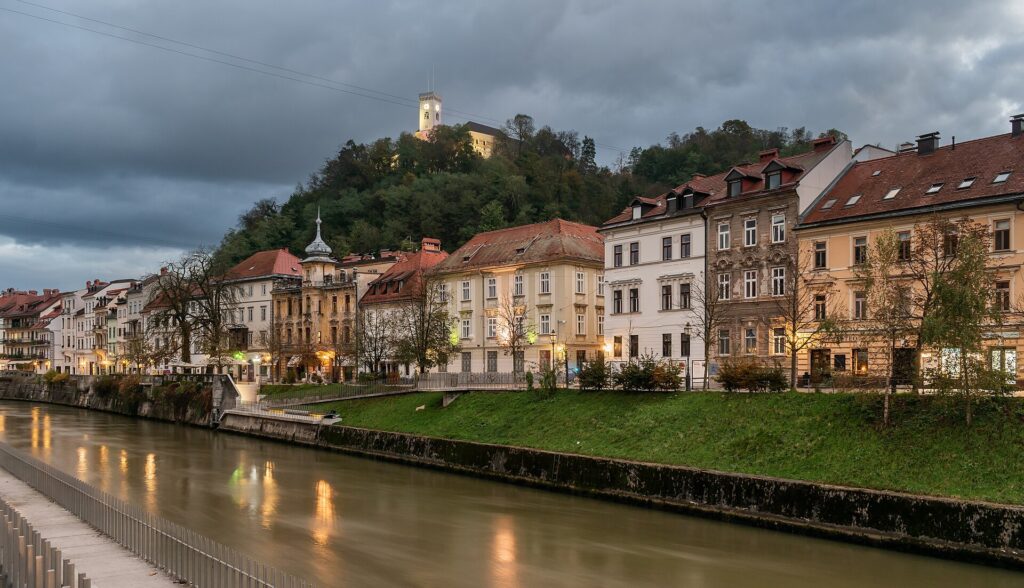
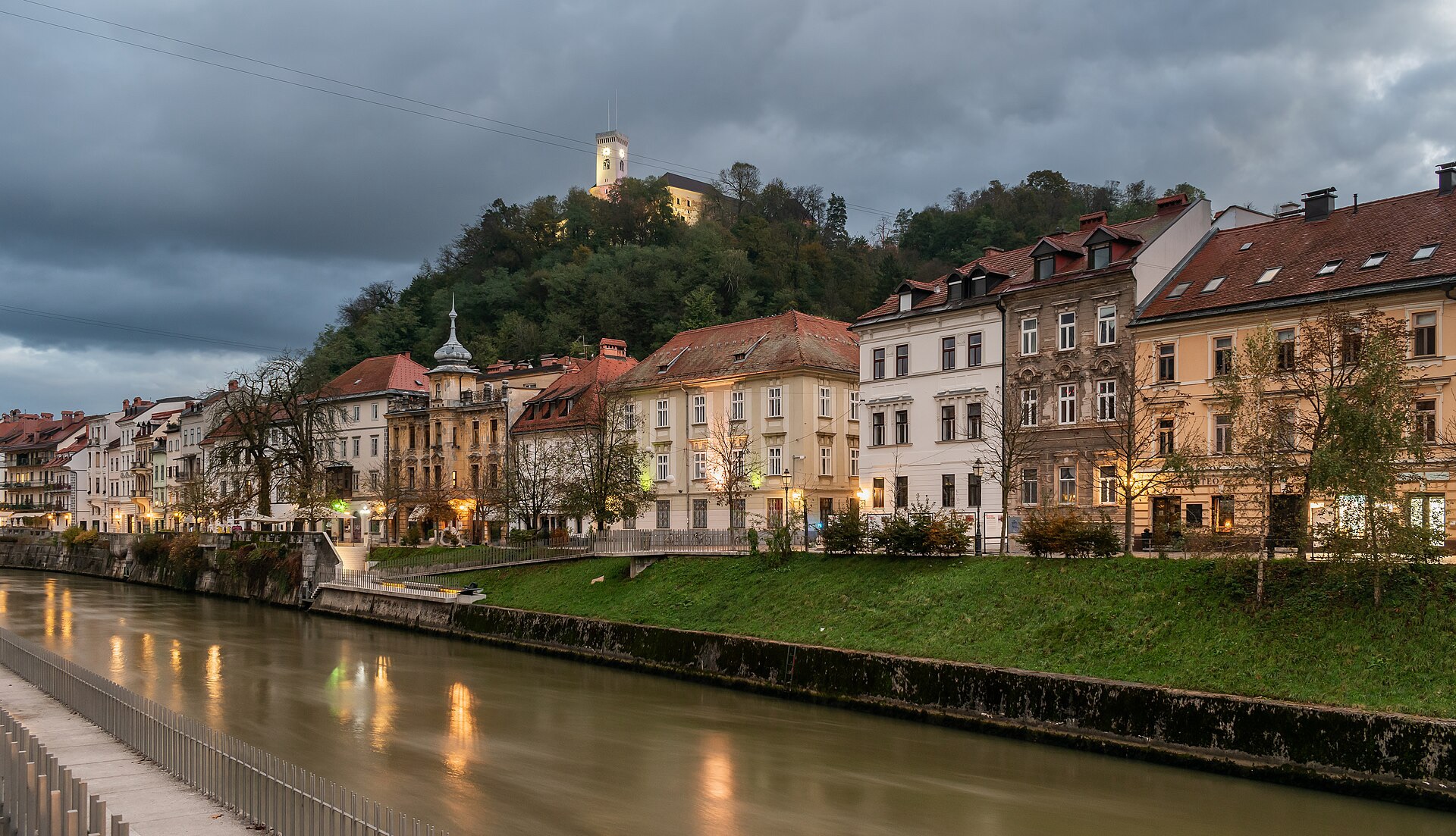
The riders assemble in Kongresni trg, Congress Square, in the centre of Ljubljana. Before racing begins, a nine-kilometre neutralised procession carries the peloton through the capital, including one of its most recognisable landmarks: Tromostovje, the Triple Bridge crossing the Ljubljanica River.
The bridge reveals much about the city around it. A stone bridge already crossed the river here in the nineteenth century, but the Slovenian architect Jože Plečnik transformed the crossing between 1929 and 1932 by adding pedestrian bridges on either side. Rather than replacing what already existed, he turned an ordinary piece of urban infrastructure into a carefully composed public space.
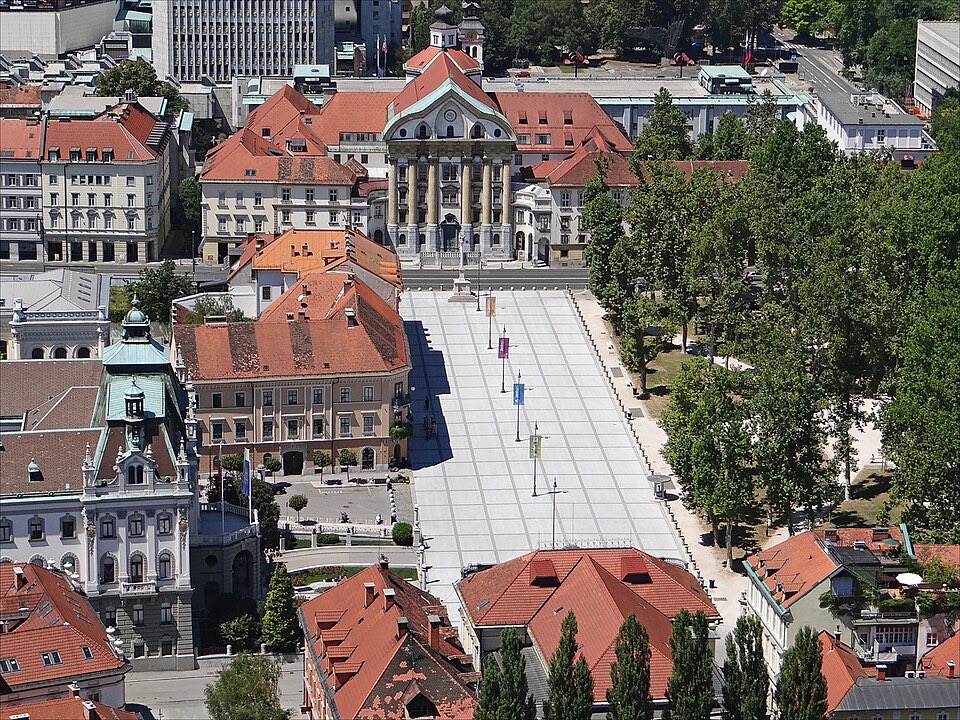
Plečnik did this repeatedly across Ljubljana. Born in the city in 1872, he worked in Vienna and Prague before returning to reshape the capital through bridges, markets, river embankments, squares, columns, libraries and civic spaces. His architecture combined classical forms with highly individual details, producing a city centre that feels coherent without belonging to a single conventional architectural style. His interventions in Ljubljana are now recognised as a UNESCO World Heritage Site.
Beneath that twentieth-century city lies a much older one. Roman Emona developed here in the first century BC and became a fortified settlement with paved streets, sewers, public buildings and defensive walls. Ljubljana later grew under Habsburg rule, became capital of the historical Duchy of Carniola and remained part of the Habsburg world until the collapse of Austria-Hungary in 1918.
The twentieth century repeatedly changed the political meaning of the city. Ljubljana passed into the Kingdom of Serbs, Croats and Slovenes after the First World War, became part of socialist Yugoslavia after the Second, and in 1991 became the capital of an independent Slovenia.
The neutralised peloton leaves these layers behind along the broad roads leading northwest. At Šentvid, historically a settlement outside Ljubljana before the expanding capital absorbed it during the twentieth century, the flag drops. The European Championship begins.
The Sava Corridor
Northwest of Ljubljana, the urban landscape begins to loosen around the Sava, one of southeastern Europe’s great rivers. Rising in the Slovenian Alps from two principal headwaters, the Sava Bohinjka and Sava Dolinka, the river eventually leaves Slovenia, passes through Zagreb and continues across the Balkans before joining the Danube at Belgrade.
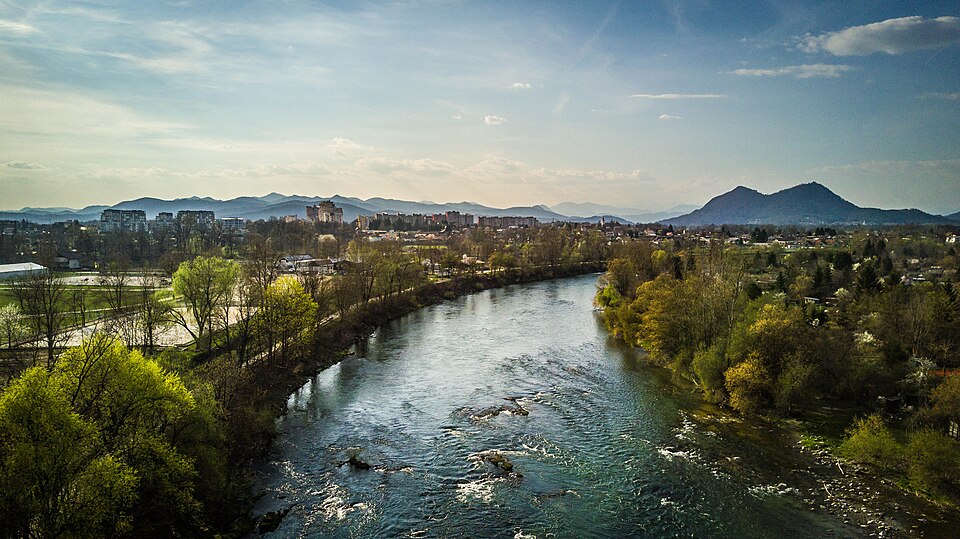
Here, however, the Sava is still relatively young. The mountains from which its waters descend remain close, and settlements occupy a corridor between river terraces, cultivated ground and forested hills. The road through Medno, Medvode and the surrounding villages follows a geography that has channelled movement north and west from Ljubljana for centuries.
Medvode takes its name from its position “between the waters”, close to the confluence of the Sora and Sava rivers. Beyond it, the peloton leaves the direct Sava corridor and follows the Sora towards one of Slovenia’s most important medieval towns.
Škofja Loka | A Medieval Town Between Two Rivers
Škofja Loka occupies the meeting point of the Poljanska Sora and Selška Sora, two rivers descending from valleys cut deeply into the hills west of the town. Its name can be translated approximately as “Bishop’s Meadow”, preserving the unusual circumstances of its development. In 973, Emperor Otto II granted the territory around Loka to the bishops of Freising, whose episcopal principality lay far away in Bavaria.
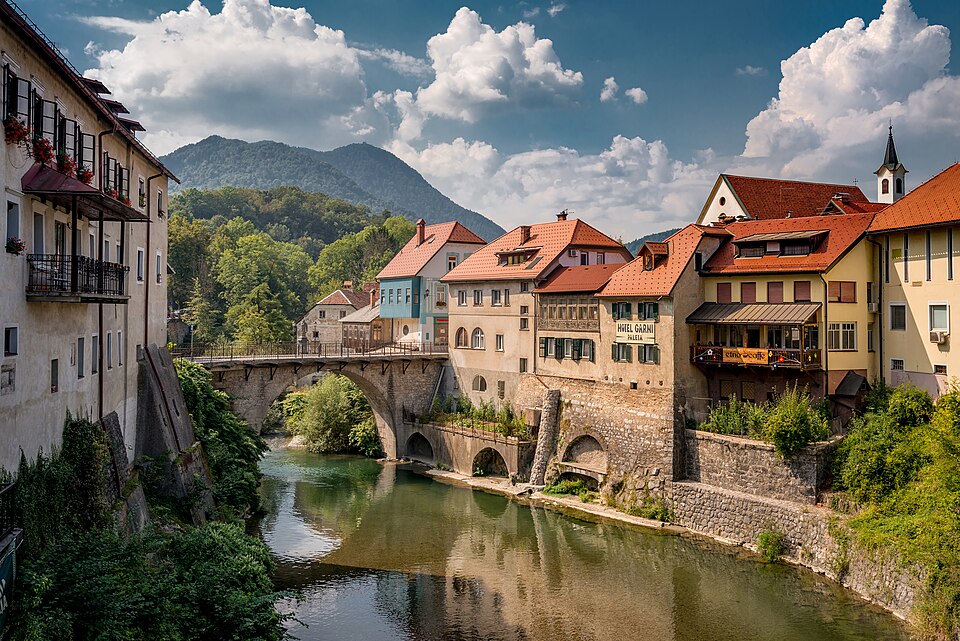
For more than eight centuries, until the secularisation of ecclesiastical territories at the beginning of the nineteenth century, the bishops of Freising remained connected with this Slovenian territory. Their presence helped shape a fortified medieval town beneath a castle overlooking the confluence.
Škofja Loka consequently preserves one of the most coherent historic centres in Slovenia. Mestni trg, the main town square, is lined by coloured façades and merchant houses, while narrow streets descend towards the stone Capuchin Bridge across the Selška Sora. Above them stands Loka Castle, rebuilt after the devastating earthquake of 1511 and today housing a museum devoted to the history and culture of the region.
The town is also associated with one of Slovenia’s most remarkable theatrical traditions. The Škofja Loka Passion, written in 1721 by the Capuchin friar Romuald of Štandrež, is the oldest preserved dramatic text written in Slovene. Conceived as a religious procession performed through the streets, it survives today as a large-scale passion play and has been recognised by UNESCO as intangible cultural heritage.
The race does not remain within this enclosed medieval world. It turns north and east again, leaving the Sora valleys behind as the landscape opens towards the basin around Kranj.
–165.7 km | Kranj
Around thirty kilometres after kilometre zero, the peloton reaches Kranj, the principal urban centre of Upper Carniola, the historical region known in Slovene as Gorenjska. The old town occupies a narrow rocky promontory above the confluence of the Sava and Kokra rivers, a naturally defensive position used by communities long before the medieval city developed.
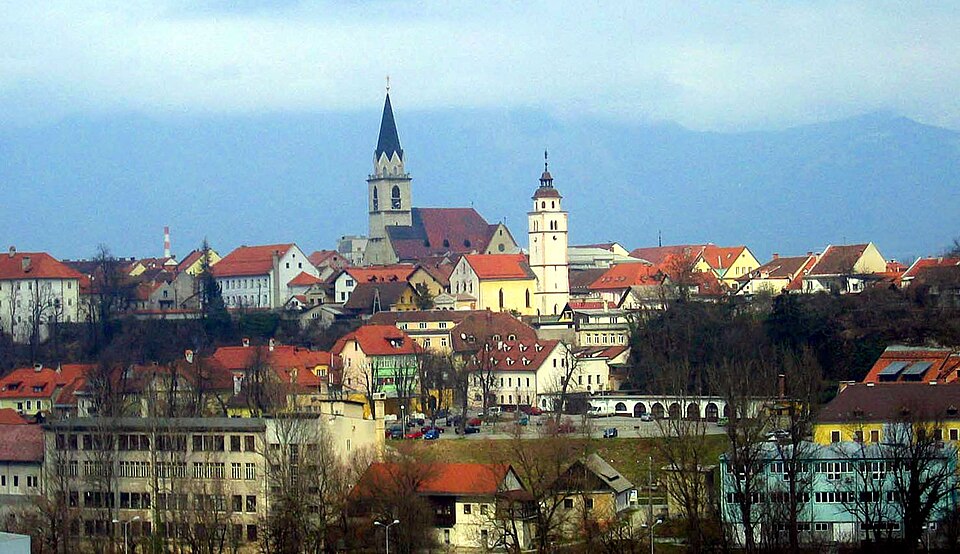
The Kokra has cut a striking canyon directly through the modern urban area. In places the gorge reaches around thirty metres below the streets, creating an unusual situation in which a deep river canyon exists only a short walk from the central squares of a major town. Bridges connect the urban fabric above while the river continues through a wooded corridor below.
Kranj is closely associated with France Prešeren, Slovenia’s national poet. Born in nearby Vrba in 1800, Prešeren spent the final years of his life working as a lawyer in Kranj and died here in 1849. His poetry helped establish Slovene as a language capable of sophisticated literary expression during a period when educated and administrative life in the Habsburg lands often operated in German.
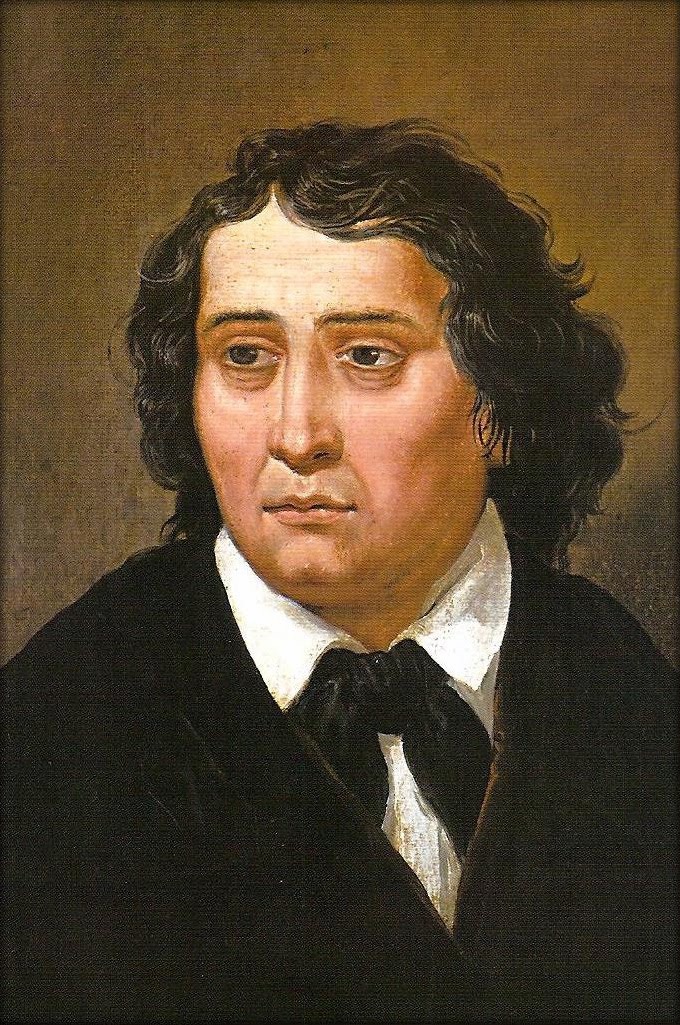
One of his poems, Zdravljica, or “A Toast”, eventually acquired a political life far beyond literature. Its seventh stanza, expressing a hope for peace and friendship among nations, became the text of Slovenia’s national anthem after independence. Prešeren’s image now appears on Slovenian currency, monuments and institutions, but his importance lies principally in the cultural confidence his work gave to a language spoken by a relatively small population inside a much larger empire.
From Kranj, the race turns away from the Alpine foothills temporarily. Instead of continuing north towards the mountains, the course bends southeast across the broad central Slovenian basin.
Across the Upper Carniolan Plain
The kilometres east of Kranj reveal a landscape characteristic of central Slovenia: compact villages separated by cultivated fields, church towers marking settlements from considerable distances and forested hills enclosing a plain that never feels entirely detached from the mountains.
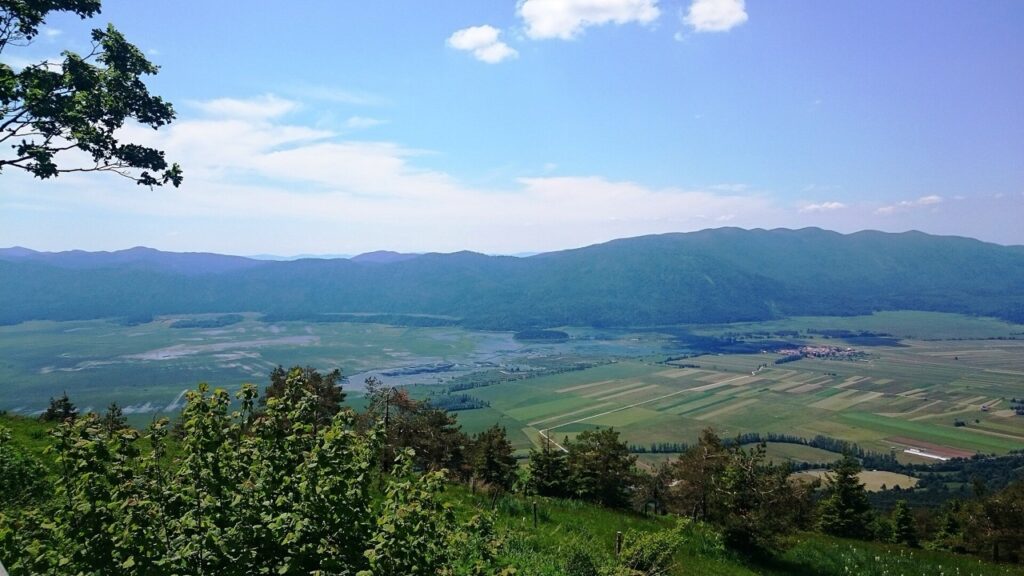
The Julian Alps stand farther west, while the Kamnik-Savinja Alps increasingly dominate the northeastern horizon. Slovenia’s mountains are not merely scenery around this landscape. For centuries they influenced where roads could pass, where communities developed, how water moved through the country and how the historical regions of Carniola connected with neighbouring lands.
The peloton crosses this broad corridor towards the eastern side of the Ljubljana Basin. The road remains comparatively gentle, and almost all of the championship’s serious climbing still lies ahead.
–132.1 km | Podgorje and the Road to Kamnik
By approximately kilometre 64, the race reaches the country west of Kamnik. The mountains now appear much closer. The long wall of the Kamnik-Savinja Alps rises abruptly beyond the settled plain, with limestone summits reaching well above 2,000 metres and forming one of Slovenia’s principal Alpine groups.
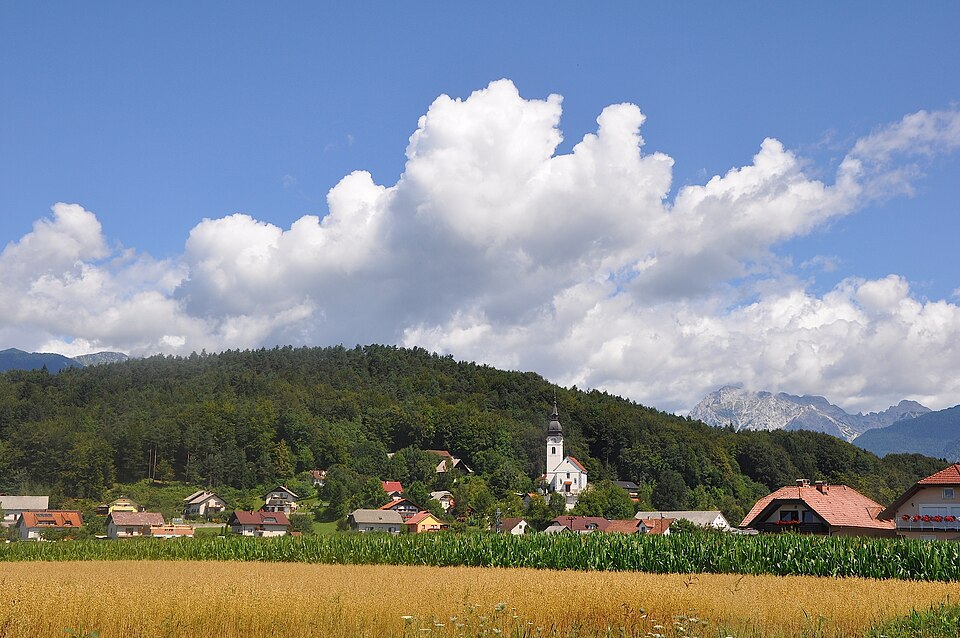
Their highest point, Grintovec, reaches 2,558 metres. Together with peaks such as Kočna, Skuta and Planjava, it forms a rugged skyline north of the race. These mountains belong geologically to the Southern Limestone Alps, built largely from carbonate rocks deposited in ancient seas and later uplifted as the Alpine system developed.
The contrast is immediate: the peloton remains on relatively low roads among fields and villages while a genuine high-mountain landscape rises only a short distance away.
That relationship between plain and Alps defines the next part of the route.
Kamnik | Beneath the Alps
Kamnik developed at the foot of the mountains where routes from the Ljubljana Basin approached passes and valleys leading deeper into the Alpine world. During the Middle Ages it became an important trading centre under the Counts of Andechs, a powerful Bavarian noble family whose possessions extended widely across the eastern Alps and northern Adriatic region.
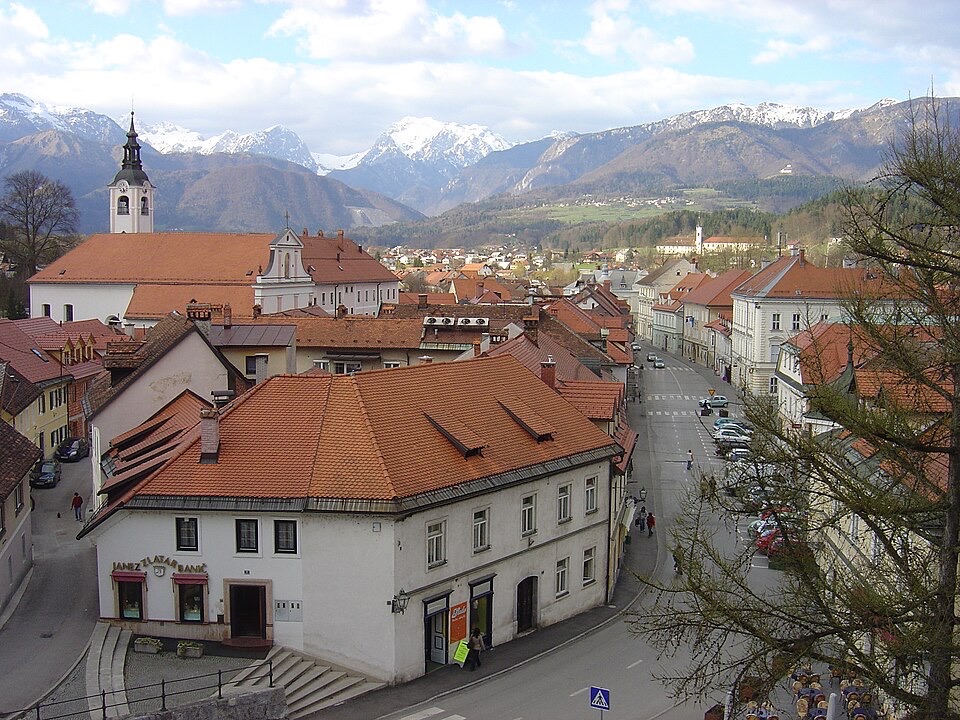
The town’s medieval importance survives in its unusual concentration of castles. Mali grad, the “Little Castle”, occupies a rocky rise in the centre and preserves a Romanesque chapel with two levels, while the ruins of Stari grad, the “Old Castle”, stand high above the town on the opposite side of the valley.
Kamnik later lost some of its commercial importance as regional routes changed, but its setting remained exceptional. The Kamniška Bistrica river descends directly from the Alps, while the mountain valleys above the town became important for forestry, pastoralism and eventually tourism.
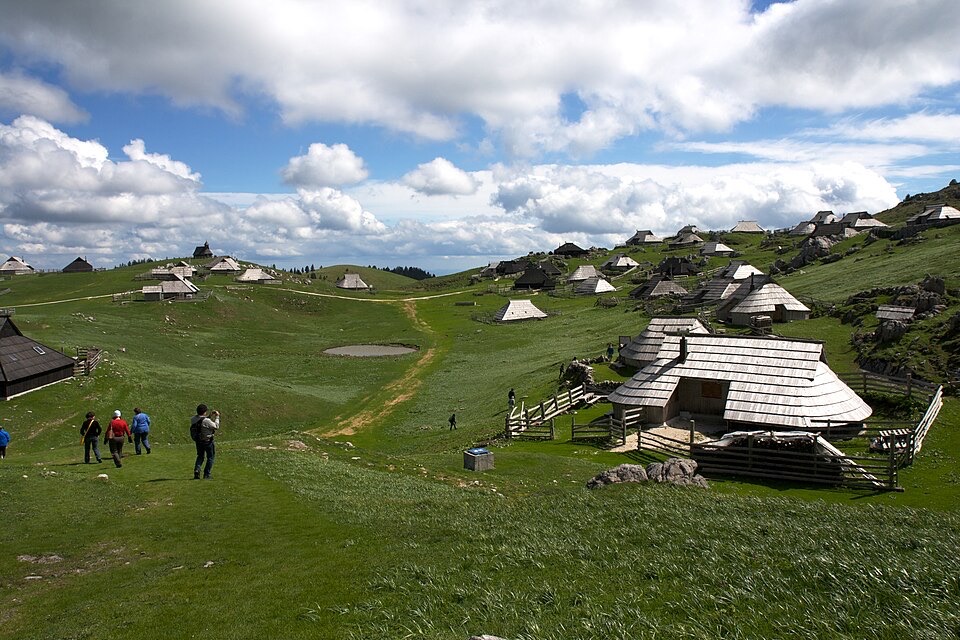
Nearby Velika Planina preserves one of Slovenia’s best-known high-mountain pastoral landscapes. Shepherds have brought cattle onto the plateau during summer for centuries, and its distinctive oval wooden huts, covered by low roofs extending almost to the ground, form a settlement unlike conventional Alpine villages. Modern tourism has changed parts of the plateau, but seasonal pastoralism remains part of its identity.
The European Championship passes below this mountain world rather than climbing into it. From Kamnik, the road turns west and then north again through the villages between the mountains and the Ljubljana Basin.
Komenda and the Slovenian Cycling Landscape
The countryside around Komenda appears modest beside the mountains behind it: fields, villages, churches and low roads spreading across the plain. Yet this small municipality occupies an outsized place in the story of modern Slovenian cycling.
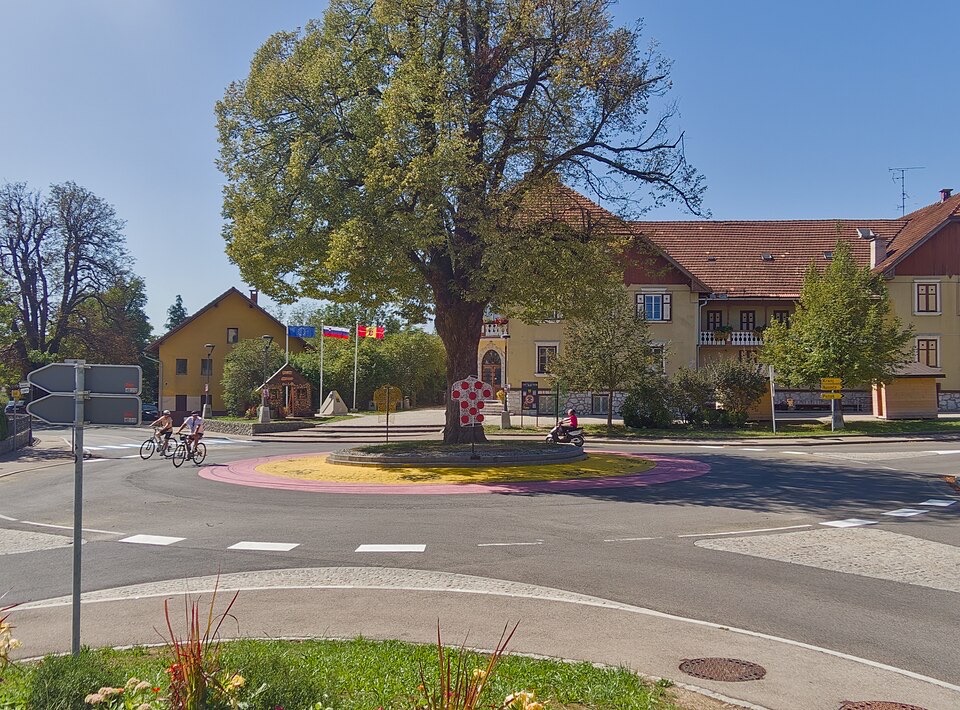
Tadej Pogačar grew up in Komenda and began racing with the Ljubljana-based Rog cycling club as a child. His rise from these roads to victories at the Tour de France, Giro d’Italia, World Championships, Monuments and other major races became part of an extraordinary Slovenian generation that altered the country’s relationship with professional road cycling.
That transformation did not begin with a single rider. Slovenia inherited a long cycling tradition stretching back to the nineteenth century, while clubs, coaches and volunteers sustained the sport through the Yugoslav period and after independence. Riders such as Andrej Hauptman, Jani Brajkovič, Simon Špilak and later Primož Roglič established increasingly visible Slovenian presences in international racing before the generation of the 2020s pushed the country to an entirely different level.
Roglič’s route into cycling was particularly unusual. Born in nearby Trbovlje and raised in Zagorje ob Savi, he initially competed internationally as a ski jumper and only turned seriously towards cycling after leaving that sport. His emergence as a Grand Tour winner, followed by Pogačar’s rise, made a country of little more than two million people one of the central forces in men’s professional cycling.
The 2026 European Championships therefore arrive in Slovenia at a very different moment from the one in which the elite men’s European road title was first introduced only a decade earlier. International cycling has come to roads where the sport is no longer peripheral.
Cerklje na Gorenjskem | Towards the Mountains
North of Komenda, the course approaches Cerklje na Gorenjskem, a small town lying beneath the southern slopes of the Kamnik-Savinja Alps. The landscape begins tightening again as the race moves towards the foothills around Preddvor and the final circuit.
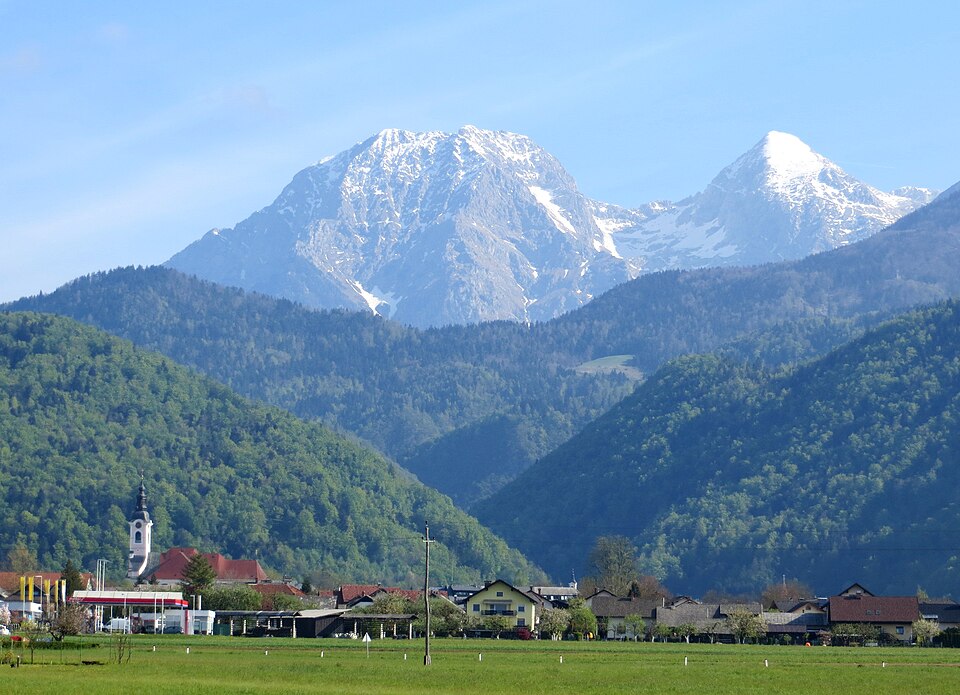
Cerklje sits below Krvavec, a high plateau reaching towards 2,000 metres that has developed into one of Slovenia’s principal ski areas. A cable car rises from the valley north of the race circuit towards the mountain, and the championship descent from Štefanja Gora will later return riders towards its lower station.
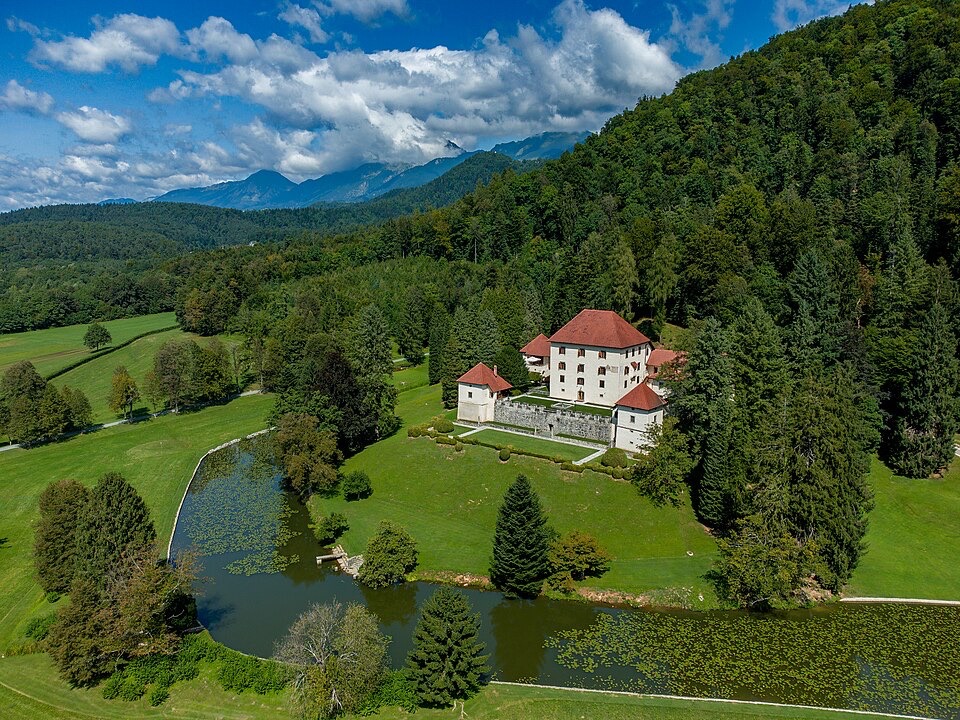
The municipality also contains Strmol Castle, one of the best-preserved castles in Slovenia. Its origins reach back to the Middle Ages, but its twentieth-century history is considerably darker. During the Second World War, its owners Rado and Ksenija Hribar were killed by Partisans in 1944, an episode that became part of Slovenia’s difficult reckoning with wartime violence and the revolutionary conflict accompanying the resistance to occupation.
The castle survived with much of its interior collection intact and today stands as both a historic residence and a reminder that Slovenia’s Second World War cannot be understood simply as a conflict between occupiers and resistance. Italian and German occupation, collaboration, communist-led resistance, civil conflict and post-war reprisals overlapped in ways that remained politically sensitive for decades.
Soon after passing through this landscape, the peloton reaches Šenčur for the first time.
The opening journey is over. The championship now contracts into 22.1 kilometres of roads beneath the Alps.
–110.6 km | The Šenčur Circuit
Five laps remain, each containing 367 metres of climbing. The circuit leaves the relatively open country around Šenčur and heads through Srednja Vas towards Olševek, where the road begins rising gradually towards the northern edge of the basin.
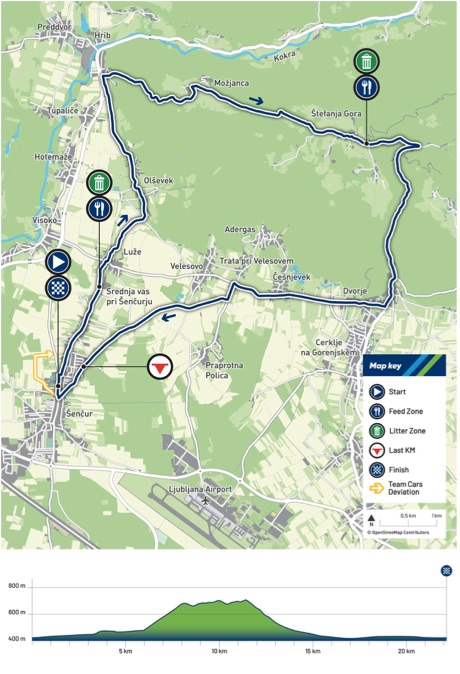
Šenčur itself lies on a fertile plain between Kranj and the Alpine foothills. It is a small settlement compared with Ljubljana or Kranj, but during the championships it becomes the centre of European road cycling: every road race finishes here, while the individual time trials and mixed relays also use the surrounding circuit.
Beyond Šenčur, the mountains increasingly control the view. The Kočna and Grintovec massifs rise beyond Preddvor, while the slopes towards Krvavec close the landscape to the east. The race has travelled for more than eighty kilometres with these mountains appearing and disappearing along the horizon. On the circuit, their foothills finally become part of the road.
The first rise through Olševek is comparatively gradual. It leads towards Tupaliče, close to Preddvor, where the geography changes abruptly. A sharp turn points the riders towards Možjanca.
Možjanca | 2.1 km at 10.2%
Možjanca is not an Alpine pass. The road climbs only 2.1 kilometres, but its average gradient of 10.2 percent and maximum of 15.8 percent make it severe enough to divide an elite championship field. More importantly, the men’s race climbs it five times.
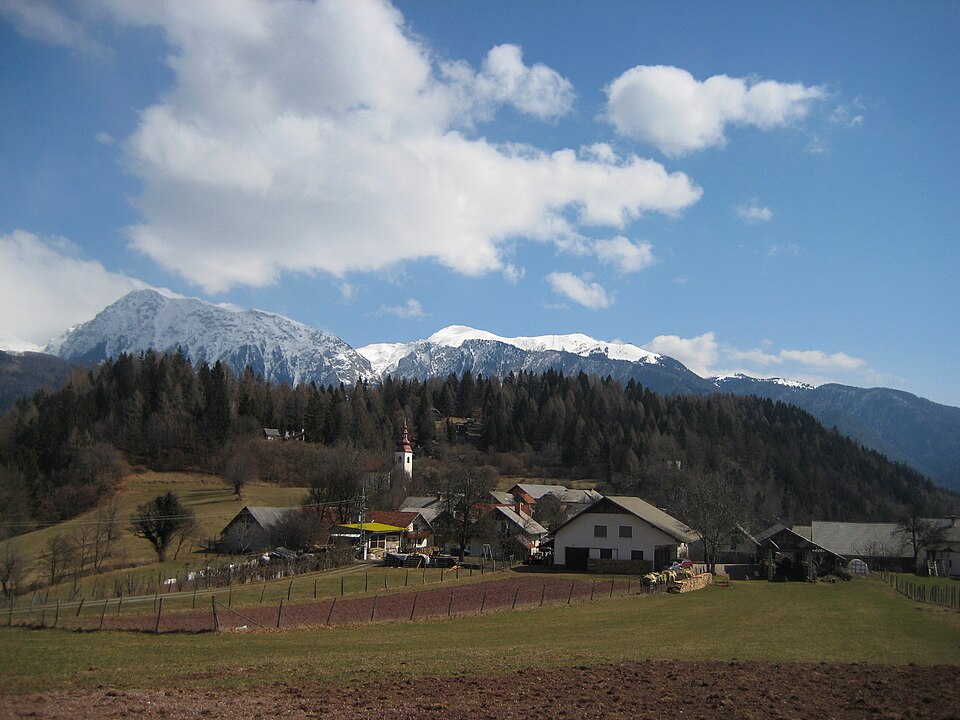
The settlement of Možjanca occupies a wooded terrace above the Kokra valley beneath the high mountains. From the surrounding slopes, views extend across the Kranj plain towards the Škofja Loka hills and south towards the Ljubljana Basin, revealing much of the territory crossed earlier in the race.
The climb concentrates that broad geography into a narrow road. Fields and villages give way to steeper slopes, and the speed that characterised much of the opening eighty kilometres disappears. Each passage adds another 2.1 kilometres at double-digit average gradient, so the fifth ascent arrives after more than ten kilometres of accumulated climbing on this road alone.
Yet reaching Možjanca does not provide the clean summit usually expected from a classified climb. The course continues across narrow, rolling terrain towards Štefanja Gora. Riders who have used everything on the steepest gradients must continue working over the high ground before the descent finally begins.
That feature may matter as much as the gradient itself. The strongest acceleration can create a gap on Možjanca, but the roads beyond determine whether it survives.
Štefanja Gora and Krvavec
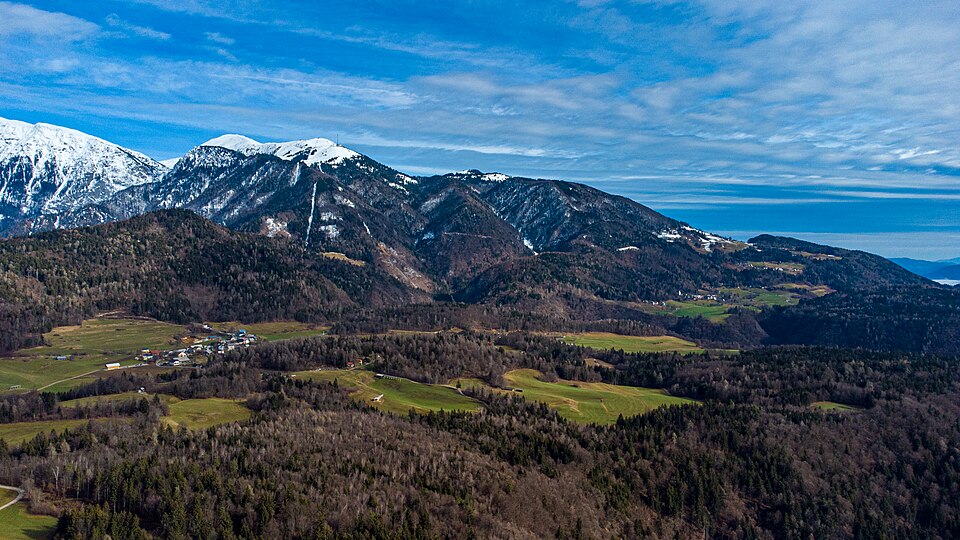
Štefanja Gora occupies the elevated country between Možjanca and the descent towards the Krvavec valley. Forest, scattered houses and open slopes replace the broad agricultural plain below, while the high Alps stand immediately beyond the course.
Krvavec rises above the eastern side of the circuit. Today it is best known as a ski mountain, its slopes served by lifts climbing from the valley towards high pastures and winter pistes. Long before modern skiing, however, these uplands formed part of the seasonal mountain economy characteristic of the Slovenian Alps, where livestock moved between lower settlements and high grazing land according to the seasons.
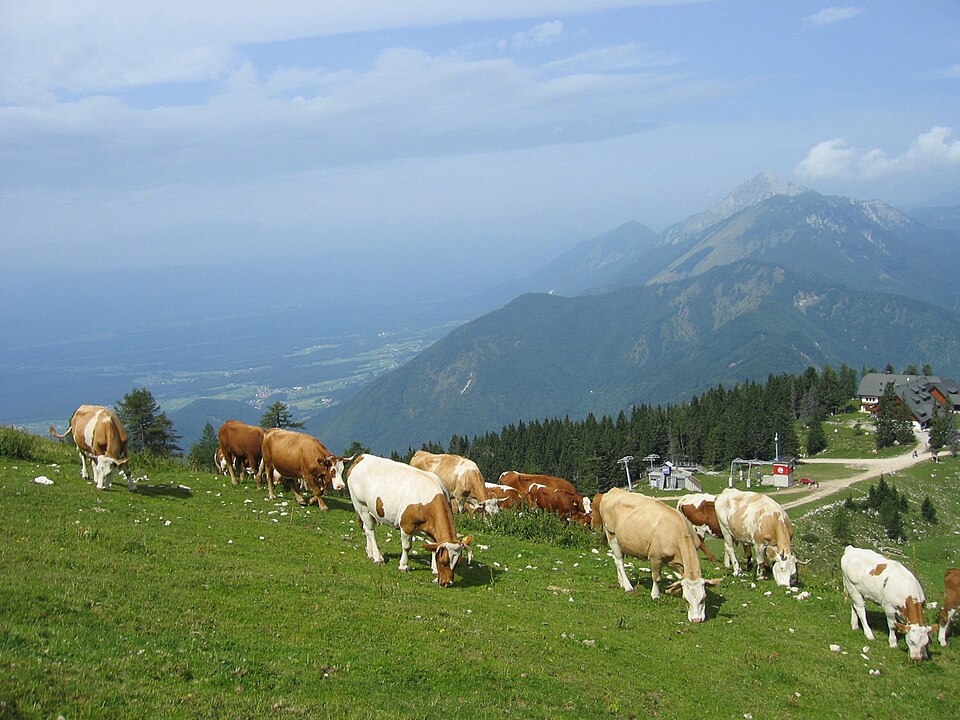
The race never climbs towards the ski area itself. Instead, a technical descent carries the riders towards the lower cable-car station before the road accelerates dramatically across the valley floor. After the slow violence of Možjanca and the rolling ridge beyond it, these kilometres allow organised groups to chase again.
Strmol Castle appears within the wider landscape before the course turns back towards Šenčur. Just over seven kilometres remain from this area to the completion of each circuit.
Then the entire sequence begins again. Five passages will take the men’s elite race from a relatively intact peloton into the group from which the European champion will emerge.
The European Championship Jersey
The elite men’s European road championship is considerably younger than the roads on which it is being contested. European championships existed for younger categories earlier, but the elite men’s road race was introduced only in 2016.
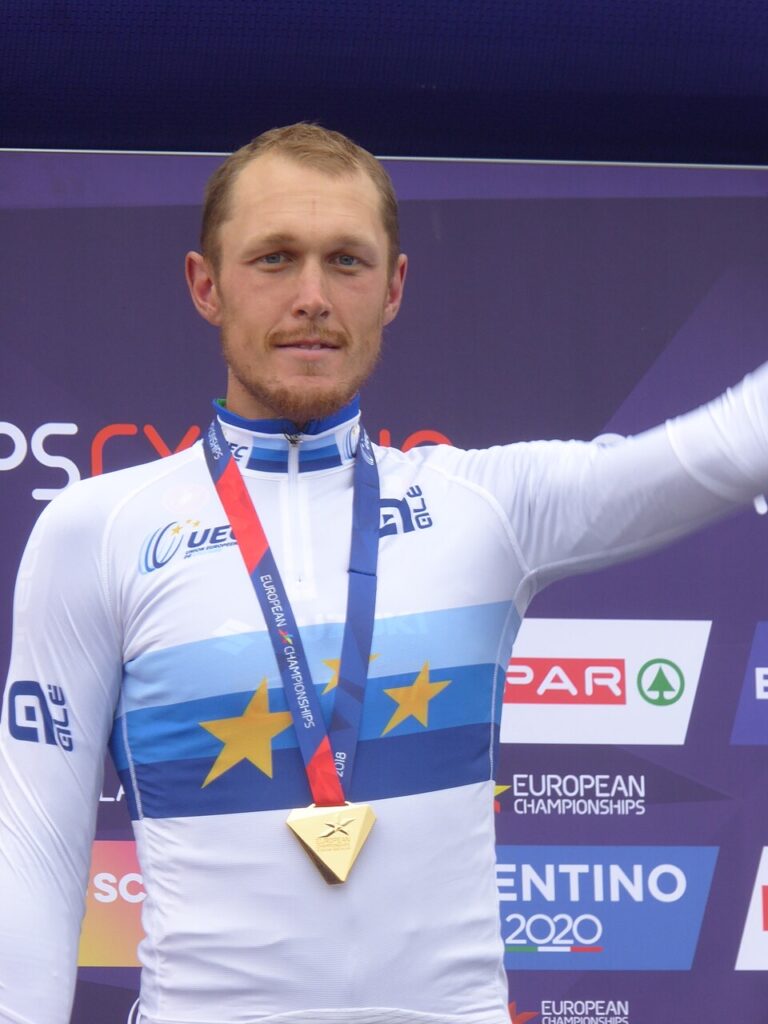
Peter Sagan became its first champion at Plumelec in Brittany, arriving in France already wearing the rainbow jersey after winning the 2015 World Championship in Richmond. He attacked from a reduced group on the Côte de Cadoudal and crossed the line alone, adding the newly created European title to a season in which his rainbow bands had already made him one of the most recognisable riders in the peloton. For the inaugural champion, the UEC could scarcely have found a more visible rider.
Alexander Kristoff followed in 2017, then Matteo Trentin, Elia Viviani, Giacomo Nizzolo, Sonny Colbrelli, Fabio Jakobsen, Christophe Laporte and Tim Merlier. In only a decade, the European champion’s jersey became a familiar part of the professional peloton. Its white base and horizontal blue bands decorated with yellow stars distinguish the continental champion throughout the following season, much as the rainbow bands identify the world champion.
The championship has also proved unusually adaptable to different types of rider. Flat courses have produced sprint finishes, while hillier editions have favoured classics specialists and attackers. Slovenia pushes the race towards its most selective end. Five ascents of Možjanca place more than 1,800 metres of climbing inside the finishing circuits alone.
The jersey may be relatively young, but the road chosen to award it in 2026 is designed to make the title difficult to acquire.
–22.1 km | The Final Circuit
The bell sends the remaining contenders away from Šenčur for the fifth and final time. Four passages through Olševek, Možjanca, Štefanja Gora and the Krvavec descent are already present in the legs, and there is no longer any reason to preserve strength for another lap.
The road rises gradually through Olševek before approaching Tupaliče. The high wall of the Kamnik-Savinja Alps dominates the northern horizon, but the decisive mountain is the much smaller road immediately ahead. Možjanca begins for the fifth time.
At 10.2 percent average gradient, positioning rapidly gives way to strength. The steepest ramps reach 15.8 percent, severe enough for small gaps to open almost immediately if a rider can no longer follow the acceleration ahead. After more than 170 kilometres and four previous ascents, differences that appeared manageable earlier can become decisive.
The crest still offers no genuine recovery. The narrow road continues across the rolling high ground towards Štefanja Gora, forcing attackers to maintain their effort and chasers to decide immediately whether the gap can be closed. Only then does the technical descent towards Krvavec begin.
Speed replaces gradient. The road drops from the wooded foothills towards the valley, where the remaining kilometres become much faster. A lone leader can exploit the descent, while a small chasing group gains the aerodynamic advantage of cooperation once the terrain opens.
Strmol Castle and the surrounding countryside mark the transition into the final run towards Šenčur. The mountains begin to recede behind the riders. After five circuits, there will be no return to Možjanca.
The European title lies ahead on the plain.
FINISH · Šenčur
Šenčur is a modest place for the finish of a continental championship. It is not a national capital, a monumental historic city or an Alpine resort. Its significance comes instead from its position within the landscape the race has spent almost two hundred kilometres revealing: between Ljubljana and the mountains, between the Sava basin and the Alpine foothills, and within the Upper Carniolan countryside from which much of modern Slovenian cycling has emerged.
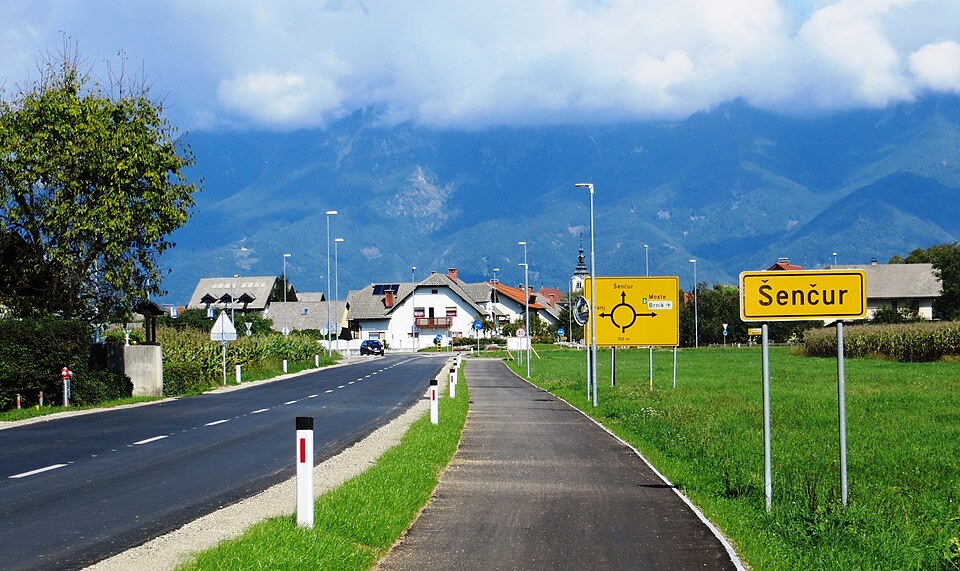
By the time the race reaches it, Ljubljana has disappeared far behind the riders. The enclosed streets of Škofja Loka have given way to river valleys, the rocky promontory of Kranj to open fields, and the towers of Kamnik to the immense limestone wall of the Alps. Those mountains, distant on the horizon during the opening kilometres, eventually close around the race until a small road climbing through Možjanca becomes the place where the championship is decided.
Slovenia’s cycling prominence can appear remarkably sudden from outside the country. Within a few seasons, Roglič and Pogačar accumulated victories that nations with far larger populations had pursued for generations. Yet the championship route reveals a deeper foundation. Cycling existed here long before the victories that made Slovenia globally visible, supported by clubs, local races, coaches and communities across a country where bicycles had been part of organised sporting life since the nineteenth century.
The European Championships arrive at the moment when several comparatively young histories meet. Slovenia has been an independent state only since 1991, the elite men’s European road title exists only since 2016, and the country’s position among the dominant nations of professional cycling is more recent still. None of those histories is particularly old by European standards. The landscape surrounding them is.
The peloton leaves a Roman and Habsburg capital, follows rivers draining the Alps and eventually reaches the mountains themselves, repeating a steep road above Šenčur until the race has been reduced to the riders capable of surviving it. After 196.3 kilometres and five ascents of Možjanca, one of them crosses the line wearing a national jersey.
He leaves it as European champion.