
Bergamo → Como · 239 km · Saturday, 10 October 2026 · UCI WorldTour · Monument
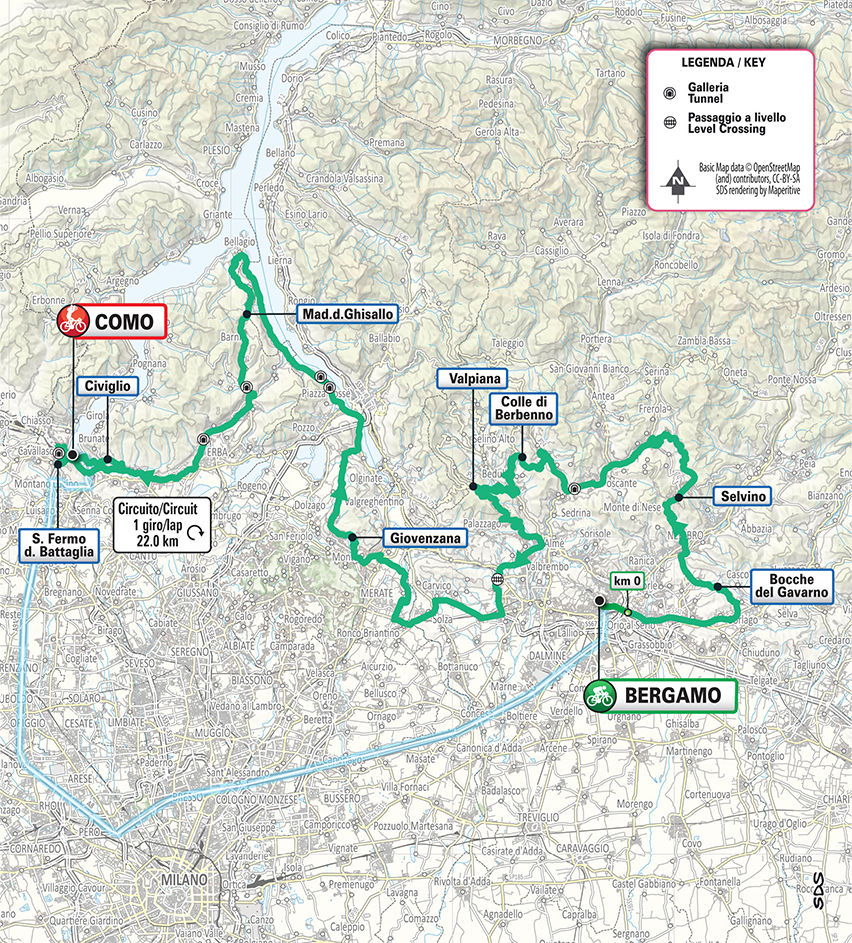
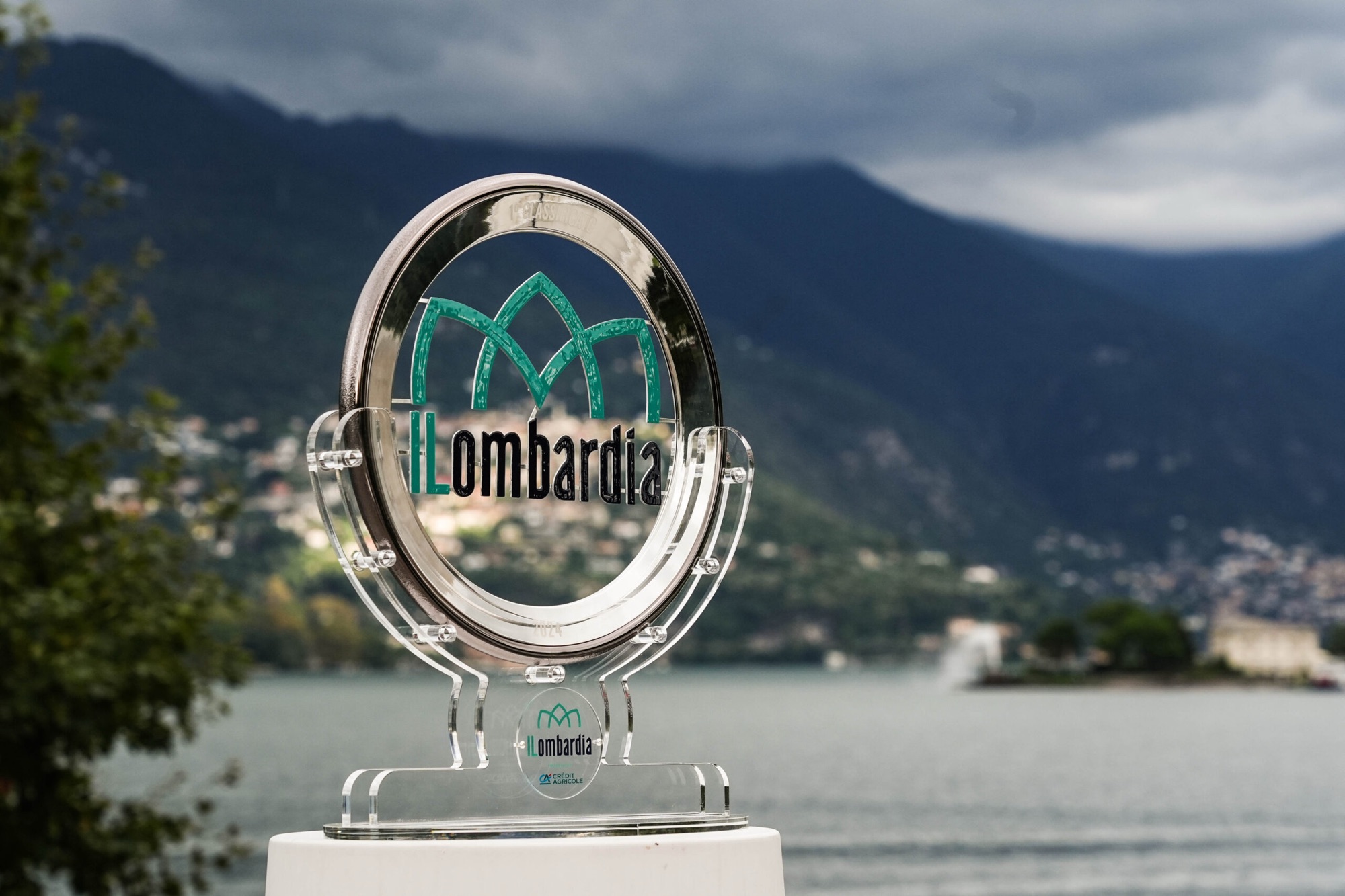
Il Lombardia reaches its 120th edition in 2026, travelling from Bergamo to Como across 239 kilometres and approximately 4,600 metres of climbing. Nine ascents carry the race through the Bergamasque Prealps, the hills of Brianza and the mountains surrounding Lake Como before a final circuit above the city. It is the last of cycling’s five Monuments and the only one whose identity is inseparable from the end of the European season, the race long known as the Classica delle Foglie Morte, the Classic of the Falling Leaves.
Yet Lombardia is unusual even among the Monuments because there is no single road that defines it. Its geography moves. Bergamo, Como and Milan have all played different roles during its history; climbs disappear and return; the direction across Lombardy changes. What survives those alterations is the meeting between the race and the southern edge of the Alps, where towns, lakes and valleys leave almost no room for a straightforward road across the region.
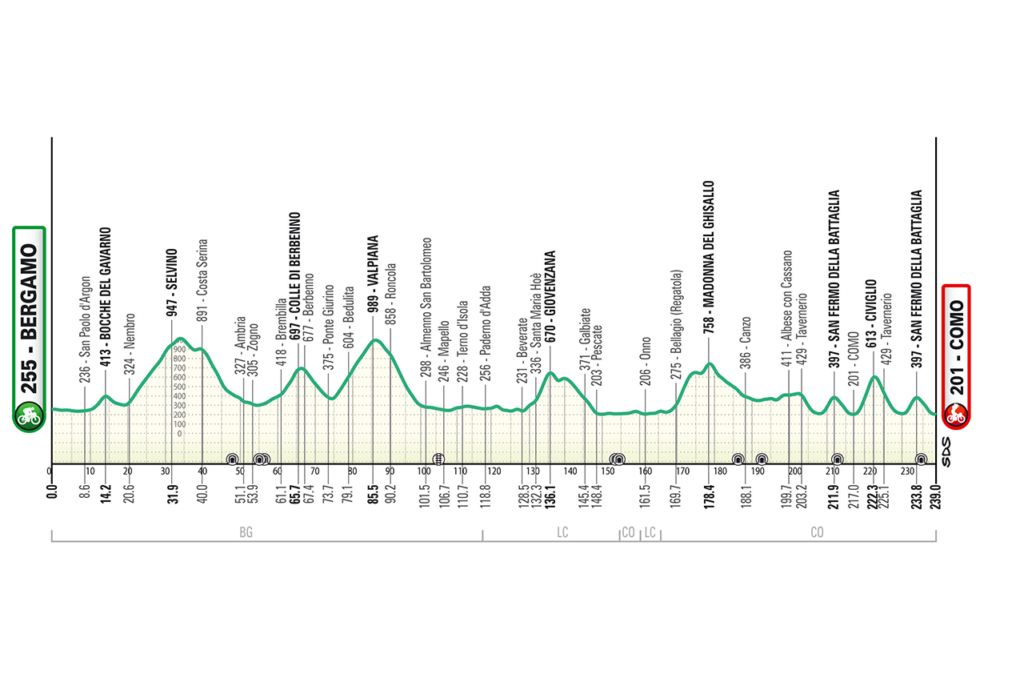
The 2026 route makes particularly good use of that geography. From Bergamo it enters Val Seriana, the valley of the Serio River, and immediately begins accumulating climbs around the Bergamasque Prealps: Colle dei Pasta, Selvino, Colle di Berbenno and Valpiana. The road then crosses Brianza, the densely settled hill country between Milan and the Alpine lakes, over the Giovenzana side of Colle Brianza before descending to Lecco. Lake Como carries the race north to Bellagio and the Madonna del Ghisallo. From there it turns towards Como and a single 22-kilometre finishing circuit containing two passages over San Fermo della Battaglia with Civiglio between them.

For a race that has existed since 1905, the route also passes through places that explain much of the world from which Italian cycling emerged: industrial valleys, mountain roads, Catholic pilgrimage, small towns, the literature of Alessandro Manzoni and the landscapes of Italian unification. At the Ghisallo, the history of the country and the history of the bicycle finally become almost impossible to separate.
START · Bergamo · Between Venice and the Alps
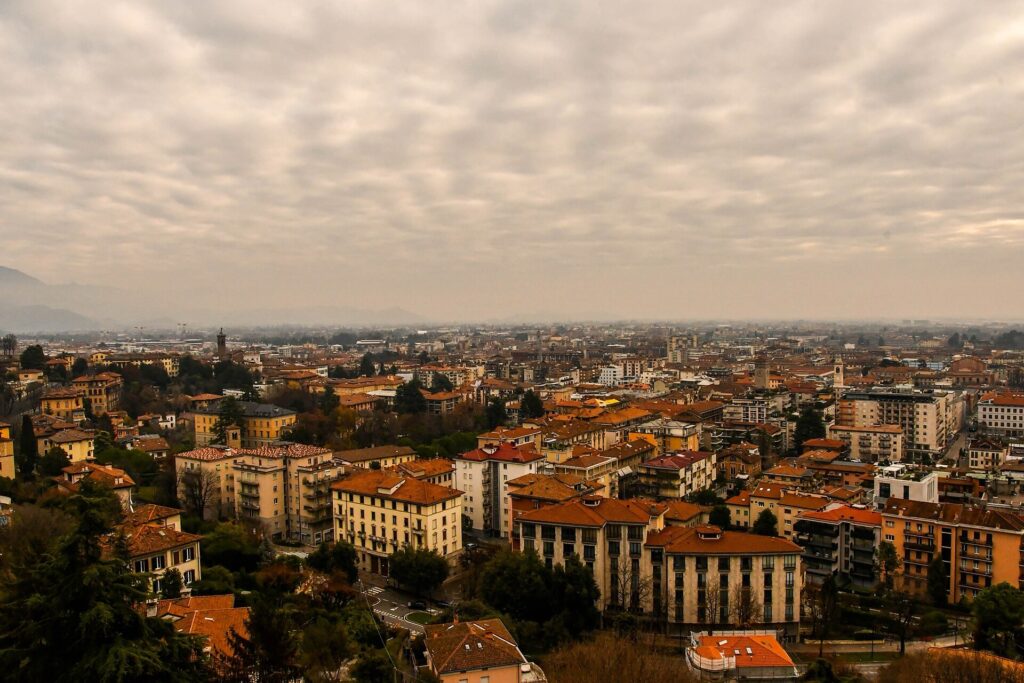
A panoramic view of Bergamo and its historic hilltop Città Alta in Lombardy. Photo by Asif Masimov, licensed under CC BY-SA 3.0, via Wikimedia Commons
Bergamo stands where the Lombard plain meets the first foothills of the Alps. Its most immediately recognisable feature is the division between Città Bassa, the lower modern city, and Città Alta, the older settlement occupying the hill above it.
The upper city is enclosed by more than five kilometres of fortifications constructed between 1561 and 1588 by the Republic of Venice, the maritime and commercial state that controlled Bergamo for more than three centuries. Bergamo stood near the western edge of Venetian territory, far from Venice itself and close to the competing political sphere of Milan, giving the fortified city strategic importance on the republic’s mainland frontier. The walls now form part of UNESCO’s transnational site dedicated to Venetian defensive works.
Inside them, the medieval street plan survives around Piazza Vecchia, the historic civic centre. Nearby stand the Palazzo della Ragione, the Basilica of Santa Maria Maggiore and the Colleoni Chapel, the elaborate Renaissance mausoleum built for Bartolomeo Colleoni, a 15th-century mercenary commander who served Venice. Italian condottieri such as Colleoni commanded professional armies hired by competing states during the fragmented political world of Renaissance Italy, accumulating wealth and influence that could rival that of the rulers who employed them.
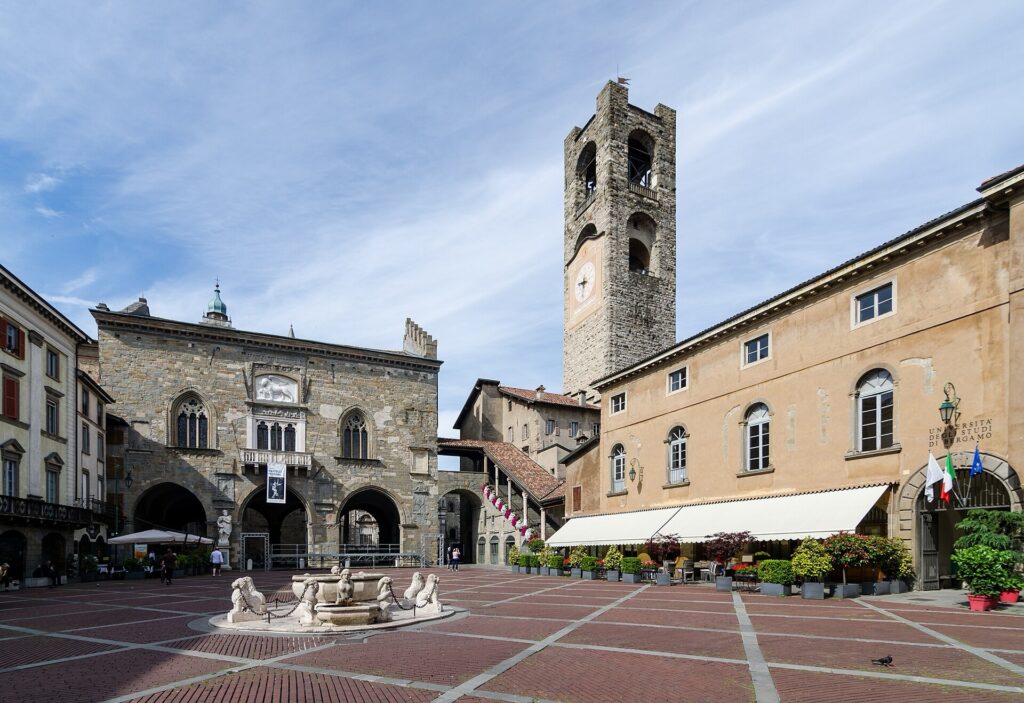
Piazza Vecchia, the historic heart of Bergamo’s Città Alta, with the Contarini Fountain and Campanone bell tower. Photo by Steffen Schmitz, licensed under CC BY-SA 4.0, via Wikimedia Commons
Bergamo’s relationship with Il Lombardia is much younger. The race spent its first decades centred on Milan and only gradually developed the shifting geography familiar today. Since 2014, Bergamo and Como have become the principal poles of the modern race, repeatedly exchanging the roles of start and finish.
The 2026 edition leaves the lower city and heads towards Val Seriana. Behind it remain the Venetian walls; ahead, the flat country quickly contracts into valleys.
THE BERGAMASQUE PREALPS · Four Climbs Before Brianza
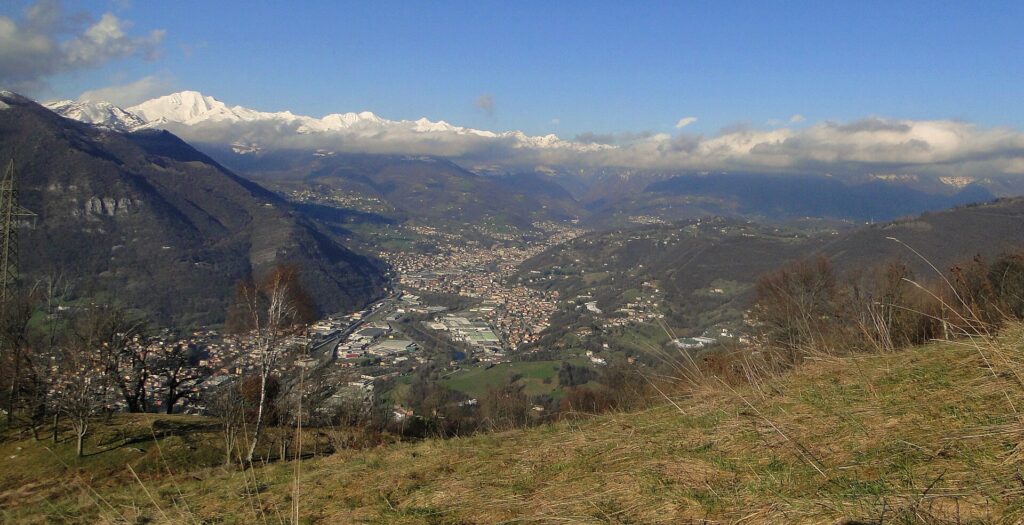
A panoramic view across the middle Seriana Valley, north of Bergamo in the Lombard Prealps. Photo by Ago76, licensed under CC BY-SA 3.0, via Wikimedia Commons
Val Seriana is one of the principal valleys running north from Bergamo into the Bergamasque Alps, following the Serio River towards mountains that rise beyond 2,000 metres. Lombardia does not travel far enough north to reach their highest summits. Instead, it works across the lower Prealps surrounding the mouth of the valley, where lateral roads repeatedly climb from one settlement and drainage basin to another.
The sequence begins with the Colle dei Pasta, cresting around Bocche di Gavarno, before the course turns towards Selvino. Colle di Berbenno and Valpiana follow, making the opening half of the Monument an accumulation of medium-length climbs rather than a journey towards one dominant pass.
This is old inhabited mountain country rather than Alpine wilderness. Villages occupy terraces and valley sides; roads connect settlements that developed around farming, forestry, quarrying and, later, industry. The proximity of Bergamo and the Lombard plain meant these valleys were never isolated from the economy below them.
Selvino · A Road Drawn Across the Mountain
Selvino is a mountain town on a plateau above Val Seriana, north-east of Bergamo. The approach to it is one of the most visually distinctive roads in the first half of the 2026 Lombardia.
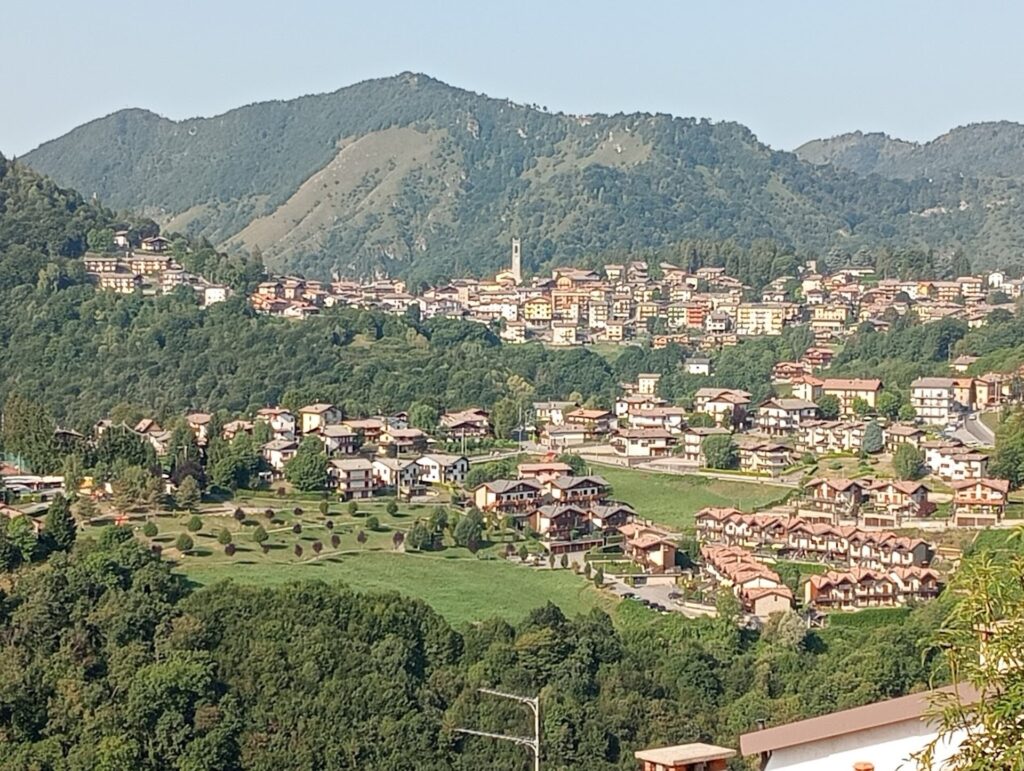
An elevated view across Selvino, a mountain resort town above the Seriana Valley in the Bergamo Prealps. Photo by Andrea Anastasi, licensed under CC BY-SA 4.0, via Wikimedia Commons
The climb rises through a long sequence of hairpins cut across the wooded mountainside. From below, successive sections of road appear stacked above one another, a piece of transport engineering that makes visible the problem faced throughout the Prealps: settlements separated by relatively short horizontal distances can sit hundreds of metres apart vertically.
Selvino developed as a mountain resort as improved roads and transport brought the plateau closer to Bergamo. Lombardia uses the same connection in the opposite way, climbing out of the lower valley before continuing across the Prealpine terrain.
Berbenno and Valpiana · Across the Valleys
The road eventually reaches Colle di Berbenno, in the hills associated with the Imagna Valley west of Bergamo, before continuing towards Valpiana, the final climb in the opening group.
By now the character of the route is clear. Lombardia has not simply climbed into the mountains and descended again. It has moved laterally across them, linking valleys through roads that rise from inhabited low ground, cross wooded ridges and fall towards another settlement.
When the sequence finally ends, the landscape begins opening towards the heavily populated hills between Bergamo, Lecco and Milan.
COLLE BRIANZA · Between the Plain and the Lakes
Brianza is the historic and geographical region of hills lying north of Milan and south of the Alpine lakes, extending across parts of the modern provinces of Monza and Brianza, Lecco and Como. There is no single administrative boundary that perfectly defines it. Brianza is better understood through its landscape: densely settled hills, old agricultural communities, villas, small industrial towns and roads constantly rising and falling between them.
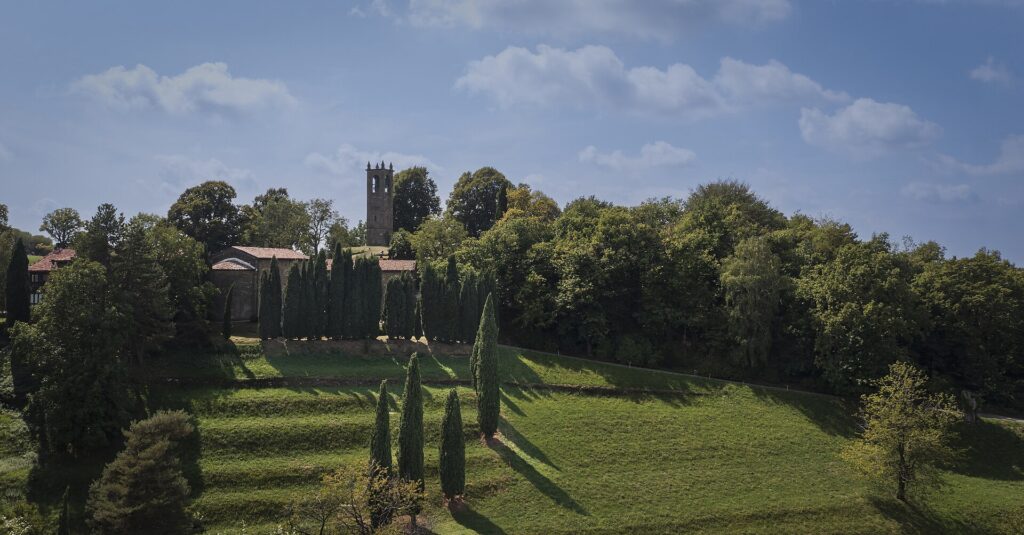
The Campanone rises above the wooded hills of Colle Brianza, part of the rolling upper Brianza landscape crossed by Il Lombardia. Photo by Maurizio Moro5153, licensed under CC BY-SA 4.0, via Wikimedia Commons
The 2026 Lombardia crosses its upper section and climbs Colle Brianza from the Giovenzana side. Giovenzana is a small hillside settlement belonging to Colle Brianza, and the road through it carries the race over the ridge separating the interior hills from the Lecco side of the region.
From the crest comes one of the major geographical transitions of the race. The mountains around Lecco appear ahead, and the road descends towards the eastern branch of Lake Como.
The landscape that follows is also one of the most famous in Italian literature. The same landscape also forms the setting of the Coppa Agostoni, centred farther west around Lissone and the roads of Brianza.
LECCO · The Lake of Alessandro Manzoni
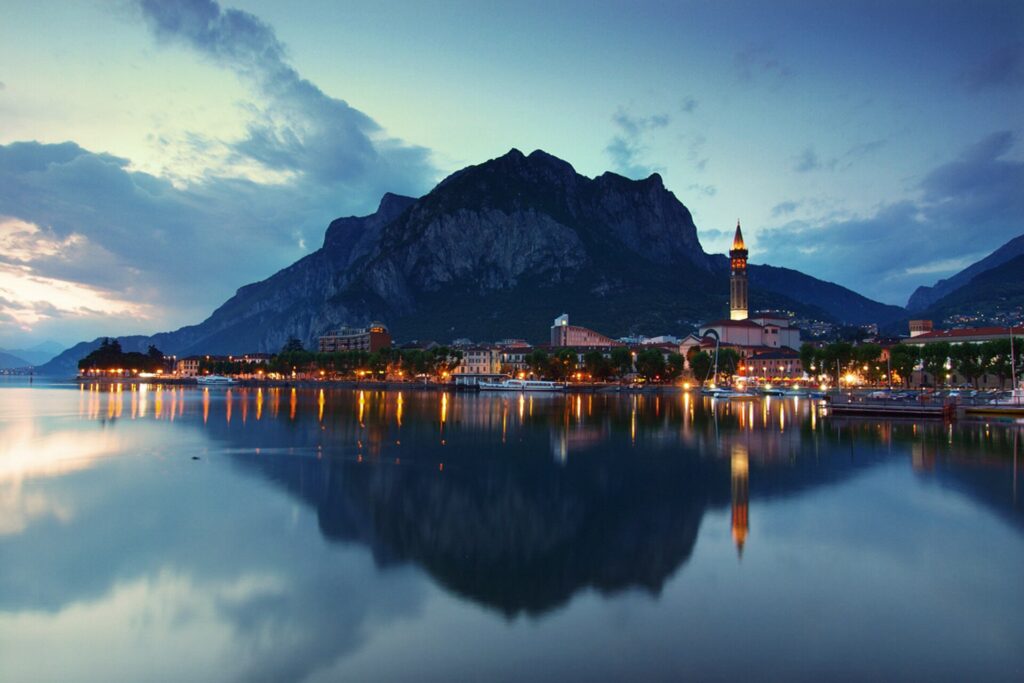
Lecco illuminated after sunset beside Lake Como, framed by the mountains of northern Lombardy. Photo by Eric Hossinger, licensed under CC BY 2.0, via Wikimedia Commons
Lecco stands at the south-eastern end of Lake Como, where the lake narrows and its waters continue into the River Adda. Mountains rise abruptly around the city, including the serrated profile of Monte Resegone, whose name refers to its resemblance to a large saw.
This is the landscape of Alessandro Manzoni, the Milanese writer whose novel I Promessi Sposi, The Betrothed, became one of the foundational works of modern Italian literature. Manzoni spent part of his youth at his family’s villa in Lecco, and memories of the lake, Resegone and the surrounding settlements supplied the physical world of his novel. The house survives today as Villa Manzoni.
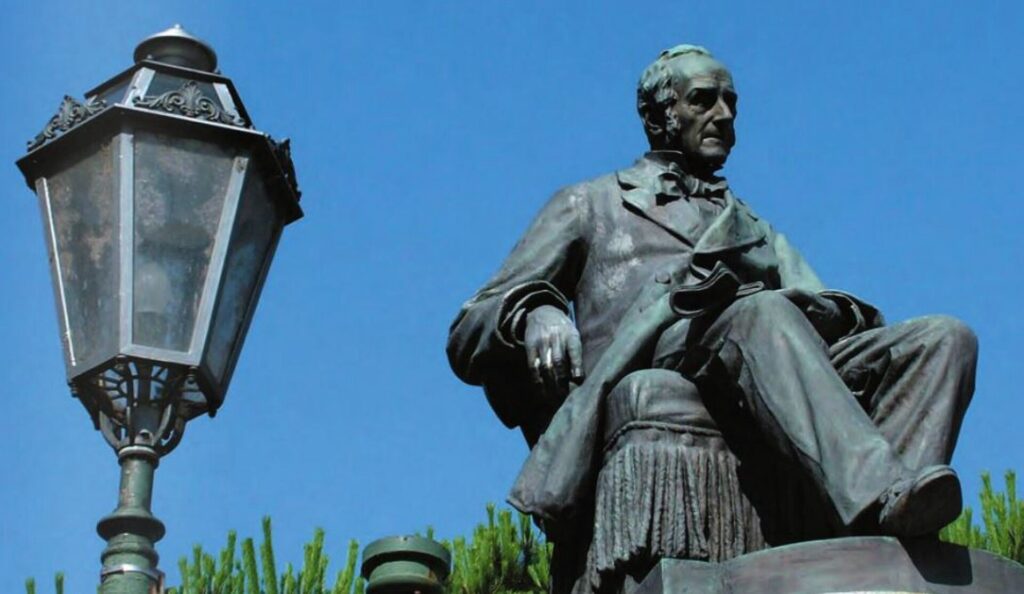
The monument to Alessandro Manzoni in Lecco, the city closely associated with his novel The Betrothed. Photo by Ale300885, licensed under CC BY-SA 4.0, via Wikimedia Commons
Published in its definitive form in 1842, The Betrothed follows Renzo and Lucia, two young people whose planned marriage is obstructed by a local nobleman in 17th-century Lombardy. Their story moves through war, famine, political violence and the plague that devastated Milan in 1630. For generations of Italian readers, the novel helped turn the country around Lecco into a literary geography in which actual mountains, villages and lakeshore roads coexist with fictional events.
Lombardia reaches that landscape from the hills above and then turns north. For the first time since Bergamo, climbing temporarily gives way to the shoreline.
ALONG LAKE COMO · From Lecco to Bellagio
Lake Como, known in Italian as Lago di Como and historically as the Lario, is a deep glacial lake cut into the southern Alps. Its distinctive inverted-Y shape divides into two southern branches, one ending at Como and the other at Lecco, with Bellagio occupying the mountainous peninsula between them.
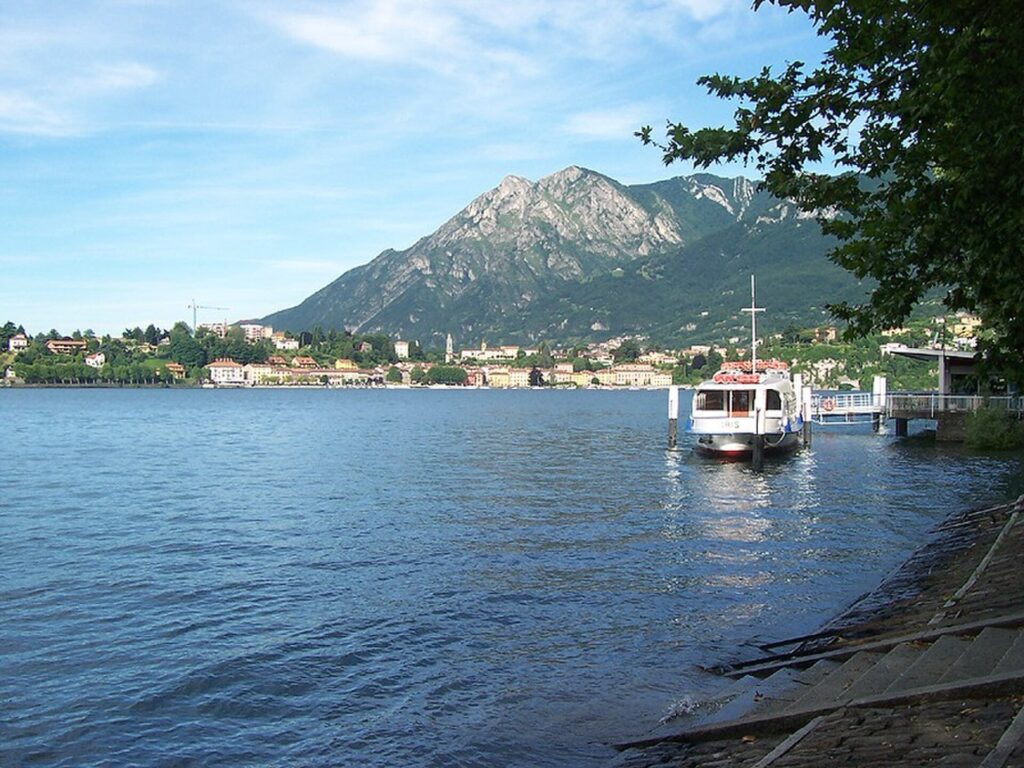
The waterfront of Lecco on the southeastern branch of Lake Como. Photo by MarkusMark, licensed under CC BY-SA 3.0, via Wikimedia Commons
The riders follow the eastern branch north from Lecco. Here the relationship between mountain and water is unusually compressed. Settlements occupy narrow strips along the shore or climb the lower slopes, while roads repeatedly squeeze between rock, houses and the lake.
For centuries the water was a transport route as much as a landscape. Boats connected communities more easily than some of the steep roads above them, carrying people and goods between villages and towards Como. Villas later appeared along the shores as wealthy families sought the combination of mountain scenery, water and relatively easy access to Milan.
The road eventually reaches Bellagio, the town occupying the point where the lake divides.
BELLAGIO · Villas at the Centre of Lake Como
Bellagio sits at the tip of the peninsula separating Lake Como’s two southern branches. From its position, water extends towards Lecco to the south-east, Como to the south-west and the upper lake towards the Alps in the north.
Bellagio’s reputation as a destination developed particularly during the 18th and 19th centuries, when Lake Como became part of the European culture of aristocratic travel. Villas and gardens spread around the peninsula, including Villa Melzi, built in the early 19th century for Francesco Melzi d’Eril, a statesman who served as vice-president of Napoleon’s Italian Republic. Its gardens descend towards the lake, part of the transformation that made Bellagio one of the places through which the image of Lake Como travelled far beyond Lombardy.
For Il Lombardia, Bellagio also marks one of the most important changes of direction in the entire race. The road that has followed the lake north now leaves the water and turns into the mountains.
At the top is a small sanctuary whose relationship with cycling predates almost everyone whose bicycle is preserved inside it.
-61 km approximately · Madonna del Ghisallo · Cycling’s Sanctuary
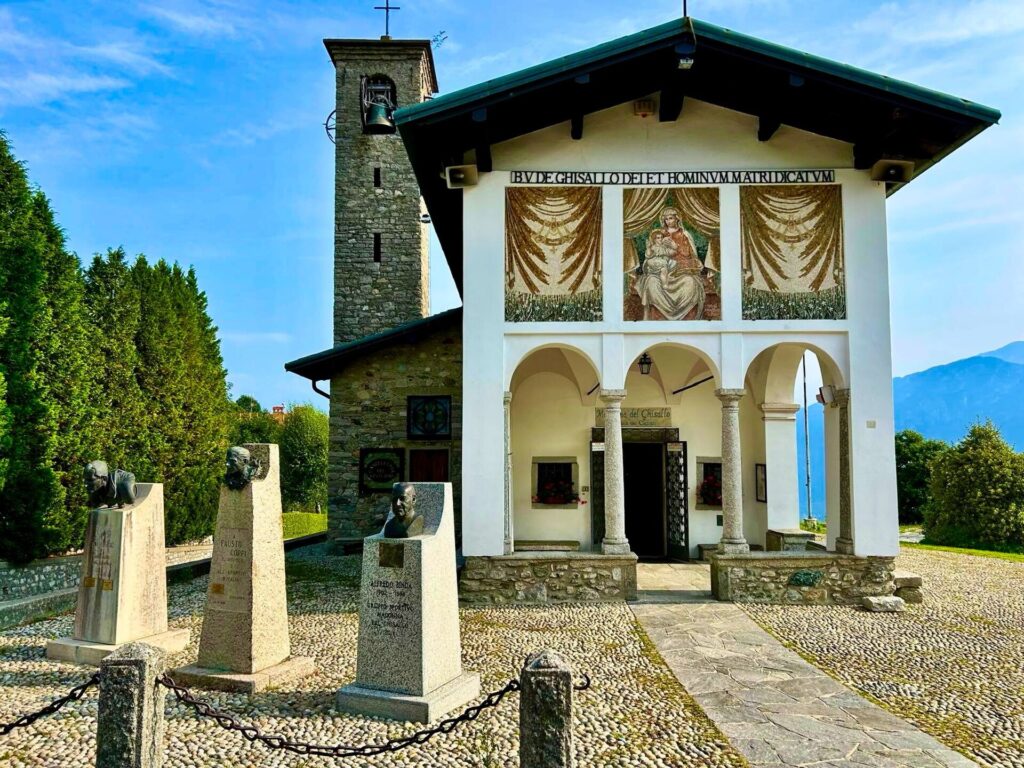
The Sanctuary of the Madonna del Ghisallo at Magreglio, cycling’s celebrated chapel and spiritual landmark near the summit of the Ghisallo climb. Photo by Olgierd Rudak, licensed under CC BY-SA 4.0, via Wikimedia Commons
The Madonna del Ghisallo is a small Catholic sanctuary at the summit of the Ghisallo pass near Magreglio. Since the mid-20th century the Madonna venerated there has been recognised as the patroness of cyclists, and the chapel has accumulated bicycles, jerseys and objects connected with riders who have become part of the sport’s history.
For Il Lombardia, however, the relationship began earlier. The Ghisallo entered the race in 1919, when Costante Girardengo was first across the summit. It subsequently became one of Lombardia’s most persistent landmarks, missing only a handful of editions and often serving as the decisive final climb during the first half of the 20th century.
The 2026 race approaches from Bellagio, the traditional harder side. The road rises away from Lake Como through a succession of bends, with gradients reaching 14 per cent. The summit comes at roughly 61 kilometres from the finish.
A Chapel Filled With Bicycles
The sanctuary’s transformation into cycling’s unofficial church is inseparable from Father Ermelindo Viganò, the local priest who promoted the connection between the Madonna del Ghisallo and cyclists after the Second World War. In 1949 Pope Pius XII proclaimed the Madonna del Ghisallo patroness of Italian cyclists.
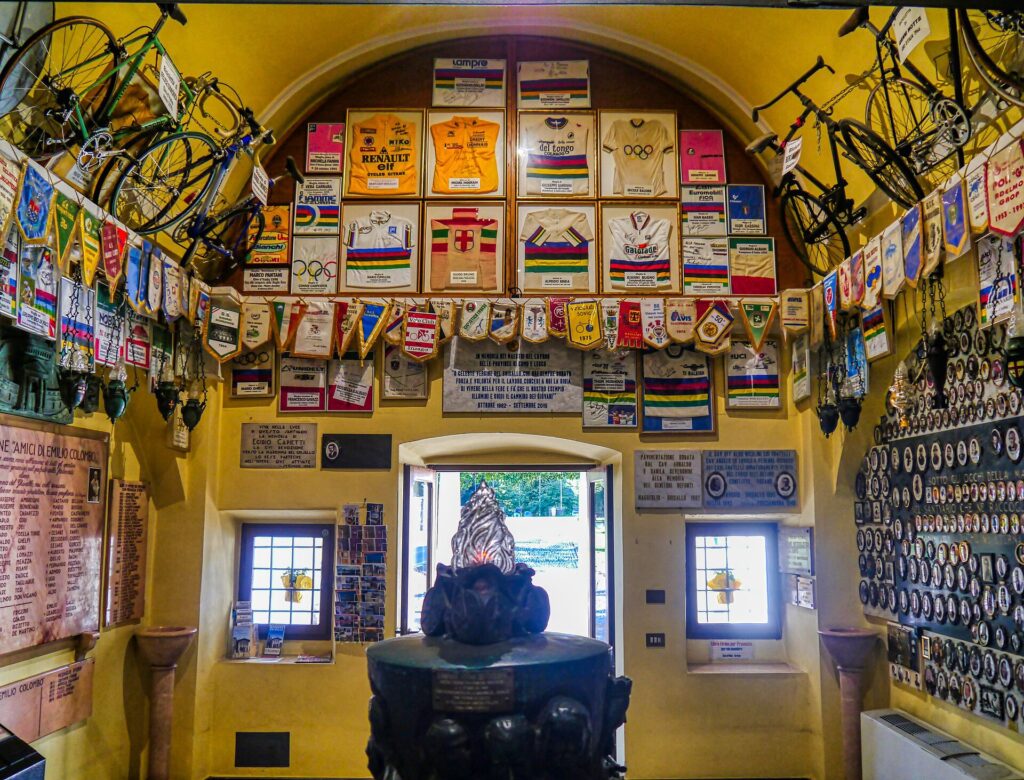
The southern nave inside the Sanctuary of the Madonna del Ghisallo, where bicycles, jerseys and other relics commemorate generations of professional cyclists. Photo by Zairon, licensed under CC BY-SA 4.0, via Wikimedia Commons
Bicycles and jerseys gradually entered the chapel as offerings and memorials. The objects are not arranged as a conventional sporting collection. Their presence inside a functioning religious sanctuary gives the building a different character, part shrine, part archive of a sport in which death, suffering and remembrance have always occupied an unusually visible place.
Outside stand monuments to riders including Fausto Coppi and Gino Bartali, the two champions whose rivalry divided post-war Italian cycling. Coppi won Il Lombardia five times, four consecutively from 1946 to 1949 and again in 1954. Bartali won three. The Ghisallo belonged to the terrain on which their reputations were repeatedly tested.
Next to the sanctuary stands the Museo del Ciclismo del Ghisallo, the cycling museum inaugurated in 2006 through the efforts of Fiorenzo Magni, the three-time Giro d’Italia winner nicknamed the Lion of Flanders. Its collections extend the story beyond professional champions to the bicycle’s broader sporting and social history.
There are more spectacular mountains in professional cycling and far harder climbs. Very few roads, however, contain so much of the sport’s memory in such a small space.
Coppi and the Race That Became His
The history waiting at the summit is particularly associated with Fausto Coppi, the Piedmontese champion known as Il Campionissimo, the Champion of Champions. His native Piedmont forms the landscape of Gran Piemonte, another of the major races of the Italian autumn.
Coppi’s four consecutive Lombardia victories between 1946 and 1949 came during the years in which Italy was emerging from the destruction of the Second World War. His 1948 victory included an attack with 83 kilometres still to race after he had crossed the Ghisallo, while the following year he won after another long solo move, completing a season in which he had already won both the Giro d’Italia and Tour de France. His fifth Lombardia came in 1954.
The record stood alone for almost seventy years. Tadej Pogačar, the Slovenian rider who dominated the modern race from 2021 onwards, matched Coppi’s five victories in 2025 while establishing a new record of five consecutive wins.
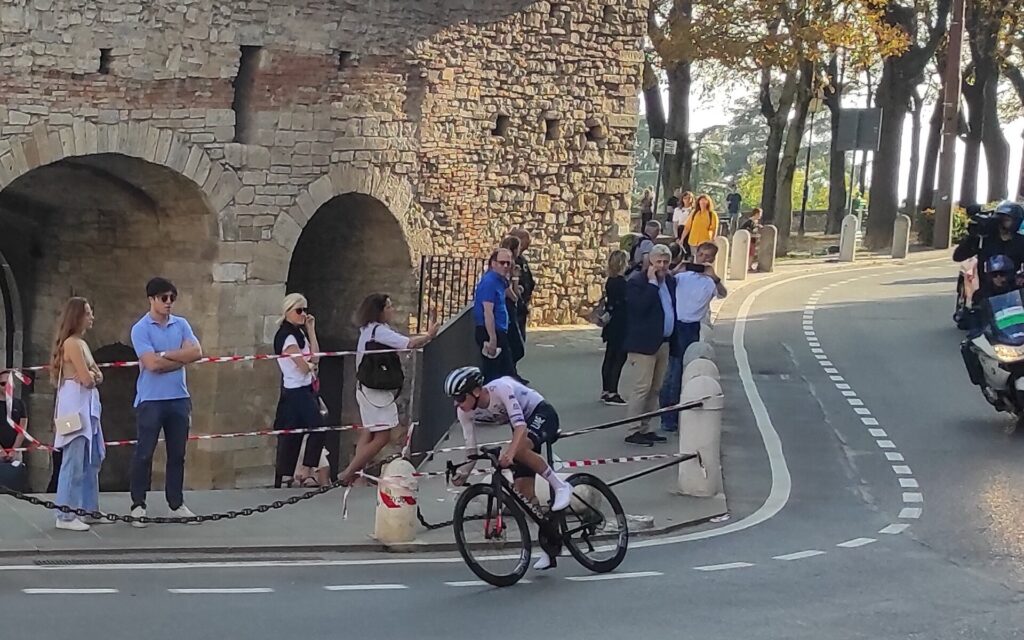
Tadej Pogačar passes Bergamo’s Porta San Giacomo during Il Lombardia 2023, on his way to a third consecutive victory in the race. Photo by Iaznavi78, cropped by Danyele, licensed under CC BY-SA 4.0, via Wikimedia Commons.
Those achievements belong to very different versions of professional cycling, but both are attached to the same autumn race and, repeatedly, to the road passing this sanctuary.
From Ghisallo the course descends through Maglio and continues towards the western branch of the lake.
TOWARDS COMO · The Other Side of the Lake
Leaving the Ghisallo means crossing from the Bellagio side of Lake Como towards Como, the city at the end of its south-western branch.
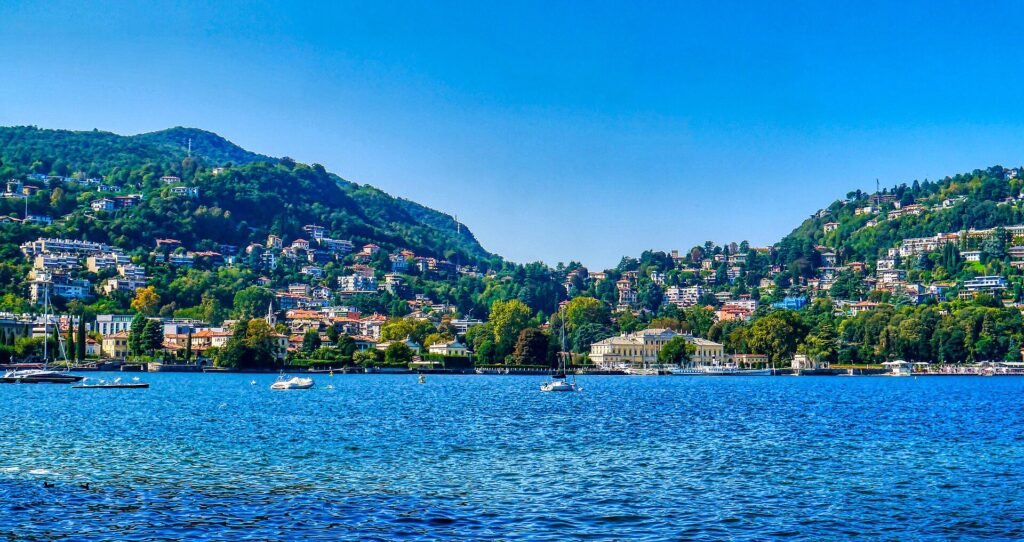
A panoramic view across Lake Como from the city of Como, where the lake’s southwestern branch reaches its southern end beneath the surrounding mountains. Photo by Zairon, licensed under CC BY-SA 4.0, via Wikimedia Commons
The long accumulation of the Bergamasque climbs is now behind the race, and Ghisallo has brought the Monument into its final sixty kilometres. The roads gradually lose altitude before the course reaches Como and begins its only circuit of the day.
The final 22 kilometres are unusually compact. San Fermo della Battaglia is climbed once before the riders pass the finish, Civiglio follows immediately afterwards, and San Fermo is then crossed for a second and final time.
COMO · Rome, Silk and Alessandro Volta
Como stands at the southern end of the lake’s western branch, pressed between the water and wooded hills that rise almost immediately behind the city.
The Romans developed Novum Comum here during the 1st century BC, and the regular street pattern of the historic centre still preserves traces of Roman planning beneath the medieval and later city. Como subsequently became an important commercial centre, repeatedly contested because of its position between the Lombard plain and routes towards the Alpine passes.
Its international economic identity eventually became tied to silk. From the early modern period, mulberry trees were cultivated across the surrounding countryside to feed silkworms, while Como developed the specialised skills needed to process, weave and finish silk. Industrialisation moved much of that production into factories, and by the 19th and 20th centuries the Como district had become one of Europe’s major centres for silk textiles, supplying fabrics and designs to international fashion houses. The industry changed dramatically as silkworm cultivation disappeared locally and raw material increasingly came from abroad, but weaving, printing, finishing and textile design remained embedded in the economy around the lake.
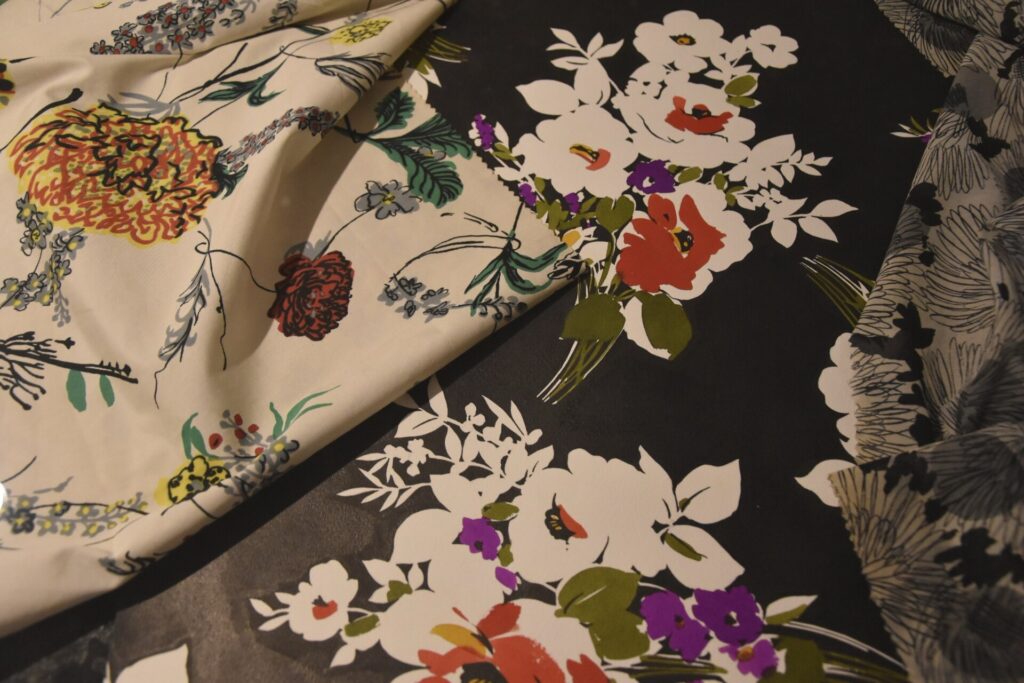
Textile exhibits inside Como’s Educational Silk Museum, preserving the material culture of the city’s historic silk industry. Photo by Visualevision, licensed under CC BY-SA 4.0, via Wikimedia Commons
Como was also the birthplace in 1745 of Alessandro Volta, the Italian physicist whose experiments with electricity led to the invention of the voltaic pile in 1800, the first device capable of producing a continuous electric current. His breakthrough disproved the prevailing theory of “animal electricity” held by his contemporary Luigi Galvani, proving instead that electricity could be generated chemically through alternating discs of zinc and copper separated by brine-soaked cardboard. The electrical unit of electromotive force, the volt, carries his name in recognition of this monumental contribution, and his legacy remains deeply woven into Como’s identity, commemorated today by the Tempio Voltiano museum on the lakeside and the prominent Piazza Volta in the town center.
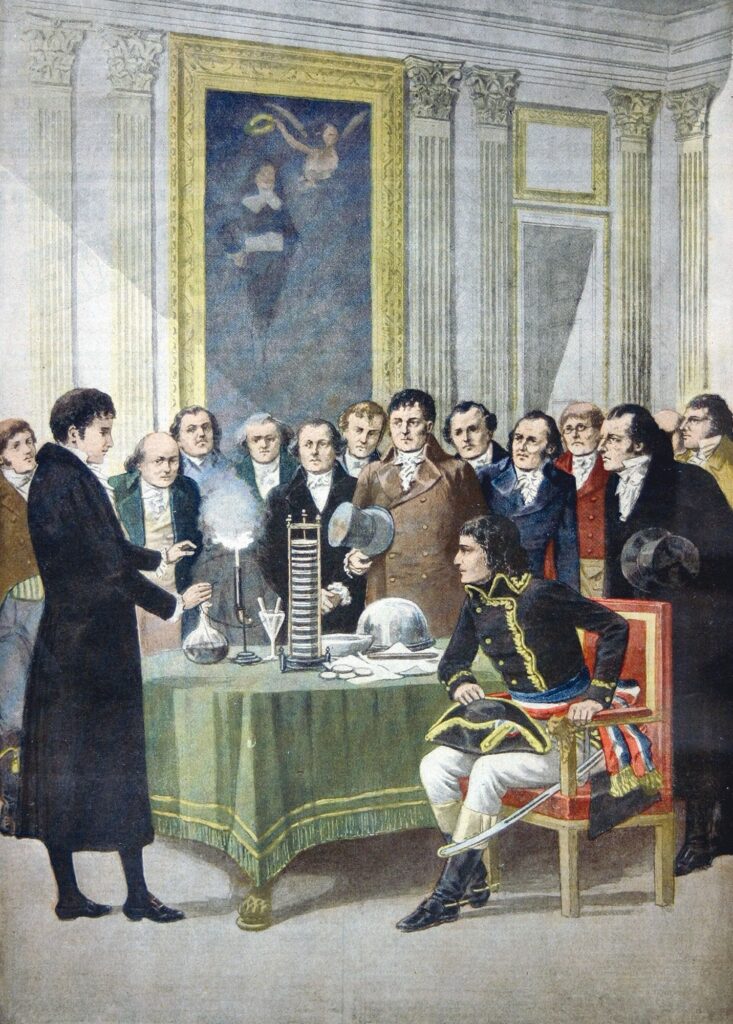
Alessandro Volta demonstrates his voltaic pile, the first electric battery, to Napoleon Bonaparte in Paris in 1801. Illustration published by Le Petit Journal in 1901, Public Domain
The hills enclosing Como against the lake provide the final roads of the Monument.
THE FINAL CIRCUIT · San Fermo, Civiglio and Back to Como
The 22-kilometre finishing circuit begins by taking the riders through Como towards San Fermo della Battaglia, a settlement on the hills west of the city. The climb is approximately 2.7 kilometres at a little over seven per cent, with steeper sections around ten per cent.
Its name carries a history much older than its role in cycling.
San Fermo della Battaglia · Garibaldi Above Como
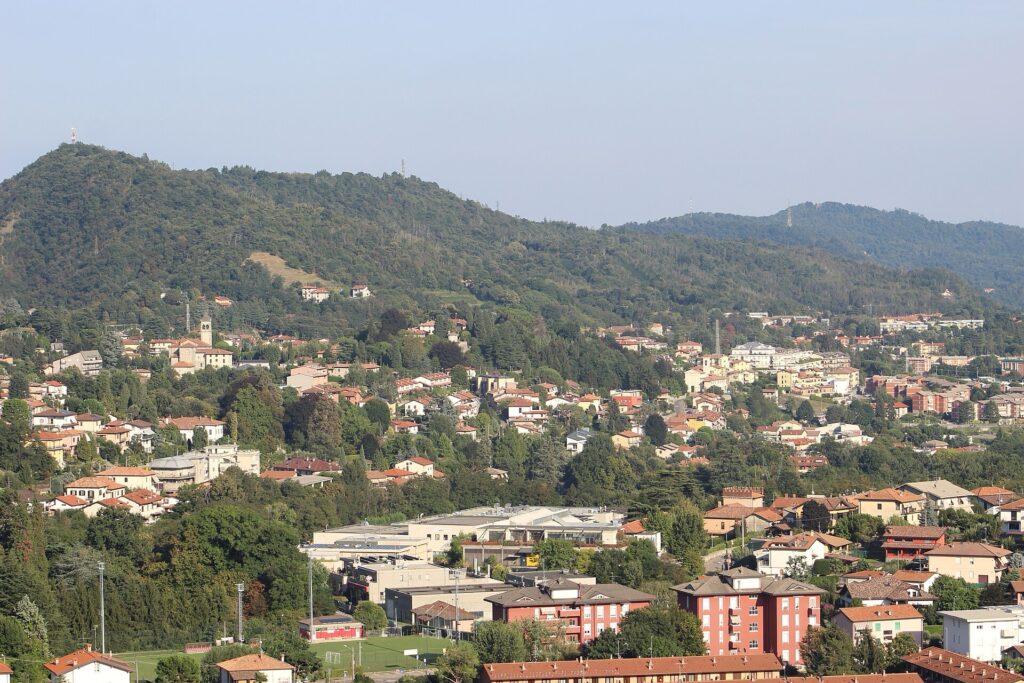
San Fermo della Battaglia viewed from the Colombirolino area of Cavallasca, among the wooded hills west of Como. Photo by Ottantafame, licensed under CC BY-SA 4.0, via Wikimedia Commons
San Fermo della Battaglia takes its modern name from a battle fought here on 27 May 1859, during the Second Italian War of Independence.
The previous day, Giuseppe Garibaldi, the soldier and revolutionary who would become one of the central figures of Italian unification, had defeated Austrian forces near Varese with his volunteer Cacciatori delle Alpi, the Hunters of the Alps. He then advanced towards Como, where Austrian troops under General Karl von Urban occupied defensive positions on the surrounding heights.
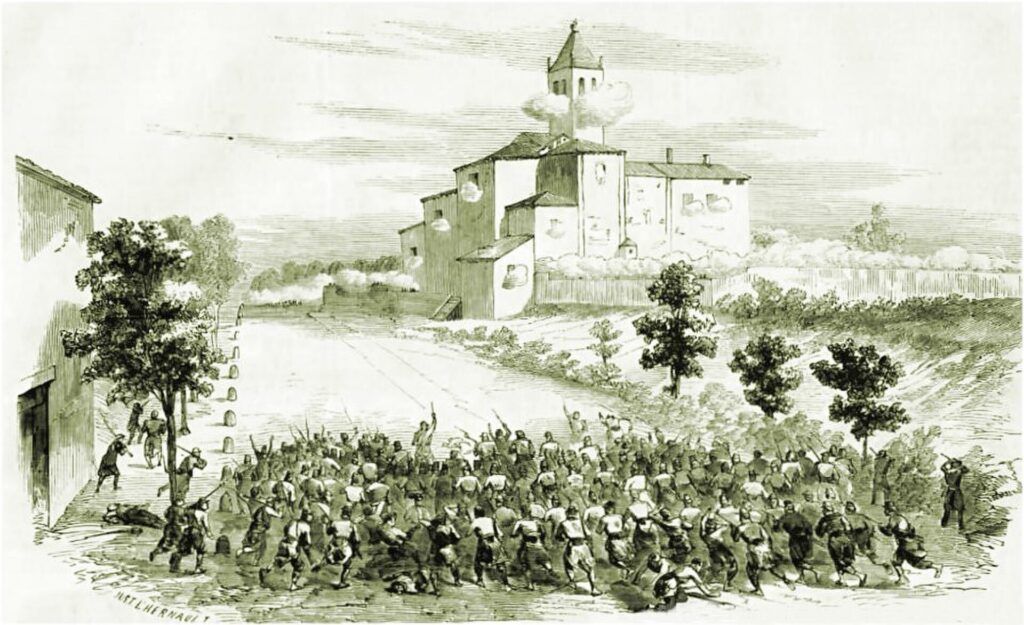
Garibaldi’s Hunters of the Alps defeat Austrian forces at the Battle of San Fermo on 27 May 1859, during the Second Italian War of Independence. Lithograph by Jules Gaildrau and Louis Godefroy Jadin, public domain, via Wikimedia Commons
At San Fermo, Garibaldi’s volunteers attacked the Austrian positions around the village. Captain Carlo De Cristoforis was killed during the fighting, but the assault succeeded and the Austrian troops withdrew. Garibaldi entered Como that evening as Urban’s forces retreated towards Monza. The battle formed part of the campaign that removed Austrian control from most of Lombardy and brought the region into the Kingdom of Sardinia, an important step towards the creation of the Kingdom of Italy in 1861.
The previous day, Giuseppe Garibaldi, the soldier and revolutionary who would become one of the central figures of Italian unification, had defeated Austrian forces near Varese, a city encountered again in our route through Tre Valli Varesine, with his volunteer Cacciatori delle Alpi…
The race descends from San Fermo into Como and crosses the finish line with one final loop still to complete. About a kilometre later, the road rises again.
Civiglio · The Village Above Como
Civiglio is an old hillside village east of central Como, incorporated into the municipality during the 20th century. Historical records place the medieval community within the pieve of Zezio, a local territorial district centred on a parish church, while archaeological discoveries in the surrounding area point to human activity much earlier than the medieval settlement.
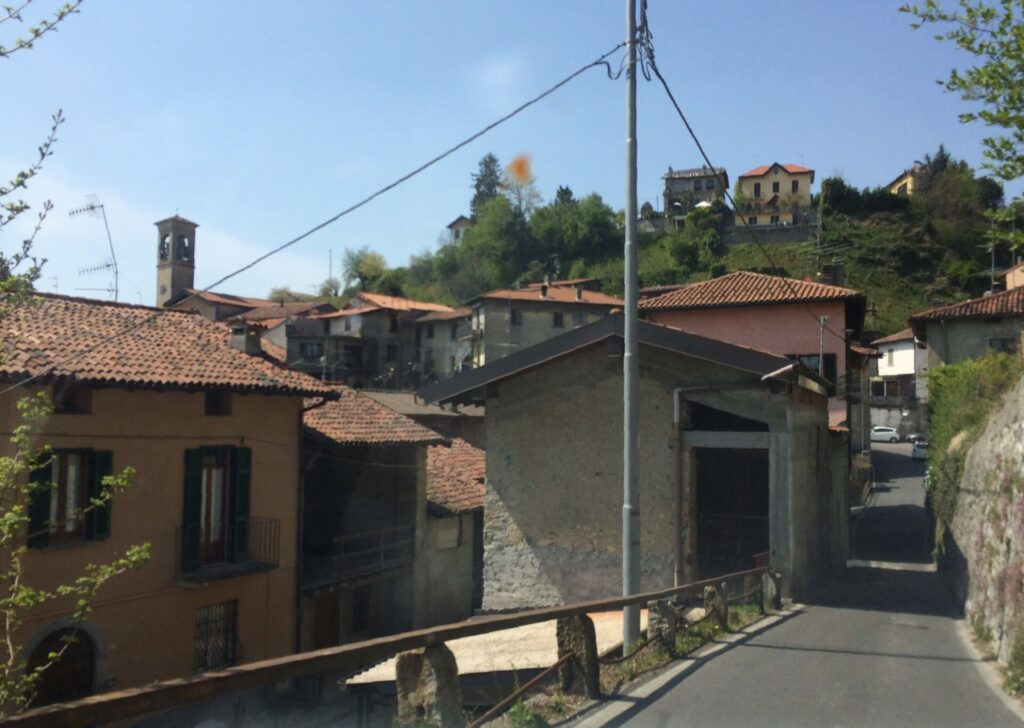
The historic centre of Civiglio, a hillside district of Como overlooking the city’s eastern approaches. Photo by Ottantafame, licensed under CC BY-SA 4.0, via Wikimedia Commons
The climb itself has a much more immediate presence in Lombardia. The road rises to 614 metres, gaining height rapidly above Como with gradients close to ten per cent for much of the ascent and a pronounced narrowing near the summit.
At approximately 4.2 kilometres averaging 9.7 per cent, Civiglio is substantially steeper than San Fermo. From the summit, the descent carries the race back towards Como, where the final passage over San Fermo is already waiting on the opposite side of the city.
FINAL CLIMB · San Fermo for the Second Time
The race crosses Como and returns to San Fermo della Battaglia. The battlefield and village are now familiar; the second passage belongs entirely to the final kilometres of the race.
The final ten kilometres begin inside Como on broad urban avenues. After the railway underpass, the climb narrows and the surface becomes rougher. The gradient sits around seven per cent and reaches ten, with several bends carrying the road back towards the heights west of the city.
The summit comes with approximately five kilometres remaining. From there the course descends quickly towards Como through two tunnels and two large roundabouts, returning to the city inside the final kilometre.
FINISH · Como and the Lake
At 600 metres to go, the course takes its final broad left-hand bend. The road then straightens beside Como for the last run to the line.
Il Lombardia began in 1905, when journalist Tullo Morgagni helped create a new end-of-season race after Pierino Albini had been defeated by Giovanni Cuniolo at Milan’s Trotter velodrome. The intended rematch produced another winner entirely: Giovanni Gerbi, the Piedmontese pioneer known as the Red Devil, won the first Giro di Lombardia. What began as an improvised addition to the calendar survived the First World War, stopped only in 1943 and 1944 during the Second World War, and grew into one of the five Monuments of professional cycling.
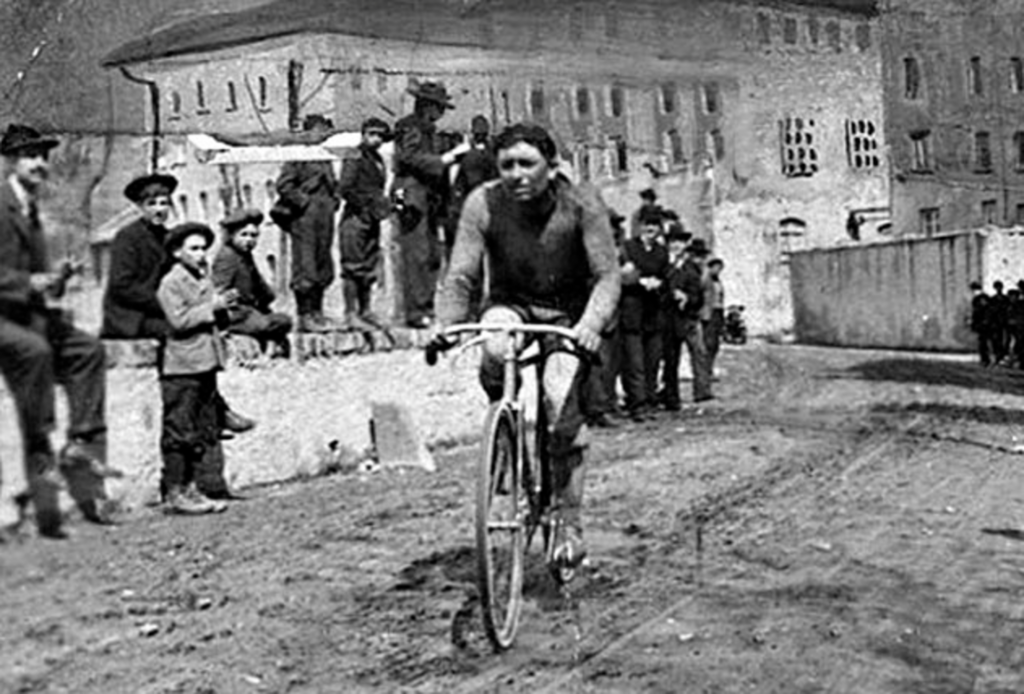
Giovanni Gerbi during the inaugural Giro di Lombardia in 1905, which he won to become the race’s first champion. Unknown photographer, public domain, via Wikimedia Commons
For decades it was also called the Mondiale d’Autunno, the Autumn World Championship, a reflection of the importance it carried when the actual World Championships were held earlier in the season. Girardengo, Binda, Bartali and Coppi shaped its early mythology; later came Merckx, Gimondi, Hinault, Kelly, Nibali and generations of riders from far beyond Italy. The course changed around them, first centred on Milan and later moving between different Lombard cities, but autumn remained its permanent setting.
The 120th edition does not need to recreate the roads of 1905 to belong to that history. It has travelled instead from Bergamo’s Venetian frontier into the Prealps, descended through Manzoni’s country to Lake Como, climbed past the bicycles and memorials of the Ghisallo and crossed the battlefield above San Fermo before returning to the water.
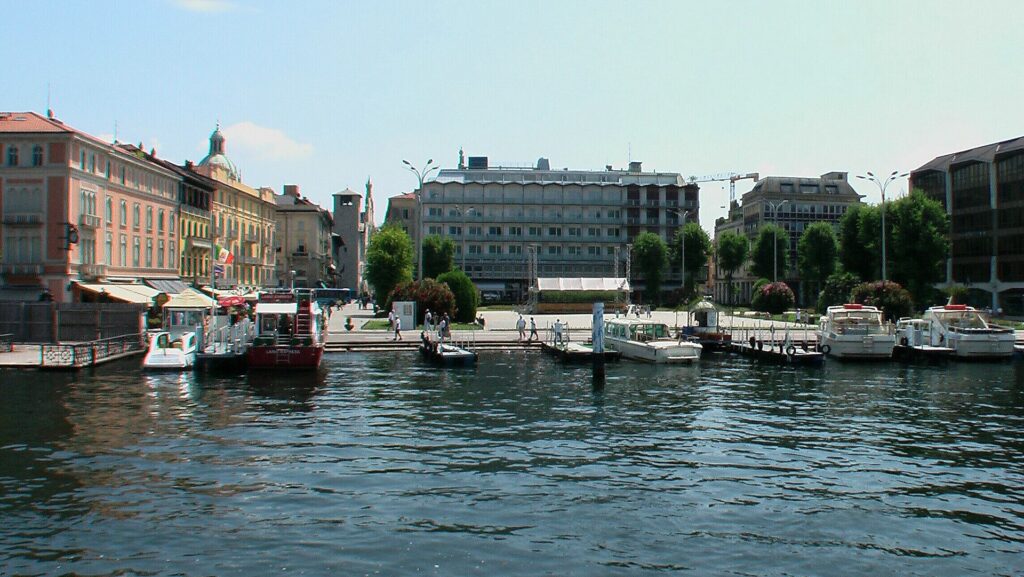
Como’s Piazza Cavour waterfront viewed from Lake Como, near the traditional finishing area where Il Lombardia reaches its conclusion. Photo by Joergsam, licensed under CC BY-SA 3.0, via Wikimedia Commons
By the time the road straightens in Como, the lake is beside the race again. The mountains that shaped the previous 239 kilometres remain immediately behind the city, close enough that even at the finish there is very little distance between Lombardia and the roads from which it came.