


The 2027 Tour de France begins in Scotland for the first time, travelling from Edinburgh through the rolling hills of the Scottish Borders before crossing into England for a finish in Carlisle. With 184 kilometres, approximately 2,000 metres of climbing and the first yellow jersey at stake, the opening stage offers more challenges than its likely sprint finish suggests.
Stage 1 | Friday, 2 July 2027 | Edinburgh → Carlisle | 184 km | Approximately 2,000 m elevation gain
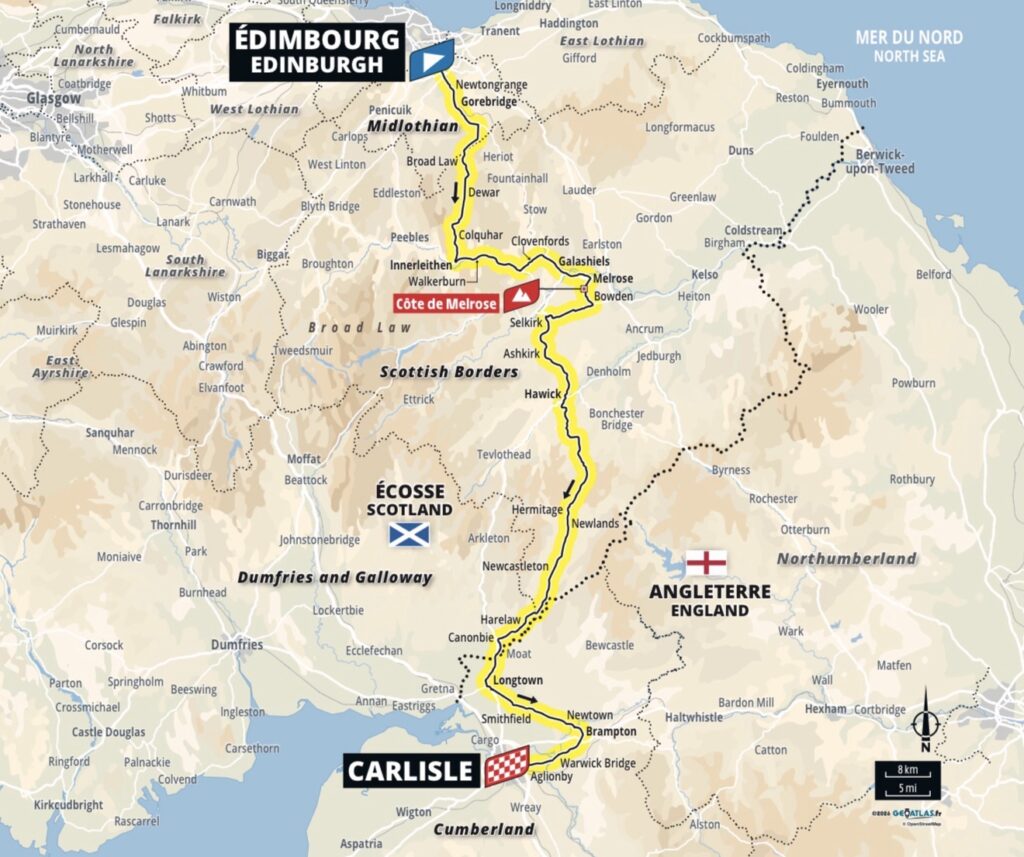
The first yellow jersey of the 2027 Tour de France will be awarded in Carlisle, an English border city whose medieval castle has witnessed centuries of conflict between Scotland and England. To reach it, the peloton must first leave Edinburgh, cross the hills of the Scottish Borders and negotiate a route that is considerably more demanding than its likely sprint finish might suggest.
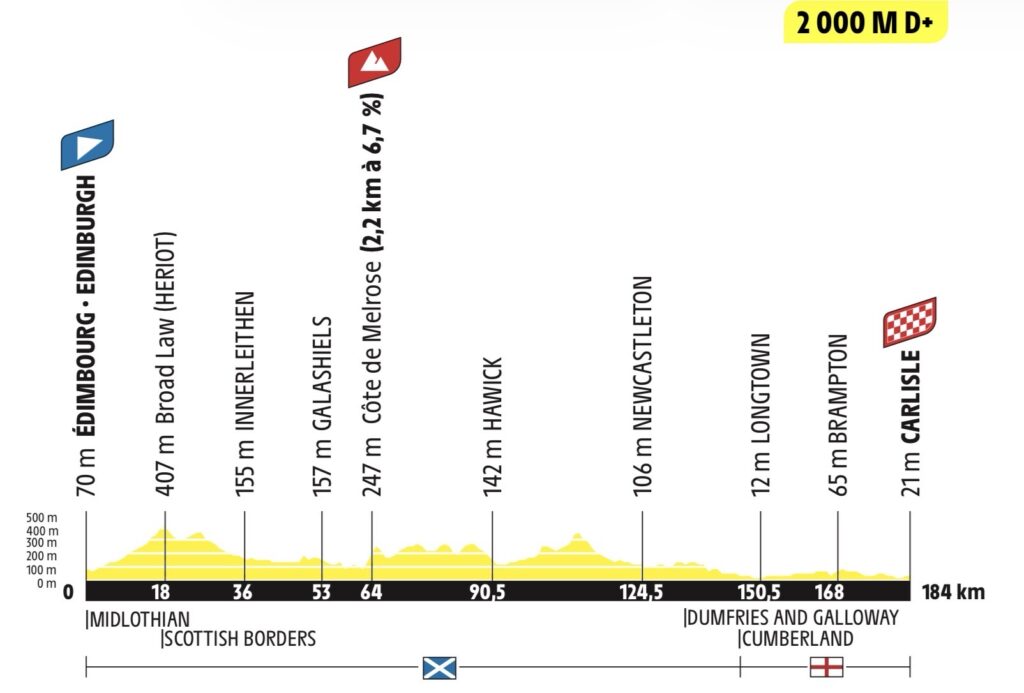
For the first time in its history, the Tour de France will begin in Scotland. The 184-kilometre Grand Départ stage takes the riders through the valleys and uplands of southern Scotland, across the Anglo-Scottish border and into northern England. Although the route includes only one categorised climb, approximately 2,000 metres of elevation gain and a succession of rolling roads could complicate the efforts of the sprint teams.
The highest marked point comes early, near Broad Law at Heriot, while the Melrose climb offers the first opportunity to score points in the mountains classification. Beyond Hawick and Newcastleton, the terrain gradually becomes more favourable for the sprinters, with a relatively flat approach through Longtown and Brampton towards Carlisle.
The stage presents two competing ambitions: the attackers seeking the first polka-dot jersey and the sprinters hoping to claim yellow. The terrain favours the latter, but the road to Carlisle offers enough uncertainty to make the opening day more than a ceremonial procession.
–184 km | Edinburgh: A Grand Départ Beneath the Castle
Edinburgh provides one of the most distinctive settings for a Tour de France Grand Départ. Its historic centre is divided between the medieval Old Town, with its narrow closes and steep streets, and the planned Georgian New Town, developed during the eighteenth and nineteenth centuries. Above them stands Edinburgh Castle, occupying an ancient volcanic outcrop that has shaped the city’s defensive and political importance.
The city’s topography is immediately recognisable. The Royal Mile descends from the castle towards the Palace of Holyroodhouse, while Arthur’s Seat rises above the eastern side of the capital. These features reflect a landscape formed by volcanic activity and subsequently modified by glaciation, long before Edinburgh developed into Scotland’s political and cultural centre.

For the 2027 Tour, the ceremonial departure is planned around the Palace of Holyroodhouse and the city’s historic streets, including the Royal Mile, Princes Street, Castle Esplanade, Grassmarket and Victoria Street. The procession will offer an introduction to Edinburgh before the riders head south towards Midlothian.
The team presentation is scheduled for 30 June at Edinburgh Castle, two days before the opening stage. The setting will place the riders in a location closely associated with Scottish royal history and the annual Royal Edinburgh Military Tattoo.
The significance of this Grand Départ extends beyond the architecture. The Tour first visited Britain in 1974, returned in 1994 and subsequently held Grand Départs in London in 2007 and Yorkshire in 2014. The Yorkshire opening attracted enormous roadside crowds and helped demonstrate the depth of Britain’s enthusiasm for professional cycling.
Scotland’s cycling heritage also provides a connection to the Tour’s history, most notably through David Millar, who became the first Scottish rider to wear the yellow jersey in 2000. His achievement belongs to a broader British tradition that the opening stage in Carlisle will bring back into focus. Before that first jersey can be awarded, however, the peloton must negotiate the hills south of Edinburgh.
–166 km to –131 km | From Midlothian to the Scottish Borders
The opening kilometres take the riders through Midlothian, where Edinburgh’s dense urban landscape gives way to agricultural land, villages and increasingly open hills.
At –166 km, the route reaches its highest marked point near Broad Law at Heriot, around 407 metres above sea level. This early rise is not classified as a King of the Mountains climb, but it introduces the undulating character of the first half of the stage.

Broad Law belongs to the upland landscape of the Moorfoot Hills, part of the wider Southern Uplands that stretch across southern Scotland. Unlike the dramatic, rocky summits of the Highlands, these hills are generally rounded, with open slopes shaped by long periods of erosion, glaciation and pastoral use.
Their appearance can be deceptive. Long false flats and exposed roads require sustained effort without offering the obvious rhythm of a major mountain ascent. A peloton travelling at racing speed may feel those gradients more acutely than their modest elevations suggest.
At –148 km, the route descends towards Innerleithen. The town lies in the Tweed valley and has developed a reputation as a centre for mountain biking, particularly through the trails of the surrounding Tweed Valley.
The connection is fitting. The Tour’s road cyclists will pass through a landscape already closely associated with cycling, although the disciplines and physical demands are very different.
At –131 km, the race reaches Galashiels, one of the principal towns of the Scottish Borders. Its development was closely connected to the textile industry, particularly woollen manufacturing, which became an important part of the regional economy during the nineteenth century.

The region’s wool industry was inseparable from its geography. Sheep farming supplied the raw material from the surrounding uplands, while rivers such as the Tweed and its tributaries provided water and, historically, power for mills. The valleys offered sites for settlements and workshops, allowing textile manufacturing to develop within a landscape that remained predominantly rural.
Galashiels became an important centre for woollen cloth, while Hawick, further south along the route, developed an international reputation for knitwear and cashmere. Together, the towns illustrate how specialised industries grew from the resources and transport routes of the Scottish Borders.
The peloton will pass through this landscape on roads that rise and fall between valleys and hillsides, encountering a succession of modest gradients rather than one defining obstacle. The terrain creates opportunities for early attacks, but the stage’s first official climbing contest is still ahead.
–120 km | Melrose: The First Battle for the Polka-Dot Jersey
The riders reach the Melrose climb, the only categorised ascent of the opening stage.
Melrose climb — 2.2 km at 6.7%
The ascent is short by Tour de France standards, but its position gives it an importance that cannot be measured by length or gradient alone. It offers the first opportunity to score points in the mountains classification and therefore the chance to become the first wearer of the polka-dot jersey.

Melrose itself is one of the Scottish Borders’ most historically significant settlements. Its ruined abbey, founded in the twelfth century under the patronage of King David I, became an important religious centre in medieval Scotland. The abbey was repeatedly damaged during periods of Anglo-Scottish conflict, and its surviving architecture remains a powerful reminder of the region’s turbulent past.
Nearby, the Eildon Hills form a distinctive group of summits overlooking the Tweed valley. Their rounded silhouettes are among the most recognisable features of the Borders landscape and have long been associated with local folklore, including stories connected to the medieval figure Thomas the Rhymer.
The Tour’s passage through Melrose brings those layers of history into the race, while the climb provides the first clear sporting objective of the day.
A rider who reaches the summit first could become the opening leader of the mountains classification, an opportunity particularly attractive to teams without a realistic chance of winning the stage in Carlisle.
The ascent is unlikely to produce a decisive selection among the general classification contenders, but it gives the opening breakaway a reason to form and an immediate reward to pursue.
Beyond Melrose, the route continues south through the Scottish Borders, with the race gradually moving towards the Anglo-Scottish frontier.
–93.5 km to –59.5 km | Hawick and Newcastleton: From Textile Valleys to Border Country
At –93.5 km, the peloton reaches Hawick, a town whose textile heritage connects it to Galashiels and the wider economy of the Borders.

Hawick became particularly associated with knitwear and hosiery, industries that developed from the region’s longstanding wool-working traditions. Its specialist manufacturing helped establish the town’s international reputation, while the surrounding countryside continued to support sheep farming and other agricultural activities.
The town also preserves a strong sense of local identity through its Common Riding, a traditional annual event associated with the history of the Borders and the memory of past conflicts.
Beyond Hawick, the route moves into more sparsely populated country. Wooded hills, open fields and river valleys replace the larger settlements, and the roads begin to reflect the region’s long history as a frontier between Scotland and England.
At –59.5 km, the riders reach Newcastleton, which hosts the opening stage’s intermediate sprint.
The village lies in Liddesdale, a district historically associated with the Border Reivers, whose activities shaped life along the Anglo-Scottish frontier from the late medieval period into the early seventeenth century.
The Reivers operated in a region where political authority was often contested and family alliances crossed national boundaries. Cattle raiding, feuding and the defence of local interests were recurring features of life in the borderlands, helping explain the concentration of fortified houses and defensive settlements across the area.

The Tour’s passage through Newcastleton therefore marks more than a geographical transition. It brings the peloton into territory where the border was once a source of persistent instability, before the race continues south towards a peaceful modern crossing into England.
The intermediate sprint will provide a sporting interruption to that journey, offering the first points-classification contest of the 2027 Tour. By then, the main climbing difficulties will be behind the riders, and the terrain will increasingly favour the teams preparing for the finish.
–59.5 km to –16 km | The Road to Carlisle
From Newcastleton, the stage enters its final 60 kilometres, travelling through the southern Borders before crossing into England.
The landscape remains rural, but the route gradually becomes less demanding. At –33.5 km, the race passes through Longtown, close to the Scottish border. The town has historically served as a market centre connecting communities on both sides.
At –16 km, the peloton reaches Brampton. Situated east of Carlisle, Brampton belongs to the historic landscape surrounding Hadrian’s Wall and the Roman frontier of northern Britain.
The final section provides a contrast with the rolling roads of Scotland. The gradients become gentler, the route approaches a larger urban centre and the stage moves towards a short finishing straight near Carlisle Castle.

For riders who have spent much of the day in a breakaway, this final approach may be particularly difficult. For the sprint teams, it offers the opportunity to bring their leaders into position before the first finish of the Tour.
The detailed tactical implications of that pursuit will depend on how the race develops, but the geography is clear: after a demanding journey through the Borders, the final kilometres favour speed and organisation.
0 km | Carlisle: A Border Fortress and a New Tour Finish
Carlisle is one of northern England’s most historically strategic cities. Its origins extend to the Roman period, when the settlement of Luguvalium developed near the western end of the frontier later marked by Hadrian’s Wall.
The wall, begun under Emperor Hadrian in the second century, stretched across northern Britain and formed part of the Roman Empire’s frontier system. Its western sector helped connect military installations and settlements across what is now Cumbria.
Carlisle remained strategically important after Roman rule ended. Its castle, founded in the late eleventh century under William II, became a major fortress during the medieval conflicts between England and Scotland.
The castle changed hands and endured sieges over the centuries, reflecting the instability of a region repeatedly affected by warfare and shifting political authority. Mary, Queen of Scots, was held there in 1568 after fleeing into England.
For the 2027 Tour, the finish near Carlisle Castle provides a remarkable historical symmetry. The race begins in Scotland’s capital, passes through a landscape shaped by centuries of border conflict and concludes beside one of the fortresses built to control that frontier.
The city’s history also connects the Tour’s opening stage to a wider story of movement and exchange. Carlisle has long served as a gateway between England and Scotland, its roads and railways linking communities on both sides of the border.
On 2 July 2027, those routes will carry a different kind of procession: the final kilometres of a Tour de France stage, with the peloton racing towards the first yellow jersey.
The First Yellow Jersey: A British Cycling Tradition
An opening-stage victory carries a significance beyond the result itself. It establishes the first leader of the general classification and gives the winner a place in the race’s history before the battle for the overall title has properly begun.
For British cycling, the yellow jersey has a particular resonance. Tom Simpson became the first British rider to wear it in 1962, helping establish a generation of British road racers who competed successfully on the European continent.

In 2000, David Millar, born in Malta to Scottish parents and raised partly in Scotland, won the opening individual time trial at Futuroscope and became the first Scottish rider to wear the yellow jersey. His performance was a landmark achievement, demonstrating that the race’s first day could create a defining moment in a rider’s career.
Mark Cavendish provided another memorable example in 2016, winning the opening stage at Utah Beach and taking the first yellow jersey of his career. It was a landmark achievement for a rider who would eventually establish a record of 35 Tour de France stage victories.
The 2027 opening offers a comparable opportunity for a sprinter. Unlike a time trial or a selective mountain stage, a relatively flat finale allows several teams to believe they can win.
That possibility creates its own tactical tension. The more teams committed to a sprint, the stronger the collective pursuit may become. Yet the greater the number of sprinters competing for position, the more difficult the final kilometres can be to control.
The first yellow jersey may therefore be decided not simply by the fastest rider, but by the team that executes the final minutes most effectively.
Stage 1 Tactical Analysis: Three Questions That Could Decide the Race
The profile suggests a bunch sprint, but three factors could influence how the stage develops.
1. Who Will Attack for the First Mountains Jersey?
The Melrose climb at –120 km is the only categorised ascent and therefore the obvious objective for riders seeking the first polka-dot jersey.
An early breakaway could form around that ambition. Teams without a leading sprinter may be particularly interested in placing a rider ahead, gaining television exposure and contesting the first available climbing points.
The key question is whether the breakaway continues to cooperate after Melrose. Once the mountains points have been awarded, some riders may lose their principal motivation for remaining in the escape.
2. Will the Rolling Terrain Weaken the Sprinters?
Approximately 2,000 metres of elevation gain is substantial for a stage expected to finish in a sprint.
The climbs are generally not steep or long enough to eliminate the strongest sprinters under normal racing conditions, but repeated accelerations could make the day more selective.
A particularly aggressive opening could force some teams to spend additional energy protecting their leaders. The effect may become apparent only in the final hour, when tired domestiques struggle to maintain the pace of the chase.
The strongest sprint teams will therefore want to control the race without turning the opening 120 kilometres into an unnecessarily exhausting contest.
3. Can the Breakaway Survive Beyond Brampton?
Newcastleton (–59.5 km), Longtown (–33.5 km) and Brampton (–16 km) provide three useful reference points for the final pursuit.
At Newcastleton, the peloton should have enough road to bring back a manageable escape. By Longtown, the chase should be entering its decisive phase.
If the breakaway still holds a significant advantage at Brampton, the sprint teams may face a difficult final calculation. They must close the gap while preserving enough riders to organise the finish.
A successful escape is not the most likely outcome, but it would become increasingly plausible if the leading teams hesitate or fail to cooperate.
Stage 1 Prediction: A Sprint for Yellow, but Not a Procession
Most likely outcome: bunch sprint.
The route’s first half offers enough climbing to encourage attacks, particularly around Melrose, but the final 60 kilometres should favour organised sprint teams.
A reduced sprint is a credible alternative if the early racing is unusually aggressive or the weather makes the exposed roads more selective. A successful breakaway would require a strong group, a favourable race situation or a failure of cooperation behind.
Without a confirmed start list, naming a favourite would be premature. The ideal winner will be a fast finisher capable of handling rolling terrain without losing the explosive power needed for the final sprint.
For the general classification contenders, the objective is simpler: avoid crashes, mechanical problems and unnecessary time losses. The opening stage offers little reason for the overall favourites to attack, but plenty of opportunities for an avoidable incident to complicate their Tour.
The broader general classification battle will take shape later, through the two individual time trials and the demanding stages in the Alps and Pyrenees. For now, the opening weekend is about opportunities, positioning and avoiding mistakes that could become costly as the race progresses.
From Edinburgh to Carlisle: Scotland Opens the 2027 Tour
The first stage of the 2027 Tour de France is more than a journey between two cities. It begins beneath Edinburgh’s castle, crosses the rounded hills and historic textile towns of the Scottish Borders, passes through landscapes shaped by centuries of Anglo-Scottish relations and finishes beside Carlisle’s medieval fortress.
Along the way, the riders will contest the first mountains points at Melrose, the intermediate sprint at Newcastleton and, most likely, a high-speed finish for the yellow jersey.
The stage may not produce the decisive attack of the 2027 Tour. Its significance lies elsewhere: in bringing the race to Scotland for the first time, introducing a new landscape to the peloton and establishing the first sporting hierarchy of a three-week competition.
When the first rider crosses the finish line in Carlisle, the yellow jersey will have a new owner. Behind him will lie 184 kilometres of Scottish and English roads, and ahead will be another 20 stages on the journey to Paris.